


Let's cut through the Instagram-filtered nonsense right now: most 'forex jobs' advertised in Cape Town are either scams, glorified sales positions, or a fast track to blowing your savings.

David van der Merwe
Emerging Markets Trader ·  South Africa
☕ 12 min read
What you'll learn:
- 1The Three Real Forex Career Paths (And Two Are Terrible)
- 2Cape Town Specifics: Loadshedding, Latency, and Lifestyle
- 3The Skills That Actually Get You Paid (Hint: It's Not Fancy Analysis)
- 4Passing a Prop Firm Evaluation: The Naked Numbers
- 5Income Expectations: The Sobering Reality Check
- 6Getting Started: Your Actionable 6-Month Plan
- 7Classic Cape Town Trader Pitfalls (I've Fallen for Most)

Let's cut through the Instagram-filtered nonsense right now: most 'forex jobs' advertised in Cape Town are either scams, glorified sales positions, or a fast track to blowing your savings. The city's beautiful backdrop doesn't make trading any easier. I've seen more careers end at the V&A Waterfront coffee shops than begin there. But, and it's a big but, there are real, viable paths to building a sustainable income from the markets here. This isn't about getting rich quick. It's about understanding the actual landscape, from prop firm evaluations to the grim reality of retail trading, so you can make an informed decision with your money and your time.
When people in Cape Town ask me about forex jobs, they're usually picturing one thing: a sleek office with six monitors, calmly pulling profits from the EUR/USD. The reality is messier and falls into three distinct categories.
1. The Brokerage Job (The 'Salary' Illusion) This is what 90% of the ads on Gumtree and LinkedIn are for. You'll see titles like 'Junior Forex Analyst' or 'Financial Markets Consultant'. Sounds fancy. What it actually means is you're a salesperson. Your job is to deposit clients. Your 'analysis' is often just regurgitated content to build trust so people fund an account. The base salary is usually pathetic - think R8,000 to R15,000 a month. You survive on commission from client deposits and, more darkly, sometimes from their losses (if the broker is a market maker). It's a grind, your ethics will be tested daily, and your actual trading skills won't improve. I did this for 9 months in 2015 at a small firm in Century City. I made a few sales, hated myself, and quit.
2. The Prop Firm Trader (The Modern Gateway) This has become the most legitimate entry point for pure trading. You pass a evaluation challenge with a firm like FTMO or The5%ers (many are accessible to South Africans). You risk their capital, split the profits. No client sales, just trading. The catch? The challenges are designed to be difficult. You need a solid, disciplined strategy and strong risk management. The real benefit is structure. It forces you to treat trading like a business. I know a few guys in Claremont who fund their lives this way. One passed a $100k challenge, makes about $3,000 to $5,000 in profit splits monthly. It's real, but it's not easy money.
3. The Independent Retail Trader (The Hardest Road) This is you, your laptop, and your own capital. No boss, no rules, but also no safety net. This is what most people dream of, but it has the highest failure rate. Your 'job' is now everything: analyst, risk manager, accountant, psychologist. Success here depends entirely on your systems and your mental game. It's a proper swing trading mindset you need, not get-rich-quick hype.

Warning: Be extremely wary of 'educational' firms that charge R20,000 for a 'guaranteed internship' or a 'mentorship' that leads to a funded account. These are often predatory. A real prop firm challenge costs a few hundred dollars for the evaluation, not tens of thousands of rand for 'training'.
“Most 'forex jobs' advertised in Cape Town are either scams, glorified sales positions, or a fast track to blowing your savings.”
Trading from the Mother City isn't the same as trading from London or Jo'burg. Local quirks will bite you if you're not prepared.
Loadshedding is Your #1 Enemy A trade doesn't care about Eskom's schedule. You must have an inverter or UPS for your router and laptop, minimum. A generator is better. I learned this the hard way during Stage 6 in 2022. I was short on the Nasdaq, left to get coffee during a supposed 'quiet' period, and loadshedding hit. By the time I got my generator humming 25 minutes later, I was staring at a 1.5% account loss. That was a R4,500 mistake. Now, I have a full backup system. Your trading plan must include a power failure protocol.
Internet and Latency For most retail styles (swing, day trading), a good fibre line is fine. But if you're scalping or using automated strategies, every millisecond counts. Your physical distance from the broker's servers adds latency. Using a local broker might seem logical, but their liquidity and spreads are often worse. Most serious traders I know here use international brokers like IC Markets or Pepperstone with servers in London or New York, and just accept the slight delay. It's better than paying huge spreads on the USD/ZAR.
The Lifestyle Trap Cape Town is a lifestyle city. It's easy to think you'll trade for two hours in the morning and then hit the beach or the trails. This is a dangerous mindset. Trading is a job that demands focus during market hours. The FOMO of seeing everyone else out enjoying the sun can lead to rushed decisions, early exits, or worse, neglecting your analysis. You need the discipline of a hermit, even with the Atlantic Ocean sparkling outside your window.

💡 Winston's Tip
Your first R10,000 in profits is the most expensive you'll ever earn. It pays for all the lessons you should have learned on demo.
“Loadshedding doesn't care about your stop-loss. Your trading plan is incomplete without a power failure protocol.”
Forget the complex indicators you see on YouTube. After 12 years, I can tell you the skill hierarchy for finding forex jobs in Cape Town or anywhere.
1. Risk & Money Management (The King) This is the non-negotiable. Can you size your positions correctly so a string of losses doesn't wipe you out? Do you know what a margin call really feels like? Prop firms test this above all else. They have strict drawdown limits. You need to use a position size calculator religiously. This single skill separates the professionals from the perpetual gamblers.
2. Psychological Discipline (The Queen) Trading is a constant battle against your own greed and fear. Can you stick to your plan when a trade goes R2,000 against you? Can you take a R500 profit when your plan says to, even though you 'feel' it could go further? This is cultivated through experience and brutal self-honesty. No course can teach you this.
3. Basic Technical & Fundamental Analysis (The Foot Soldiers) You need a working understanding of support/resistance, maybe a core indicator or two like the RSI indicator or MACD indicator. For fundamentals, you need to know what the SARB interest rate decisions mean for the ZAR, and how global risk sentiment flows. But you don't need to be a wizard. A simple strategy executed with discipline (points 1 & 2) beats a complex one executed poorly every time.
4. Sales & Communication (For Brokerage Jobs) If you go the brokerage route, this is your primary skill. Can you build rapport? Can you explain complex concepts simply? Can you handle rejection 50 times a day? This has zero to do with trading proficiency.

Pro Tip: To test your real discipline, try this for a month: trade a demo account, but treat every 10,000 demo dollars as R1,000 of your real money. Emotionally attach yourself to it. If you can't follow your rules with 'fake' money you care about, you'll fail with real capital.
“Loadshedding doesn't care about your stop-loss. Your trading plan is incomplete without a power failure protocol.”
Let's get specific about the most common path to a real forex trading job: the prop firm challenge. It's a numbers game with strict rules.
Typical Two-Phase Challenge Structure:
- Evaluation Phase: Hit a profit target (often 10%) within a time limit (30 days), while staying under a maximum daily and overall drawdown (e.g., 5% daily, 10% total). No consistency rules here, just hit the target.
- Verification Phase: A shorter, similar test to prove the first wasn't a fluke. Often a 5% target in 60 days with the same drawdown rules.
The Math You Must Internalize: If you have a $100,000 evaluation account with a 10% max drawdown, your loss buffer is $10,000. That sounds like a lot. It isn't. If you risk 1% per trade ($1,000), ten consecutive losses blow your account. Your risk per trade must be tiny, usually 0.5% or less.
My Own Experience: In 2023, I attempted a $50k challenge. My strategy was solid, or so I thought. I aimed for a 10% target ($5,000). I risked 0.75% per trade ($375). I got to $2,150 profit (4.3%) by day 12. Then I got cocky. I saw a 'sure thing' setup on gold (XAU/USD) and broke my rule, risking 2%. The trade went south. I lost $1,000 in a day, tripping my daily drawdown limit. Account failed. I was out the $350 evaluation fee. Lesson? The rules aren't just guidelines; they are the entire game. The firms aren't testing if you can pick winners. They're testing if you can follow a boring, repetitive, low-risk process.

Example:
- Account Size: $100,000
- Max Total Drawdown: 10% = $10,000
- Smart Risk Per Trade: 0.5% = $500
- Consecutive Losses Before Blow-up: $10,000 / $500 = 20 trades. This gives you a huge buffer. Your goal isn't to get rich in the challenge; it's to survive and grind out the small target.
💡 Winston's Tip
If you can't explain your trade setup in one simple sentence, you don't understand it well enough to risk money on it.

“A simple strategy executed with discipline beats a complex one executed poorly every single time.”
Let's talk numbers in Rands and Cents. The hype videos promise Lamborghinis. The reality is a modest living, if you're good.
Prop Firm Trader: You pass a $100k account. You're on an 80/20 or 70/30 profit split. A very good and consistent monthly return is 5-10% on the account. Let's be conservative and say 5%.
- Monthly Profit: $100,000 * 5% = $5,000
- Your 80% Share: $4,000
- In ZAR (at ~R18/$): R72,000 per month. That's an excellent income. But here's the truth: achieving a consistent 5% every single month is elite-level performance. Most funded traders have months at +2%, months at +8%, and months at -1% (but within drawdown). Your income will be volatile. You also have to pay for your own challenges, software, data, and taxes.
Independent Retail Trader: This is tougher. You start with your own capital. Say you save R100,000. A stellar annual return is 20-30%. Let's take 25%.
- Annual Profit: R25,000
- Monthly Average: Just over R2,000. That's not a salary; that's pocket money. This is why most retail traders fail - they're undercapitalized and expect their R20k account to generate R50k a month. It's mathematically impossible with sane risk. To make a R30,000 monthly income (R360k p.a.) from trading your own capital with a 25% annual return, you'd need a starting capital of R1,440,000. Let that sink in.
Brokerage Employee: Base: R10,000 - R15,000 p.m. Commission can double or triple that if you're a top salesperson, but it's unstable. Most burn out within 18 months.
The clear message? The prop firm route is the only one that offers a realistic path to significant income without needing a massive personal fortune to start. It provides the use (the firm's capital) that is otherwise inaccessible.
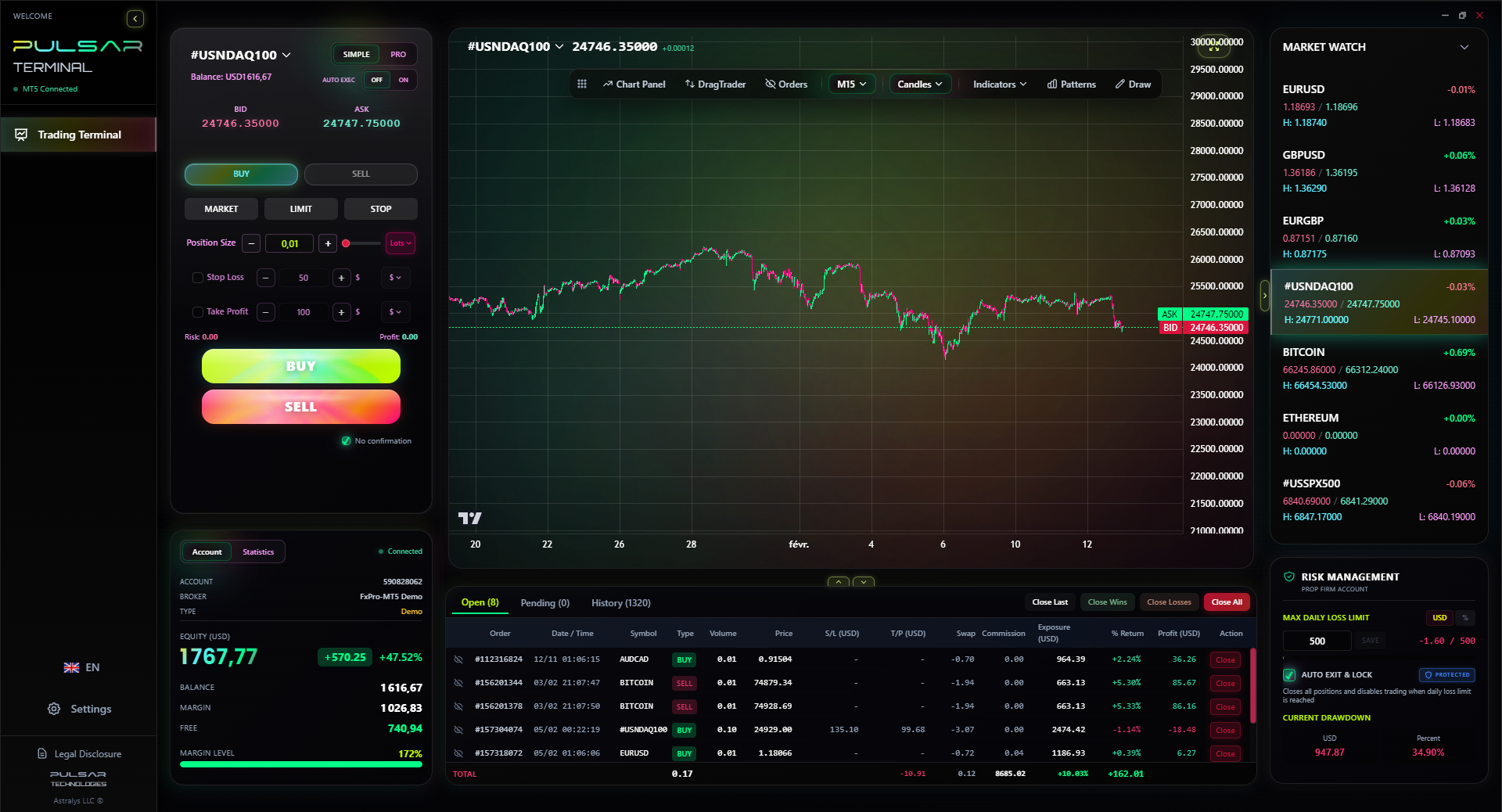
Managing the strict daily loss limits of a prop firm challenge is a constant mental drain, which is why automating those rules with a tool like Pulsar Terminal is a game-saver for serious traders.
Pulsar Terminal
The all-in-one MT5 companion: drag-and-drop orders, multi-TP/SL, trailing stop, grid trading, Volume Profile, and prop firm protection. Used by 1,000+ traders daily.
“A simple strategy executed with discipline beats a complex one executed poorly every single time.”
If you're in Cape Town and serious about this, here's a no-BS plan. Skip a step, and you'll likely fail.
Months 1-2: Education & Paper Trading Don't spend a cent on real money or evaluations. Learn the absolute basics: what a pip is, how use works, what the spread costs you. Pick one market to focus on, like the EUR/USD guide. Develop one simple trading strategy based on price action or one indicator. Then, paper trade it on a demo account for 8 weeks. Log every trade. Your goal is not profit; it's consistency and following your rules 100% of the time.
Months 3-4: Live Micro-Account Trading Deposit the smallest amount possible with a reputable international broker. For Exness or XM, that's like $10-$50. Trade the smallest position sizes (micro lots). The goal is to feel the psychological pressure of real money gains and losses. Your R100 is your tuition fee. If you can't grow this over two months (or at least not blow it up), you are not ready for a prop challenge.
Months 5-6: Prop Firm Simulation & Challenge Simulate the exact rules of a prop firm challenge on your demo account. Pick one (e.g., 10% target, 5% max daily loss). Run the simulation twice. If you pass both times, then and only then, pay for your first real evaluation. Start with the smallest, cheapest challenge they offer. The goal of your first paid challenge is to learn the process, not necessarily to pass. Expect to fail your first one or two. It's part of the cost of education.
Infrastructure Setup: During this time, get your tech sorted: reliable fibre, a UPS, a backup 4G/LTE router, a clean, distraction-free workspace. This is your office. Treat it like one.
💡 Winston's Tip
The market doesn't know you exist. Your ego, your bills, your desire for a new car - it cares about none of it. Trade the price, not your life.
“The prop firms aren't testing if you can pick winners. They're testing if you can follow a boring, repetitive, low-risk process.”
We have our own unique ways of screwing up here.
The 'Side Hustle' Mentality: Too many people try to trade around their 9-5. You miss key London open moves because you're in a meeting. You're distracted. Trading, especially early on, needs your full attention. It's either a serious pursuit or a hobby that will likely cost you money. There's little in-between.
Chasing the ZAR Pairs: The USD/ZAR, EUR/ZAR are incredibly volatile and prone to sudden gaps on political news. They're seductive because you 'understand' the Rand. They're also much harder to trade consistently than major pairs like EUR/USD which have deeper, more liquid markets. Start with the majors.
Ignoring Tax Implications: SARS is not your friend. Trading income is taxable. If you're successful with a prop firm, you're receiving income in dollars. You need to keep careful records of all trades, fees, and withdrawals. Get an accountant who understands trading income early on. The taxman doesn't care about your losing streaks.
Community Echo Chambers: Cape Town has trading groups and meetups. Some are great. Many are full of people reinforcing bad habits, sharing 'hot tips,' and complaining about 'the market being against them.' Be very selective about who you listen to. A real mentor won't promise you anything but hard work.
Underestimating the Loneliness: This is a solitary job. Even in a city of 4 million, you'll spend hours alone with your charts. The lack of office camaraderie gets to people. You need to build structure and discipline into your day, or you'll drift into bad habits.

FAQ
Q1What is the average salary for a forex trader in Cape Town?
There's no 'average' because most aren't salaried employees. A brokerage salesperson might earn R15k-R40k with commission. A successful prop firm trader's income is highly variable but can range from R30k to R100k+ monthly based on performance. An independent retail trader's income depends entirely on their own capital and skill, often starting at zero or a loss.
Q2Do I need a finance degree to get a forex job in Cape Town?
Absolutely not. For brokerage sales jobs, they'll take anyone with the gift of the gab. For prop trading or independent trading, your results (demo or live) are the only qualification that matters. A degree is irrelevant compared to a proven track record of disciplined trading.
Q3Are prop firms like FTMO legal for South Africans?
Yes, there is no South African law prohibiting you from participating in a prop firm's evaluation program based overseas. You trade their capital on international markets. The income you earn is considered foreign income and is fully taxable by SARS.
Q4What's the minimum amount I need to start trading forex in Cape Town?
To start learning with real money? As little as $10 (about R180) with some brokers on a micro account. To realistically generate a meaningful income as an independent trader? You'd need hundreds of thousands of rands in capital. This is why the prop firm path is so popular - it gives you access to large capital with only the risk of the evaluation fee (a few hundred dollars).
Q5What trading platform is most popular among serious Cape Town traders?
MetaTrader 5 (MT5) is the industry standard for accessing global markets through international brokers. Its scripting and automation capabilities are essential for many. Some advanced traders also use dedicated platforms like TradingView for analysis, but execute trades through MT5.
Q6Is forex trading a stable career choice in South Africa?
Stable? No. It's one of the least stable 'careers' you can choose. Your income is directly tied to your performance and market conditions. It offers freedom and high upside potential, but zero stability, no pension, no medical aid. You are the business, and businesses can have bad years.
Q7Can I make a living from forex trading in Cape Town within a year?
It's possible but highly unlikely for a complete beginner. A more realistic timeline for developing the skill, discipline, and track record to generate consistent income is 2-3 years of dedicated, full-time effort. Anyone promising you a living wage in months is selling you a dream, not a reality.
Prof. Winston's Lesson
Key Takeaways:
- ✓Prop firm evaluations are the most viable path to trading large capital.
- ✓Risk management is 90% of the job; analysis is the other 10%.
- ✓Expect to need 2-3 years of full-time effort to achieve consistency.
- ✓Your starting capital dictates your realistic income more than your skill.
How useful was this article?
Click a star to rate
Weekly Trading Insights
Free weekly analysis & strategies. No spam.
About the Author
David van der Merwe
Emerging Markets Trader
Johannesburg-based trader with 11 years in emerging market currencies. Specializes in ZAR pairs, FSCA-regulated trading, and South African market analysis.
Comments
Risk Disclaimer
Trading financial instruments carries significant risk and may not be suitable for all investors. Past performance does not guarantee future results. This content is for educational purposes only and should not be considered investment advice. Always conduct your own research before trading.
You Might Also Like

Cara Trading Forex Sukses: 7 Prinsip dari Trader Profesional
Cara trading forex sukses dengan 7 prinsip trader pro: manajemen modal, disiplin, journal trading, backtest. Data nyata, bukan janji profit palsu.
Jam Trading Forex Terbaik untuk Trader Indonesia: Panduan Lengkap dengan Tabel Waktu
Panduan jam trading forex untuk trader Indonesia. Tabel 4 sesi dunia, jam emas 20:00-00:00, sesi mana yang harus dihindari. Data akurat + tips dari trader berpengalaman.
Top 5 Sàn Forex Uy Tín Nhất 2026: Review Jujur dari Trader Indonesia
Top 5 sàn forex uy tín 2026 untuk trader Indonesia. Review jujur: spread, deposit, withdraw, dukungan lokal. Exness, XM, IC Markets & lebih.
Get Pulsar Terminal
All these calculators are built into Pulsar Terminal with real-time data from your MT5 account. One-click position sizing, automatic risk management, and instant calculations.
Get Pulsar Terminal