


Every new trader in Lagos or Abuja hears the same sales pitch: 'Use high use to turn small money into big money!' It's the fastest way I see Nigerian accounts get blown up.

Olumide Adeyemi
West African Trading Pioneer ·  Nigeria
☕ 11 min read
What you'll learn:
- 1What use Actually Is (It's Not Free Money)
- 2A Real Forex use Example with Naira Math
- 3Why Nigeria's Market Makes This Even More Dangerous
- 4How to Calculate Your *Safe* use (The 1% Rule)
- 5Broker use Compared: Who Offers What in Nigeria
- 6My use Mistakes (So You Don't Pay for Them)
- 7A Practical use Strategy for Nigerian Traders
- 8Final Word: use is a Tool, Not a Strategy
Every new trader in Lagos or Abuja hears the same sales pitch: 'Use high use to turn small money into big money!' It's the fastest way I see Nigerian accounts get blown up. The brokers aren't lying about the numbers, but they're not telling you the full story either. Let me show you a real forex use example with Naira conversions, explain why that 1:1000 offer is a double-edged sword, and give you a blunt strategy for using use without self-destructing.
Let's get this straight first. use is a loan from your broker to control a larger position than your cash balance. If you have 1:100 use, for every $1 in your account, you can control $100 in the market. In Nigeria, because we don't have local retail forex regulations capping this, brokers compete by offering insane ratios. I've seen 1:2000, 1:3000, even 'unlimited'.
But here's what they don't put in the big, bold font: use amplifies losses at the exact same rate it amplifies gains. It doesn't improve your strategy. It doesn't make a bad trade good. It just makes the outcome more dramatic, faster. Think of it like driving a Formula 1 car. More power, less room for error. If you're still learning to drive, you'll crash. Hard.
Your broker makes money from your trading activity (spreads, commissions) and from the market moving. They don't make money if you blow up instantly. But let's be honest, the high use is a marketing tool to get you in the door, feeling powerful. The real test comes with your first margin call.

Warning: That 'unlimited use' offer? It's a trap. It allows you to size a position so large that a tiny, normal market wiggle can wipe out your entire account in seconds. I've watched it happen.

💡 Winston's Tip
If you can't explain your maximum loss in Naira before you click 'buy,' you're not trading. You're praying. Close the platform.
Let's make this concrete. You're in Port Harcourt, you've saved ₦200,000. You deposit this with a broker offering 1:500 use. At an exchange rate of roughly ₦1,450/$, that's about $138 in your trading account.
You see a setup on EUR/USD. With 1:500 use, your usable margin lets you open a position worth 500 times your capital: $138 * 500 = $69,000. That's a standard lot (100,000 units) is too big, so you go for a mini lot (10,000 units), which is a $10,000 position.
The Trade:
- Your Capital: $138 (₦200,000)
- Broker's Loan (use): $9,862
- Total Position Value: $10,000 on EUR/USD
- Required Margin (1/500th): $20
- Your Free Margin Left: $118
Looks great, right? You're controlling $10,000 with only ₦200,000! Now, let's see the risk.
The Profit Scenario
EUR/USD moves in your favor by 50 pips (0.0050). On a $10,000 position, each pip is worth $1 (for a mini lot).
- Profit: 50 pips * $1 = $50 profit.
- Return on Your Capital: ($50 / $138) * 100 = 36.2% gain in one trade.
The Loss Scenario (The One You Need to Memorize)
EUR/USD moves against you by 50 pips.
- Loss: 50 pips * $1 = $50 loss.
- Your Account Now: $138 - $50 = $88.
- Return on Your Capital: -36.2% loss in one trade.
But it gets worse. Your broker has a margin call level at, say, 50%. When your equity (balance + floating P/L) falls to 50% of your used margin ($20), they'll start closing your position. That's when your equity hits $10. A move of just 128 pips against you wipes out your entire ₦200,000 deposit. 128 pips. That can happen in an hour during news volatility.

Example: This isn't theory. In 2021, I got cocky with GBP/JPY. I used 1:400 use on a $5,000 account (a $200k position). The pair moved 80 pips against me on a surprise BoJ headline. Loss: $1,600. I lost 32% of my account in 15 minutes. I was over-leveraged and not respecting the instrument's volatility. My position size calculator now never leaves my screen.
“High use is a marketing tool to get you in the door, feeling powerful. The real test comes with your first margin call.”
Trading from Nigeria adds unique layers of risk that your broker in Cyprus or Seychelles doesn't care about.
First, the Naira volatility. Your deposit is in Naira, but your account is likely in USD. If you deposited when USD/NGN was 1,200 and the Naira strengthens to 1,000, your capital's dollar value has dropped even before you place a trade. You're already starting behind. This is why some brokers like FXTM and HFM offer NGN-denominated accounts - it removes that currency risk from your deposit/withdrawal process.
Second, funding. If you blow your account, topping up isn't as simple as a card tap. You might need to use a BDC with limits, or deal with bank transfer delays. This pressure to 'make it back' leads to even worse, emotionally-driven, over-leveraged trades. I've been there, trying to revenge trade after a loss, and it never ends well.
Third, the regulatory gap. Since the SEC and CBN aren't setting use caps for retail, you're the only one responsible for your risk management. The broker's 'unlimited' offer isn't illegal here; it's just irresponsible for 99% of traders. The CBN's new FX Code is for wholesale banks, not for you and me on MT5. This means you have to be your own regulator.

Pro Tip: Before you even think about use, master the basics of a pip and the spread on your chosen pair. If you don't know how much you're paying the broker to get into the trade, you've already lost.
Forget the broker's maximum. Your safe use is a function of your position size and risk per trade. Here's the only formula you need for survival.
The Rule: Never risk more than 1% of your account on any single trade.
Let's redo our earlier forex use example with this rule.
- Account Balance: $138 (₦200,000)
- 1% Risk: $1.38
- Trade Setup: You plan to buy EUR/USD at 1.0850 with a stop loss at 1.0820 (a 30-pip risk).
- Pip Value Needed: To lose only $1.38 over 30 pips, each pip must be worth $1.38 / 30 = $0.046.
- Position Size: For EUR/USD, a 0.01 mini lot (1,000 units) has a pip value of ~$0.10. That's too high. You need a micro lot (0.001, or 100 units). A micro lot has a pip value of ~$0.01.
Your Safe Trade:
- Position Size: 0.046 lots (460 units). Most platforms let you do this.
- Capital Required (at 1:500 use): For a ~$460 position, margin required is about $0.92.
- Your Risk: 30 pips * $0.046 = $1.38 (1%).
See the difference? In the first reckless example, we used $20 of margin and risked $50 (36%). In this safe example, we use $0.92 of margin and risk $1.38 (1%). The broker's 1:500 use is still there, but we're using a tiny, controlled fraction of it. The use isn't controlling us; we're controlling the use. This is the core of professional swing trading discipline.
💡 Winston's Tip
The best use is the amount that lets you sleep soundly after placing your stop loss. For 99% of you, that's below 1:100.
“Adding to a losing position is just using more use to dig a deeper hole.”
Not all high use is the same. You need to check the margin call and stop out levels. Here’s a quick comparison of popular brokers for Nigerian traders:
| Broker | Typical Max use for Nigerians | Key Thing to Know |
|---|---|---|
| Exness | 'Unlimited' on Pro Accounts | Yes, literally no cap. Extreme danger for beginners. Good for very specific, advanced strategies only. Read our full Exness review. |
| XM | Up to 1:1000 | Well-known here, but that 1:1000 is a siren song. Their XM review shows they offer good education, which you'll need to resist using that max. |
| IC Markets | Up to 1:1000 | Raw spreads are tight, which is good. But again, 1:1000 is a test of your discipline, not a feature. Our IC Markets review details their True ECN model. |
| HFM | Up to 1:2000 | Offers NGN accounts, which is a big plus. But 1:2000? That's asking for trouble. |
| Pepperstone | Up to 1:1000 | A top-tier broker with Razor accounts. Their Pepperstone review highlights their strong regulation, which is more important than the use number. |
My advice? Pick a broker for their spreads, execution, and NGN funding options, NOT for who offers the highest use. Then, in your account settings, manually lower your use to 1:50 or 1:100. It forces discipline.
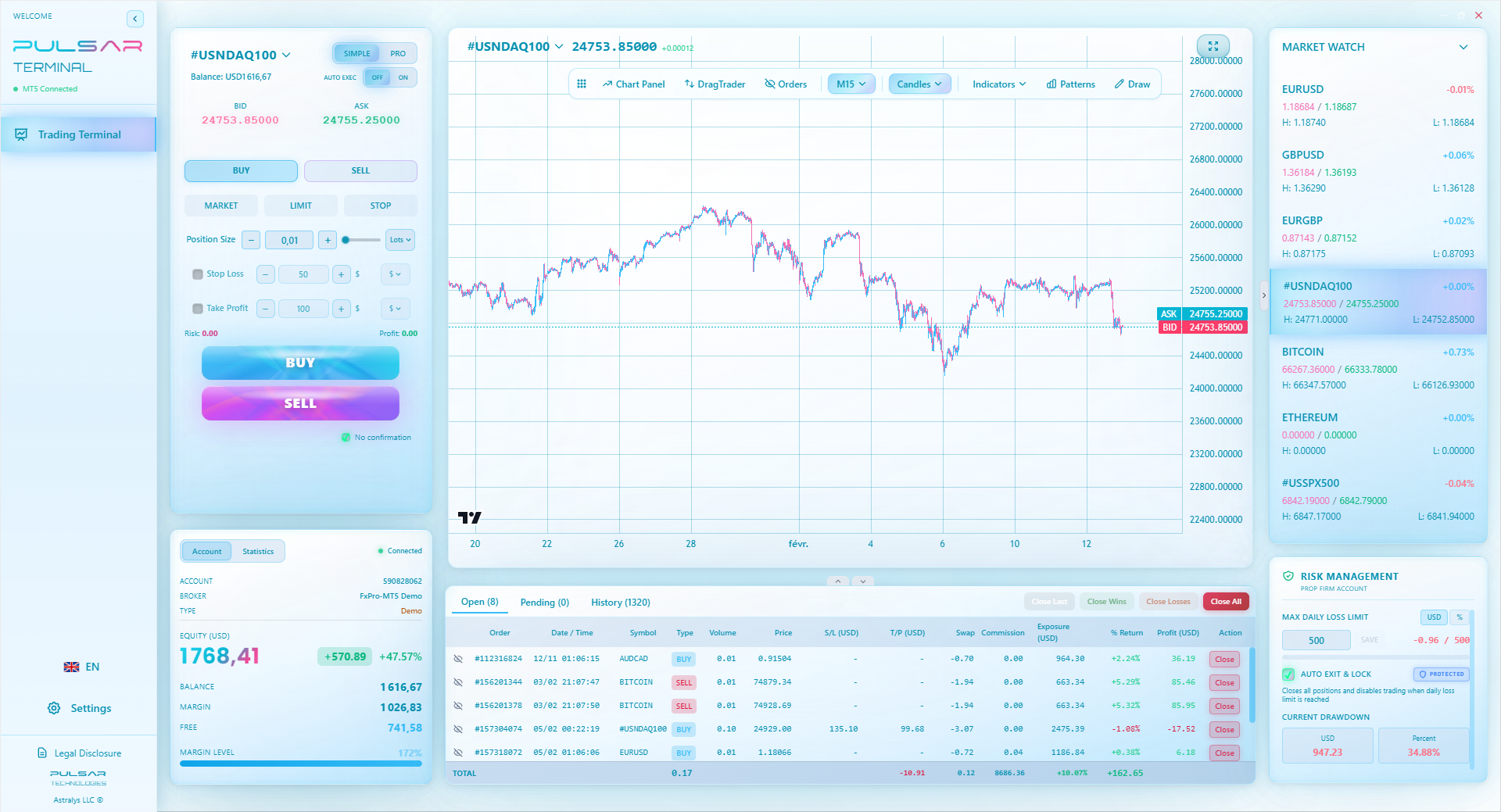
Managing multiple trades with high leverage is stressful, but tools like Pulsar Terminal let you set precise stop-loss and take-profit orders with partial closures directly on your MT5 chart, automating your risk management so you don't panic.
Pulsar Terminal
The all-in-one MT5 companion: drag-and-drop orders, multi-TP/SL, trailing stop, grid trading, Volume Profile, and prop firm protection. Used by 1,000+ traders daily.
I've paid my tuition to the market. Here are two expensive lessons.
Lesson 1: The News Spike Wipeout. Earlier, I mentioned the GBP/JPY 32% loss. What I didn't say was that my stop loss was a 'mental stop.' I thought I could watch it and get out. The spike blew through my level so fast my market order filled 40 pips worse than I planned. Mental stops don't work with high use. Always use a hard stop-loss order.
Lesson 2: Adding to a Losing Position. This is the killer. I was short USD/NGN (yes, I traded it on a CFD) in 2023. The Naira was weakening, and I was wrong. Instead of taking my 2% loss, I thought, 'It has to reverse. I'll add more to lower my average.' I used more use. The Naira kept falling. I turned a $500 loss into a $3,500 loss in two days. I violated every rule. Adding to a loser is just using more use to dig a deeper hole. Now, if a trade hits my stop, I'm out. No debate. I use the MACD indicator for trend confirmation, but the stop loss is sacred.
The common thread? High use removed my margin for error - both in the market and in my own psychology. When you're over-leveraged, every tick against you feels like a crisis, and you make panicked decisions. When you're sized correctly, you can think clearly.
“Your safe use is a function of your position size and risk per trade, not the broker's marketing page.”
Here's a step-by-step plan you can start with today.
- Deposit an Amount You Can Afford to Lose: This is non-negotiable. If you need that ₦500,000 for school fees or rent, do not trade it.
- Choose a Broker & Set a Lower use Cap: Open an account, but immediately go to settings and request use of 1:50 or 1:100. This physically prevents you from the worst excesses.
- Use a Position Size Calculator: Before every trade, input: Account Balance, Risk % (start at 1%), Stop Loss in Pips. Let it tell you the lot size. Do not override it.
- Start with Micro Lots: Even if the calculator says you can trade a mini lot, start with a micro lot (0.01) for your first 20-30 trades. Get used to the emotional ride with real, but small, money.
- Focus on Risk/Reward: Aim for trades with a potential reward at least 1.5 times the risk. A 1:1.5 risk/reward ratio means you can be wrong more than you're right and still break even. This is more important than use.
For example, if you're risking 30 pips (1% of your account), your profit target should be at least 45 pips away. This mindset forces you to look for quality setups, not just hoping any move will make you rich because you're leveraged 1:1000. This is the foundation of a sustainable scalping strategy or any other approach.
Pro Tip: Your first goal isn't to make 100% return. Your first goal is to survive for 6 months without a margin call. If you can do that, you're in the top 20% of retail traders already.
💡 Winston's Tip
Your first profitable month with 1:30 use is worth ten blown accounts from chasing profits with 1:1000. Patience compounds. use detonates.
The most successful traders I know in Nigeria - the ones who've lasted through Naira crashes, fuel shortages, and internet outages - treat use like a sharp knife. Useful in skilled hands, dangerous if you wave it around.
They use the broker's high use as a safety buffer. It means they can use very little of their margin for each trade, leaving the rest as a protective cushion. They're not using 1:1000; they're trading as if they have 1:20, but with the benefit of lower margin requirements on their capital.
Your takeaway from this forex use example shouldn't be 'use is bad.' It's that uncontrolled use is a guaranteed account destroyer. The power is in your choice. You can choose to be the guy who blew his savings in a week chasing a dream sold in an ad. Or you can be the disciplined trader who grows an account steadily, using use as a controlled accelerator, not a nitro boost into a wall.
Start small. Risk 1%. Use a stop loss. Survive. Then, and only then, think about gradually increasing your size. The market will be here tomorrow. Make sure your account is too.
FAQ
Q1Is 1:1000 use illegal for forex trading in Nigeria?
No, it's not illegal. Nigeria's SEC and CBN currently do not set specific use caps for retail online forex trading. This creates a regulatory gap where international brokers can offer very high use to Nigerian clients under their own (often offshore) regulations. You are legally allowed to use it, but that doesn't make it wise.
Q2What is a good use for a beginner in Nigeria?
I recommend beginners start with no more than 1:50 use. Even better, ask your broker to set your account to 1:20. This forces you to learn proper position sizing with real capital constraints. The goal is to learn to trade, not to gamble with maximum firepower from day one.
Q3How do I calculate my margin requirement?
Use this formula: (Trade Size in Lots * Contract Size) / use Ratio. For a 0.01 lot (1,000 units) trade with 1:100 use: (0.01 * 100,000) / 100 = $10 margin required. Most platforms have a built-in calculator, or you can use our free position size calculator which does this and your risk automatically.
Q4Can I lose more money than I deposit with use?
With a standard retail forex account, you generally cannot lose more than your account balance due to mandatory margin calls and stop-out levels. The broker will automatically close your positions before your balance goes negative. However, in extreme volatility or if you have other positions open, a temporary negative balance is possible, though most reputable brokers now offer negative balance protection.
Q5Why do Nigerian brokers offer such high use?
It's primarily a marketing tool to attract clients in a competitive market with low barriers to entry. High use makes small deposits seem powerful, which appeals to new traders. It also increases potential trading volume (and broker fees). Remember, the broker makes money from your activity, not just your success.
Q6Should I use an NGN or USD trading account?
If your broker offers it (like FXTM or HFM), an NGN account is often better. It eliminates the currency risk between your Naira deposits/withdrawals and your trading account. Your profit and loss are clearer in your local currency. With a USD account, a strengthening Naira can reduce your capital's dollar value before you even trade.
Q7What's the biggest mistake with use?
Using the broker's maximum available use on every trade. This leaves no margin for error, turns small market noise into large losses, and triggers emotional, panicked decisions. The mistake is letting the use number dictate your trade size, instead of letting your risk management rules dictate how much use you actually use.
Prof. Winston's Lesson
Key Takeaways:
- ✓Maximum broker use is a trap, not a feature.
- ✓Never risk more than 1% of your capital per trade.
- ✓Calculate position size *before* thinking about use.
- ✓Use a hard stop-loss order every single time.
- ✓Survival for 6 months is a better goal than 100% returns.
How useful was this article?
Click a star to rate
Weekly Trading Insights
Free weekly analysis & strategies. No spam.
About the Author
Olumide Adeyemi
West African Trading Pioneer
One of Nigeria's most active forex trading educators. 8 years of experience trading from Lagos. Specializes in low-capital strategies and prop firm challenges for African traders.
Comments
Risk Disclaimer
Trading financial instruments carries significant risk and may not be suitable for all investors. Past performance does not guarantee future results. This content is for educational purposes only and should not be considered investment advice. Always conduct your own research before trading.
You Might Also Like

Cara Trading Forex Sukses: 7 Prinsip dari Trader Profesional
Cara trading forex sukses dengan 7 prinsip trader pro: manajemen modal, disiplin, journal trading, backtest. Data nyata, bukan janji profit palsu.
Jam Trading Forex Terbaik untuk Trader Indonesia: Panduan Lengkap dengan Tabel Waktu
Panduan jam trading forex untuk trader Indonesia. Tabel 4 sesi dunia, jam emas 20:00-00:00, sesi mana yang harus dihindari. Data akurat + tips dari trader berpengalaman.
Top 5 Sàn Forex Uy Tín Nhất 2026: Review Jujur dari Trader Indonesia
Top 5 sàn forex uy tín 2026 untuk trader Indonesia. Review jujur: spread, deposit, withdraw, dukungan lokal. Exness, XM, IC Markets & lebih.
Get Pulsar Terminal
All these calculators are built into Pulsar Terminal with real-time data from your MT5 account. One-click position sizing, automatic risk management, and instant calculations.
Get Pulsar Terminal