


Forget the charts for a second.

Olumide Adeyemi
West African Trading Pioneer ·  Nigeria
☕ 11 min read
What you'll learn:
- 1What a 'Forex Login' Really Means in Nigeria
- 2Choosing a Broker You Can Actually Log Into
- 3The Real Cost of Funding: Fees, Spreads, and Slippage
- 4The Login's Endgame: Withdrawals and the 10% Tax Man
- 5Securing Your Login: Beyond the Password
- 6The Technical Setup: Logging In Without Lag or Loss
- 7The Psychological Login: Your Most Important Session
Forget the charts for a second. Your most important trade of the day happens before the market even opens, when you click that forex login button. In Nigeria, that simple act is a minefield of banking restrictions, regulatory grey areas, and tax implications that can wipe out your account faster than a bad EUR/USD bet. I've been locked out, had profits frozen, and made every funding mistake in the book. This isn't just about remembering your password. It's about understanding the entire environment that lets you trade from Lagos, Abuja, or Port Harcourt. I'll walk you through the real, unvarnished process of accessing the forex market from Nigeria in 2025.
When we say 'forex login,' most tutorials show a guy typing a username into MT5. For us in Nigeria, it's a three-act play. Act One is getting past your bank. Act Two is convincing an international broker you're a legitimate client. Act Three is actually logging into a trading platform without your internet cutting out.
Your forex login starts the moment you decide to fund an account. The Central Bank of Nigeria (CBN) doesn't want Naira leaving the country to speculate on currencies, so they've made it famously difficult. Your bank card will likely be declined for direct broker deposits. I learned this the hard way in 2020, trying to fund an account with a GTBank card. Six attempts, six failures, and a call from the bank's fraud department later, I realized the login process begins with finding a backdoor.
That backdoor is usually a payment processor or a crypto gateway. You're not just logging into Exness or IC Markets; you're logging into a third-party system that converts your Naira into something the broker will accept. This adds layers of fees and points of failure. A successful forex login in Nigeria means you've navigated this invisible obstacle course first.

Warning: Never use a friend's card or account to fund your trading. It creates a nightmare for withdrawing profits and can link your trading income to someone else's tax profile. The name on your funding source must match the name on your broker account exactly.
Not all brokers are created equal for Nigerian traders. Your primary filter shouldn't be use or spreads, but accessibility. Can you deposit Naira? Do they accept the payment methods that work here?
The Naira Account Illusion
Some brokers, like HFM, offer Naira-denominated accounts. This sounds perfect, right? You deposit Naira, trade, and withdraw Naira. The catch is the spread. To offset the risk and cost of handling Naira, the broker often widens the spread on these accounts. You might save on deposit fees but lose more on every trade. I compared a $100 trade on EUR/USD between a standard USD account (funded via crypto) and a Naira account. The Naira account's wider spread cost me an extra $1.50 on entry and exit. That adds up fast.
International Brokers That 'Get' Nigeria
Your best bets are large international brokers with a global client base. They've seen the Nigerian situation before and have integrated payment solutions. Brokers like Pepperstone and XM have strong systems for accepting deposits from regions with capital controls. They don't advertise 'Nigeria-specific' solutions, but their support teams know the drill. I've had the smoothest experience with these brokers, using cryptocurrency to fund the account. The forex login is then just a matter of opening MT5.
The Regulation Tightrope
Here's the controversial bit: you likely won't be using a CBN-licensed broker. The CBN's focus is on the official forex market and entities operating within Nigeria. As an individual, you are generally permitted to trade with international, reputable brokers regulated elsewhere (like the FCA, ASIC, or CySEC). Your due diligence is critical. Read reviews, check their license numbers, and see how they handle withdrawals. A broker's XM review from other Global South traders is often more telling than its marketing copy.

💡 Winston's Tip
Your first login of the day shouldn't be to your trading platform. It should be to your trading plan. Know your rules before you see the candles.
“In Nigeria, a successful forex login means you've already navigated an invisible obstacle course of banking restrictions.”
Let's talk numbers. That $200 you want to trade with might only be $185 by the time it hits your broker. Here’s where your profit battle is often lost.
| Funding Method | Typical Fee | Time to Deposit | Hidden Cost |
|---|---|---|---|
| Bank Card (Int'l) | 2-5% + CBN Charges | Instant (if it works) | High failure rate, bank alerts |
| Crypto (USDT) | Network fee + 0-1% broker fee | 10-60 mins | Crypto volatility during transfer |
| E-Payment (e.g., Flutterwave) | 1.5-4% | 1-24 hours | Processor limits, extra KYC |
| Direct Bank Transfer | $25-$50 flat fee | 3-5 business days | Terrible exchange rate by broker's bank |
I used a direct bank transfer once to fund an account with a well-known broker. I sent $500. The broker's receiving bank took a $30 fee, and their conversion rate was 5% worse than the market rate. I logged in to see $448. My first trade had to make up a 10.4% loss before I even started. Don't be me.

Example: You want to trade a 0.1 lot on EUR/USD. On a good ECN account, the spread might be 0.1 pips and commission $0.45. But if you funded via a method with a 3% fee on a $500 deposit, you've already paid a $15 'fee spread.' That's the equivalent of 150 pips of loss on that 0.1 lot trade before you click buy.
The most cost-effective method I've settled on is using a stablecoin like USDT on the TRON network (low fees). I buy it on a local exchange, send it to the broker's crypto address, and it's converted to USD. The total cost is usually under 1.5%. This is non-negotiable for scalping strategy where every pip counts.
You logged in, traded well, and made a profit. Now comes the hardest part: getting your money back into your Nigerian bank account and keeping it there. This is where many traders get a nasty surprise.
The Federal Inland Revenue Service (FIRS) wants 10% of your gross profits as Capital Gains Tax. Gross profits. Not net after losses. If you make five trades, win $1000 on four and lose $900 on one, your net is $100. But your gross profit is $1000. The taxman sees $1000. You owe $100 in tax, wiping your net gain. This makes record-keeping your most important trading tool.
Your withdrawal path is usually the reverse of your deposit. If you deposited via crypto, you'll withdraw crypto. The broker will send USDT to your wallet, and you cash out on a local exchange. This creates a clear, traceable record. The local exchange will report large transactions to the authorities. Be prepared to show your trading statement from your broker to prove the source of funds.
I learned this lesson after a $5,000 withdrawal was held by my local exchange for two weeks. They needed proof it wasn't from fraud or money laundering. My broker's trade history and statements saved me. Now, I document every trade, every deposit, and every withdrawal in a simple spreadsheet. When you login to trade, remember you're also logging data for your future self and the FIRS.

Pro Tip: Withdraw profits regularly, not just in one lump sum. Smaller, consistent withdrawals look more like legitimate business income and are less likely to trigger red flags with your bank or the exchange than one massive, unexpected cash influx.
“The 10% tax is on gross profits, not net. A profitable month can still leave you with a tax bill larger than your net gain.”
A forex login is a high-value target. Hackers know there's real money behind it. Your security needs to be Nigerian-internet tough.
1. The Two-Factor Authentication (2FA) Non-Negotiable: If your broker offers 2FA (and they all should), enable it. Use an app like Google Authenticator or Authy, not SMS. Why? SIM swap fraud is a real industry here. Someone convinces your telecom provider to port your number to their SIM card, intercepts your SMS 2FA code, and empties your account. An app-based code stays on your device.
2. The Public Wi-Fi Trap: Logging into your trading account from a café's free WiFi in Ikeja is asking for trouble. Use your mobile data (it's more secure) or a reputable VPN if you must use public networks. I know a trader who had his account credentials stolen this way. The hacker didn't even trade; they just initiated a withdrawal to a crypto wallet he couldn't trace.
3. The 'Helper' Scam: You get a message on WhatsApp or Telegram: 'I see you trade forex. My mentor can help you make 50% a month. Just give me your login details to analyze.' Never, ever share your login credentials. No legitimate mentor needs your password. They can analyze your trades from a screenshot or your myfxbook profile.
Your trading platform itself needs security. Use a strong, unique password. Don't save it in your browser. Consider the security of your position size calculator spreadsheet or trading journal - if it's on a cloud drive, protect it. Your entire trading operation is only as strong as your weakest login.
💡 Winston's Tip
Treat your forex login credentials with the same seriousness as your bank account PIN. Because that's exactly what they are.
A failed login during a volatile news event is a special kind of torture. Your setup matters.
Internet: A stable fibre connection is best, but a good 4G/LTE mobile backup is essential. I have a router from my fibre provider and a dedicated MTN mifi device as backup. They're on different networks. If one fails, I switch in seconds. The cost? About 15k NGN for the mifi and a separate data plan. Worth every kobo to avoid a margin call due to downtime.
Device: Don't trade on a phone if you can help it. A laptop or desktop gives you screen space for proper analysis. More importantly, keep your device clean. Don't install random software, cracks, or free games. They can contain keyloggers. My trading laptop has Windows, MT5, my broker's plugin, a browser, and nothing else. It's boring, but it's safe.
Platform Settings: When you first login to MT5 or cTrader, configure these:
- Auto-logout: Set it to a reasonable time (15-30 mins). If you walk away, you're protected.
- Price Alerts: Set them! If your platform crashes, you can get an SMS or email alert for key levels.
- One-Click Trading: Enable it. In fast markets, the half-second you save not confirming an order can be worth 5 pips.
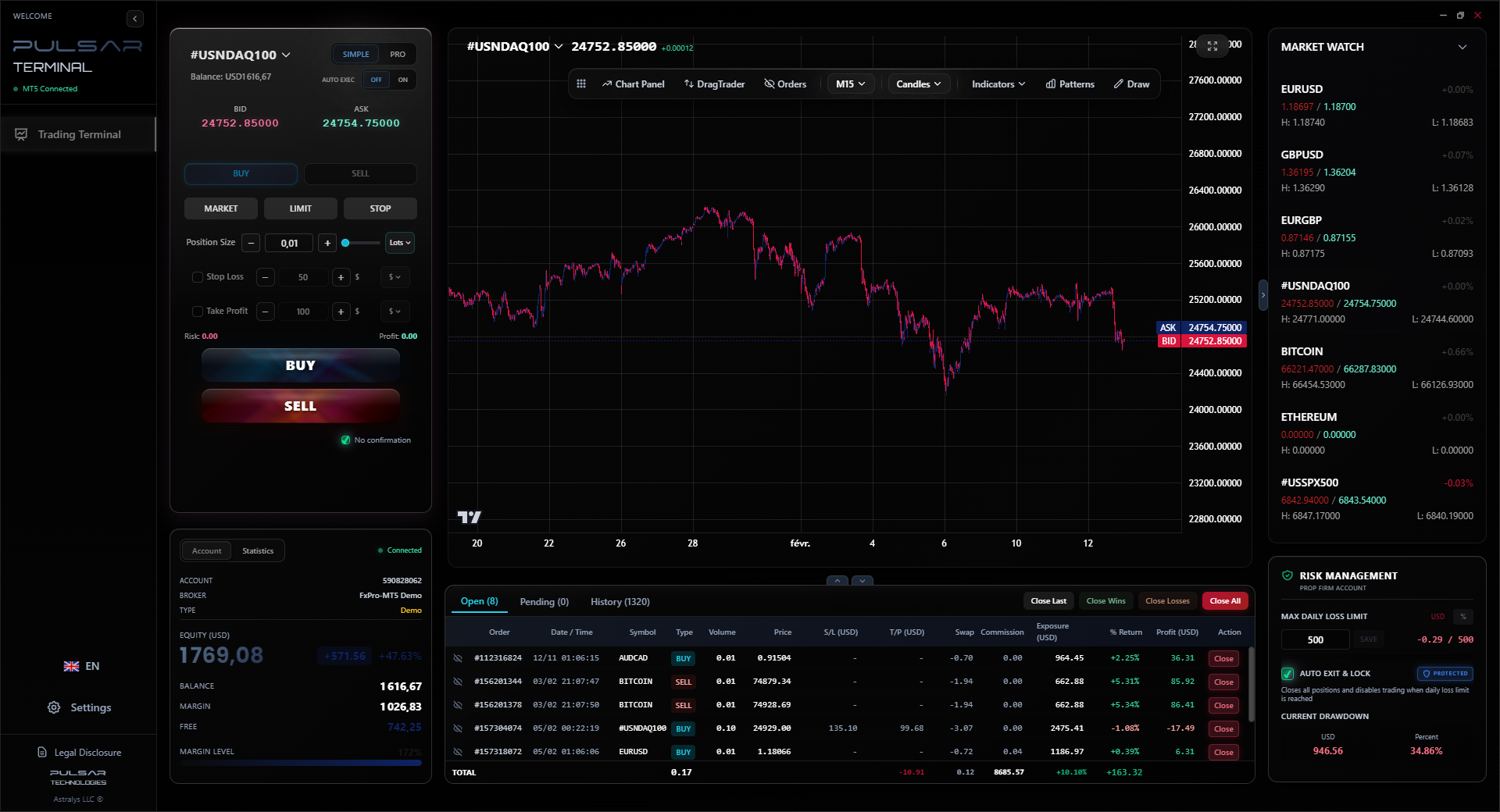
This is where tools like Pulsar Terminal shine for MT5 users. It runs as a companion, adding features like one-click order modification and advanced trade management. But the foundation is your own reliable connection and a dedicated machine. I treat my trading setup like a surgeon treats his tools: clean, specific, and always ready.
When a fast market demands quick action, a reliable platform is key, and tools like Pulsar Terminal add essential one-click order management and advanced trade automation directly to your MT5 login.
Pulsar Terminal
The all-in-one MT5 companion: drag-and-drop orders, multi-TP/SL, trailing stop, grid trading, Volume Profile, and prop firm protection. Used by 1,000+ traders daily.
“Your most critical login isn't to your broker; it's into the right mindset before you even see a chart.”
The final, most critical forex login isn't to your broker. It's into the right mindset. The Nigerian context adds unique psychological pressure.
You're trading in USD while living in Naira. A 50-pip loss on a standard lot is about $500. That's over 700,000 NGN at today's rate. Seeing losses in dollar terms can feel abstract, but converting them to Naira in your head can induce panic. It makes you hold losers too long ('it's just $200') or take profits too early ('700k Naira is enough!').
I set my charts to display the monetary value of a pip in USD, and I stick to that. I only convert my net monthly profit or loss to Naira when I do my accounts. This mental separation is crucial. It stops you from making emotional trades based on local currency needs.
The pressure to 'make it back' after a loss is amplified when you think about the difficulty of funding the account. You fought bank restrictions, paid fees, and finally logged in. Now you're down? The urge to revenge trade is strong. This is where a strict trading plan and predefined risk per trade (use that position size calculator!) act as your psychological login credentials. They let you into a state of disciplined execution, not emotional reaction.
Logging in should be a calm, routine process. If you find your heart pounding as you type your password, anxious about 'making today's target,' you've already lost. The best trade is sometimes no trade. It's okay to login, look at the charts, see no setup, and logout. Preserving capital is a victory, especially when adding to that capital is such a mission.
💡 Winston's Tip
If logging in fills you with anxiety, log out. The market will be there tomorrow. Your capital might not be if you trade scared.
FAQ
Q1Is it legal for me in Nigeria to login and trade with international forex brokers like Exness or IC Markets?
Yes, it is generally considered legal for individual Nigerian residents to trade with international brokers regulated outside Nigeria (e.g., by CySEC, FCA, ASIC). The CBN's restrictions focus on using official forex windows for funding and on entities operating within Nigeria. However, you are responsible for declaring any income and paying the 10% Capital Gains Tax to FIRS.
Q2Why does my Nigerian debit card keep failing when I try to deposit to my broker?
The Central Bank of Nigeria (CBN) has imposed restrictions to prevent Naira from leaving the country for speculative activities like forex trading. Many banks have proactively blocked international transactions to CFD/forex brokers. It's a system-wide barrier, not a problem with your specific card.
Q3What is the safest way to fund my forex trading account from Nigeria?
The most reliable and increasingly common method is using cryptocurrency, specifically stablecoins like USDT. You buy USDT on a local crypto exchange with Naira, then transfer it to your broker's provided crypto wallet address. It bypasses bank restrictions, is relatively fast, and fees are often lower than traditional international transfers. Always ensure you're using the correct network (e.g., TRC-20 for low fees).
Q4How do I pay taxes on my forex profits, and how much is it?
You pay a 10% Capital Gains Tax on your gross trading profits to the Federal Inland Revenue Service (FIRS). Gross profit means the sum of all your winning trades, not your net profit after subtracting losses. You must keep detailed records of all trades, deposits, and withdrawals. When you file your annual tax returns, you declare this income and pay the 10%.
Q5I'm worried about my account security. What's the single most important security step?
Enable Two-Factor Authentication (2FA) using an app like Google Authenticator, NOT SMS. SIM swap fraud is prevalent in Nigeria, where scammers can hijack your phone number to receive SMS codes. An app-based 2FA code stays on your physical device, making it vastly more secure.
Q6Can I use a VPN to login to my forex broker if their website is sometimes blocked?
You can, but be cautious. Using a VPN may violate your broker's Terms of Service, as it can look like suspicious login activity from a different country. Some brokers may even freeze your account if they detect a VPN. It's better to use a reliable mobile data connection or contact your broker's support for recommended solutions for Nigerian clients.
Q7My internet is unstable. How can I prevent being logged out during a critical trade?
First, use a desktop platform (MT5/MT4) rather than a web platform, as it's more stable. Second, always set Stop-Loss and Take-Profit orders the moment you enter a trade. This protects you if you get disconnected. Third, have a backup internet source - a 4G MiFi device from a different provider than your main line is a great investment.
Prof. Winston's Lesson
Key Takeaways:
- ✓Funding costs can be a 3-5% 'hidden spread' on every deposit.
- ✓Always use app-based 2FA, never SMS, to secure your login.
- ✓The FIRS taxes gross profits at 10%, making detailed records essential.
- ✓A backup internet source is not a luxury; it's a necessary business expense.
How useful was this article?
Click a star to rate
Weekly Trading Insights
Free weekly analysis & strategies. No spam.
About the Author
Olumide Adeyemi
West African Trading Pioneer
One of Nigeria's most active forex trading educators. 8 years of experience trading from Lagos. Specializes in low-capital strategies and prop firm challenges for African traders.
Comments
Risk Disclaimer
Trading financial instruments carries significant risk and may not be suitable for all investors. Past performance does not guarantee future results. This content is for educational purposes only and should not be considered investment advice. Always conduct your own research before trading.
You Might Also Like

Cara Trading Forex Sukses: 7 Prinsip dari Trader Profesional
Cara trading forex sukses dengan 7 prinsip trader pro: manajemen modal, disiplin, journal trading, backtest. Data nyata, bukan janji profit palsu.
Jam Trading Forex Terbaik untuk Trader Indonesia: Panduan Lengkap dengan Tabel Waktu
Panduan jam trading forex untuk trader Indonesia. Tabel 4 sesi dunia, jam emas 20:00-00:00, sesi mana yang harus dihindari. Data akurat + tips dari trader berpengalaman.
Top 5 Sàn Forex Uy Tín Nhất 2026: Review Jujur dari Trader Indonesia
Top 5 sàn forex uy tín 2026 untuk trader Indonesia. Review jujur: spread, deposit, withdraw, dukungan lokal. Exness, XM, IC Markets & lebih.
Get Pulsar Terminal
All these calculators are built into Pulsar Terminal with real-time data from your MT5 account. One-click position sizing, automatic risk management, and instant calculations.
Get Pulsar Terminal