


If you think a 'lot' is just something you buy at Shoprite, you're about to get a serious market education.

Olumide Adeyemi
West African Trading Pioneer ·  Nigeria
☕ 13 min read
What you'll learn:
- 1What Is a Forex Lot, Anyway?
- 2The Forex Lot Size Chart Explained (With Naira Examples)
- 3How to Calculate Your Own Lot Size (The 3-Step Rule)
- 4Cent, Standard, and Prop Firm Accounts: Lot Size Adjustments
- 5Common Lot Size Mistakes Nigerian Traders Make (And How to Stop)
- 6Practical Examples: From Gold (XAU/USD) to Major Pairs
- 7Tools to Make Lot Sizing Easy (Stop Doing Mental Math)
- 8Putting It All Together: Your 5-Point Action Plan
If you think a 'lot' is just something you buy at Shoprite, you're about to get a serious market education. Most new traders in Nigeria jump into forex, pick a random lot size, and pray. They treat it like betting on a football match. That's a surefire way to turn your hard-earned Naira into a broker's bonus. I'm here to set the record straight: your lot size isn't a guess. It's your most important risk management decision. Let's break down the forex lot size chart so you can trade with confidence, not hope.
Forget the complex definitions. In simple terms, a 'lot' is the standardized batch size for a trade. It's like buying a crate of eggs instead of a single egg. The forex market deals in these batches to keep things orderly.
There are three main sizes you need to know:
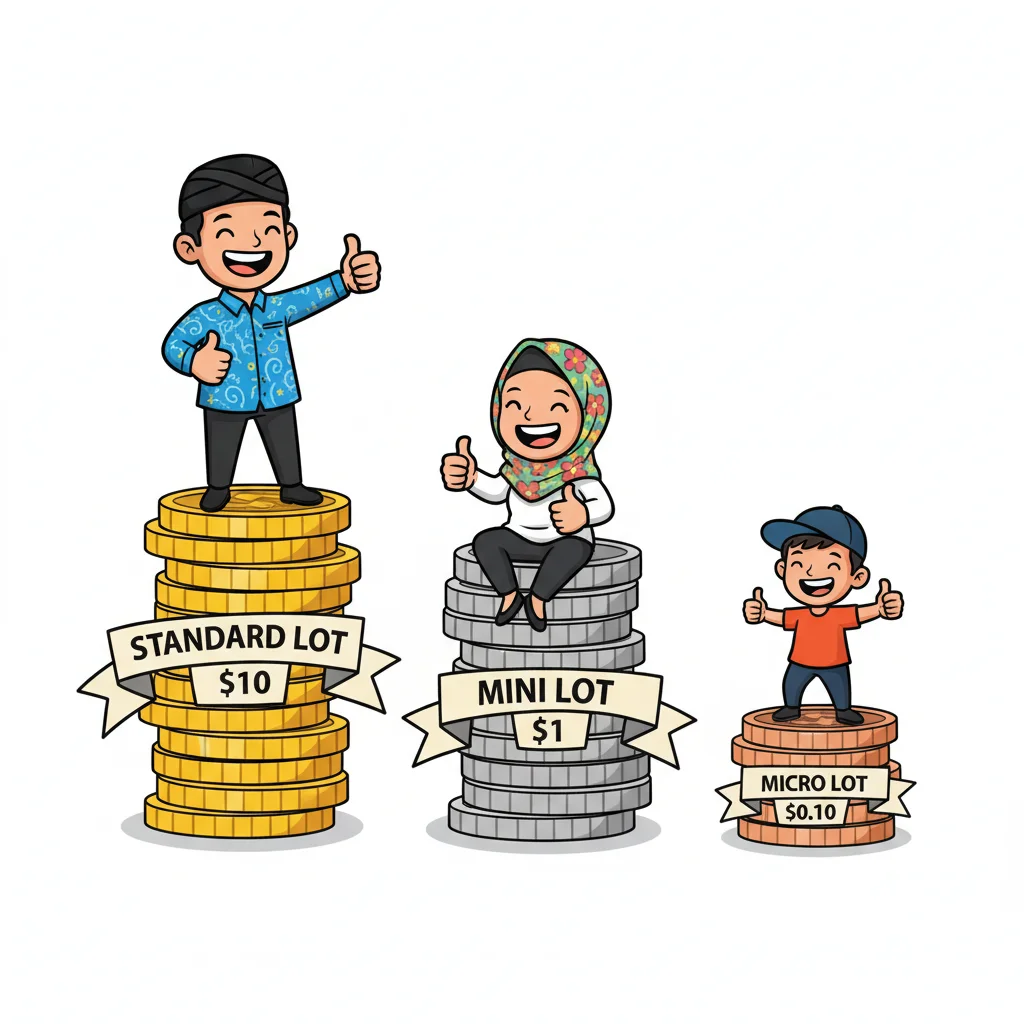
| Lot Type | Units of Base Currency | What It Means |
|---|---|---|
| Standard Lot | 100,000 units | The big league. 1 pip move = ~$10 (varies by pair). |
| Mini Lot | 10,000 units | The common starting point. 1 pip move = ~$1. |
| Micro Lot | 1,000 units | The risk-tamer. 1 pip move = ~$0.10. |
Now, here's where Nigerian traders get tripped up. Your broker's platform might show your balance in USD, but your brain thinks in Naira. When you see '1.00' in the lot size box, that's usually a standard lot. If your account is $100, that trade is a suicide mission. A 10-pip loss would wipe you out.

Warning: Never assume the lot size number on your platform. Always check your broker's specs. On some platforms, '1.0' is a standard lot. On others, it might be 100,000 units directly. Confusing this is the #1 cause of instant margin calls.
I learned this the hard way early on. I deposited 50,000 Naira (about $33 at the time). I got a hot tip on GBP/USD, and in my excitement, I entered '1' as the lot size, thinking it was a mini lot. It was a standard lot. The trade went 5 pips against me, and my account was liquidated. Poof. 50,000 Naira gone in under a minute. That painful lesson cost me more than any course ever could.
A forex lot size chart isn't a magical diagram. It's a practical table that shows you the real-money impact of each pip movement based on your lot size and currency pair. The core concept is Pip Value.
For most pairs where USD is the quote currency (like EUR/USD, GBP/USD), the pip value for a standard lot is roughly $10. For a mini lot, it's $1. For a micro lot, it's $0.10.
But what about USD/NGN? Or if your account is in Naira? You need to do a tiny bit of math. Don't worry, I'll walk you through it.
Let's say you have a 100,000 Naira trading account with a broker like Exness that offers Naira accounts. You decide to risk 1% of your account on a EUR/USD trade. That's 1,000 Naira risk.
Your analysis says your stop-loss should be 50 pips away from your entry. How do you find the correct lot size?
- Risk in USD: Convert your Naira risk to USD. At an exchange rate of ~1500 Naira/USD, 1,000 Naira is about $0.67.
- Pip Risk: Your stop-loss is 50 pips. So, you need a position where 50 pips of movement equals $0.67.
- Calculate Pip Value Needed: $0.67 / 50 pips = $0.0134 per pip.
- Find the Lot Size: Since a micro lot (0.01) gives you ~$0.10 per pip, that's too big. You need an even smaller size. Many brokers offer nano lots (0.001). $0.0134 per pip is roughly a 0.0013 lot size. You'd round down to 0.001 lots for safety.

Example:
- Account: 100,000 NGN
- Risk: 1% = 1,000 NGN ≈ $0.67
- Stop-Loss: 50 pips
- Pip Value Needed: $0.67 / 50 = $0.0134
- Lot Size: ~0.0013 (Use 0.001)
See? Without this calculation, you might have just blindly traded a 0.01 lot (a micro lot). That would have risked about 5,000 Naira on that same stop-loss - five times your intended risk! This is why a mental or written lot size chart is non-negotiable. I keep a simple note on my desk: "For my 150k Naira account: 0.01 lots = ~150 Naira per pip on EUR/USD." It keeps me grounded.

💡 Winston's Tip
A lot size chart is useless if your stop-loss is arbitrary. Your stop defines your risk, not the other way around. Find the market's logical pain point first, then calculate the size.

“Your lot size isn't a guess. It's your most important risk management decision.”
Forget memorizing charts for every pair. Learn this universal formula, and you'll be independent. I use this before every single trade. It takes 30 seconds.
The Formula: Lot Size = (Account Risk in Currency) / (Stop-Loss in Pips * Pip Value per Standard Lot)
Let's break it down with our Nigerian perspective.
Step 1: Define Your Account Risk
This is the maximum Naira you are willing to lose on the trade. The professional standard is between 0.5% and 2% of your account balance. Let's use 1%.
If your live account is 200,000 Naira, your risk per trade is 2,000 Naira. Convert this to your account currency. If your account is USD, that's ~$1.33. If it's Naira, you can use Naira in the next steps if your broker allows it (like a XM Naira account).
Step 2: Determine Your Stop-Loss in Pips
This isn't a random number. Place your stop-loss based on technical analysis - a swing low, a resistance break, etc. Don't just say "30 pips because it sounds safe." Measure it on the chart. Let's say your EUR/USD setup has a logical stop-loss 40 pips away.
Step 3: The Calculation (Naira Example)
Assume:
- Account: 200,000 NGN
- Risk: 1% = 2,000 NGN
- Stop-Loss: 40 pips
- Pair: EUR/USD (Pip value for 1 standard lot ≈ $10 or ~15,000 NGN)
Lot Size = (2,000 NGN) / (40 pips * 15,000 NGN) Lot Size = 2,000 / 600,000 Lot Size = 0.00333
You would enter a trade size of 0.003 lots (or 3 micro lots). Most platforms allow this precision.

Pro Tip: Don't do this math manually every time. Use a free online position size calculator. Input your account currency (NGN), balance, risk %, stop-loss in pips, and the pair. It spits out the perfect lot size. This is the most underused tool by new traders.
Your account type dramatically changes what a 'lot' means for your risk. Getting this wrong is a classic trap.
Cent Accounts (The Training Wheels): Brokers like Exness offer these. 1 Standard Lot in a cent account is 1,000 units of the base currency (not 100,000). The money is in cents. This is fantastic for practice. A 0.01 lot in a cent account is tiny, real-risk practice. Your 10,000 Naira can feel like 1,000,000. It lets you test your scalping strategy without sleepless nights.
Standard Live Accounts (The Real Deal): This is what we've been discussing. 1.00 = 100,000 units. This is where your serious capital lives. Your lot size calculations here are critical. A mistake here costs real family money.
Prop Firm Challenges (The Tightrope): This is a whole different ball game. Firms like FTMO or The5%ers have strict drawdown rules. You might have a $100,000 challenge account but only be allowed a 5% daily loss ($5,000). Your lot size calculation must use the challenge account balance ($100k) for the percentage, but the maximum daily loss ($5k) as an absolute cap.
For example, if you risk 0.5% of the challenge account on a trade, that's $500. But if you've already lost $4,500 that day, your next trade can only risk $500 more before hitting the daily limit. Your lot size must shrink throughout the day. This requires insane discipline. A tool that can automate this daily loss protection is the difference between passing and failing.
I failed my first prop challenge because I didn't adjust my lot sizes after a winning morning. I took a huge afternoon trade with my standard size, a news event hit, and I blew through the daily loss limit in one go. I learned that in a prop challenge, your lot size isn't static. It's dynamic based on your daily P&L.

“A big lot size doesn't make you a big trader. Consistent profitability with controlled lot sizes does.”
Let's talk about the pitfalls I see every day in trading groups. Avoiding these will put you ahead of 90% of traders.
Mistake 1: Trading Standard Lots with a Small Account. This is the account killer. With a $100 account, a 0.01 (mini) lot is aggressive. A 1.00 (standard) lot is gambling. The market doesn't care if you need a quick win to pay a bill. It will take your money.
Mistake 2: Ignoring Currency Conversions. You think, "My profit is $50, that's great!" But when you withdraw, that $50 is 75,000 Naira before fees. You must always think in your local currency's final value. A 2% risk in USD terms might be a 3% risk in Naira terms after conversion swings. Always calculate based on your account's native currency if possible.
Mistake 3: No Stop-Loss, So No Real Lot Size Calculation. If you don't have a predetermined stop-loss, you can't calculate a proper lot size. You're just guessing. This leads to emotional decisions: "I'll just make the lot smaller." But how small? Without a stop, you have no reference point. Always, always define your stop first. Use support/resistance or an indicator like RSI to help find logical levels.
Mistake 4: Increasing Lot Size to Recover Losses. You lose 5,000 Naira on a trade. Your next thought: "I'll just double my lot size on the next trade to get it back fast." This is the road to ruin. It violates your risk management rules and turns trading into revenge betting. Stick to your percentage. A losing streak is when you should consider reducing your lot size, not increasing it.
Warning: Your ego is not a risk management tool. A big lot size doesn't make you a big trader. Consistent profitability with controlled lot sizes does.
💡 Winston's Tip
If you can't instantly state what percentage of your account this trade will risk, you have no business entering it. Make that mental check your non-negotiable rule.

Lot size feels different for different instruments because pip values vary wildly.
Example 1: Trading Gold (XAU/USD) Gold is quoted in USD per ounce. A 1 pip move in gold is typically $0.01 for a standard lot? Wrong. Gold's 'pip' is often a full dollar move for a standard lot. The volatility is huge.
- If gold is at $2,300 per ounce, a standard lot (100 oz) means a $1 move = $100 P&L.
- For a 200,000 Naira account risking 1% (2,000 NGN ≈ $1.33), and a $20 stop-loss...
- Your allowed loss in dollars is $1.33. With a $20 stop, your position size must be tiny.
- Lot Size = $1.33 / $20 = 0.0665 of an ounce. You'd need to trade a micro lot (0.01) or even smaller.
This is why new traders blow up on gold. They use the same lot size as EUR/USD. Always check the specific pip/value per lot for commodities. Read our XAU/USD guide for a deeper dive.
Example 2: EUR/USD vs. USD/JPY
- EUR/USD: Pip value is roughly $10 for a standard lot, as we know.
- USD/JPY: The pip value changes with the exchange rate. At 150.00 JPY, a 1 pip move (0.01) for a standard lot is about 666 JPY, which is roughly $4.44. That's less than half the value of a EUR/USD pip!
If you trade the same lot size on both pairs with the same stop-loss in pips, you're actually risking less money on the USD/JPY trade. Your lot size chart needs to account for this. A good broker's platform or a position size calculator will do this math for you automatically.
“If you're still typing in lot sizes from memory or gut feeling, you're working too hard and risking too much.”
You're not a human calculator. Use technology to eliminate errors.
1. Built-in Platform Calculators: Most modern platforms like MetaTrader 5 have a built-in calculator. When you open a new order window, you input your entry, stop-loss, and account risk. It suggests a lot size. Use it. For MT5 users, advanced tools like Pulsar Terminal integrate directly, adding even more precision and automation to this process.
2. Online Position Size Calculators: Bookmark one. These are free. You input:
- Account Balance (e.g., 500,000 NGN)
- Account Currency (NGN)
- Risk Percentage (e.g., 1.5%)
- Stop-Loss in Pips (e.g., 25)
- Trade Pair (e.g., GBP/USD)
It calculates the exact lot size. This removes all emotion and guesswork.
3. Trading Journals with Sizing Features: Apps like TraderSync or Edgewonk let you log your trades and force you to input your planned risk % and lot size before you enter. This creates a mandatory pre-trade ritual that saves you from impulsive decisions.
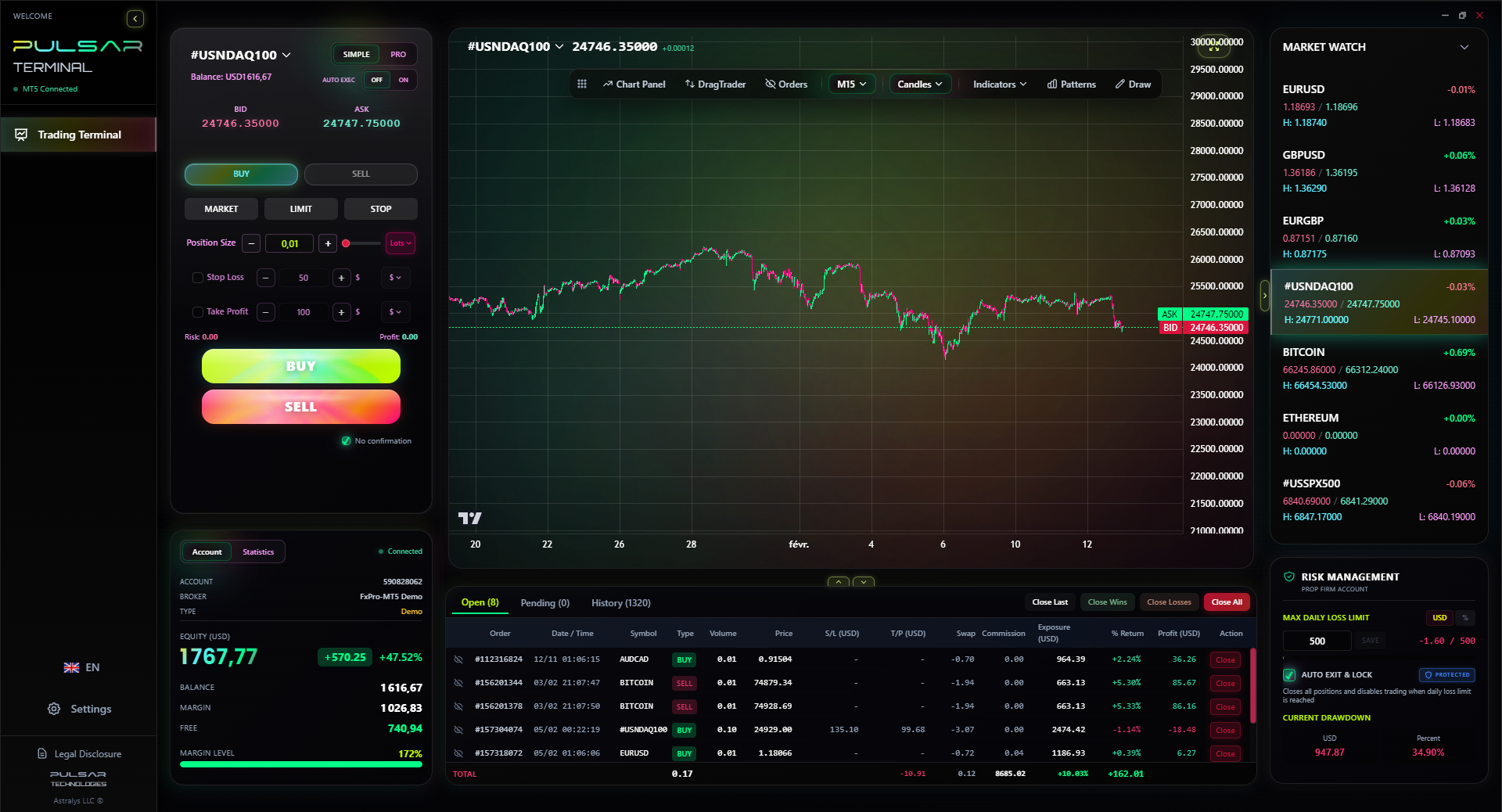
4. Advanced Trading Terminals: For serious traders, platforms beyond basic MT4/MT5 offer drag-and-drop order entry with pre-configured risk profiles. You can set, for example, "Risk 0.5% per trade" as a default, and the software will automatically calculate and set the lot size every time you place an order on any chart. This is the ultimate safeguard. It turns proper lot sizing from a conscious discipline into an automatic habit.
The bottom line? If you're still typing in lot sizes from memory or gut feeling, you're working too hard and risking too much. Automate the basics so you can focus on analysis.
💡 Winston's Tip
The best lot size chart is the one you don't need because your trading platform's calculator is doing the work for you. Automate your discipline.

Manually calculating lot sizes for every trade is error-prone; Pulsar Terminal automates this with drag-and-drop orders and pre-set risk profiles directly on your MT5 charts.
Pulsar Terminal
The all-in-one MT5 companion: drag-and-drop orders, multi-TP/SL, trailing stop, grid trading, Volume Profile, and prop firm protection. Used by 1,000+ traders daily.
Theory is useless without action. Here's exactly what to do next.
1. Audit Your Last 10 Trades. Go through your history. Did you have a consistent risk %? Or did your lot sizes jump around randomly? Calculate what percentage of your account you actually risked on each trade. Be horrified, then be educated.
2. Choose Your Max Risk Percentage. Pick one number between 0.5% and 2%. Write it on a sticky note on your monitor. You are not allowed to deviate from this for your next 50 trades. No exceptions.
3. Bookmark a Calculator. Right now, find a free online position size calculator. Bookmark it. Make it your new pre-trade homepage.
4. Practice on a Demo Account. Open a demo account with a broker like IC Markets or Pepperstone. Give yourself a virtual 500,000 Naira. Practice entering trades where you MUST calculate the lot size using a 1% risk rule and a logical stop-loss before every entry. Do this 20 times.
5. Implement on Your Smallest Live Account. Start with a live account you can afford to lose. Even 50,000 Naira. Apply the exact same process from your demo. The goal is not profit; the goal is executing the correct lot size process under real emotional pressure.
Mastering the forex lot size chart isn't about memorizing numbers. It's about installing a disciplined process between your analysis and your click of the 'Buy' or 'Sell' button. It's the single most effective thing you can do today to become a professional trader tomorrow. Now go and trade like your Naira depends on it - because it does.
FAQ
Q1What is a good lot size for a 50,000 Naira forex account in Nigeria?
With a 50,000 Naira account, you should be trading in micro or nano lots to manage risk. If you risk 1% (500 Naira) with a 30-pip stop-loss, your lot size for EUR/USD would be roughly 0.001 to 0.002 lots. Never trade mini (0.01) or standard (1.00) lots with an account this size.
Q2How does lot size affect my profit and loss in Naira?
Lot size is the multiplier. A larger lot size amplifies both your profit and loss per pip. For example, on EUR/USD, a 0.01 (micro) lot might give you a ~15 Naira move per pip (at ~1500 NGN/USD). A 0.10 (mini) lot gives ~150 Naira per pip. Choosing the right size controls how much of your capital is on the line with each market movement.
Q3Is a 0.01 lot size good for beginners in Nigeria?
It can be, but it's not automatically 'safe.' It depends on your account size and stop-loss. A 0.01 lot on a 20,000 Naira account with a wide 100-pip stop-loss could still risk 5% or more of your capital. Always calculate the lot size based on your specific account balance and stop-loss, don't just use a default like 0.01.
Q4What is the difference between a standard lot and a cent account lot?
A massive difference. In a standard account, 1.00 lot = 100,000 currency units. In a cent account, 1.00 lot = 1,000 currency units (and the monetary value is in cents). A 0.01 lot in a cent account is an extremely small position, perfect for practicing real trading psychology with minimal financial risk.
Q5How do I calculate lot size for USD/NGN trades?
You need to know the pip value. If USD/NGN is at 1500.00, a 1 pip move (0.01) for a standard lot is 100,000 * 0.01 = 1,000 Naira. So, if your risk is 2,000 Naira and your stop-loss is 50 pips, you'd calculate: Lot Size = 2000 / (50 * 1000) = 0.04 lots. Using a calculator that supports Naira pairs is much easier.
Q6Why did I get a margin call even with a 'small' lot size?
A 'small' lot is relative. You likely didn't account for your stop-loss distance or the instrument's volatility. A 0.1 lot on GBP/JPY with a 200-pip stop-loss risks far more than the same lot on EUR/USD with a 20-pip stop. Also, if you had other open positions, your total margin used was too high. Always check your used margin percentage before entering a new trade.
Q7Can I change my lot size after entering a trade?
You cannot directly change the lot size of an open position. You can, however, partially close the trade (sell off some of the units) to effectively reduce your position size, or you can add to the position (increase size) by opening another trade in the same direction at a different price. The latter increases your average entry price and complexity.
Prof. Winston's Lesson
Key Takeaways:
- ✓Risk a maximum of 1-2% of your account per trade.
- ✓Always calculate lot size *after* setting your stop-loss.
- ✓A 0.01 lot can be reckless on a tiny account.
- ✓Use a position size calculator for every single trade.
- ✓Different pairs (EUR/USD vs. XAU/USD) have wildly different pip values.
How useful was this article?
Click a star to rate
Weekly Trading Insights
Free weekly analysis & strategies. No spam.
About the Author
Olumide Adeyemi
West African Trading Pioneer
One of Nigeria's most active forex trading educators. 8 years of experience trading from Lagos. Specializes in low-capital strategies and prop firm challenges for African traders.
Comments
Risk Disclaimer
Trading financial instruments carries significant risk and may not be suitable for all investors. Past performance does not guarantee future results. This content is for educational purposes only and should not be considered investment advice. Always conduct your own research before trading.
You Might Also Like

Cara Trading Forex Sukses: 7 Prinsip dari Trader Profesional
Cara trading forex sukses dengan 7 prinsip trader pro: manajemen modal, disiplin, journal trading, backtest. Data nyata, bukan janji profit palsu.
Jam Trading Forex Terbaik untuk Trader Indonesia: Panduan Lengkap dengan Tabel Waktu
Panduan jam trading forex untuk trader Indonesia. Tabel 4 sesi dunia, jam emas 20:00-00:00, sesi mana yang harus dihindari. Data akurat + tips dari trader berpengalaman.
Top 5 Sàn Forex Uy Tín Nhất 2026: Review Jujur dari Trader Indonesia
Top 5 sàn forex uy tín 2026 untuk trader Indonesia. Review jujur: spread, deposit, withdraw, dukungan lokal. Exness, XM, IC Markets & lebih.
Get Pulsar Terminal
All these calculators are built into Pulsar Terminal with real-time data from your MT5 account. One-click position sizing, automatic risk management, and instant calculations.
Get Pulsar Terminal