


I lost 150,000 NGN in one afternoon trying to 'buy dollars' on a whim.

Olumide Adeyemi
West African Trading Pioneer ·  Nigeria
☕ 12 min read
What you'll learn:
- 1What is Forex Trading? (The Simple Truth)
- 2How Forex Trading Works for a Nigerian Trader
- 3Is Forex Trading Legal in Nigeria? (The Critical Fine Print)
- 4The Real Costs & What You Need to Start
- 5What to Trade & Basic Strategies That Work
- 6The Biggest Risks & How Nigerians Get Wiped Out
- 7Your Action Plan to Start Trading Forex in Nigeria
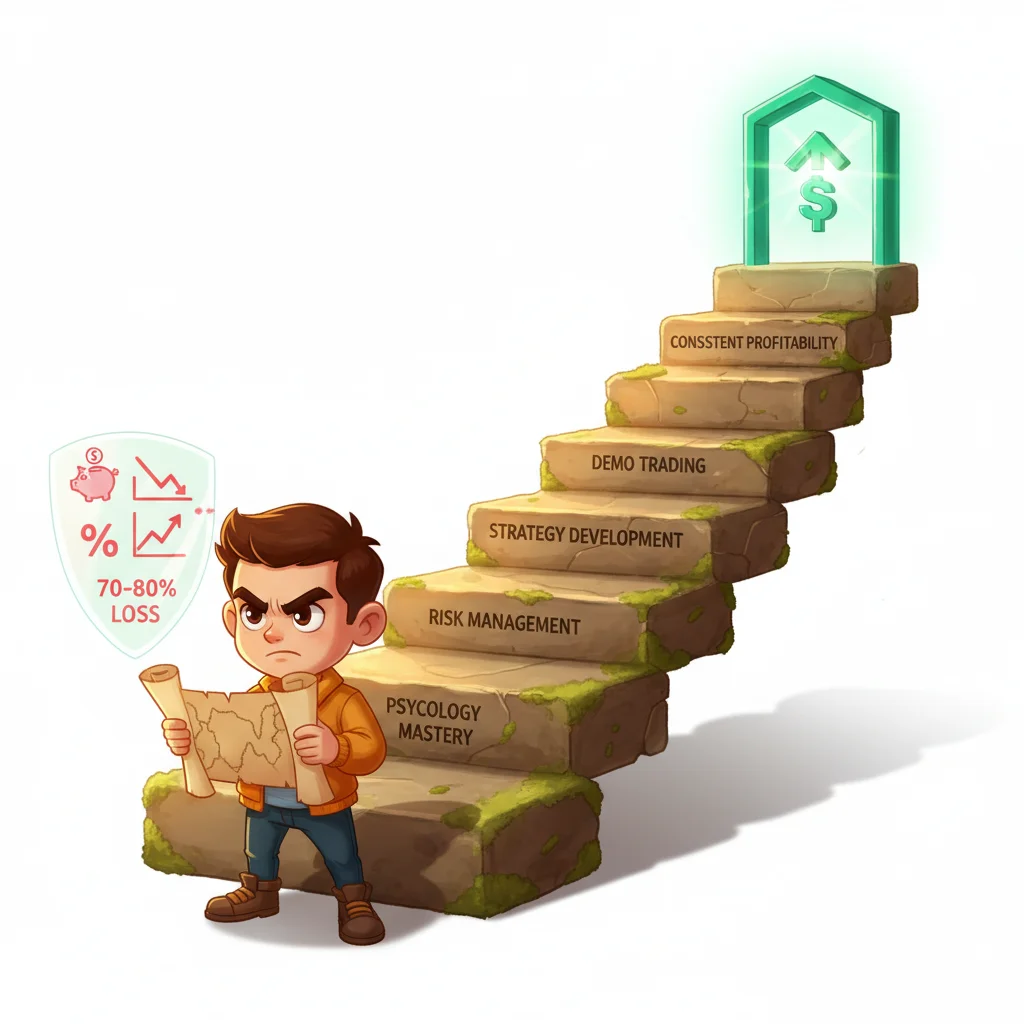
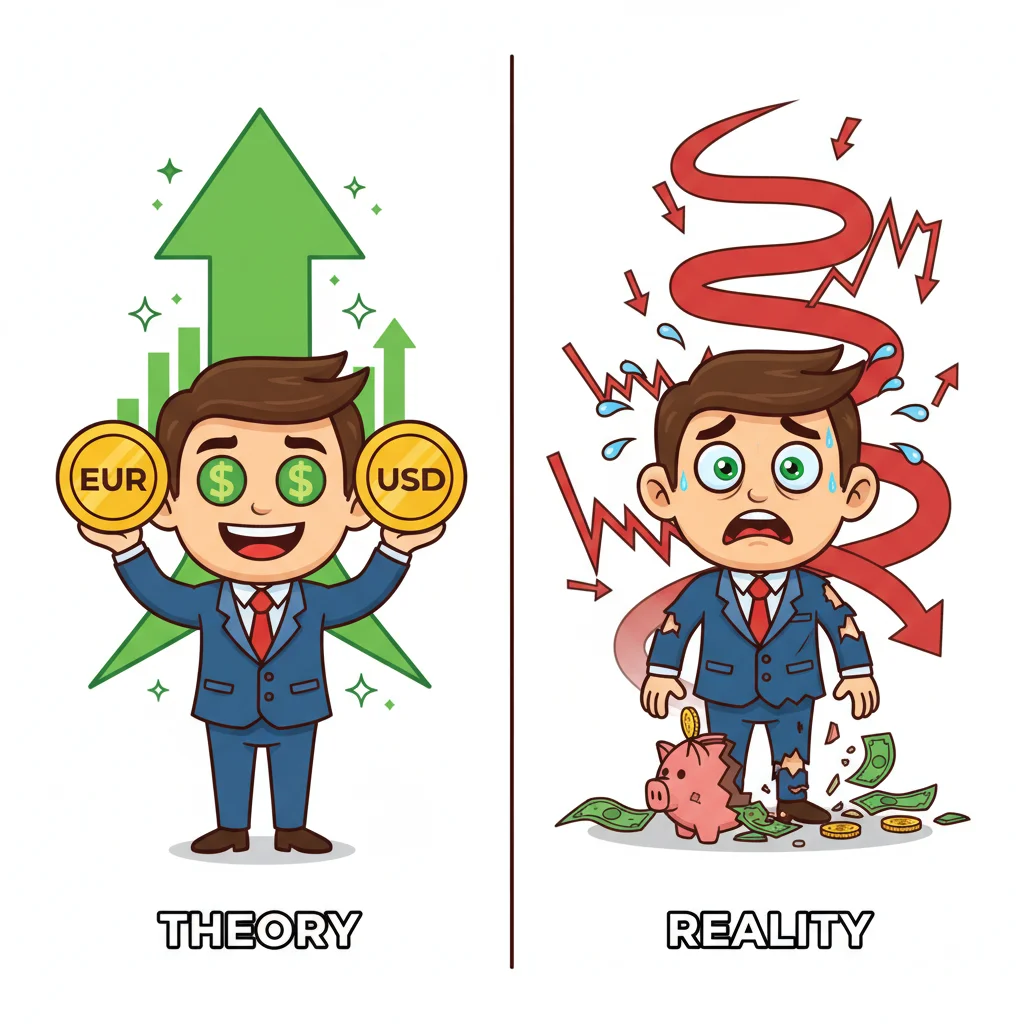
I lost 150,000 NGN in one afternoon trying to 'buy dollars' on a whim. I saw the USD/NGN rate moving, thought I was a genius, and jumped in without a plan. I didn't understand the real forex meaning - it's not just guessing currency prices. It's a global market of immense pressure, where your local bank account is a liability and your emotions are your biggest enemy. That loss taught me more than any win ever could. Let's break down what forex trading actually is for someone sitting in Lagos, Port Harcourt, or Abuja, so you don't make my expensive mistake.
Forget the textbook definitions. In practice, forex trading is the act of speculating on the price movement between two currencies. You're betting that one currency will get stronger or weaker relative to another. The 'forex meaning' in your pocket is simple: you profit if you buy a currency pair and it goes up, or sell it and it goes down.
It's the largest financial market on earth, with over $7 trillion traded daily. That liquidity is why you can get in and out of trades in milliseconds. It runs 24 hours a day from Monday morning in Sydney to Friday evening in New York, which is perfect for us Nigerians trading after work hours.
The core thing you're trading is the exchange rate. For example, if the EUR/USD pair is at 1.0850, it means 1 Euro is worth 1.0850 US Dollars. If you think the Euro will strengthen, you buy (go 'long'). If you think it will weaken, you sell (go 'short'). It's always traded in pairs because you're exchanging one currency for another.

Warning: Many 'gurus' sell forex as a get-rich-quick scheme. It's not. It's a skilled profession. That 24-hour market means it can move against you while you're asleep, which is why risk management isn't optional.
For Nigerians, the most relatable pair is USD/NGN. You see the parallel market rate on the news every day. Trading it, however, is a different ball game with international brokers, as you'll see in the regulations section.
“The real 'forex meaning' for a Nigerian trader is navigating a global system with local limitations.”
The mechanics are universal, but your experience as a Nigerian trader has unique hurdles and steps. Here's the real-world process:
The Trading Platform
You don't call a dealer. You use software - usually MetaTrader 4 or 5 (MT4/MT5) - provided by your broker. This is your portal to the markets. You see live prices, charts, and place orders with a click. Understanding your platform is step one. I spent my first month just learning how to set a stop-loss properly on MT4.
The Currency Pair
You choose what to trade. Major pairs like EUR/USD have tight spreads (the broker's fee). Exotic pairs, which might include the Naira, have wider spreads and can be more volatile. I stick to majors and a few minors like GBP/USD for clarity.
Placing a Trade
You decide your direction (buy/sell), your trade size (volume in lots), and you MUST set your protective stops. A 'lot' is a standardized unit. A standard lot is 100,000 units of the base currency. Thankfully, you can trade micro lots (1,000 units) or even nano lots with some brokers, which is where you should start. Never, ever trade a full lot with a small account. Use a position size calculator for every single trade.
The Role of the Broker
Your broker is your gateway. They provide the platform, use, and execute your trades. Since you can't use Nigerian banks for speculative forex deposits, you fund your international broker account using methods like credit/debit cards (which might be declined), bank wire transfers (slow and expensive), or cryptocurrencies (increasingly common). Withdrawal is the same process in reverse.
Here’s a comparison of what you’re actually dealing with:
| Component | What It Means For You |
|---|---|
| Spread | The immediate cost of the trade. A 1.0 pip spread on EUR/USD means the price must move 1 pip in your favor just to break even. |
| use | A double-edged sword. 1:100 use lets you control $10,000 with $100. It amplifies both gains and losses. A 1% move against you wipes your $100. |
| Margin | The collateral ($100 in the example above) you put up to open that leveraged trade. If losses eat into this, you get a margin call. |
| Swap/Rollover | An interest fee or credit for holding a trade overnight. It's based on the interest rate differential between the two currencies. For swing trading positions, this can add up. |

💡 Winston's Tip
Your first 50 trades should be on a demo account. Your only goal is to not break the rules of your own trading plan. Profit is a secondary concern.
“Overleveraging is the #1 account killer. With 1:1000 use, a 0.1% move against you is a 100% loss.”
This is the most important section for any Nigerian. The short answer is yes, it is legal for you as an individual to trade forex. The long answer is where most people get confused and run into problems.
The Central Bank of Nigeria (CBN) and the Securities and Exchange Commission (SEC) oversee financial markets. However, the CBN prohibits Nigerian banks from facilitating transactions for speculative forex trading. This is the key rule that changes everything.
What does this mean for you?
- You cannot walk into Zenith or UBA, use the official CBN window, and wire money to a forex broker for trading. They will block it.
- The SEC Nigeria does not license international retail forex brokers. So, when you see a broker 'regulated in Nigeria,' be extremely skeptical. It's likely a marketing gimmick.
Therefore, Nigerian traders use internationally regulated brokers. Your protection comes from overseas authorities like the Financial Sector Conduct Authority (FSCA) in South Africa, the Cyprus Securities and Exchange Commission (CySEC), or the British Virgin Islands Financial Services Commission (BVIFSC). These brokers accept Nigerian clients.
You fund your account using alternative methods: international bank transfers (which might go through if labeled differently), credit/debit cards (with possible declines), or crypto. This is the legal workaround. Brokers like Exness and XM have tailored their deposit/withdrawal systems for this reality.

Pro Tip: Always verify a broker's regulation yourself on the regulator's website. Don't just trust the logo on their homepage. Search for the broker's licensed name and number. I learned this after almost depositing with a 'regulated' broker that had a cloned license.
Your trading profits are considered capital gains and are technically subject to a 10% tax payable to the FIRS. In practice, compliance among retail traders is low, but you should be aware of the obligation.
“Overleveraging is the #1 account killer. With 1:1000 use, a 0.1% move against you is a 100% loss.”
Let's talk numbers, because the 'free to start' ads are misleading. Your costs are built into every trade.
1. The Spread: This is the main cost. It's the difference between the buy (ask) and sell (bid) price. If EUR/USD is quoted as 1.0850 / 1.0851, the spread is 1 pip. You 'pay' this spread the moment you enter a trade. On a standard lot (100,000 units), a 1-pip spread costs you $10. On a micro lot (1,000 units), it's $0.10. Brokers like IC Markets offer raw spread accounts where you pay a lower spread plus a separate commission.
2. Commissions: Some account types charge a direct fee per lot. E.g., $6 per standard lot round turn. This is often paired with spreads as low as 0.0 pips.
3. Swap Fees: As mentioned, the overnight holding cost. It can be a small credit or debit. Check your broker's swap table.
4. Inactivity Fees: Some brokers charge if you don't trade for several months.
Now, what do you need to start?
- Broker Account: With a reputable international broker.
- Minimum Deposit: This varies wildly. Some brokers allow $1 (FBS), others $10-50 (Exness, OctaFX), and many have a $100 minimum (AvaTrade, Pepperstone).
- Realistic Starting Capital: Here's my blunt advice. If you start with $10 (about 15,000 NGN), you're practically guaranteed to blow the account. You can't manage risk properly. A $100 account trading micro lots is a learning tool. For serious practice with breathing room, I tell my students to start with no less than $500 (approx. 750,000 NGN). This allows for sensible position sizing and surviving a string of losses.

Example: You start with $500. You risk 1% per trade ($5). On a EUR/USD trade with a 50-pip stop-loss, your position size is $5 / (50 pips * $0.10 per pip on micro) = 1 micro lot. That's proper risk management. With a $10 account, you can't do this.
💡 Winston's Tip
If you can't explain in one sentence why you're in a trade, you shouldn't be in it. 'It feels like it will go up' is not a strategy.
“Your goal for the first 6 months is to preserve capital, not get rich.”
You don't need to trade 50 pairs. Master one or two. For Nigerians, understanding these is key:
- Majors (Liquid, Tight Spreads): EUR/USD, GBP/USD, USD/JPY. These are the workhorses. I've made most of my consistent profits on EUR/USD because its movements are well-studied and predictable in ranges.
- Commodity Pairs: USD/CAD, AUD/USD. Tied to oil and minerals.
- Exotics (Volatile, Wide Spreads): USD/NGN, USD/ZAR, USD/TRY. The USD/NGN pair is emotionally tempting but often has huge spreads (sometimes 500+ pips!) on international platforms, making short-term trading nearly impossible. It's better for long-term directional bets if you have strong convictions.
Basic Strategy Foundations
Forget complex indicators at first. Price action is king.
Support & Resistance: These are price levels where the market has historically reversed. Buying near support, selling near resistance. It's simple but powerful. Draw horizontal lines on your chart where price has bounced.
Trend Following: 'The trend is your friend.' In an uptrend (higher highs, higher lows), you look for opportunities to buy on pullbacks. In a downtrend, you sell rallies. Use moving averages (like the 50 and 200 period) to help identify the trend direction.
Using Indicators Wisely: Don't clutter your chart. I use two:
- The RSI indicator to spot overbought (above 70) or oversold (below 30) conditions within a range.
- The MACD indicator to gauge momentum and potential trend changes.
A simple swing trade setup: Wait for price to pull back to a key support level in an uptrend. Check if RSI is dipping near or below 30 (oversold). When price shows signs of bouncing (e.g., a bullish candlestick pattern), enter with a stop-loss just below the support. This is the core of my swing trading approach.
For faster action, a scalping strategy aims for 5-10 pips per trade, but it requires intense focus and a broker with ultra-low spreads. It's stressful and I don't recommend it for beginners.
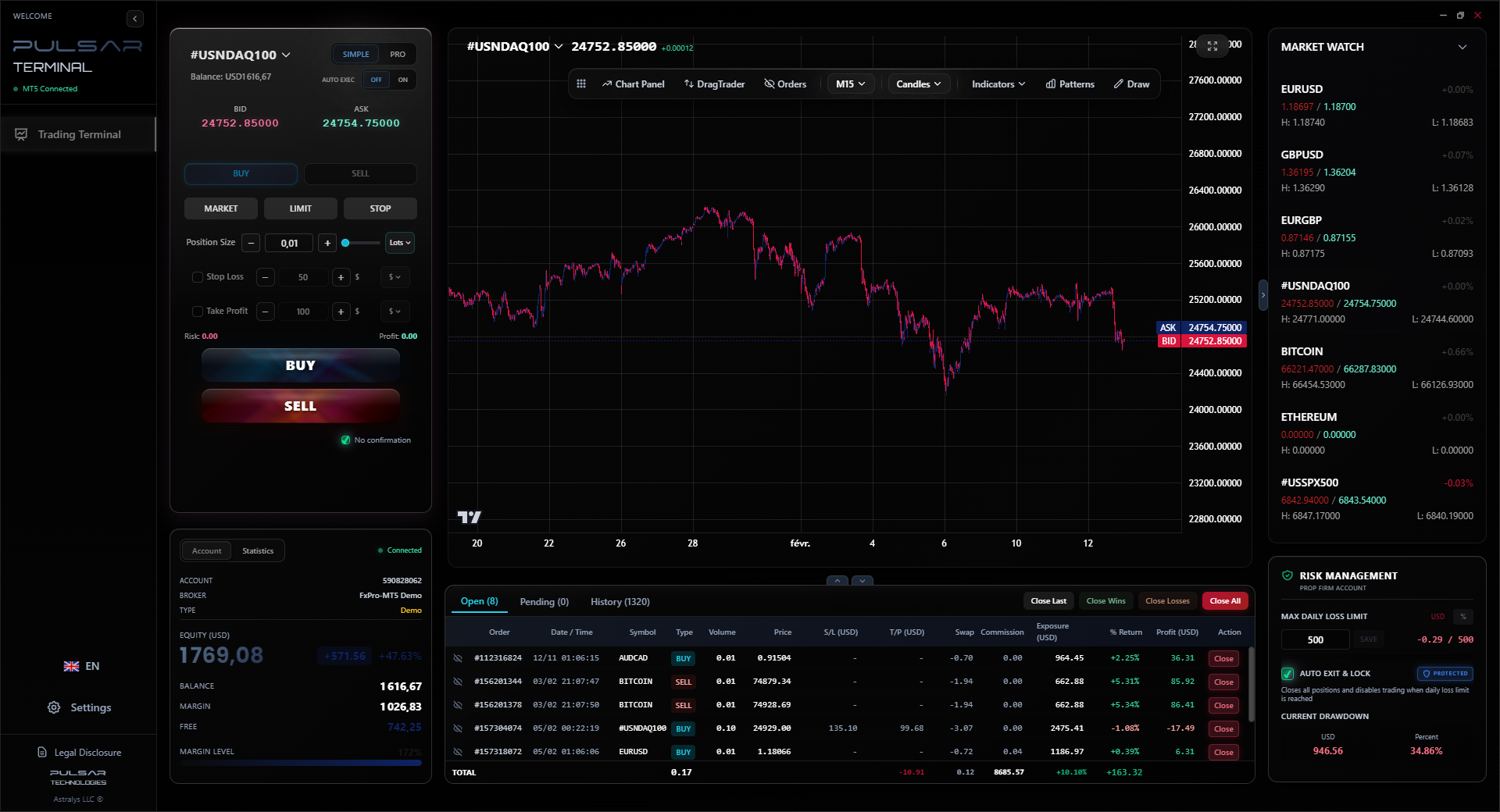
Managing multiple trades and setting precise stops is where most fail, which is why a tool like Pulsar Terminal that adds advanced order management to MT5 is a game-saver for serious traders.
Pulsar Terminal
The all-in-one MT5 companion: drag-and-drop orders, multi-TP/SL, trailing stop, grid trading, Volume Profile, and prop firm protection. Used by 1,000+ traders daily.
“Your goal for the first 6 months is to preserve capital, not get rich.”
I've seen these destroy accounts, including my own early on.
- Overleveraging: This is the #1 killer. With 1:1000 use, a $100 account can control $100,000. A 0.1% move against you is a 100% loss. It's suicidal. I once used 1:500 on a $200 account, caught a 30-pip move against me, and lost 75% of my capital in minutes. Stick to 1:10 or 1:20 until you're consistently profitable.
- No Stop-Loss: 'I'll just wait for it to come back.' It often doesn't. A trade without a stop-loss is a disaster waiting to happen. Define your risk before you enter. Every. Single. Time.
- Trading USD/NGN Emotionally: You hear the news, you have an opinion on the Naira, and you want to 'bet' on it. The spreads are monstrous, and the market can be manipulated around CBN announcements. It's a great way to lose money quickly.
- Signal Services & 'Funded Account' Scams: If someone else could trade profitably 100% of the time, they'd be using a bank's money, not selling signals for 20k NGN a month. Prop firm challenges are legitimate, but many are designed for you to fail by using unrealistic drawdown rules.
- Ignoring Total Capital Risk: Don't risk more than 1-2% of your account on any single trade. If you have a 100,000 NGN account, your max loss per trade should be 1,000-2,000 NGN. This ensures you can survive 10-20 losing trades in a row (which will happen) and live to trade another day.
- Poor Internet & Power: This is a Nigerian-specific risk. A trade can go bad during 'NEPA taking light.' Use a UPS for your router and PC, and consider a mobile data backup. Also, know your broker's policy on 'requotes' and slippage during high volatility.
💡 Winston's Tip
The market doesn't care about your rent, your bills, or your ego. Trade the price you see, not the price you need.

“A trade without a stop-loss is a disaster waiting to happen. Define your risk before you enter. Every. Single. Time.”
Here's your step-by-step guide, in order. Don't skip steps.
Step 1: Education (1-3 Months) Don't deposit a single kobo yet. Learn. Understand what a pip is, how use works, what a spread is. Read articles like this one cover to cover. Watch reputable free content on YouTube (but be wary of gurus selling dreams).
Step 2: Open a Demo Account Choose a broker like HFM, Exness, or IC Markets and open a demo (practice) account. Trade with virtual money for at least two months. Your goal is not to make fake profit, but to develop and test a simple strategy, and get used to the platform. Practice setting stop-losses and take-profits every time.
Step 3: Choose a Live Broker & Fund Your Account Based on your demo experience, pick a broker with a regulation you trust (FSCA, CySEC) and a reliable deposit method for Nigeria. Start with the minimum amount you're willing to lose completely. For most, that's between $100 and $500.
Step 4: Trade Micro Lots & Keep a Journal When you go live, trade the smallest size possible (micro or nano lots). Your goal for the first 6 months is to preserve capital, not get rich. Keep a detailed journal: entry price, exit price, why you took the trade, your emotional state. Review it weekly. This is how you improve.
Step 5: Gradually Scale & Stay Disciplined Only after 3-6 months of consistent, small, disciplined trading should you consider adding more capital or slightly increasing your position size. The market will always be there. Your job is to make sure your capital is still there to participate.
The real 'forex meaning' for a Nigerian trader isn't about Lamborghinis. It's about understanding a global system, navigating local limitations, and applying relentless discipline to manage risk. It's a marathon, not a sprint. Now you know the real starting line.
FAQ
Q1Is forex trading a good way to make money in Nigeria?
It can be, but it's a high-skill profession, not a side hustle. It requires significant education, discipline, and risk management. Most beginners lose money. Treat it as a serious business venture that requires startup capital (which you can lose) and years of practice to potentially become profitable.
Q2Which forex broker is best for Nigerians?
There's no single 'best.' Look for brokers with strong international regulation (like FSCA or CySEC) that reliably accept Nigerian clients and offer convenient deposit/withdrawal methods like crypto or bank transfers. Brokers such as Exness, HFM, and IC Markets are popular choices, but you must verify their current terms and deposit options yourself.
Q3How much money do I need to start forex trading in Nigeria?
Technically, you can start with as little as $1 with some brokers. Realistically, to trade properly with sensible risk management, you should start with no less than $500 (approx. 750,000 NGN). This allows you to trade micro lots and survive the inevitable losing streaks without blowing your account on one or two bad trades.
Q4Do I pay tax on forex trading profits in Nigeria?
Yes, legally. Profits are considered capital gains and are subject to a 10% Capital Gains Tax payable to the Federal Inland Revenue Service (FIRS). However, many retail traders do not formally declare these profits. You should consult with a tax professional to understand your personal obligations.
Q5Can I trade the Naira (USD/NGN) on international platforms?
Yes, some international brokers offer the USD/NGN pair. However, be warned: the spreads (trading cost) are often extremely wide - sometimes several hundred pips - making short-term trading very difficult and expensive. It's often more suitable for long-term positional trades if you have a strong view on the Naira's direction.
Q6What is the safest way to fund my forex trading account from Nigeria?
There is no perfectly 'safe' way due to CBN restrictions on speculative forex. The most reliable methods currently are cryptocurrency (USDT) transfers or international bank wire transfers (which may be slow and incur fees). Using credit/debit cards is hit or miss, as banks often block such transactions.
Prof. Winston's Lesson
Key Takeaways:
- ✓Start with at least $500 for realistic risk management.
- ✓Never risk more than 1-2% of your capital on a single trade.
- ✓Use use of 1:20 or less as a beginner.
- ✓Trade majors like EUR/USD, avoid exotic pairs initially.
- ✓Demo trade for 2-3 months before using real money.
How useful was this article?
Click a star to rate
Weekly Trading Insights
Free weekly analysis & strategies. No spam.
About the Author
Olumide Adeyemi
West African Trading Pioneer
One of Nigeria's most active forex trading educators. 8 years of experience trading from Lagos. Specializes in low-capital strategies and prop firm challenges for African traders.
Comments
Risk Disclaimer
Trading financial instruments carries significant risk and may not be suitable for all investors. Past performance does not guarantee future results. This content is for educational purposes only and should not be considered investment advice. Always conduct your own research before trading.
You Might Also Like

Cara Trading Forex Sukses: 7 Prinsip dari Trader Profesional
Cara trading forex sukses dengan 7 prinsip trader pro: manajemen modal, disiplin, journal trading, backtest. Data nyata, bukan janji profit palsu.
Jam Trading Forex Terbaik untuk Trader Indonesia: Panduan Lengkap dengan Tabel Waktu
Panduan jam trading forex untuk trader Indonesia. Tabel 4 sesi dunia, jam emas 20:00-00:00, sesi mana yang harus dihindari. Data akurat + tips dari trader berpengalaman.
Top 5 Sàn Forex Uy Tín Nhất 2026: Review Jujur dari Trader Indonesia
Top 5 sàn forex uy tín 2026 untuk trader Indonesia. Review jujur: spread, deposit, withdraw, dukungan lokal. Exness, XM, IC Markets & lebih.
Get Pulsar Terminal
All these calculators are built into Pulsar Terminal with real-time data from your MT5 account. One-click position sizing, automatic risk management, and instant calculations.
Get Pulsar Terminal