


I was short USD/ZAR at R18.45 in March 2020.

David van der Merwe
Emerging Markets Trader ·  South Africa
☕ 12 min read
What you'll learn:
- 1What a Real Mentor Actually Does (Hint: It's Not Giving Signals)
- 2The Red Flags of a Fake Guru (South African Edition)
- 3The Self-Mentorship Path: Building Your Own Framework
- 4Finding Your Tribe: The Right Community vs. Toxic Isolation
- 5The Essential Skills No One Teaches You
- 6A Realistic Timeline: From Novice to Consistent
- 7Curated Resources to Start Your Journey (The Free Stuff)
- 8When It *Might* Make Sense to Pay for Guidance

I was short USD/ZAR at R18.45 in March 2020. The world was panicking, the Rand was tanking, and my 'mentor's' perfect harmonic pattern had just failed. My stop-loss at R18.70 got taken out, and the pair ripped to R19.35 in hours. I lost R12,000 on that single trade - money I couldn't afford. That's when I realized the 'guru' selling me signals didn't have a clue about risk. A real forex mentor doesn't show you magic entries. They show you how to survive.
Let's clear this up right now. If someone is selling you daily trade signals or promising a 'secret strategy,' they're not a mentor. They're a salesperson. I've paid for three of these services early in my career. The best one had a 58% win rate over six months. Sounds decent, right? I still lost money.
Why? Because they never talked about position sizing for a South African account starting with R5,000. They never explained how the spread on exotic pairs like USD/ZAR or EUR/ZAR widens during local liquidity drops (around 4-6 PM SAST). They gave one-size-fits-all advice that doesn't fit our market's quirks.
A genuine forex mentor does one primary thing: they install a risk management framework that becomes automatic. They're less like a football coach drawing up plays and more like a drill sergeant making sure you always check your safety gear. Their value isn't in predicting the market; it's in preventing you from self-destructing.

Warning: Be extremely wary of any mentor who cannot or will not share a verifiable, multi-year track record of their own personal trading account statements (with personal details blurred). A demo account or 'prop firm challenge' pass doesn't count. Real money, real history.
This means teaching you how to use a position size calculator religiously, especially when trading volatile ZAR pairs. It means drilling into you that your maximum risk per trade should be a boring 1-2% of your capital, not the 5% or 10% desperation plays you see on Telegram groups. A true mentor makes the boring stuff non-negotiable.

💡 Winston's Tip
Your trading plan is your first and best mentor. If it doesn't explicitly forbid moving a stop-loss further from your entry, you don't have a plan. You have a suggestion.
The local 'trading education' space is flooded with characters who've mastered marketing, not markets. Here's how to spot them.
They focus on lifestyle, not process. If their Instagram is more about rented supercars in Sandton and bottles at VIP than about charts, journaling, or dealing with loss, run. I fell for this. The glamour is a decoy for a lack of substance.
They use pressure tactics. 'Join my mastermind before the price increases at midnight!' 'Only 5 spots left for my live class!' This is pure FOMO marketing. Real trading skill develops over years, not in a 48-hour limited-time offer.
They're vague on costs and results. A real mentor will be upfront. They should clearly state what their program costs (in Rands), what exactly you'll learn, and what a realistic outcome is (e.g., 'learn to protect your capital' not 'make R50k a month').
They promise consistency that doesn't exist. No one wins every week. The market has quiet periods, especially in our timezone. If they claim to have winning weeks back-to-back-to-back, they're likely curve-fitting past data or lying.
The Local Payment Trap
A big red flag specific to us: being asked to pay via unusual methods. A legitimate business will have a proper invoicing system. Be suspicious of mentors who only accept direct EFTs to a personal account with no VAT number, or worse, want payment in USDT or other crypto. You have zero recourse if they disappear.
My worst 'mentorship' cost me R8,500 upfront. It consisted of a Dropbox folder of pirated US trading books and a weekly Zoom call where the 'guru' would just trade live with no explanation. When I asked a basic question about margin call levels on my broker's platform, he told me to 'google it.' That was the last straw.
“Your ego is your worst enemy. A trade hits your stop-loss. That's the system working. It's not a failure.”
Waiting for the perfect mentor is a form of procrastination. You can and must start mentoring yourself. This is the core of a professional mindset.
Step 1: Journal Like Your Career Depends On It (It Does). Every trade. Every day. Not just 'bought EUR/USD, won.' You need: Entry reason (e.g., '4H MACD indicator crossover above zero, retest of S/R'), entry price, stop-loss price and why it was placed there, take-profit price and why, position size in lots and as a % of capital, exit price, P/L in Rands. Then, the most important columns: 'What I did well' and 'Mistake to avoid.'
Step 2: Backtest and Forward-Test ONE Strategy. Pick a simple concept. Maybe a moving average crossover on the EUR/USD guide daily chart, or support/resistance plays on XAU/USD guide. Don't tweak it for 6 months. Test it in a demo account for at least 100 trades. Record every result in your journal. This data is your first real teacher.
Step 3: Define Your Rules, Then Codify Them. Your self-made trading plan is your silent mentor. It should answer:
- What markets do I trade? (Stick to 2-3 major pairs to start)
- What is my maximum daily loss? (e.g., 3% of account)
- What is my maximum weekly loss? (e.g., 6% of account)
- What is my risk per trade? (e.g., 1% of account)
- What are my entry criteria? (Be specific: 'Price above 200 EMA, 1-hour RSI > 30 and rising')
- What are my exit criteria? (Both for profit and loss)

Example: Your account is R10,000. Your risk per trade is 1% = R100. You're buying USD/ZAR, and your stop-loss is 50 pips away. A pip definition on USD/ZAR is roughly R0.67 per standard lot (100,000 units). To risk only R100, you'd calculate: R100 / (50 pips * R0.67) = ~2.98 mini lots (29,800 units). You'd round down to 2.5 mini lots. This math is non-negotiable.
This process is tedious. It's not sexy. But this discipline is what separates a gambler from a trader. It's the foundation every real forex mentor would force you to build.
Trading is lonely. A good community acts as a group mentor, providing perspective and accountability. A bad community acts as an echo chamber for bad ideas.
Avoid:
- Groups where everyone is posting massive, unverified profit screenshots all day. This creates unrealistic pressure.
- Groups where questioning a popular idea or leader is met with hostility.
- 'Pump and dump' crypto or penny stock groups. This is illegal and you will be the bag holder.
Seek Out:
- Small, focused groups or forums where traders discuss process. Look for conversations about journaling, psychology, and risk management.
- Communities attached to reputable, transparent educators or brokers. Some broker forums for Exness review or IC Markets review have decent educational sections.
- Local meetups (in Johannesburg, Cape Town, Durban) that are about learning, not recruiting. Ask specific questions: 'How do you handle drawdown?' not 'What's your next trade?'
I once joined a small Discord server of 30 traders. We had a rule: you could only post a trade before you entered it, with your planned stop and target. No post-trade glory stories. The collective scrutiny was a better mentor than any individual guru. It forced clarity and accountability I never had on my own.
💡 Winston's Tip
The market's job is to find the price where you will make the most emotional, worst possible decision. A real mentor's job is to build the cage that keeps you from reaching for it.

“The goal of any mentorship should be to make the mentor obsolete.”
Beyond indicators and patterns, these are the real skills that preserve your capital.
1. The Skill of Doing Nothing. Most of trading is waiting. Waiting for your setup. Waiting in a trade. The market is open 24/5, but your brain isn't built to be. A real mentor teaches you to walk away. I schedule my chart time. Outside of that, I'm not allowed to look. This saved me from countless impulsive trades.
2. The Skill of Being Wrong Gracefully. Your ego is your worst enemy. A trade hits your stop-loss. That's the system working. It's not a failure. The failure is moving your stop-loss further away 'just until it comes back.' I've done that. It turns a R500 loss into a R5,000 loss. A mentor drills into you that a triggered stop is a correct decision, not a bad one.
3. The Skill of Managing Winners. This is harder than managing losers. You're in a trade, up a nice 30 pips. Greed whispers, 'It could go to 100!' Fear whispers, 'Take it now before it reverses!' A mentor helps you build rules: a trailing stop, or taking partial profits at predetermined levels. Without a plan, you'll give back most of your gains.
4. The Skill of Broker Selection. It's not just about low spreads. For South Africans, it's about: Can I deposit/withdraw in ZAR easily? What are the fees? Are they regulated by a reputable body (not just an offshore license)? Do they offer the specific instruments I want? I learned this the hard way with a bucket-shop broker that had 'slippage' on every major news event. Do your due diligence like you would on a XM review or Pepperstone review.
These aren't technical skills. They're behavioral skills. And they're 80% of the game.
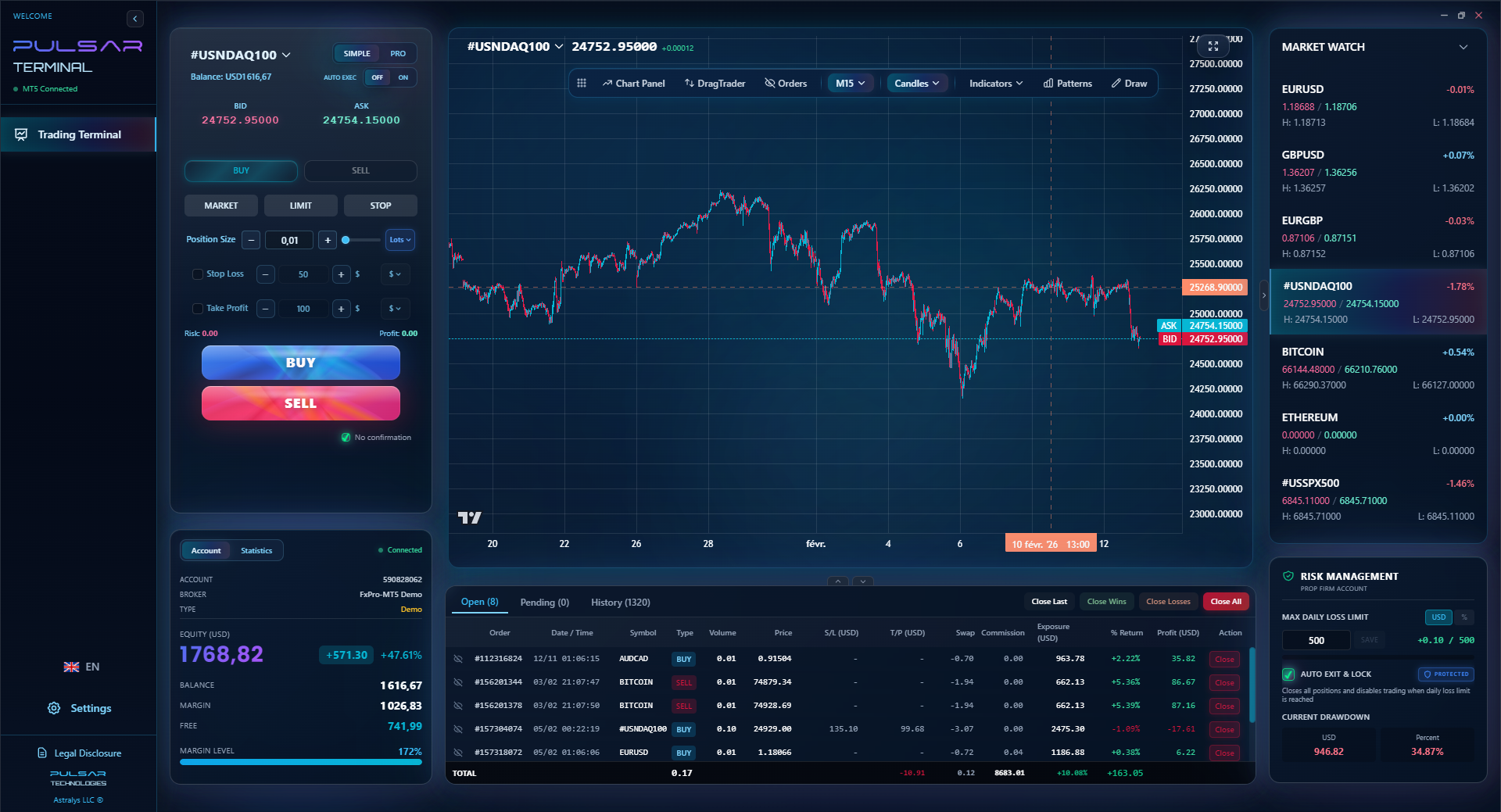
Managing winners and losers requires iron-clad rules, which is why tools like Pulsar Terminal that let you set multi-level take-profits and trailing stops directly on your MT5 chart are so valuable—they automate the discipline you lack.
Pulsar Terminal
The all-in-one MT5 companion: drag-and-drop orders, multi-TP/SL, trailing stop, grid trading, Volume Profile, and prop firm protection. Used by 1,000+ traders daily.
Throw out the 'get rich quick' timeline. Here's a more honest, grinding schedule based on what I've seen and lived.
Year 1: The Expensive Lesson. You will likely blow up your first account. Your goal this year is not to be profitable. Your goal is to lose slowly. Learn to use a demo account for 3-6 months minimum. Then trade a live micro account (like R2,000) where a 10% loss is R200, not R20,000. Focus entirely on executing your plan and journaling. Expect to be net negative. Success is surviving the year with capital and a detailed journal.
Year 2: The Grind. You might break even. You'll have periods of profit followed by drawdowns. You're refining your strategy, learning about different market conditions (trending vs. ranging), and starting to control your emotions better. This is where you might explore more advanced concepts like market structure or different styles like scalping strategy vs. swing trading.
Year 3: The Threshold of Consistency. If you've done the work - the brutal, boring, repetitive work of journaling, risk management, and self-review - you might start to see modest, consistent returns. I'm talking 1-3% per month on average, not 20%. Your system is now a part of you. The losses don't sting as much, the wins don't elate as much. You're a business owner, not a gambler.
This timeline assumes 10-15 hours of focused work per week. If you're treating it as a casual hobby you check on your phone, it will take longer, if you ever get there at all.
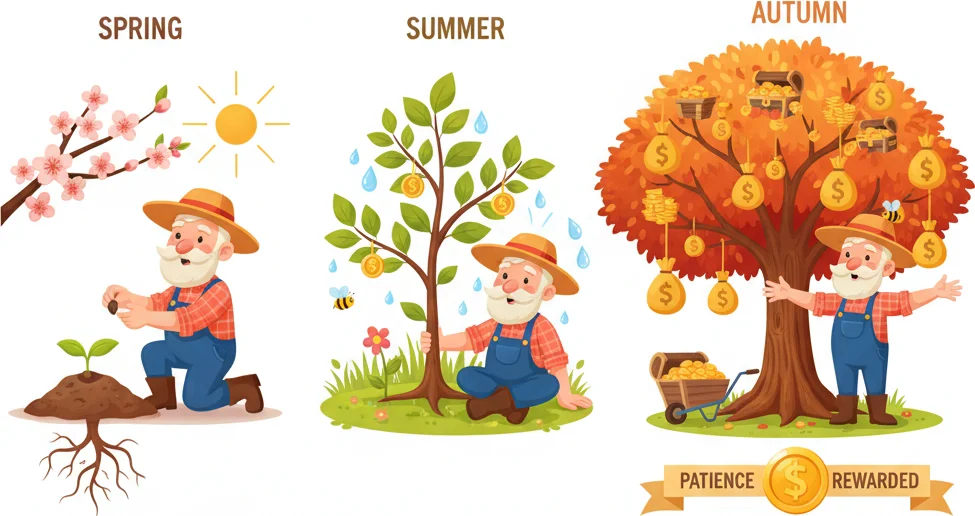
“You're a business owner, not a gambler. Start acting like the CFO of your own small, risky venture.”
You don't need to pay R20,000 for a course to start. These are the foundational resources I wish I'd used from day one.
Books (The Classics):
- Trading in the Zone by Mark Douglas. This is the bible of trading psychology. Read it twice.
- The Disciplined Trader by Mark Douglas. Read this first. It's harder, but it lays the groundwork.
- Market Wizards series by Jack D. Schwager. Interviews with legendary traders. It shows you the myriad of ways to succeed, but the common thread is always discipline and risk management.
Free Online Content (Be Selective):
- Babypips.com School of Pipsology. Start here. It's free, structured, and covers all the absolute basics from what a pip definition is to what a spread definition means.
- Broker Education Hubs. Reputable brokers like Pepperstone and IC Markets have extensive, free articles and webinars. Stick to the conceptual ones about risk management, not the 'here's today's trade idea' ones.
Your Own Spreadsheet: This is your most important tool. Build a trading journal in Google Sheets or Excel. Track every metric I mentioned earlier. This data becomes your personal forex mentor. It tells you, objectively, where you're weak. Are you losing more on long trades or short trades? Are your losses bigger than your wins? The spreadsheet doesn't lie, even when your memory does.

Pro Tip: When you read or watch anything, ask this question: 'Is this teaching me a specific action to improve my process, or is it just selling me hope?' Focus on the actionable. Ignore the inspirational fluff.
💡 Winston's Tip
You don't need a guru's crystal ball. You need a spreadsheet that tells you, coldly and clearly, that your win rate on Tuesday afternoons is 28%. That's the data that makes you money.
After 1-2 years of self-study and live micro-account trading, paid guidance can accelerate your growth. But you must choose with extreme care.
Look for a coach, not a guru. The difference? A guru says 'follow me.' A coach says 'show me your process and let's improve it.' A good coach will want to see your trading journal first. They'll work on your strategy and your psychology, not sell you theirs.
Expect a structured curriculum, not random calls. You should get a syllabus. Modules on psychology, risk management, strategy development, and review processes. It should be about education, not entertainment.
The price should be transparent and fixed. No upsells, no 'inner circle' fees. A one-time fee for a course, or a monthly fee for ongoing coaching. For a quality program from a legitimate coach, expect to pay anywhere from R5,000 to R30,000. Anything promising life-changing results for R500 is a scam.
The best value often isn't a 'mentor' at all. It's a strong trading tool that enforces discipline. This is where technology can act as your unemotional mentor. For example, a platform that lets you set advanced order types, automate partial closures, and enforce daily loss limits can save you from your worst impulses.
, the goal of any mentorship should be to make the mentor obsolete. They should be building your confidence and skill to the point where you trust your own system completely. That's the final sign you've learned the real lesson.
FAQ
Q1How much should I pay a forex mentor in South Africa?
If you're paying for a structured course from a credible coach (with verified track records), expect R5,000 to R30,000. For ongoing monthly coaching, R1,500 to R5,000 per month is a common range. Never pay a huge lump sum upfront for vague promises. Any 'mentor' asking for R50,000+ for a 'mastermind' is almost certainly selling dreams, not education.
Q2Can I learn forex trading completely on my own for free?
Yes, the core knowledge is freely available. You can learn mechanics from Babypips, psychology from library books, and charting from broker demos. The hardest part alone is the accountability and spotting your own blind spots. This is where a journal and a small, serious peer group become essential. Free learning takes longer and requires immense self-discipline.
Q3What's the biggest mistake new traders make when looking for a mentor?
They look for someone who promises high returns, instead of someone who emphasizes capital preservation. They're drawn to confidence and swagger, rather than humility and a focus on process. They want a shortcut to profits, and gurus sell that fantasy. The right mentor will talk more about managing losses than picking winners.
Q4Is passing a prop firm challenge proof that someone is a good mentor?
Not at all. Prop firm challenges have specific, short-term rules (like a 5-10% profit target and a daily loss limit). They test a very narrow skill set under controlled conditions. They do not test long-term consistency, adaptability to different market cycles, or real-life psychological pressure of trading your own saved capital. It's a data point, not proof of expertise.
Q5What should I ask a potential mentor before paying them?
- 'Can I see a sample of the curriculum or syllabus?' 2. 'What is your background as a trader, and can you share a verified long-term track record?' 3. 'What is your teaching philosophy regarding risk management?' 4. 'What is expected of me as a student in terms of time and work?' 5. 'What is the total cost, and are there any other fees?' If they dodge these, walk away.
Q6How long does it take to become a consistently profitable trader?
For most people who treat it seriously (10-15+ hours a week), it's a 2-3 year journey to modest consistency. Year 1 is usually a net loss, Year 2 is often break-even, and Year 3 can see small, steady gains. Anyone telling you it can be done consistently in a few months is lying or selling something.
Prof. Winston's Lesson
Key Takeaways:
- ✓Risk per trade is non-negotiable: 1-2% max.
- ✓A detailed trade journal is your true mentor.
- ✓Expect 2-3 years of work for modest consistency.
- ✓Avoid anyone who focuses on profits, not process.
How useful was this article?
Click a star to rate
Weekly Trading Insights
Free weekly analysis & strategies. No spam.
About the Author
David van der Merwe
Emerging Markets Trader
Johannesburg-based trader with 11 years in emerging market currencies. Specializes in ZAR pairs, FSCA-regulated trading, and South African market analysis.
Comments
Risk Disclaimer
Trading financial instruments carries significant risk and may not be suitable for all investors. Past performance does not guarantee future results. This content is for educational purposes only and should not be considered investment advice. Always conduct your own research before trading.
You Might Also Like

Cara Trading Forex Sukses: 7 Prinsip dari Trader Profesional
Cara trading forex sukses dengan 7 prinsip trader pro: manajemen modal, disiplin, journal trading, backtest. Data nyata, bukan janji profit palsu.
Jam Trading Forex Terbaik untuk Trader Indonesia: Panduan Lengkap dengan Tabel Waktu
Panduan jam trading forex untuk trader Indonesia. Tabel 4 sesi dunia, jam emas 20:00-00:00, sesi mana yang harus dihindari. Data akurat + tips dari trader berpengalaman.
Top 5 Sàn Forex Uy Tín Nhất 2026: Review Jujur dari Trader Indonesia
Top 5 sàn forex uy tín 2026 untuk trader Indonesia. Review jujur: spread, deposit, withdraw, dukungan lokal. Exness, XM, IC Markets & lebih.
Get Pulsar Terminal
All these calculators are built into Pulsar Terminal with real-time data from your MT5 account. One-click position sizing, automatic risk management, and instant calculations.
Get Pulsar Terminal