


Here's a statistic that should keep you up at night: the Financial Sector Conduct Authority (FSCA) estimates that roughly 74% of retail CFD traders in South Africa lose money.

David van der Merwe
Emerging Markets Trader ·  South Africa
☕ 11 min read
What you'll learn:
- 1Forex Money Is Not What You Think
- 2The ZAR Forex Market: A Different Beast
- 3The Psychology of Losing Money (It's Not Greed)
- 4Realistic Money Management for South African Traders
- 5Brokers, Costs, and Getting Your Money Out
- 6Shifting from Losing to Making Money
- 7Local Pitfalls: What to Avoid in South Africa
- 8Building a Sustainable Edge, Not a Gamble

Here's a statistic that should keep you up at night: the Financial Sector Conduct Authority (FSCA) estimates that roughly 74% of retail CFD traders in South Africa lose money. Not 'struggle to make a profit' - they actively lose their capital. If you're reading this to learn how to make forex money, you first need to understand why it's so easy to lose it. This isn't about get-rich-quick schemes or 'secret indicators.' It's a frank, evidence-based look at the real economics of trading ZAR pairs, from the spread you pay to the psychological traps that empty accounts.
When you hear 'forex money,' you probably picture consistent profits rolling in. The reality is messier. For most new traders, 'forex money' is actually the cost of doing business - the money that permanently leaves your account before you even have a chance to win.
Let's break down where your money really goes first. The biggest silent killer isn't a bad trade, it's the spread. On a major pair like EUR/USD, a 1.2 pip spread might seem trivial. But trade it 20 times a day with a standard lot? That's $240 gone, just in spread costs. Now, trade a ZAR cross like USD/ZAR where spreads can be 50-150 pips? You're starting every trade in a deep hole. Your first job isn't to be right on direction, it's to overcome this built-in friction. I learned this the hard way early on, scalping GBP/ZAR. I'd be 'right' on a 70 pip move, but after a 90 pip spread and commission, I was still down. That's not trading, that's donating to your broker.
Then there's the swap, or overnight financing. Holding a ZAR-based pair can have monstrous swap rates, depending on the direction. I once held a short USD/ZAR position over a weekend, thinking I was clever. The Monday morning swap charge was more than the entire week's potential profit. It felt like a tax for being in the market. These aren't occasional fees, they're the constant drip-drip that erodes capital. Making forex money starts with understanding and minimizing these leaks. Every rand saved on unnecessary cost is a rand earned.

💡 Winston's Tip
If you can't calculate your maximum loss before you enter a trade, you're not trading, you're gambling. The exit plan is more important than the entry idea.
Trading the Rand isn't like trading the Euro or Yen. It's a volatile, sentiment-driven emerging market currency, and that changes everything about your approach to forex money.
Liquidity and News Sensitivity
The ZAR is hyper-sensitive to local and global risk sentiment. US payroll data? It moves. A speech by the SARB governor? It moves. Load-shedding announcements or political noise? It definitely moves. The liquidity isn't as deep as with majors, which means moves can be sharper and spreads can widen violently during news events. Trying to trade ZAR pairs with a scalping strategy during local data releases is a recipe for slippage and frustration. The money is often made by being patient, not hyper-active.
The Carry Trade Dynamic
For years, the ZAR was a classic carry trade currency. Investors would borrow in a low-yielding currency like the JPY and buy the high-yielding ZAR. This created a persistent, underlying bid for the Rand. But when global risk sours, that trade unwinds fast, causing the ZAR to plummet. You need to know which regime you're in. Are you getting paid in swap to hold a position, or are you funding someone else's carry trade? Ignoring this can turn a technically good entry into a financially draining one.

Warning: Never assume a ZAR trend will continue just because of a high interest rate differential. The unwind during a 'risk-off' event can wipe out months of carry profits in hours.
Practical Pair Selection
You don't have to trade ZAR pairs. Many successful South African traders focus on majors like EUR/USD or XAU/USD (Gold) where spreads are tight and liquidity is deep. Your profit and loss are in USD, but your living costs are in ZAR. This adds a currency conversion layer to your returns, which can be a risk or an opportunity. The key is to choose the battlefield. If you're new, fighting the spread on USD/ZAR is a tougher battle than on EUR/USD.
“Protecting your forex money is 80% about protecting yourself from yourself.”
Everyone talks about greed and fear. I think the real destroyer of forex money is something more subtle: the need to be proven right. Your ego is your worst enemy in this game.
I'll give you a personal example. I once entered a long trade on EUR/GBP. It went 15 pips against me, hitting my mental stop. But I didn't execute the order. I thought, 'The setup was perfect, the market is wrong.' I moved my stop-loss further away. It went another 20 pips against me. I doubled my position to 'average down.' My brain was now fully committed to being right, not to managing risk. The trade eventually hit my broker's hard stop, triggering a margin call. I lost over 8% of my account on one stupid trade. That wasn't greed for more profit, it was an inability to accept a small, planned loss.
This need to be right manifests in revenge trading after a loss, in refusing to take profits too early ('it might go further!'), and in over-leveraging to make back what you lost. The market doesn't care about your thesis, your analysis, or your feelings. It only cares about price. The moment you start arguing with it, you start losing money. Protecting your forex money is 80% about protecting yourself from yourself. A good broker with solid execution, like Pepperstone or IC Markets, gives you the tools, but you have to have the discipline to use them.

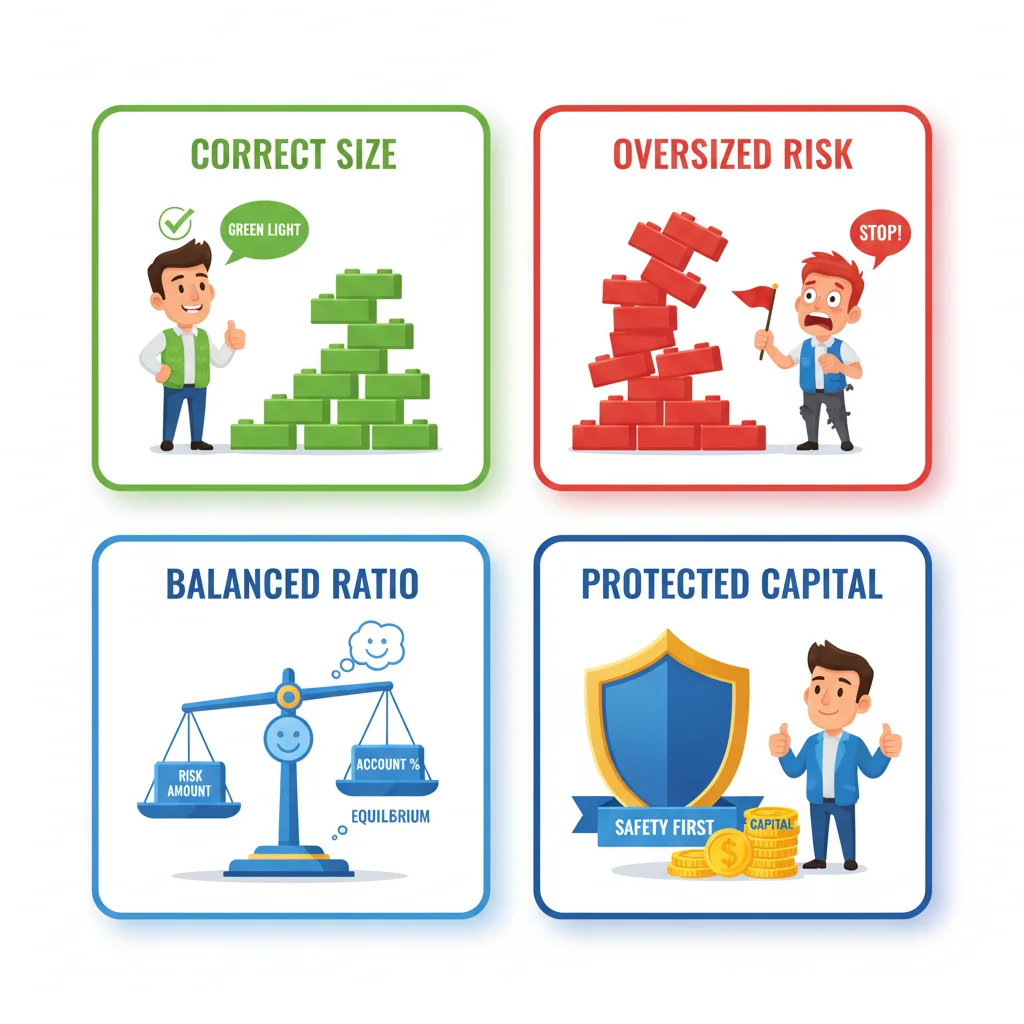
Forget the 'risk 2% per trade' rule for a second. That's the destination. Let's talk about the starting line. If you have a R20,000 account, 2% is R400. On USD/ZAR, with its wild swings, that R400 could be gone in a 10-pip move on a mini lot. The rule is sound, but the application needs context.
Start with Position Size, Not Percentage
Your first calculation should always be position size. How many units can you trade so that a reasonable stop-loss (based on your chart analysis) equals a loss you can stomach? This is where a position size calculator is non-negotiable. You tell it your account balance in ZAR, your entry and stop price, and your risk percentage. It spits out the exact lot size. This removes emotion from the most critical decision.
The 'Survival First' Rule
Your primary goal in your first year isn't to make forex money, it's to survive. To learn. That means risking tiny amounts - 0.5% to 1% of your account - per trade. Yes, the profits will be small. That's the point. You're paying tuition, not buying a Lamborghini. I traded for 9 months risking 0.75% before I even considered moving to 1.5%. That patience is what kept me in the game.
Accounting for ZAR Volatility
When your account is in ZAR but you're trading USD pairs, your risk in Rands fluctuates with the USD/ZAR rate. If the Rand weakens, your USD-based losses become more expensive in ZAR terms. You either need to factor this into your risk calc or keep a portion of your capital in USD. It's a complexity many ignore until it bites them.

Example: You risk $100 on a EUR/USD trade. If USD/ZAR is at 18.50, that's a R1,850 risk. If USD/ZAR jumps to 19.00 while your trade is open, that same $100 loss is now R1,900. Your risk just increased by R50 without you changing a thing.
💡 Winston's Tip
The spread isn't a fee, it's the market's first move against you. Never enter a trade where the required move to breakeven is larger than your average profitable move.
“The transition to making money doesn't happen when you find a magic indicator, it happens when your process changes.”
This is where the rubber meets the road. You can make all the right trades, but if your broker is shady or your withdrawals are a nightmare, your forex money is just a number on a screen.
Regulation is Your Safety Net
Only use brokers regulated by the FSCA. It's not a perfect guarantee, but it's the strongest protection you have. It means the broker must adhere to capital adequacy requirements, keep client funds segregated, and follow fair practice rules. International regulation from bodies like ASIC (Australia) or CySEC (Cyprus) is also strong. I've seen too many stories of traders with 'offshore' brokers who suddenly can't log in. Stick with reputable, regulated names. Do your homework on our reviews for Exness, XM, or IC Markets to see how they operate for South Africans.
The Full Cost Picture
Don't just look at the spread. Ask about:
- Commission per lot (if it's a RAW/ECN account).
- Inactivity fees.
- Deposit and withdrawal fees (especially for ZAR transfers).
- Currency conversion fees if you deposit in ZAR but trade USD pairs.
A 'zero spread' account often has a high commission. A 'no commission' account has a wide spread. They're just different ways of charging you. You need to calculate the total cost per round turn for your typical trade size.
Withdrawing Your Profits
This should be smooth. Before you deposit a cent, check the withdrawal policy. How long does it take? What are the fees? Do they pay directly into your South African bank account? A good broker processes withdrawals within 24-48 hours. If it takes weeks and requires endless documentation, that's a major red flag. Your profit isn't real until it's in your FNB or Standard Bank account.
The transition doesn't happen when you find a magic indicator. It happens when your process changes. Here's the shift I had to make, and it took years.
I stopped trying to predict the market and started reacting to it. My edge wasn't in knowing what would happen next, it was in having a strict plan for every possible outcome. I used the MACD indicator not for signals, but to gauge momentum strength. I used the RSI indicator to identify potential exhaustion, not reversal points. The tools became guides for managing a trade, not crystal balls for entering one.
I also embraced the power of doing nothing. For a swing trading approach, I might only place 2-3 trades a month. The rest of the time was spent watching, waiting, and protecting capital. This boredom is where real forex money is made. The frantic, screen-glued activity is where it's lost.
Finally, I started journaling not just my trades, but my emotional state. 'Felt impatient after two losing days, forced a trade here.' Seeing that pattern in writing was the only way to break it. Your trading journal is your most valuable tool, bar none. It turns your expensive mistakes into concrete, avoidable lessons.
“Your edge is simply a repeatable process that gives you a statistical advantage over many trades. It doesn't need to be complicated.”
Beyond the global mistakes, there are specific traps for South African traders.
- The 'Black Friday' Prop Firm Trap: The allure of prop firms offering 'funded accounts' is huge. But many have challenge rules designed for you to fail, like insanely high profit targets or restrictive time limits. They bank on you blowing the challenge and buying another one. If you go this route, read the rules like a lawyer. The daily loss limit is key. Some advanced tools, like Pulsar Terminal, can even automate the daily loss protection for these challenges, which is a game-saver.
- Trading Around Load-Shedding: Your internet and power are not reliable. This is a physical risk. You must have a UPS, a mobile data hotspot as backup, and never hold highly leveraged positions over known load-shedding slots if you can't monitor them. A stop-loss is useless if your modem is off.
- The 'Tax-Free' Misconception: Forex trading profits are not tax-free in South Africa. They are considered income from a business or capital gains, depending on your trading frequency and intent. SARS will want its share. Keep immaculate records from day one. Consult a tax professional who understands trading.
- Signal Services and 'Gurus': The market is flooded with local WhatsApp groups and 'mentors' selling signals. 99% are scams or simply repackaged basic ideas. If they were so good at making forex money, why would they sell signals for R500 a month? Your education is your responsibility.
💡 Winston's Tip
Your trading journal should have one non-negotiable column: 'Mistake Made.' If you can't fill it in, you didn't review the trade properly.
Managing the complex rules of a prop firm challenge, like daily loss limits, is a huge stressor that tools like Pulsar Terminal can automate directly on your MT5 platform.
Pulsar Terminal
The all-in-one MT5 companion: drag-and-drop orders, multi-TP/SL, trailing stop, grid trading, Volume Profile, and prop firm protection. Used by 1,000+ traders daily.

Your edge is simply a repeatable process that gives you a statistical advantage over many trades. It doesn't need to be complicated.
For me, it became a simple supply/demand zone strategy on the 4-hour chart, combined with a 1:2 risk-to-reward ratio. I'd only enter if price reacted at a clear zone. My win rate was about 45%, but because my winners were twice the size of my losers, I was profitable over 100 trades. That's it. No fancy algorithms.
The key was consistency. I traded the same way, every time. I didn't abandon the plan after three losses. I trusted the math. This is the boring, unsexy truth about making forex money. It's a grind of disciplined repetition, not a series of brilliant insights.
Start by mastering one concept. Understand what a pip really costs on your chosen pair. Truly get how the spread works. Paper trade your one strategy until you can execute it in your sleep. Then, and only then, risk real capital. The market will be here tomorrow. Your job is to make sure your account is too.
FAQ
Q1Is forex trading legal in South Africa?
Yes, absolutely. It is legal for individuals to trade forex through brokers regulated by the Financial Sector Conduct Authority (FSCA). The key is using a properly regulated broker, not an offshore 'bucket shop' with no oversight.
Q2How much money do I need to start trading forex in South Africa?
You can start with as little as R500-R1000 with some micro-account brokers. However, I strongly advise against it. With such a small amount, proper risk management is nearly impossible, and costs will eat you alive. A more realistic starter amount that allows for sensible position sizing is R10,000 - R20,000. This lets you risk small amounts (like R100-200 per trade) while you learn.
Q3What is the best ZAR currency pair to trade?
There's no single 'best' pair. USD/ZAR is the most liquid, but has very wide spreads. EUR/ZAR or GBP/ZAR might offer better technical trends at times. Many experienced SA traders avoid the ZAR's volatility altogether and focus on major pairs like EUR/USD, where costs are lower and charts are cleaner. It depends entirely on your strategy and tolerance for cost.
Q4How are forex trading profits taxed in South Africa?
SARS views trading profits either as revenue from a business (if you trade frequently and actively) subject to income tax, or as capital gains (if it's more passive investing). Most active retail traders will fall under income tax. You must declare your net profit (profits minus losses, minus allowable expenses like data fees, broker fees). You must keep detailed records and consult a tax advisor.
Q5Why do most South African forex traders fail?
The core reasons are universal: poor risk management (over-leveraging), a lack of a tested edge, emotional trading, and not accounting for the true costs (spreads, swaps). In SA, additional factors include trading highly volatile ZAR pairs with massive spreads, falling for local 'guru' scams, and not planning for the operational reality of load-shedding.
Q6Can I make a living from forex trading in South Africa?
Statistically, it's extremely unlikely. The 74% loss rate quoted by the FSCA tells the story. While a small minority do succeed, you should not approach trading as a primary income source for at least the first 2-3 years. Treat it as a serious skill to be learned with risk capital you can afford to lose. The goal should be consistent profitability first, then scaling up very slowly over years.
Prof. Winston's Lesson
Key Takeaways:
- ✓Spreads and swaps are silent capital destroyers; calculate them first.
- ✓Risk a maximum of 1% per trade while learning survival skills.
- ✓Trade majors (EUR/USD) to learn, not volatile ZAR pairs.
- ✓Only use FSCA or top-tier internationally regulated brokers.
- ✓Profit isn't real until it's in your South African bank account.
How useful was this article?
Click a star to rate
Weekly Trading Insights
Free weekly analysis & strategies. No spam.
About the Author
David van der Merwe
Emerging Markets Trader
Johannesburg-based trader with 11 years in emerging market currencies. Specializes in ZAR pairs, FSCA-regulated trading, and South African market analysis.
Comments
Risk Disclaimer
Trading financial instruments carries significant risk and may not be suitable for all investors. Past performance does not guarantee future results. This content is for educational purposes only and should not be considered investment advice. Always conduct your own research before trading.
You Might Also Like

Cara Trading Forex Sukses: 7 Prinsip dari Trader Profesional
Cara trading forex sukses dengan 7 prinsip trader pro: manajemen modal, disiplin, journal trading, backtest. Data nyata, bukan janji profit palsu.
Jam Trading Forex Terbaik untuk Trader Indonesia: Panduan Lengkap dengan Tabel Waktu
Panduan jam trading forex untuk trader Indonesia. Tabel 4 sesi dunia, jam emas 20:00-00:00, sesi mana yang harus dihindari. Data akurat + tips dari trader berpengalaman.
Top 5 Sàn Forex Uy Tín Nhất 2026: Review Jujur dari Trader Indonesia
Top 5 sàn forex uy tín 2026 untuk trader Indonesia. Review jujur: spread, deposit, withdraw, dukungan lokal. Exness, XM, IC Markets & lebih.
Get Pulsar Terminal
All these calculators are built into Pulsar Terminal with real-time data from your MT5 account. One-click position sizing, automatic risk management, and instant calculations.
Get Pulsar Terminal