


Here's a fact that should sober you up: in 2024, the South African forex market was worth over R70 billion.

David van der Merwe
Emerging Markets Trader ·  South Africa
☕ 10 min read
What you'll learn:
- 1Understanding the Rules: FSCA, SARB, and You
- 2The Real Costs of Trading: Spreads, Taxes, and Fees
- 3Broker Choices and Depositing Your Rand
- 4Trading the ZAR: Majors and Crosses
- 5Platforms, Tools, and Getting Filled
- 6Crypto, DeFi, and the New Regulatory Frontier
- 7Building a South African-Specific Trading Plan
Here's a fact that should sober you up: in 2024, the South African forex market was worth over R70 billion. By 2033, it's projected to hit R124 billion. That's a lot of money changing hands, and a lot of traders getting chewed up by spreads, taxes, and regulations they don't understand. If you're trading forex money exchange rates from SA, you're not just battling the charts. You're up against the FSCA, SARS, and the SARB's ever-tightening grip on the Rand. I've seen too many 'students' make a killing on USD/ZAR, only to lose half of it to the taxman or a withdrawal freeze. Let's fix that.
You can't trade forex money exchange rates here without tripping over a regulator. There are two you absolutely must know: the Financial Sector Conduct Authority (FSCA) and the South African Reserve Bank (SARB). They're not the same, and confusing them will cost you.
The FSCA is your broker's watchdog. They license brokers as Financial Services Providers (FSPs). This means your broker should segregate client funds, get audited yearly, and provide clear risk warnings. Always, and I mean always, check a broker's FSP number on the FSCA's website before you deposit a cent. A global brand name means nothing if their local entity isn't licensed. I made that mistake early on with a fancy international broker, only to find their SA offering was a shell. Stick to the known, regulated players like those reviewed on our site, such as Exness or IC Markets, but verify their FSCA status yourself.
Then there's the SARB. This is where it gets personal for you. The SARB controls the movement of money across our borders. Their rules aren't suggestions; they're law. You get a Single Discretionary Allowance of R1 million per year to move offshore for any reason (travel, trading deposits) without tax clearance. Need more? You can apply for a Foreign Investment Allowance of up to R10 million, but you'll need a Tax Compliance Status PIN from SARS. This is critical for funding offshore brokers.

Warning: The rules tightened in October 2025. Banks now need proof you're tax-compliant before sending money to non-residents. If you're behind on your tax returns, your international broker withdrawal could be blocked at the border. Get compliant with SARS before you need to move serious money.
Forget the 'commission-free' marketing. Trading forex money exchange rates in SA has layers of cost, and if you ignore any of them, your profit calculations are a fantasy.
The Obvious Cost: Spreads
This is your direct broker fee. On the major pairs like EUR/USD, you'll see a huge range. Some FSCA brokers offer raw spreads from 0.0 pips (on a commission-based account), while standard accounts can be 1.6 pips or more. On a R1 million notional trade, that 1.6 pip spread is a R1,600 instant loss. You need to be right just to get back to breakeven. For ZAR pairs like USD/ZAR, spreads are naturally wider due to lower liquidity - expect 50-100 pips as the norm. Don't try scalping these; the spread will eat you alive.
The Certain Cost: Tax
This is where most traders go blind. SARS does not care if you call it 'trading.' If you're buying and selling currency pairs frequently to profit from price movements, it's income. Full stop. That income gets added to your salary and taxed at your marginal rate (18%-45%).
Let me give you a real, painful example from my 2022 tax year. I had a great run on GBP/USD and XAU/USD (gold), netting R420,000 in profits. I was clever, I thought. I'd withdrawn some to a local account and left the rest with my offshore broker. Come tax season, my accountant asked for the statements for all my trading accounts, local and offshore. SARS got the full picture. My taxable income jumped, pushing me into a higher bracket. The tax bill was R147,000. That's 35% of my profit, gone. I hadn't set aside nearly enough. Lesson learned: calculate your tax liability as you earn.
You can deduct legitimate expenses: a portion of your internet, data, trading courses, even a new monitor. Keep every receipt. If your trading is very occasional and long-term, you might argue for Capital Gains Tax (inclusion rate of 40%, effective rate up to 18%). But with the increased oversight noted in 2026, SARS is leaning hard on frequent traders to declare it as income. Assume it's income until your accountant proves otherwise.

Example: You make R100,000 profit this year. You're already in the 36% tax bracket from your job. That trading profit adds R100,000 to your income. The tax on that portion is R36,000. Your real, after-tax profit is R64,000. Did your strategy account for that?

💡 Winston's Tip
Your first calculation for any trade shouldn't be your potential profit. It should be: Spread Cost + Potential Slippage + Approximate Tax = Your Real Breakeven Point. If the trade doesn't clear that hurdle comfortably, don't take it.
“Trading your home currency feels intuitive, but it's a different beast.”
Your broker is your gateway to the forex money exchange rates. In SA, you have a solid mix of global brands with local licenses and a few homegrown options.
Minimum Deposits: They're all over the shop. You can start with R500 (Khwezi Trade) or $5 (about R90) with XM. Others like Pepperstone or IC Markets might ask for $200 (R3,600+). My advice? Don't start with the minimum. Start with an amount you can afford to lose completely on a single, stupid trade - that's usually more than R500. It forces a bit more respect for the process.
Funding Your Account: This is the first practical test of the SARB rules. Most brokers accept ZAR deposits via bank transfer (EFT) or credit/debit card. The broker's local entity converts it to USD or EUR. This uses part of your Single Discretionary Allowance. For larger deposits into an offshore entity, you'll go through your bank as an 'Authorised Dealer.' They will ask questions. Have your broker's details and a simple explanation ready ('investment in foreign securities/CFDs').
use: FSCA-regulated brokers offer it, often up to 1:500 on majors. This is a tool, not a goal. Using maximum use on volatile ZAR pairs is a one-way ticket to a margin call. I once used 1:200 on EUR/ZAR during a political announcement. The 150-pip spike against me wiped out 60% of my account in 12 minutes. It was a brutal, expensive lesson in humility and position size.
Trading your home currency feels intuitive, but it's a different beast. The ZAR is an emerging market currency, which means it's highly sensitive to local politics, commodity prices (platinum, gold), and global risk sentiment.
USD/ZAR is the big one. It's liquid but can gap like crazy on SA budget speeches or US Fed announcements. EUR/ZAR and GBP/ZAR are great for playing off divergence between major economies and SA. Pairs like AUD/ZAR often correlate with commodity cycles.
Here’s what most new traders miss: the spread. Compare typical costs for a standard lot (100,000 units):
| Currency Pair | Typical Spread (Pips) | Cost in ZAR (Approx.) |
|---|---|---|
| EUR/USD | 1.0 | R 150 |
| USD/ZAR | 80.0 | R 800 |
| EUR/ZAR | 100.0 | R 1,000 |
See the difference? You start R1,000 in the hole on that EUR/ZAR trade. Your strategy must account for this. Trend-following or swing trading strategies work better here than quick scalps. Also, mind the rollover (swap) rates; they can be significantly positive or negative depending on the SA repo rate vs. other central banks.
💡 Winston's Tip
Open a separate, high-interest savings account and label it 'SARS.' The moment you withdraw trading profits to your main bank, transfer 30% of it directly into that account. Do not touch it. When the tax bill comes, you'll sleep like a baby.
“SARS does not care if you call it 'trading.' If you're buying and selling frequently to profit, it's income. Full stop.”
MetaTrader 4 and 5 are the kings here. Most FSCA brokers offer them. They're reliable, but their native order management is clunky. This is where your execution edge can be won or lost.
Let's talk about a specific tool: trailing stops. On MT5, setting a manual trailing stop is a hassle. You're constantly dragging a line. In a fast-moving ZAR pair, you can miss the move. I lost out on an extra R8,000 of profit on a USD/ZAR trade because I was too slow to manually trail my stop. The price ripped up 300 pips and I only caught 180 of it.
Modern tools that plug into MT5 can automate this, along with other critical functions like setting multiple take-profit levels or moving your stop to breakeven at a predefined point. This isn't just about convenience; it's about enforcing your trading plan without emotion. When a trade is running, your job is to manage risk, not fiddle with lines on a chart.

Pro Tip: Don't get platform-loyal. Test the execution speed on your broker's MT5 during volatile times (like SA market open or US non-farm payrolls). Place a demo market order on USD/ZAR and see if there's any slippage. A 10-pip slippage on a standard lot is another R100 vanished before you even start.
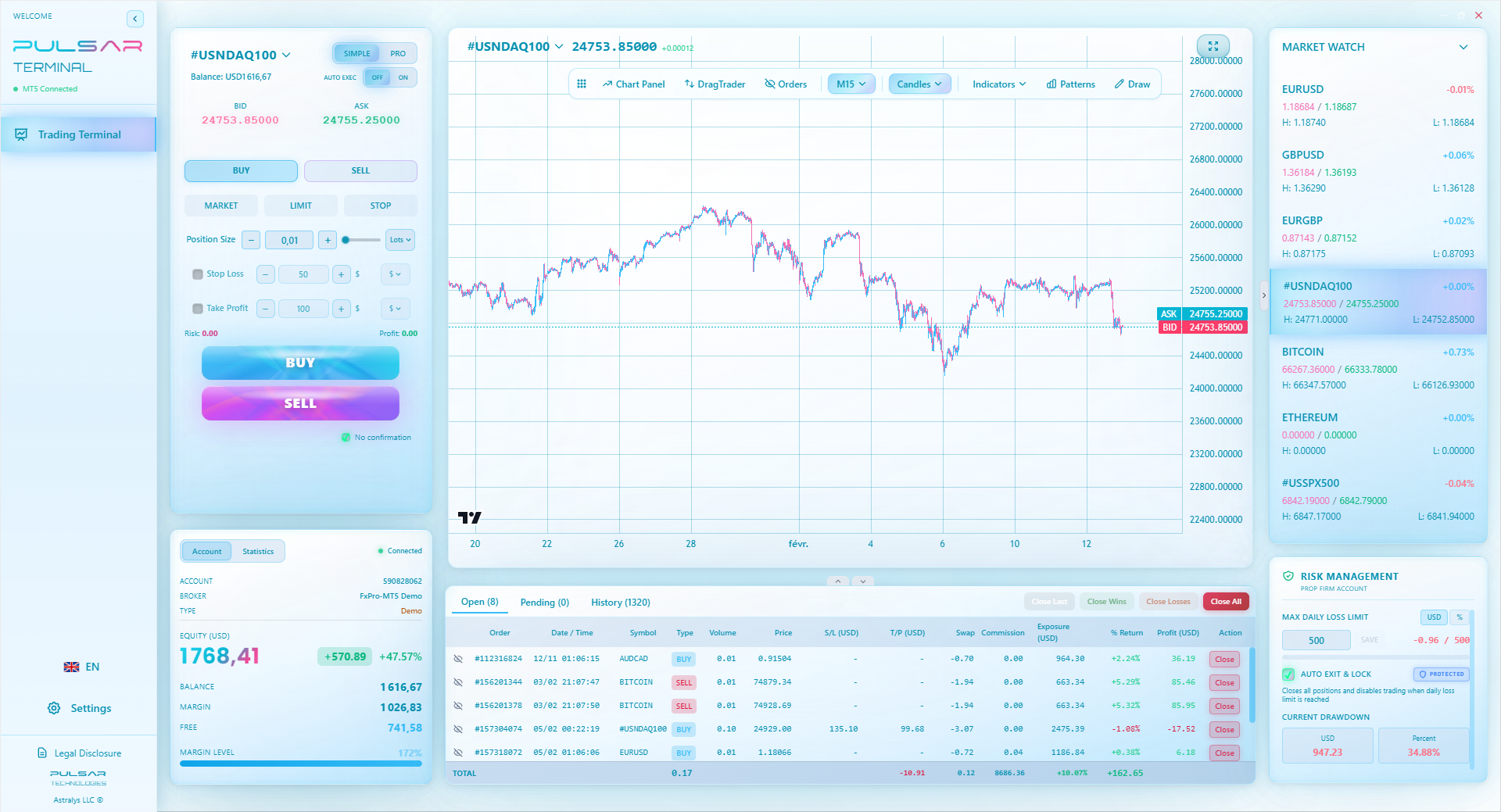
Managing complex orders and trailing stops on volatile ZAR pairs is critical, which is why tools like Pulsar Terminal that automate this directly on MT5 are essential for SA traders.
Pulsar Terminal
The all-in-one MT5 companion: drag-and-drop orders, multi-TP/SL, trailing stop, grid trading, Volume Profile, and prop firm protection. Used by 1,000+ traders daily.
This is the wild west, and the sheriffs are moving in fast. Since 2025, the FSCA considers crypto assets 'financial products.' In 2026, the National Treasury started amending exchange controls to cover crypto.
What does this mean for you? If you're trading crypto CFDs through your FSCA-regulated forex broker, it's business as usual - your profits are likely treated as income. But if you're moving ZAR to an offshore crypto exchange (Binance, etc.) to trade spot crypto, that's a cross-border transfer. It falls under SARB exchange controls. You're using your discretionary allowance.
The bigger issue is tax. SARS is now fully aware of this asset class. They can and will ask for records from crypto exchanges. If you convert crypto profits back to ZAR and into your bank account, that's a taxable event. The onus is on you to keep careful records: purchase price, sale price, dates, and the ZAR value at each point. It's a admin nightmare, but it's the cost of playing this new game.
💡 Winston's Tip
Test your broker's execution with a small real-money trade during high volatility. Demo accounts often have perfect execution. Reality doesn't. A few hundred Rand spent testing for slippage is cheaper than finding out on a R100,000 position.
“This paperwork and planning is what separates the consistent survivors from the flash-in-the-pan gamblers.”
Your trading plan isn't complete until it's South African-ised. Here’s the checklist most generic plans miss:
- Tax Provisioning: Decide on a percentage of each withdrawal you will set aside for tax. I use 30% as a conservative buffer. It goes into a separate savings account immediately. Out of sight, out of mind, ready for SARS.
- SARB Allowance Tracking: Keep a simple log. Date, amount in ZAR, purpose (e.g., 'Deposit to Broker X'). Track it against your R1 million annual allowance. Exceed it, and you need to file for the Foreign Investment Allowance, which takes time.
- Broker Statement Archiving: You need clear, auditable records. Download your monthly statements from every broker, local and offshore. Store them with your deposit/withdrawal bank statements. A single PDF per month per account. This is your first line of defense in a SARS audit.
- Strategy Adjustments for ZAR Pairs: If your plan involves ZAR crosses, your risk per trade must account for the wider spread. Your profit targets need to be proportionally larger to be meaningful. A 50-pip target on EUR/USD might be fine; on EUR/ZAR, it's barely covering costs.
- Exit Strategy for Large Profits: What happens when you hit a R500,000 profit offshore? How do you get it home? Factor in the time, paperwork, and potential tax clearance needed. Don't let a winning trade become a logistical and regulatory loss.
This is the unsexy side of trading forex money exchange rates. But this paperwork and planning is what separates the consistent survivors from the flash-in-the-pan gamblers who wonder where all their money went.
FAQ
Q1Is forex trading legal in South Africa?
Yes, it's completely legal. However, you must use a broker licensed by the Financial Sector Conduct Authority (FSCA) as a Financial Services Provider (FSP). Trading with an unregulated offshore broker is legal for you, but you have zero protection if they disappear with your funds.
Q2How much tax will I pay on my forex trading profits?
SARS almost always treats frequent trading profits as ordinary income. This gets added to your other income (like your salary) and taxed at your marginal rate, which can be from 18% up to 45%. You only start paying tax if your total taxable income exceeds R95,750 (2026 tax year). Keep detailed records of all trades and expenses.
Q3What is the best forex broker for South Africans?
There's no single 'best' broker. The right broker has a valid FSCA license, offers tight spreads on the pairs you trade (check our XM review and Pepperstone review for examples), provides reliable MT4/MT5 platforms, and has a smooth ZAR deposit/withdrawal process. Always verify the FSP number on the FSCA website.
Q4Can I move more than R1 million offshore for trading?
Yes, but it's not automatic. The R1 million is your Single Discretionary Allowance. To move more (up to R10 million total per year), you must apply for the Foreign Investment Allowance. This requires a Tax Compliance Status (TCS) PIN from SARS, proving you are up-to-date with all tax affairs. Your bank will guide you through the process.
Q5Why are the spreads on USD/ZAR so wide?
The South African Rand is less liquid than major currencies like the US Dollar or Euro. Fewer buyers and sellers at any given moment mean brokers face higher costs to execute your trade, which they pass on as a wider spread. It's the cost of trading an emerging market currency.
Q6Do I need to pay tax on profits I haven't withdrawn from my broker?
Yes. SARS taxes you on your accrued income, not just cash in your bank account. If you made a profit in your trading account during the tax year (March to February), that profit is taxable income for that year, whether you withdrew it or not.
Q7What's the biggest mistake South African forex traders make?
Ignoring the total cost structure. They focus on the entry price and potential profit but forget about the spread cost, the swap fees on held positions, and - most catastrophically - the tax liability. They celebrate a R100,000 profit without realizing R35,000+ of it already belongs to SARS.
Prof. Winston's Lesson
Key Takeaways:
- ✓Verify your broker's FSCA FSP number before any deposit.
- ✓Set aside 30% of every profit withdrawal for tax immediately.
- ✓Track all cross-border transfers against your R1 million SARB allowance.
- ✓Wider ZAR pair spreads require larger profit targets to be viable.
How useful was this article?
Click a star to rate
Weekly Trading Insights
Free weekly analysis & strategies. No spam.
About the Author
David van der Merwe
Emerging Markets Trader
Johannesburg-based trader with 11 years in emerging market currencies. Specializes in ZAR pairs, FSCA-regulated trading, and South African market analysis.
Comments
Risk Disclaimer
Trading financial instruments carries significant risk and may not be suitable for all investors. Past performance does not guarantee future results. This content is for educational purposes only and should not be considered investment advice. Always conduct your own research before trading.
You Might Also Like

Cara Trading Forex Sukses: 7 Prinsip dari Trader Profesional
Cara trading forex sukses dengan 7 prinsip trader pro: manajemen modal, disiplin, journal trading, backtest. Data nyata, bukan janji profit palsu.
Jam Trading Forex Terbaik untuk Trader Indonesia: Panduan Lengkap dengan Tabel Waktu
Panduan jam trading forex untuk trader Indonesia. Tabel 4 sesi dunia, jam emas 20:00-00:00, sesi mana yang harus dihindari. Data akurat + tips dari trader berpengalaman.
Top 5 Sàn Forex Uy Tín Nhất 2026: Review Jujur dari Trader Indonesia
Top 5 sàn forex uy tín 2026 untuk trader Indonesia. Review jujur: spread, deposit, withdraw, dukungan lokal. Exness, XM, IC Markets & lebih.
Get Pulsar Terminal
All these calculators are built into Pulsar Terminal with real-time data from your MT5 account. One-click position sizing, automatic risk management, and instant calculations.
Get Pulsar Terminal