


Let's cut through the noise.

David van der Merwe
Emerging Markets Trader ·  South Africa
☕ 10 min read
What you'll learn:
Let's cut through the noise. The biggest mistake I see from new traders in Johannesburg, Cape Town, and Durban is thinking a forex news signal service is a shortcut to riches. They sign up, get an alert, and blow their account on the first spike. News trading is one of the hardest games in town, and doing it wrong in South Africa comes with unique pitfalls - from SARS knocking on your door to getting ripped off by an unregulated provider. This guide isn't about selling you signals. It's about showing you how the pros actually use news, the real numbers you need to know, and how to stay on the right side of the FSCA and the taxman.
Forex news signals are trading recommendations triggered by fundamental news events. They're not just a buy/sell alert. A proper signal should tell you the expected market impact (High, Medium, Low), the currency pairs affected, the direction (Buy/Sell), and crucially, a suggested entry, stop-loss, and take-profit level.
Most services get this wrong. They blast out "SELL USD/ZAR" five minutes before a US jobs report drops, with no context on position size or where to get out if it goes south. That's not a signal; it's a gamble.
In South Africa, you need to pay extra attention to signals involving the Rand (ZAR). It's an emerging market currency, which means it can move violently on both local and global news. A signal for USD/ZAR around a South African budget speech is a different beast to one for EUR/USD around a European Central Bank announcement. The volatility isn't comparable, and your risk management absolutely cannot be.

Warning: Be extremely wary of any signal service that doesn't explicitly discuss volatility expectations or provide clear risk parameters (stop-loss). Trading the ZAR without a tight leash is a sure way to a margin call.

💡 Winston's Tip
The first 90 seconds after a news drop are for amateurs. The real money is made in the 5-minute consolidation that follows, where the market decides what it actually thinks.
“A forex news signal without a defined stop-loss isn't a recommendation; it's a liability.”
You can't trade news effectively if you don't understand the playing field. Ignorance here will cost you more than a bad trade.
FSCA Regulations & Broker Choice
The Financial Sector Conduct Authority (FSCA) is your first line of defence. Only use brokers licensed by them. This isn't a suggestion; it's a requirement for legal operation and your fund safety. Check the FSP number on the FSCA register. A regulated broker like those in our Exness review or IC Markets review must segregate client funds, which matters when you're moving money in and out around big news events.
use is capped at 30:1 for retail traders. This is a gift. News spikes can cause slippage and widen spreads dramatically. High use on a volatile news trade is a recipe for instant account vaporization. The 30:1 limit forces a bit of sanity.
The Tax Man Cometh (SARS)
This is where I see too many traders get blindsided. SARS views frequent forex trading as income, not capital gains. Your profits are added to your salary and taxed at your marginal rate (up to 45%).
Let me give you a real example from 2023. A student of mine in Pretoria made a R150,000 profit over the financial year from a mix of swing trading and news plays. He didn't keep a detailed ledger - just broker statements. SARS requested a full audit. The process was a nightmare. He ended up paying tax on the gross profit, with no clear deduction for his losses spread across the year, because his records were a mess. The takeaway? Log every single trade, deposit, and withdrawal from day one.
The Hidden Costs of News Trading
- Spreads: That "0.0 pip" spread on your ECN account? It vanishes 5 minutes before a high-impact news event. I've seen EUR/USD spreads blow out to 15-20 pips on major news. On USD/ZAR, it can be 50 pips or more. Your signal's entry price becomes meaningless if you're entering into a 50-pip wide spread.
- Slippage: Your order gets filled at a worse price than expected. During the Swiss Franc "Francogeddon" event, slippage was in the hundreds of pips. While that's extreme, expecting 5-10 pips of slippage on a major US news release is realistic.
- Commissions: If you're using an ECN account with a commission (e.g., $3.50 per lot per side), a scalping strategy around news becomes much harder to make profitable. You need the move to cover the spread, the slippage, AND the commission.

Example: You get a buy signal for GBP/USD ahead of UK CPI data. You plan to risk 1% of your R20,000 account (R200). With a typical stop-loss of 20 pips for this event, your position size calculator says to trade 0.1 lots. But at the moment of entry, the spread is 12 pips instead of 1. Your effective risk is now 31 pips (12 spread + 19 pips to your stop). Your R200 risk is now exceeded before the price even moves. This happens all the time.
“Trading the ZAR with generic signals is like navigating a Johannesburg minibus taxi route with a map of Paris.”
Forget trying to trade every news item. Focus on the market movers. Here’s how I approach them.
The Economic Calendar is Your Bible
You need to know what’s coming. Mark these:
- Interest Rate Decisions (SARB, Fed, ECB): The kings of volatility. The initial spike is often a trap (the "knee-jerk"). The real move comes from the press conference and forward guidance. I rarely trade the instant release.
- Inflation Data (CPI): Directly impacts rate expectations. A big miss or beat can cause sustained trends.
- Employment Data (US NFP): Famous for whipsaws. I remember one NFP where I went long on USD/JPY on a beat. It spiked up 25 pips, then reversed and dropped 80 pips in 90 seconds. I was stopped out for a full loss. The lesson? Wait for the initial chaos to settle, often 2-3 minutes after release.
- South African Specifics: Budget speeches, SARB MPC statements, local CPI and unemployment data. These are the prime drivers for ZAR pairs.
The Two Main Strategies
- The Fade (My Preferred Method): You wait for the initial, often exaggerated, news spike and trade in the opposite direction, betting the market overreacted. This requires patience and a very tight stop-loss placed beyond the extreme of the spike.
- The Momentum Ride: You try to catch the initial spike and ride it. This is higher risk due to slippage. You need to be pre-positioned or have an incredibly fast execution platform.
For ZAR pairs, I almost exclusively use the fade strategy. The liquidity just isn't deep enough to reliably catch the first spike without getting a terrible fill.

Pro Tip: Don't trade the actual news number against the forecast. Trade the market's reaction to the number. If a fantastic US NFP number comes out and the USD barely moves, that's a signal in itself - it was already priced in. Look for divergence between the data and the price action.
💡 Winston's Tip
If you can't explain in one sentence why a specific news event should move a currency pair in a specific direction, you have no business trading it. Guessing isn't a strategy.
“The 30:1 use limit isn't a restriction; it's the FSCA saving you from yourself during a news spike.”
Should you pay for signals? Maybe, but with extreme caution.
Red Flags of a Bad Service:
- Promises of "90% win rates." Absolute nonsense.
- No discussion of drawdowns or risk per signal.
- Alerts come seconds before the news with no prior analysis.
- They're not registered as a financial service provider with the FSCA (if they're based in SA).
What a Good Service Looks Like:
- Provides a weekly outlook explaining the key events.
- Sends alerts 30-60 minutes BEFORE high-impact news, with a clear strategy (e.g., "We will look to SELL USD/ZAR on a spike above 18.50 post-CPI").
- Shows a verified, long-term track record with all wins AND losses.
- Clearly states the risk percentage per signal.
The DIY Alternative: This is what I advocate for. Build your own news analysis skill. Use a free economic calendar. Learn to read the forecasts and understand the data. Paper trade the events for 3 months. Note the typical volatility for different event types on different pairs. This knowledge is priceless and turns you from a signal follower into a self-sufficient trader. Start by focusing on just one or two currency pairs, like the ones in our EUR/USD guide or XAU/USD guide, to understand their specific news sensitivities.
“The 30:1 use limit isn't a restriction; it's the FSCA saving you from yourself during a news spike.”
This is the section that saves your account. News trading amplifies every mistake.
Position Sizing is Critical: Your risk on any single news trade should never exceed 1% of your account. With the volatility, I often use 0.5%. If your account is R10,000, you're risking R50-R100 per trade. Use a calculator. Every time.
Wider Stops: Your normal 10-pip stop on EUR/USD is useless. News volatility can easily produce 20-30 pip candles in a second. Place your stop-loss at a logical level beyond the recent noise, not an arbitrary number. If you can't afford a stop that wide for your 1% risk, your position is too big. Reduce it.
Limit Orders vs. Market Orders:
- Market Order: You get filled instantly at the current price (with potential slippage). Use this if you MUST get into the trade.
- Limit Order: You set a price at which you want to enter. This is great for the fade strategy (e.g., "Buy USD/ZAR at 18.20 if it spikes down to there"). The risk? The price might not hit your level and you miss the trade. That's better than taking a bad fill.
The Golden Rule: If you miss the entry because the move was too fast, let it go. There will be another event next week. Chasing a news move is the single fastest way to lose money.
Managing multiple take-profit levels and moving stops to breakeven on a volatile news trade is stressful and click-intensive. Doing it manually on MT5 during a spike is a great way to make an error.
💡 Winston's Tip
Your best tool for news trading isn't a signal service; it's a spreadsheet logging every news trade you take: the event, your rationale, the outcome, and most importantly, the maximum adverse excursion (how far against you it went before winning). This data is gold.
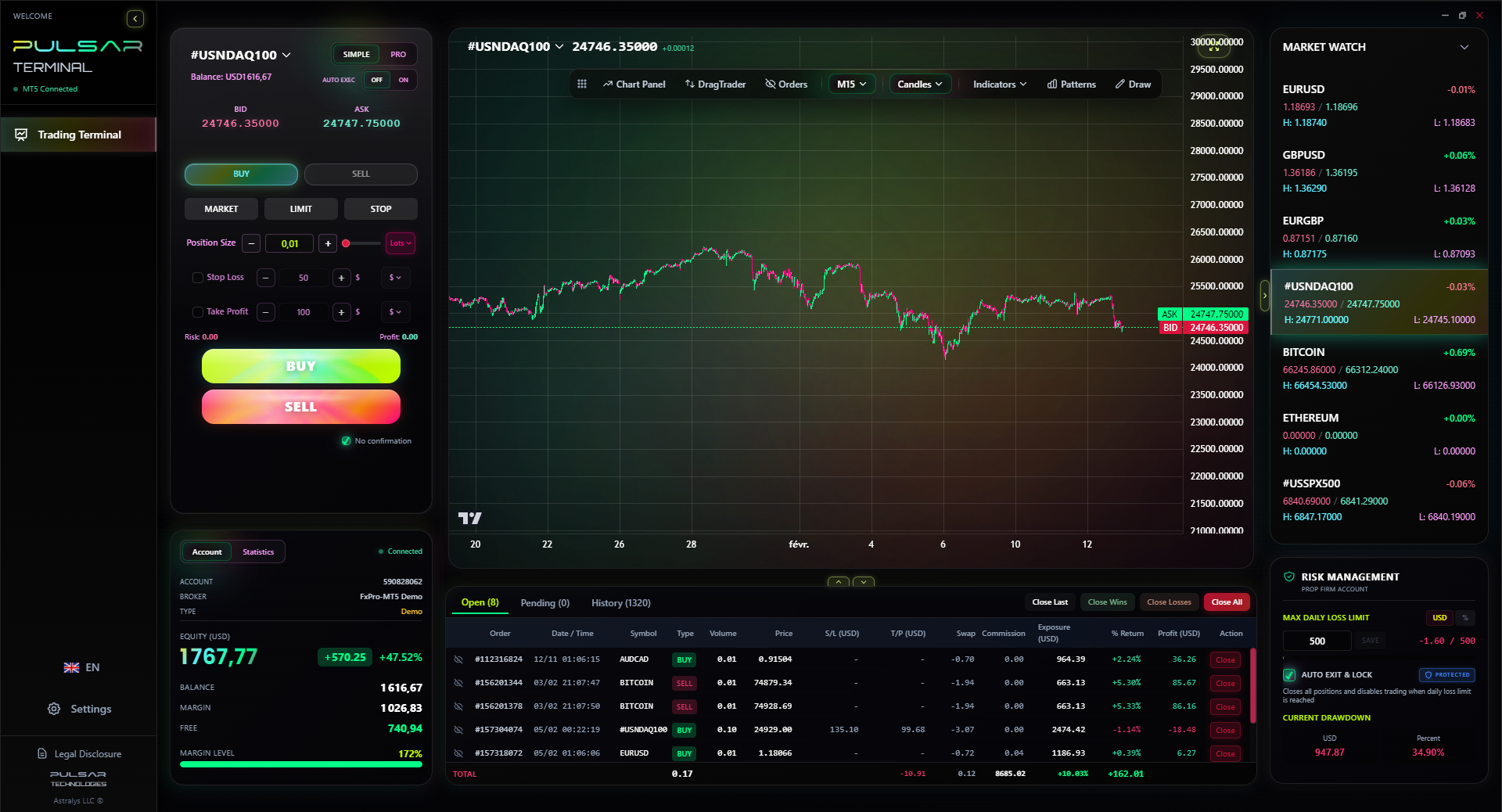
Manually moving stops to breakeven and managing partial closures on a fast-moving news trade is nearly impossible, which is why tools like Pulsar Terminal automate these risk management rules directly on your MT5 platform.
Pulsar Terminal
The all-in-one MT5 companion: drag-and-drop orders, multi-TP/SL, trailing stop, grid trading, Volume Profile, and prop firm protection. Used by 1,000+ traders daily.
“SARS doesn't care if your winning trade was from genius analysis or a lucky guess. They just want their share.”
Trading USD/ZAR, EUR/ZAR, or GBP/ZAR with generic forex news signals is a trap. You need local context.
What Moves the Rand?
- Commodity Prices: Gold, platinum, palladium. A strong gold price often supports the ZAR. I once took a long ZAR position (short USD/ZAR) ahead of a major Fed meeting not because of the Fed, but because gold was breaking a key technical resistance level. It worked.
- Eskom & Load-Shedding: Grid stability announcements move local markets. A signal saying "buy ZAR" is dangerous if it's issued during a week of severe stage 6 load-shedding.
- Political Risk: Local elections, cabinet reshuffles, and policy announcements from the ANC. This is often more impactful than medium-tier economic data.
- Global Risk Sentiment: As an EM currency, the ZAR is sold off when global investors flee to safe havens like the USD and JPY. A global risk-off event can overwhelm positive local news.
Broker Selection for ZAR Pairs: Not all brokers offer tight spreads on ZAR pairs. You need a broker with good local liquidity. Some international brokers with FSCA licenses might have wider spreads on USD/ZAR than a dedicated local broker like some of those mentioned in our XM review. Always check the typical spread on the ZAR pairs you want to trade during both quiet and active hours. A 50-pip spread is normal for USD/ZAR on some platforms; on others, it's 15. That's a huge difference to your bottom line.
Payment Methods: Using a ZAR-denominated account with a local broker can save you on currency conversion fees when you deposit and withdraw. Methods like EFT via FNB or Standard Bank are standard. This isn't just about convenience; it's about preserving your capital from unnecessary bank charges.
FAQ
Q1Are forex news signal services legal in South Africa?
Yes, but the service provider must be licensed as a Financial Service Provider (FSP) by the FSCA if they are giving advice or dealing from within South Africa. Many offshore services operate in a grey area. Using an unregulated service offers you no protection if their signals are fraudulent or cause you significant losses.
Q2How does SARS know about my forex trading profits?
SARS has data-sharing agreements with many countries and can request information from international brokers. Also,, any transfer over R1 million into or out of your South African bank account is automatically flagged. The safest assumption is that they can find out. Declare your profits and keep impeccable records of all trades, statements, and bank transfers.
Q3What's the best time to trade news in South Africa?
The most volatile overlaps are during the European session (10:00-16:00 SAST) when EU and UK data drops, and the early US session (14:30-17:00 SAST) for US data. South African-specific news usually breaks during business hours (08:00-17:00 SAST). Avoid trading major US news at 15:30 SAST if you're not experienced with the extreme volatility.
Q4Can I use a robot (EA) to trade news signals automatically?
Technically yes, but I strongly advise against it. News events cause abnormal market conditions - extreme spreads, slippage, and rapid price gaps. Most EAs are not built to handle this and will execute orders at disastrous prices or fail entirely. Human discretion is essential for news trading.
Q5What is a realistic win rate for news trading?
Anyone telling you it's consistently above 60-65% is likely lying or has a very short track record. A well-executed news trading strategy might aim for a 50-55% win rate but with a strong risk-to-reward ratio (e.g., risking 1% to make 2%). It's about the overall expectancy, not the percentage of wins.
Q6Why did my stop-loss not work during a news event?
This is slippage. If the price gaps from 18.00 to 17.50 instantly on news, and your stop-loss was at 17.95, it will be executed at the next available price, which could be 17.50. This is a major risk of news trading. Guaranteed stops (offered by some brokers like IG) prevent this but come at a premium cost.
Q7Is trading USD/ZAR more risky than EUR/USD?
Yes, categorically. The ZAR is an emerging market currency with lower liquidity. This means spreads are wider, slippage can be more severe, and it's more susceptible to sudden shifts in global risk sentiment and local political shocks. You must use a smaller position size on ZAR pairs relative to your account size.
Prof. Winston's Lesson
Key Takeaways:
- ✓Risk max 0.5-1% per news trade.
- ✓Always verify your broker's FSCA FSP number.
- ✓Log every trade for SARS immediately.
- ✓Wider stops are mandatory for news volatility.
- ✓The fade is often safer than the momentum chase.
How useful was this article?
Click a star to rate
Weekly Trading Insights
Free weekly analysis & strategies. No spam.
About the Author
David van der Merwe
Emerging Markets Trader
Johannesburg-based trader with 11 years in emerging market currencies. Specializes in ZAR pairs, FSCA-regulated trading, and South African market analysis.
Comments
Risk Disclaimer
Trading financial instruments carries significant risk and may not be suitable for all investors. Past performance does not guarantee future results. This content is for educational purposes only and should not be considered investment advice. Always conduct your own research before trading.
You Might Also Like

Cara Trading Forex Sukses: 7 Prinsip dari Trader Profesional
Cara trading forex sukses dengan 7 prinsip trader pro: manajemen modal, disiplin, journal trading, backtest. Data nyata, bukan janji profit palsu.
Jam Trading Forex Terbaik untuk Trader Indonesia: Panduan Lengkap dengan Tabel Waktu
Panduan jam trading forex untuk trader Indonesia. Tabel 4 sesi dunia, jam emas 20:00-00:00, sesi mana yang harus dihindari. Data akurat + tips dari trader berpengalaman.
Top 5 Sàn Forex Uy Tín Nhất 2026: Review Jujur dari Trader Indonesia
Top 5 sàn forex uy tín 2026 untuk trader Indonesia. Review jujur: spread, deposit, withdraw, dukungan lokal. Exness, XM, IC Markets & lebih.
Get Pulsar Terminal
All these calculators are built into Pulsar Terminal with real-time data from your MT5 account. One-click position sizing, automatic risk management, and instant calculations.
Get Pulsar Terminal