


Most new traders in South Africa think a 'forex office' is just a room with a computer.

David van der Merwe
Emerging Markets Trader ·  South Africa
☕ 11 min read
What you'll learn:
- 1What a 'Forex Office' Really Means in South Africa
- 2The Legal & Tax Setup: Don't Get Nailed by SARS
- 3Choosing Your Broker: FSCA Regulation & Real Costs
- 4Trading ZAR Pairs: The Local Advantage (and Pitfalls)
- 5Managing Your Capital & Risks
- 6The Professional Trader's Daily Routine
- 7Scaling Your Forex Office
Most new traders in South Africa think a 'forex office' is just a room with a computer. They're wrong. It's your entire legal, financial, and operational setup - the foundation that determines if you'll be a hobbyist or a professional. I've seen too many talented traders get tripped up by SARS or exchange controls before they even place a trade. Let's set the record straight and build your trading business the right way, from the ground up.
Forget the glossy ads of guys in suits staring at six screens. Your forex office isn't about the furniture. It's your command center: the legal structure, the bank accounts, the tax records, and the trading plan. It's the boring admin that separates the gamblers from the business owners.
When I started, I thought all I needed was a laptop and an internet connection. My first 'office' was my couch. I made R15,000 in my first month trading USD/ZAR swings and felt like a genius. Then tax season hit. I hadn't kept a single record of my deposits, withdrawals, or trades. Reconciling that mess with SARS took me two full weeks and a serious headache. That experience taught me more about risk management than any losing trade ever did.
In South Africa, your forex office has to handle two big realities: the Financial Sector Conduct Authority (FSCA) watching the brokers, and the South African Reserve Bank (SARB) controlling how money moves in and out. You're running a micro-export business, . You're converting ZAR into other currencies to try and bring back more ZAR. That means you play by financial services rules.

Warning: Trading with an international broker that isn't FSCA-licensed isn't illegal for you, but it strips you of local recourse if something goes wrong. You're relying on a foreign regulator, which is a much harder fight from Johannesburg or Cape Town.
“Your forex office isn't about the furniture. It's the legal structure, the bank accounts, the tax records, and the trading plan.”
This is where most traders screw up. They treat profits like found money. SARS does not. How you structure this from day one defines your net profit.
The Tax Reality: Income vs. Capital
SARS looks at your trading activity. Are you in and out of trades daily, chasing pips? That's income. Your profits get added to your salary and taxed at your marginal rate (up to 45%). Are you buying and holding currency for months, like an investment? That might be considered a capital gain. But here's the kicker: SARS decides based on frequency, volume, and intent. As a full-time trader, I've always had my profits treated as income. Assume you will too.
The Single Discretionary Allowance & Beyond
You need to get your money to a broker. Every South African resident over 18 gets a R1 million Single Discretionary Allowance (SDA) per calendar year. You can use this for trading deposits without tax clearance. Need more? There's an additional R10 million Foreign Investment Allowance (FIA). This one needs a Tax Compliance Status (TCS) pin from SARS. I use my SDA for initial funding and have my TCS pin ready if I want to scale up mid-year.

Pro Tip: Open a separate, fee-free bank account just for trading. Route all deposits and withdrawals through it. This creates a clean audit trail. One spreadsheet with dates, amounts, and broker statements is your best friend come tax time.
Record Keeping is Non-Negotiable
I keep three records: 1) A trade journal with every entry/exit, reason, and screenshot. 2) A financial ledger of all bank transfers to/from the broker. 3) Monthly profit/loss statements. My accountant loves me. When I started using a dedicated position size calculator, it automatically logged part of this data for me.
Using an FSCA-regulated broker like Exness or IC Markets means they'll provide the necessary statements, but the onus is on you to compile them. I learned the hard way that a R50,000 profit can quickly become R30,000 after tax if you're not prepared.

💡 Winston's Tip
Your first investment isn't in a trade; it's in a filing cabinet (digital or physical). Organize your bank statements, broker statements, and trade logs from day one. Future-you will pay handsomely for this service.
“A R50,000 profit can quickly become R30,000 after tax if you're not prepared.”
The broker is your gateway to the market. In SA, regulation is your first filter. An FSCA license means client money segregation, audited operations, and a local entity you can complain to. Here’s a breakdown based on real 2025 numbers.
| Broker | Min. Deposit | Typical EUR/USD Spread | Max use (Retail) | Why It Matters for SA Traders |
|---|---|---|---|---|
| IC Markets | $200 | 0.0 pips | 1:500 | Raw spreads, great for scalping strategy. FSCA regulated. |
| XM | $5 | 0.7 pips | 1:1000 | Ultra-low barrier to entry. Good for testing strategies. |
| Exness | $10 | 0.0 pips | 1:Unlimited* | Popular for ZAR pairs. *Professional clients only. |
| Pepperstone | $200 | 0.0 pips | 1:500 | Strong reputation, excellent execution. |
Understanding the Real Costs
That 'zero spread' looks great, but you must check the commission. Some brokers bake costs into the spread, others charge a fee per lot. For example, a broker might offer 0.0 pips but charge $7 per lot. On a standard lot (100,000 units), that's $7 to open and $7 to close. On a mini lot (10,000 units), it's $0.70 each way.
For ZAR pairs like USD/ZAR, expect wider spreads. It's just less liquid than EUR/USD. I've seen spreads from 5 pips to 50 pips during volatile SA news events. That's a cost you must factor in. A 10-pip spread definition means the pair needs to move 10 pips in your favor just to break even.
use is a double-edged sword. The FSCA caps retail use at 1:500 for major forex pairs, but some brokers offer higher levels if you classify as a professional client (meeting certain income/trading experience thresholds). I started with 1:100. Even now, I rarely go above 1:30 for my core swing trading positions. High use is a fast track to a margin call.
Deposit and withdrawal fees can eat small accounts. Many brokers now offer instant, fee-free deposits via Ozow or SID Instant EFT. I use these exclusively. Always check the broker's funding page before you sign up.
“A R50,000 profit can quickly become R30,000 after tax if you're not prepared.”
Trading USD/ZAR or EUR/ZAR feels familiar, but that familiarity can be deceptive. You hear the news driving the moves - load-shedding, political speeches, SARB decisions - and think you have an edge. Sometimes you do. Often, the market has already priced it in.
The Volatility Game
ZAR pairs are volatile. A normal day might see a 100-200 pip range. On a big news day, 500+ pips is common. That's opportunity, but also massive risk. My worst trade ever was on USD/ZAR. I shorted it (betting the Rand would strengthen) at 18.50 right before a major credit rating announcement. I didn't have a hard stop. It spiked to 19.10 in minutes. I was down 600 pips, or R6,000 per mini lot, before I could blink. I learned about news trading and hard stops the very expensive way.
Your True Edge: Understanding Local Flow
Your real advantage isn't guessing the news; it's understanding local market hours and liquidity. The ZAR market is most active during the Johannesburg stock exchange hours (9am-5pm SAST). London overlap (10am-12pm SAST) is also key. Trying to trade USD/ZAR at 2am SAST? You're dealing with thin, weird liquidity and wider spreads.
I've had more consistent success trading EUR/USD during London/New York overlap, using the skills and calm I developed from watching the wild moves of the Rand. It's like practicing in heavy seas before sailing in a calm bay. Tools like the RSI indicator and MACD indicator work on any pair, but their signals can be extra noisy on ZAR pairs. I use longer timeframes (4-hour and daily) to filter out the noise.

Example: A trade on USD/ZAR. Entry at 18.2000, Stop Loss at 18.2500 (50 pip risk). Take Profit at 18.1000 (100 pip target). Risk/Reward = 1:2. On a 0.1 lot (10,000 units), each pip is worth R1. So, risk = R50, potential reward = R100. This is where a position size calculator is essential to not over-use on a volatile pair.
💡 Winston's Tip
Test every strategy first on EUR/USD. Its high liquidity and clean price action make it the best 'laboratory' to see if your edge is real, before applying it to the noisy, emotional ZAR pairs.
“With R10,000, 2% is R200. Now you can trade mini lots on sensible stops and actually make progress.”
This is the core of your forex office's operations. Your trading capital is your business's inventory. Blow it, and you're out of business.
Start With Realistic Numbers
Forget the 'trade with $10' stories. To trade properly, with sensible risk, you need meaningful capital. A realistic start in South Africa is R5,000 to R20,000. Why? Let's say you start with R2,000. A standard 2% risk per trade is R40. On USD/ZAR, with a 50-pip stop, that means you can only trade a position size so small that 50 pips equals R40. You're talking micro lots or smaller. Brokerage fees and spreads become a huge percentage of your potential profit. It's a grind.
With R10,000, 2% is R200. Now you can trade mini lots (0.1) on sensible stops and actually make progress. I tell beginners: save up for three more months to get to R10k. It changes everything.
The Golden Rule: Risk Per Trade
Never, ever risk more than 1-2% of your total account balance on a single trade. This isn't a suggestion; it's a survival law. On a R20,000 account, 2% is R400. If you take 10 losing trades in a row (it happens), you're down 20%, not 100%. You're still in the game.
I automate this. I decide my stop loss distance in pips first. Then I use a calculator to tell me the exact lot size that makes my loss equal to 1.5% of my account. This discipline alone saved me during a brutal losing streak in 2022 where I had 7 losers consecutively. My account dipped 10.5%, not 70%.
Withdrawing Profits: Pay Yourself
When your account grows 20-30% above its starting balance, withdraw the profits. Move it to your savings or use it to pay a bill. This does two things: it locks in real-world gains, and it psychologically reinforces that this is a business generating income. I have a rule: any month I'm up more than 10%, I withdraw half the excess. It keeps me grounded.
“With R10,000, 2% is R200. Now you can trade mini lots on sensible stops and actually make progress.”
Your forex office needs operating hours. You're not a 24/7 gambler. You're a business owner with a schedule.
My day (when I'm actively trading):
- 7:00 AM SAST: Check economic calendar. What's due today? SARB speech? US CPI? I'm not trading the news, but I need to know where the landmines are.
- 8:30 AM - 12:00 PM SAST: My primary trading window. This covers the tail end of Asia, the open of Johannesburg, and the London open. Liquidity is building. I review the charts I marked up the night before. I might take 1-2 trades if my setup is clear.
- Afternoon: Analysis, not execution. I review closed trades. Why did it work? Why did it fail? I mark up charts for the next day, looking for key support/resistance levels on pairs like EUR/USD or XAU/USD. This is when I do my planning.
- Evening: Mental shutdown. No charts. This separation is critical to avoid burnout and revenge trading.
The mindset is everything. Losses are business expenses, not personal failures. A winning trade doesn't make you a genius. Your goal is consistency over months and years, not heroics in a single day. I had to unlearn the casino mentality. It took me two years of breaking even before my psychology caught up with my strategy.
💡 Winston's Tip
Schedule a monthly 'CEO meeting' with yourself. Review your P&L, your journal, and your emotional state. Are you sticking to your rules? This is how you transition from a reactive trader to the manager of your forex office.
“Losses are business expenses, not personal failures.”
You're consistently profitable for 6+ months. Your records are clean. Now what?
Prop Firm Challenges
Many traders look at prop firms as capital scaling. You pass a challenge, they give you a larger account to trade for a split of the profits. Here's the SA angle: you need to get your profit share out of the prop firm and into your South African bank account. This falls under your Single Discretionary Allowance or Foreign Investment Allowance. Keep all prop firm statements - they are your proof of source of funds for your bank and SARS.
The challenges themselves require extreme discipline on daily loss limits. A tool that automates daily loss protection can be the difference between passing and blowing an account over one bad trade.
Going Full-Time
Don't quit your job until your average monthly trading profit exceeds your salary for at least 12 months, and you have 12-24 months of living expenses saved in cash. Trading income is variable. In Q1 2023, I made R45k, R52k, then R18k in consecutive months. That third month would have been terrifying without a buffer.
Systems and Automation
As you scale, manual everything becomes a bottleneck. You'll want to explore tools that help with trade management: trailing stops, breakeven moves, taking partial profits at multiple targets. Managing 3-4 trades at once manually is stressful. Letting a system handle the mechanics while you focus on analysis is a game-changer for growth.
, scaling is about working on your business, not just in it. You become a manager of your own trading system.
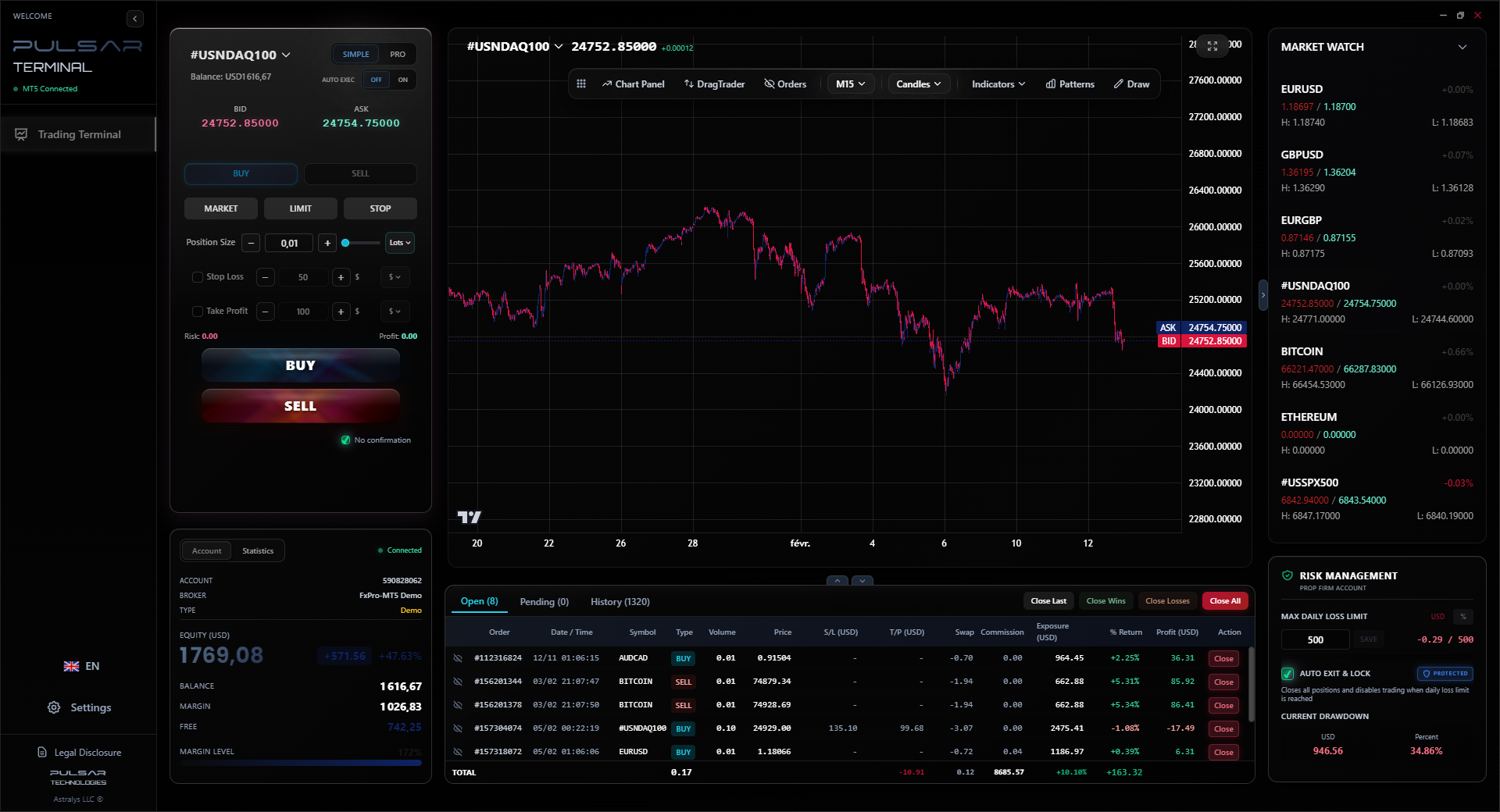
When scaling up and managing multiple trades, manually moving stops to breakeven or taking partial profits becomes a huge distraction. A tool like Pulsar Terminal automates these exact mechanics directly on your MT5 platform, letting you focus on analysis.
Pulsar Terminal
The all-in-one MT5 companion: drag-and-drop orders, multi-TP/SL, trailing stop, grid trading, Volume Profile, and prop firm protection. Used by 1,000+ traders daily.
FAQ
Q1Is forex trading legal in South Africa?
Yes, completely legal. It's regulated by the Financial Sector Conduct Authority (FSCA). The key is using reputable, FSCA-licensed brokers to ensure your funds are protected under South African law.
Q2How much money do I need to start a forex office?
You can technically start with as little as $5 with some brokers, but for serious, sustainable trading with proper risk management, a realistic starting capital is between R5,000 and R20,000. This allows you to trade sensible position sizes without fees destroying your profits.
Q3How are my forex profits taxed by SARS?
If you trade frequently (daily/weekly), SARS will almost certainly treat your profits as taxable income, added to your other income and taxed at your marginal rate (up to 45%). You must declare this income. careful record-keeping of all trades, deposits, and withdrawals is non-negotiable.
Q4What's the best broker for South African traders?
There's no single 'best.' It depends on your style. For low-cost scalping, look at IC Markets or Pepperstone. For beginners with small capital, XM is accessible. Always prioritize brokers with a clear FSCA regulation for their South African entity.
Q5Can I use my R1 million allowance to fund my trading?
Yes. Your annual Single Discretionary Allowance (SDA) of R1 million can be used to transfer funds to an international broker without needing tax clearance. This is the simplest way to fund your account. For amounts beyond that, you'll need to use the Foreign Investment Allowance with a Tax Compliance Status pin.
Q6Is trading USD/ZAR better than trading EUR/USD?
Not necessarily 'better.' USD/ZAR is more volatile and can have wider spreads, but you might understand the drivers better. EUR/USD is the most liquid pair in the world, with tighter spreads. Many successful SA traders use EUR/USD for its technical cleanliness and trade ZAR pairs selectively around major local events.
Q7How much can a beginner realistically earn?
With solid education and discipline, a beginner aiming for 3-5% monthly returns on a R10,000 account is a realistic goal. That's R300-R500 per month. Focus on consistency and protecting capital first. The big earnings come from scaling your account size over time, not from insane monthly percentages.
Prof. Winston's Lesson
Key Takeaways:
- ✓Treat your trading as a regulated business from day one.
- ✓Never risk more than 2% of your capital on a single trade.
- ✓Start with at least R5,000-R10,000 for realistic position sizing.
- ✓Withdraw profits regularly to reinforce real-world success.
- ✓Trade EUR/USD to learn; trade ZAR pairs with extreme caution.
How useful was this article?
Click a star to rate
Weekly Trading Insights
Free weekly analysis & strategies. No spam.
About the Author
David van der Merwe
Emerging Markets Trader
Johannesburg-based trader with 11 years in emerging market currencies. Specializes in ZAR pairs, FSCA-regulated trading, and South African market analysis.
Comments
Risk Disclaimer
Trading financial instruments carries significant risk and may not be suitable for all investors. Past performance does not guarantee future results. This content is for educational purposes only and should not be considered investment advice. Always conduct your own research before trading.
You Might Also Like

Cara Trading Forex Sukses: 7 Prinsip dari Trader Profesional
Cara trading forex sukses dengan 7 prinsip trader pro: manajemen modal, disiplin, journal trading, backtest. Data nyata, bukan janji profit palsu.
Jam Trading Forex Terbaik untuk Trader Indonesia: Panduan Lengkap dengan Tabel Waktu
Panduan jam trading forex untuk trader Indonesia. Tabel 4 sesi dunia, jam emas 20:00-00:00, sesi mana yang harus dihindari. Data akurat + tips dari trader berpengalaman.
Top 5 Sàn Forex Uy Tín Nhất 2026: Review Jujur dari Trader Indonesia
Top 5 sàn forex uy tín 2026 untuk trader Indonesia. Review jujur: spread, deposit, withdraw, dukungan lokal. Exness, XM, IC Markets & lebih.
Get Pulsar Terminal
All these calculators are built into Pulsar Terminal with real-time data from your MT5 account. One-click position sizing, automatic risk management, and instant calculations.
Get Pulsar Terminal