


Most new traders think they need to understand dozens of currency pairs to succeed.

David van der Merwe
Emerging Markets Trader ·  South Africa
☕ 10 min read
What you'll learn:
- 1What Actually Is a Forex Pair? (It's Not What You Think)
- 2The Three Families: Majors, Minors, and Exotics
- 3The Pairs Every South African Trader Should Watch
- 4How to Read a Quote: Bid, Ask, and That Massive Spread
- 5How to Choose Which Pairs to Trade (Your Personal Checklist)
- 6Brokers, Regulation, and Getting Your Money In & Out
- 7The Top 3 Mistakes (I Made Them All)
Most new traders think they need to understand dozens of currency pairs to succeed. They'll spend hours staring at charts for EUR/CHF or AUD/CAD, convinced they're missing some secret. I did the same thing when I started. The truth is, you only need to really know a handful of pairs to make consistent money. In South Africa, with our unique market and the Rand's wild swings, this is even more important. Let's cut through the noise and get straight to the forex pairs explained in a way that actually helps you trade better, right here from SA.
A forex pair isn't just two currencies. It's a price relationship, a constant tug-of-war between two economies. When you buy EUR/USD, you're not buying euros and selling dollars in a vacuum. You're making a bet that the European economy will outperform the American one, or that the dollar will weaken for some specific reason.
The first currency listed (EUR) is the base currency. The second (USD) is the quote currency. The price tells you how much of the quote currency you need to buy one unit of the base. If EUR/USD is at 1.0850, it costs 1.0850 US dollars to buy 1 euro.
Here's where most beginners mess up: they treat all pairs the same. They'll use the same lot size on USD/ZAR as they do on EUR/USD. That's a quick way to blow up your account. A standard lot (100,000 units) of USD/ZAR with the pair at 18.50 means you're controlling 1,850,000 ZAR worth of exposure! The volatility is a different beast entirely. You must use a position size calculator religiously, especially with our local pairs.

Warning: Never assume a "pip" is worth the same across different pairs. On EUR/USD, a pip on a standard lot is roughly $10. On USD/ZAR, with the pair at 18.50, a pip movement is about 100 ZAR. That's a massive difference in risk if you're not paying attention.
“Forex pairs explained simply: Majors are for precision, exotics like USD/ZAR are for patience.”
The Majors (The Liquid Giants)
These are the pairs that include the US Dollar and one of the other big global currencies: EUR, GBP, JPY, CHF, CAD, AUD, and NZD. Think EUR/USD, GBP/USD, USD/JPY. They have the tightest spreads, the most liquidity, and are open to trade 24/5. They're your bread and butter. If you're starting out, live here. The spreads are so low on brokers like IC Markets or Pepperstone that your cost of doing business is minimal.
The Minors (Crosses)
These are major currencies paired against each other, excluding the USD. EUR/GBP, AUD/JPY, GBP/CAD. They're less liquid than majors, so spreads are wider and they can be more prone to sudden gaps. I made a costly mistake early on with AUD/JPY. I treated it like EUR/USD, got caught in a liquidity squeeze during Asian session news, and the spread widened from 1.5 pips to over 12 pips in a second. My stop-loss was executed at a much worse price than I planned.
The Exotics (The Wild Cards)
This is where our local action is. An exotic pairs a major currency with one from a developing economy: USD/ZAR, EUR/ZAR, GBP/ZAR, USD/TRY, USD/MXN.

Pro Tip: For South Africans, USD/ZAR isn't just an exotic; it's a personal economic indicator. We feel it every time we fill up with petrol or buy imported goods. This gives you a natural, intuitive edge if you learn to read the local news and SARB announcements.
Exotics have wide spreads (often 50-200 pips on USD/ZAR), are less liquid, and can be manipulated by central bank intervention. But boy, do they move. A 500-pip day on USD/ZAR is not uncommon. You trade these for bigger swings, but with much smaller position sizes. Don't even think about scalping these unless you have a broker with incredibly raw pricing, like the conditions you might find with Exness on their professional accounts.

💡 Winston's Tip
Stop looking for the 'hot' pair. Find the sleepy, trending pair you understand. Consistency beats excitement every time.
“The 80-pip spread on USD/ZAR isn't a cost; it's the price of admission to the volatility carnival.”
While you should know the majors, your unique advantage lies in understanding the pairs that move with our economy.
USD/ZAR (The Big One): This is the most traded ZAR pair. It's driven by US dollar strength, SA political risk, commodity prices (especially platinum and gold), and SARB interest rate decisions. I once caught a great swing on USD/ZAR short (betting on Rand strength) back in late 2022. I entered at 18.25 after a massive over-extension and a dovish turn from the Fed, rode it down to 16.80 over six weeks. The key was patience and ignoring the intraday noise.
EUR/ZAR & GBP/ZAR: These give you a different angle. Sometimes the Rand is weak globally, but the dollar is also weak. EUR/ZAR can show pure Rand sentiment against Europe. These pairs are fantastic for swing trading setups based on broader risk trends.
Gold (XAU/USD) - The Honorary South African Pair: We're a mining country. Gold often moves inversely to the USD and is a safe-haven. When there's local political uncertainty, gold might rally and the Rand might weaken. Watching XAU/USD alongside USD/ZAR can give you powerful confirmation signals. If both are shooting up, it's a global risk-off moment impacting emerging markets like ours.
Here’s a quick reality check on costs for a standard lot (100k units):
| Pair | Approx. Spread (SA Broker) | Pip Value (at current rate) | Implied Cost to Enter Trade |
|---|---|---|---|
| EUR/USD | 0.8 pips | ~$10 | $8 |
| USD/ZAR | 80 pips | ~100 ZAR | 8,000 ZAR |
See the difference? Trading ZAR pairs without adjusting your size is financial suicide.
“The 80-pip spread on USD/ZAR isn't a cost; it's the price of admission to the volatility carnival.”
Let's use USD/ZAR from a typical broker platform:
Sell 18.420 / Buy 18.500
- Bid Price (18.420): The price you can sell at. If you think USD/ZAR is going down, you sell here.
- Ask Price (18.500): The price you can buy at. If you think USD/ZAR is going up, you buy here.
- Spread: The difference. 18.500 - 18.420 = 0.080, or 80 pips. This is your immediate loss the moment you enter the trade. The price needs to move 80 pips in your favor just for you to break even.

Example: You buy 1 mini lot (10,000 units) of USD/ZAR at 18.500. With a pip value of ~10 ZAR, you are immediately 80 pips * 10 ZAR = 800 ZAR in the hole. The price needs to hit 18.580 for you to be at zero.
This is why exotic pairs are for directional swings, not quick in-and-out trades. You need the market to move significantly to overcome that spread hurdle. This is also why choosing a broker with good pricing is critical. That 80-pip spread can be 100+ pips with a less competitive broker.
💡 Winston's Tip
Your biggest edge in USD/ZAR isn't a secret indicator. It's reading the local business news and understanding the mood on the ground. Fundamentals drive the big moves.
“Trading more pairs doesn't make you a better trader. It usually just means you're good at losing money in more creative ways.”
Don't trade a pair just because it's moving. Have a system.
- Match the Pair to Your Schedule: Trading AUD/JPY at 10 PM SA time? Bad idea. The Tokyo session is winding down, liquidity is drying up. Trade EUR/USD during London/New York overlap (3 PM - 5 PM SA time) for maximum action. Trade USD/ZAR when both the SA and US markets are awake for the clearest moves.
- Check the Economic Calendar: Is the SARB announcing rates tomorrow? Then maybe don't hold a massive USD/ZAR position overnight unless you're intentionally speculating on the news. I learned this the hard way holding GBP/USD through a Brexit vote. The gap against me was brutal.
- Know Your Average True Range (ATR): This indicator shows how many pips a pair typically moves in a day. EUR/USD might have a 70-pip ATR. USD/ZAR might have a 500-pip ATR. If your profit target is 50 pips, EUR/USD is a reasonable target. On USD/ZAR, a 50-pip target is noise - you'll get stopped out constantly. Aim for targets in line with the pair's personality.
- Start with ONE Major and ONE Exotic: Seriously. Master EUR/USD. Learn its rhythms, its reactions to news. Then, add USD/ZAR. Understand how it correlates (or doesn't) with global risk sentiment. Two pairs are enough to build a solid strategy. I made more money when I focused on just EUR/USD and Gold than when I had 12 charts open.
- Respect the use Rules: The FSCA caps use at 30:1 for local brokers. On a volatile pair like USD/ZAR, 30:1 is still extremely powerful. That 500-pip move against you with over-leveraged positions will trigger a margin call faster than you can say "loadshedding."
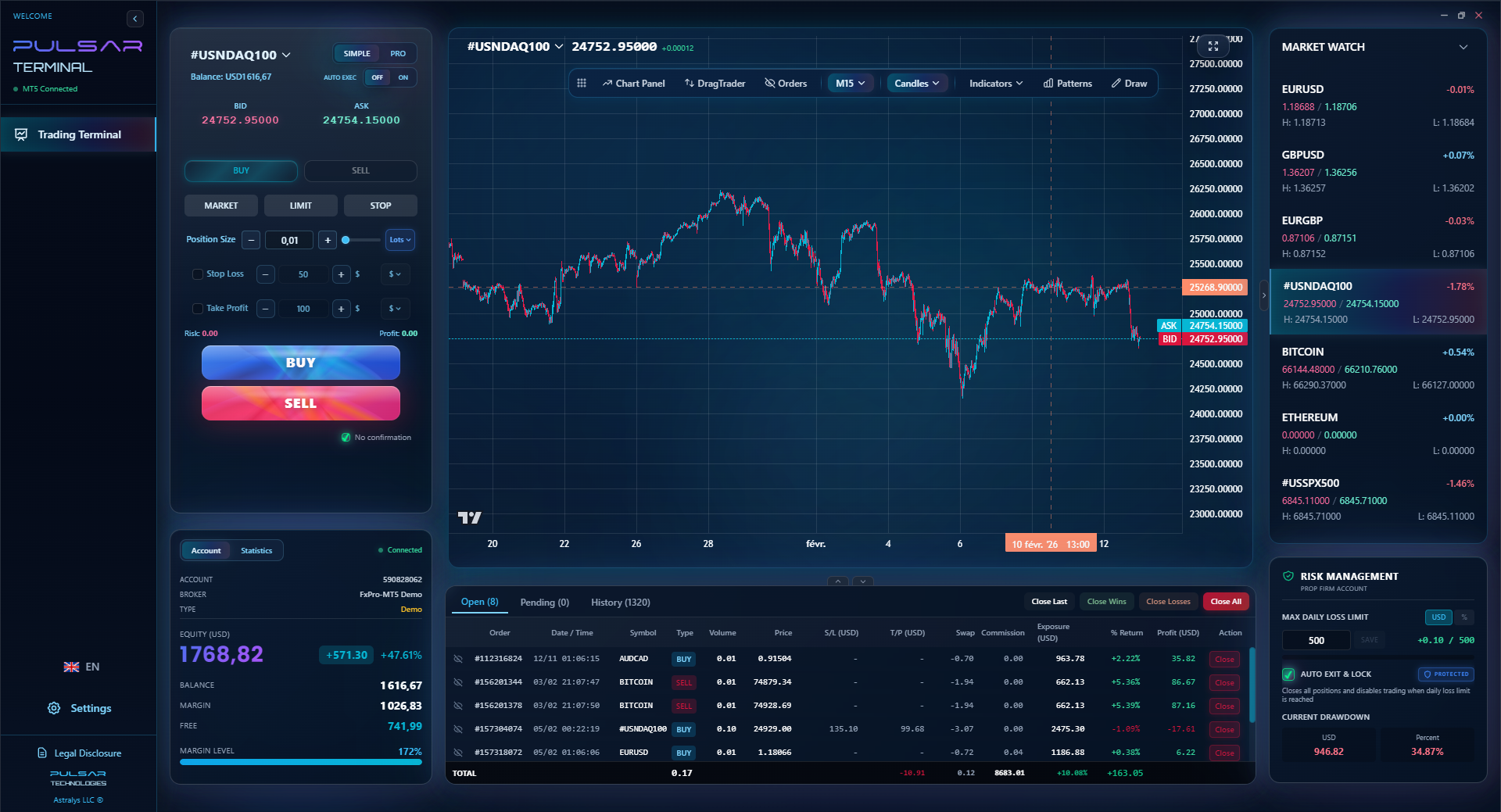
Managing multiple trades and setting precise stop-losses on volatile pairs is key, and Pulsar Terminal's drag-and-drop order tools and multi-TP/SL features on MT5 make executing those complex risk management plans effortless.
Pulsar Terminal
The all-in-one MT5 companion: drag-and-drop orders, multi-TP/SL, trailing stop, grid trading, Volume Profile, and prop firm protection. Used by 1,000+ traders daily.
“Trading more pairs doesn't make you a better trader. It usually just means you're good at losing money in more creative ways.”
This is the practical SA stuff nobody talks about until there's a problem.
Regulation is Your Safety Net: Only use brokers regulated by the Financial Sector Conduct Authority (FSCA). This means client funds should be segregated, and you have a local recourse if things go wrong. That XM review or Pepperstone review you read? Check if it's specifically for their FSCA-regulated entity.
The International Broker Loophole (and its Risks): Many South Africans sign up with the international entity of a broker (like Exness Global) for higher use - sometimes 1:500 or even unlimited. This is legal, but you're then under that country's regulator (like the FSC in Mauritius). Your protection is different. And crucially, getting your profits back to SA involves exchange control.
The Big Withdrawal Headache (The New Rule): Here's the critical 2025/2026 update everyone misses. The South African Reserve Bank (SARB) now requires banks to check your tax status before sending money overseas to you. If you're withdrawing profits from an international broker, your bank might ask for a SARS Tax Compliance Status PIN for an International Transfer (TCS-AIT). If you haven't declared your trading income to SARS, they won't give you the PIN, and your bank can't send you the money. The days of quietly profiting offshore are over. SARS wants its share, and they've closed the loop with the banks.
The Solution:
- Keep Impeccable Records: Every trade, deposit, withdrawal, and statement.
- Declare Your Trading Income: Work with a tax practitioner who understands forex. It's typically taxed as income, not capital gains.
- Consider a Local ZAR Account: Some FSCA brokers offer ZAR-denominated accounts. You fund and withdraw in Rands, simplifying the tax and exchange control process dramatically, though you might face currency conversion on the broker's side for trading non-ZAR pairs.
💡 Winston's Tip
If you can't instantly state your maximum loss on a trade in Rand terms, you shouldn't be in the trade. Know your numbers cold.
“SARS and SARB now work together. If you profit offshore but aren't tax compliant, your money might stay offshore.”
- Trading Exotics Like Majors: My first USD/ZAR trade was a 1 standard lot. The spread cost me R800 instantly. A small 50-pip move against me felt like nothing on the chart, but it wiped out R5,000. I didn't respect the pair's scale. Use a tenth of your usual position size, or less.
- Ignoring Correlation: One week, I was long EUR/USD (betting euro up) and also long USD/ZAR (betting dollar up against rand). This is contradictory! If the dollar strengthens, EUR/USD goes down. I was hedging myself into a guaranteed loss on one side. Check if your pairs are moving together or apart. Tools that visualize correlation can save you from this.
- Chasing Illiquid Pairs During News: I once tried to trade GBP/ZAR right before a UK election result. The spread blew out to 150 pips, my market order filled at a horrific price, and by the time the news hit, I was already stopped out. If you're trading around news, stick to the ultra-liquid majors or stay out. For local pairs, SARB announcements are the same - expect massive spread widening.
Pro Tip: Your first tool shouldn't be a fancy indicator. It should be a spreadsheet. Log every trade: pair, entry, exit, spread cost, reason for entry, reason for exit. After 100 trades, you'll see clearly which pairs you're good at and which are eating your money. For me, it was AUD pairs. I'm just bad at them. I stopped trading them, and my profitability improved.
FAQ
Q1What is the most traded forex pair in the world, and should I focus on it?
EUR/USD is the most traded pair globally, making up about 20-25% of all forex volume. Yes, you should absolutely focus on it, especially as a beginner. Its high liquidity means tight spreads (often below 1 pip), clear trends, and tons of free analysis available. It's the best pair to learn basic technical analysis and risk management on.
Q2Why is the spread on USD/ZAR so much wider than on EUR/USD?
It comes down to liquidity and risk. EUR/USD has billions traded every hour by banks, funds, and corporations globally. USD/ZAR has far less volume, making it harder for brokers to instantly offset your trade. The wider spread (often 50-100+ pips) compensates the broker for this higher risk and lower liquidity. It also reflects the higher volatility and political risk associated with an emerging market currency like the Rand.
Q3As a South African, can I trade with international brokers offering higher use?
Technically, yes. Many South Africans use the international entities of brokers like Exness or XM to access use above the FSCA's 30:1 retail limit. However, you sacrifice local regulatory protection. More importantly, withdrawing profits back to South Africa has become much harder due to new SARB rules requiring tax compliance checks. Your bank may block the transfer if you can't provide a SARS tax compliance PIN.
Q4How are my forex trading profits taxed in South Africa?
SARS generally views frequent forex trading as a revenue-generating activity, so profits are taxed as ordinary income at your marginal tax rate (up to 45%), not as capital gains. You must declare this income on your annual tax return. It's crucial to keep detailed records of all trades, deposits, and withdrawals. Failure to declare can lead to penalties and problems bringing your money home.
Q5What's a good strategy for trading USD/ZAR?
Swing trading based on fundamental catalysts works well. Don't try to scalp it. Look for over-extended moves (e.g., a rapid spike to 19.00+) and fade them on signs of reversal, or trade the direction of clear trends driven by interest rate differentials (SARB vs. Fed) or major commodity price shifts. Always use a small position size relative to your account because of the high volatility, and place stop-losses that account for its large daily range.
Q6Is it better to have a USD or ZAR trading account in South Africa?
A ZAR account simplifies life. You deposit and withdraw in Rands, avoiding constant currency conversion fees and making your tax calculations (profit/loss in ZAR) straightforward. The downside is that when you trade a pair like EUR/USD, your broker converts your ZAR margin to the needed currency, which might come with a small fee. A USD account is simpler for trading but complicates funding and withdrawals due to exchange control.
Prof. Winston's Lesson
Key Takeaways:
- ✓Master just EUR/USD and one exotic pair first.
- ✓A pip on USD/ZAR can be 10x the value of a pip on EUR/USD.
- ✓FSCA use is 30:1 - more than enough to blow an account.
- ✓New SARB rules link international withdrawals to SARS tax status.
- ✓Trade USD/ZAR in mini or micro lots only.
How useful was this article?
Click a star to rate
Weekly Trading Insights
Free weekly analysis & strategies. No spam.
About the Author
David van der Merwe
Emerging Markets Trader
Johannesburg-based trader with 11 years in emerging market currencies. Specializes in ZAR pairs, FSCA-regulated trading, and South African market analysis.
Comments
Risk Disclaimer
Trading financial instruments carries significant risk and may not be suitable for all investors. Past performance does not guarantee future results. This content is for educational purposes only and should not be considered investment advice. Always conduct your own research before trading.
You Might Also Like

Cara Trading Forex Sukses: 7 Prinsip dari Trader Profesional
Cara trading forex sukses dengan 7 prinsip trader pro: manajemen modal, disiplin, journal trading, backtest. Data nyata, bukan janji profit palsu.
Jam Trading Forex Terbaik untuk Trader Indonesia: Panduan Lengkap dengan Tabel Waktu
Panduan jam trading forex untuk trader Indonesia. Tabel 4 sesi dunia, jam emas 20:00-00:00, sesi mana yang harus dihindari. Data akurat + tips dari trader berpengalaman.
Top 5 Sàn Forex Uy Tín Nhất 2026: Review Jujur dari Trader Indonesia
Top 5 sàn forex uy tín 2026 untuk trader Indonesia. Review jujur: spread, deposit, withdraw, dukungan lokal. Exness, XM, IC Markets & lebih.
Get Pulsar Terminal
All these calculators are built into Pulsar Terminal with real-time data from your MT5 account. One-click position sizing, automatic risk management, and instant calculations.
Get Pulsar Terminal