


I was staring at a spreadsheet in late 2022, tallying up the numbers from my first year as an Introducing Broker (IB).

David van der Merwe
Emerging Markets Trader ·  South Africa
☕ 9 min read
What you'll learn:
- 1What Are 'Forex Partners'? (It's Not One Thing)
- 2The IB Reality Check: Commission Math That Hurts
- 3The Prop Firm Partner Trap: Selling Dreams
- 4Signal Scams & 'Managed Accounts': The Quickest Way to Lose Everything
- 5How to Evaluate a Real Partnership Opportunity
- 6The Better Path: Building Your Own Brand First
- 7Legal & Tax Implications in South Africa

I was staring at a spreadsheet in late 2022, tallying up the numbers from my first year as an Introducing Broker (IB). I'd brought in over R120,000 in client deposits for a broker, expecting a nice commission. The payout? Just under R4,000. That's when the shiny allure of 'forex partners' programs completely shattered for me. In South Africa, the term gets thrown around to describe everything from legitimate referral setups to outright pyramid schemes hiding behind trading jargon. Let's cut through the noise and look at what these partnerships actually are, who makes real money, and how you can avoid getting played.
When someone in SA talks about being a 'forex partner,' they could be wearing one of three very different hats. You need to know which one you're dealing with, both as a trader and as someone looking at the business side.
The Introducing Broker (IB)
This is the most common formal structure. You refer clients to a regulated broker (like Exness, IC Markets, or XM) and earn a commission based on their trading activity. You're a sales and support affiliate. The broker handles all the regulatory heavy lifting with the Financial Sector Conduct Authority (FSCA), which is crucial. The money comes from the spread or a small commission on each trade your referred client makes.
The Prop Trading Firm 'Edu-Partner'
This is a newer, often murkier model. A prop firm (which may or may not be properly licensed in SA) partners with 'educators' or 'coaches.' The partner's job is to sign up traders for the firm's evaluation challenges. The partner gets a cut of the challenge fee, sometimes as high as 40-50%. The conflict of interest is glaring: their incentive is to get you to buy the challenge, not necessarily to pass it. I've seen coaches push expensive 'guaranteed pass' courses for R5,000+ while downplaying the actual difficulty of the firm's rules.
The Signal Seller/Account Manager
This is the riskiest category and where most scams live. The 'partner' offers to manage your account or sell you trading signals for a monthly fee or a percentage of profits. The vast majority have no FSCA license for discretionary management, which makes it illegal. They often use fake MyFxBook statements and pressure you with stories of Lamborghinis. Run, don't walk, away from these.

Warning: If a 'partner' asks for direct access to your trading account login details, it's an immediate red flag. No legitimate, licensed financial manager in South Africa would ever need your password. They would use a limited power of attorney (LPOA) through the broker's system.
“The dream of easy passive income from IB commissions is a myth. It's a sales and client service job with thin margins.”
Let's get back to my IB story, because the numbers tell the real tale. The broker offered a 'generous' revenue share. Sounds great, right? Here's what they don't put in the shiny brochure.
Your commission is a tiny slice of the broker's revenue from your client's trades. We're talking 0.2 to 1 pip worth of value per round-turn lot. For a standard lot (100,000 units), a client might generate $8-$10 in spread cost for the broker. You might get $0.80 to $2.00 of that, per lot.
Now, consider the average retail trader in South Africa. They're not trading 10 lots a day. They might trade a 0.1 lot position on EUR/USD a few times a week. Let's do the math:
- Client trades 0.1 lot on EUR/USD.
- Broker earns approx. $0.80 on the spread (assuming a 0.8 pip raw spread).
- Your 20% revenue share = $0.16.
- At a ZAR/USD rate of 18.5, that's about R2.96 per trade.
To make even R5,000 a month as an IB, you'd need your referred clients to collectively trade over 1,600 of those 0.1-lot trades. That requires a huge, active client base you constantly support. The dream of easy passive income is a myth. It's a sales and client service job with thin margins.

Example: I once spent 3 hours on the phone walking a referred client through MT5 installation and deposit. His first month's trading generated R47 in commission for me. My effective hourly rate for that support was pathetic. You're building a business, not hitting a jackpot.

💡 Winston's Tip
A 'partner' who talks more about their car than their risk management framework is a clown, not a collaborator. Ignore the spectacle.
“If you can't pass the prop firm challenge yourself, you have no business selling it to others.”
The prop firm partner space in SA is exploding, and it's messy. Your Instagram feed is probably full of them. The model is simple: you get a unique link, promote Firm X's challenge, and earn a commission on every sale.
The problem? Your success is tied to selling a dream, not delivering trading success. The prop firm's profit is primarily from challenge fees that people fail to pass. As a partner, you're incentivized to minimize how hard the challenge is. You'll hear lines like 'It's just a 10% profit target' without mentioning the strict daily drawdown rules, time limits, and consistency rules that wipe out 80-90% of participants.
I tried this briefly. I promoted a firm, made a few sales, and earned about R3,000 in commissions. Then I had to face the people I referred when they blew their accounts on the second day trying a reckless scalping strategy. The ethical dissonance was too much. I stopped.
If you consider this path, ask yourself: are you providing real value and preparing people for the real difficulty, or are you just a marketing funnel for a firm that profits from failure? Your reputation is on the line.

Pro Tip: If you're going to be a prop firm affiliate, actually take the challenge yourself first. Pay for it with your own money. If you can't pass it consistently, you have no business selling it to others. This one act will separate the honest educators from the hype merchants.
“If you can't pass the prop firm challenge yourself, you have no business selling it to others.”
This is where 'forex partners' becomes outright dangerous. The FSCA repeatedly warns the public about unlicensed financial service providers. Offering trading signals for a fee or managing client accounts without a license is illegal in South Africa.
How these scams work:
- The Bait: Amazing performance screenshots (easily faked). 'Make 20% per month guaranteed!'
- The Hook: A small fee to join their 'VIP Telegram' or a 'performance fee' structure (e.g., 30% of profits).
- The Switch: Once you're in, the signals are vague, late, or incredibly high-risk. If you lose, it's 'your fault' for not executing fast enough. If by some miracle a few win, they pressure you to invest more.
- The Managed Account Variant: They ask for your login details. They'll then often 'over-trade' (churn your account to generate commission for their broker partner) or place absurdly large bets leading to a total loss and a margin call. Then they ghost you.
I have a rule: any 'partner' who cannot provide a verifiable FSCA license number for financial advisory or discretionary management is not a partner. They are a gambler with your money. The FSCA website has a searchable register. Use it.
💡 Winston's Tip
Your first partnership agreement should be with yourself: to paper trade for six months and not lose your own capital. Master that before you even think about others' money.
“Your brand is your asset. A partnership should be a tool that serves it, not the other way around.”
So, is there anything legitimate? Yes, but you need a ruthless checklist.
For IBs:
- Regulation is Non-Negotiable: The broker must be FSCA regulated. Don't touch offshore-only brokers with a ten-foot pole for this.
- Check the Payout Terms: Is it revenue share or cost per acquisition (CPA)? CPA (a flat fee for a verified deposit) is often cleaner. Understand the payment threshold and schedule (monthly? in ZAR?).
- Support Tools: Do they provide marketing materials, a dedicated account manager, and a transparent backend to track referrals?
- Client Onboarding: Who handles KYC and compliance? It must be the broker.
For Prop Firm Affiliates:
- Firm Transparency: Does the prop firm clearly state its rules, profit split, and scaling plan? Are their payouts verified by third parties?
- Your Own Integrity: Can you create content that truly helps people pass, like risk management tutorials using a position size calculator, rather than just hyping the prize?
- Conflict Disclosure: Do you clearly disclose you earn a commission if someone signs up through your link?
For Everyone:
- Sustainable Model: Does the partnership rely on you recruiting more 'partners' in a downline? If yes, it's a pyramid scheme disguised as forex.
- Your Value: What unique skill do you bring? Is it education, community building, or technical analysis? The partnership should amplify that, not replace it with selling.
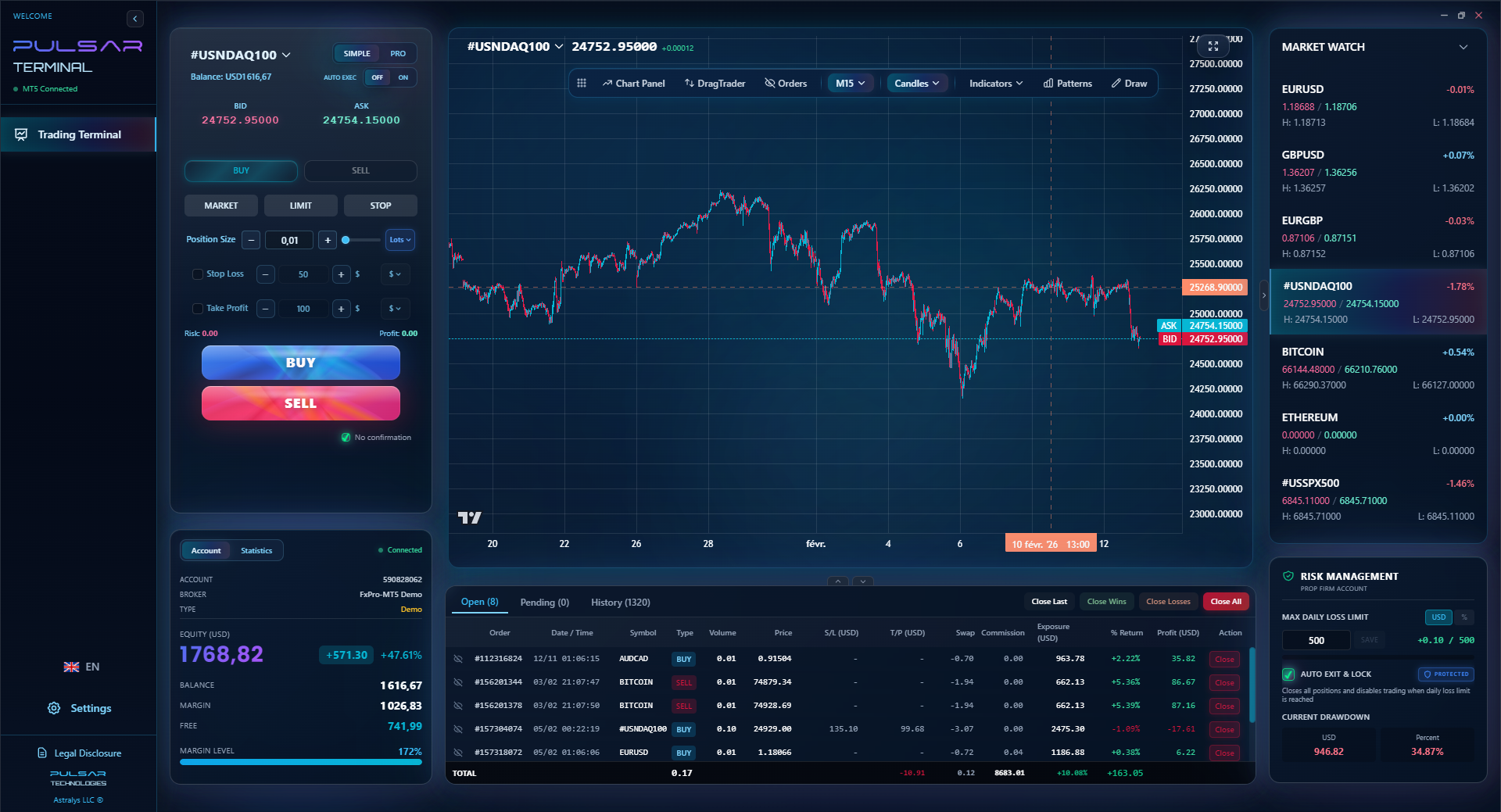
If you're educating traders for a prop firm partnership, showing them tools that enforce discipline—like automated trade management—adds real value beyond just hype.
Pulsar Terminal
The all-in-one MT5 companion: drag-and-drop orders, multi-TP/SL, trailing stop, grid trading, Volume Profile, and prop firm protection. Used by 1,000+ traders daily.
“Your brand is your asset. A partnership should be a tool that serves it, not the other way around.”
The most valuable lesson I learned from my failed IB experiment is this: build your own audience and reputation before you try to monetize it through partnerships. Otherwise, you have no use and you're desperate for any commission.
Start by providing genuine, free value. Share your real trade analyses (wins and brutal losses). Explain concepts like the MACD indicator or why risk management is everything. Use platforms like YouTube or a dedicated blog. Be brutally honest. I started posting weekly recaps showing my swing trading journal, including the R2,000 loss I took on a bad XAU/USD trade.
After a year, I had a small but engaged following who trusted me because I was transparent. Then I negotiated a better IB deal with a broker, not as a desperate affiliate, but as a content creator with an audience they wanted to reach. I also said no to 90% of the 'partner offers' in my inbox because they didn't align with what my community needed.
Your brand is your asset. A partnership should be a tool that serves it, not the other way around. Focus on becoming a credible voice in the SA trading scene first. The monetization options, including legitimate forex partners, will follow with much better terms.
💡 Winston's Tip
The most valuable partnership isn't with a broker; it's with a disciplined trading process. Cultivate that one first.
“Spend on a good accountant. It's cheaper than a SARS audit.”
You can't talk about making money without talking about SARS. Getting this wrong will cost you more than a losing trade.
Income Tax: All commission income from IB work or affiliate marketing is considered ordinary income. It must be declared on your annual tax return (ITR12). You cannot claim it's a 'hobby' if you're consistently receiving payments. Keep careful records of all invoices and broker statements.
Provisional Tax: If your partnership income exceeds the threshold (you'll likely need an accountant to determine this), you may need to register as a provisional taxpayer and make bi-annual payments.
Business Structure: If it grows, consider registering a sole proprietorship or a private company (PTY Ltd). This separates your personal and business finances and can have tax advantages. The initial cost and admin are higher, though.
Legal Liability: As an IB, you are giving financial advice by recommending a broker. If your referred client loses money and claims you misled them about risks, you could face legal action. Your agreement with the broker should include clauses that protect you, but don't assume you're safe. Always, always include clear risk disclaimers on all your content.
Warning: Do not try to handle this alone if you're making significant money. Spend R2,000-R5,000 on a consultation with a South African accountant who understands freelance/affiliate income. It's the best investment you'll make.

FAQ
Q1What's the minimum I can expect to earn as a forex IB in South Africa?
Realistically, many small IBs earn less than R1,000 per month in their first year. It's a volume game. You need a large, active client base to generate meaningful income. Don't quit your day job.
Q2Are prop firm challenges themselves a scam?
Not inherently, but the business model is designed where most participants fail and forfeit their challenge fee. As a 'partner' selling them, your success is tied to that high failure rate, which creates a major ethical conflict. Do your own deep due diligence on any firm.
Q3Can I legally sell trading signals in South Africa?
It's a grey area that often crosses into regulated financial advice. If you present signals as a guaranteed or expert-guided path to profits, you likely need an FSCA license. General market commentary is safer. When in doubt, assume it's regulated and you need a license.
Q4How do I know if a broker's IB program is trustworthy?
First, the broker must be FSCA regulated. Second, talk to other existing IBs (find them on forums). Ask about punctuality of payments and support. Third, read the partnership contract carefully, especially the clauses on client ownership and payment calculations.
Q5What's the biggest mistake new 'forex partners' make?
Focusing on the commission percentage instead of the actual payout math and the long-term value of their audience. Chasing a 50% rev share from an obscure broker is worse than a 20% share from a reputable one with loyal clients who trade for years.
Q6Do I need to pay tax on prop firm affiliate commissions?
Yes. SARS considers this affiliate income, which is fully taxable. The prop firm (if international) likely won't deduct SA tax, so it's your responsibility to declare it. Keep all records.
Prof. Winston's Lesson
Key Takeaways:
- ✓IB commissions often pay less than R3 per standard lot trade.
- ✓Over 80% of prop firm challengers fail, funding the model.
- ✓Unlicensed account management is illegal (FSCA Rule).
- ✓Declare all partnership income to SARS or face penalties.
How useful was this article?
Click a star to rate
Weekly Trading Insights
Free weekly analysis & strategies. No spam.
About the Author
David van der Merwe
Emerging Markets Trader
Johannesburg-based trader with 11 years in emerging market currencies. Specializes in ZAR pairs, FSCA-regulated trading, and South African market analysis.
Comments
Risk Disclaimer
Trading financial instruments carries significant risk and may not be suitable for all investors. Past performance does not guarantee future results. This content is for educational purposes only and should not be considered investment advice. Always conduct your own research before trading.
You Might Also Like

Cara Trading Forex Sukses: 7 Prinsip dari Trader Profesional
Cara trading forex sukses dengan 7 prinsip trader pro: manajemen modal, disiplin, journal trading, backtest. Data nyata, bukan janji profit palsu.
Jam Trading Forex Terbaik untuk Trader Indonesia: Panduan Lengkap dengan Tabel Waktu
Panduan jam trading forex untuk trader Indonesia. Tabel 4 sesi dunia, jam emas 20:00-00:00, sesi mana yang harus dihindari. Data akurat + tips dari trader berpengalaman.
Top 5 Sàn Forex Uy Tín Nhất 2026: Review Jujur dari Trader Indonesia
Top 5 sàn forex uy tín 2026 untuk trader Indonesia. Review jujur: spread, deposit, withdraw, dukungan lokal. Exness, XM, IC Markets & lebih.
Get Pulsar Terminal
All these calculators are built into Pulsar Terminal with real-time data from your MT5 account. One-click position sizing, automatic risk management, and instant calculations.
Get Pulsar Terminal