


My phone buzzed on the desk, the screen flashing with an unknown UK number.

David van der Merwe
Emerging Markets Trader ·  South Africa
☕ 12 min read
What you'll learn:
- 1What You're Actually Looking For (It's Not Just Digits)
- 2Why a Real, Local Contact Number is Non-Negotiable
- 3Step-by-Step: How to Verify a Broker's Legitimacy in South Africa
- 4Red Flags & Scam Tactics: When the 'Forex Phone Number' is a Trap
- 5How to Use Phone Support Effectively (When You Have a Real One)
- 6Beyond the Phone: Other Avenues for Support & Information
- 7What to Do If You've Been Scammed or Have a Serious Dispute
- 8Brokers with FSCA Regulation & Local Presence (A Starting Point)
My phone buzzed on the desk, the screen flashing with an unknown UK number. It was March 2023, and a smooth-talking 'account manager' from a firm called 'Elite Capital Markets' was explaining how my R20,000 deposit could become R80,000 in weeks trading gold. He sounded professional, gave me a direct line - a forex phone number that felt legit. I almost bit. Then I asked for their FSCA license number. The line went quiet, then he hung up. That moment, more than any winning trade, taught me the real value of a verified contact. In South Africa's trading scene, knowing who you're really calling isn't just convenient, it's the difference between building wealth and being robbed blind.
When you search for a 'forex phone number,' you're not just hunting for digits to dial. You're seeking a lifeline to a legitimate, regulated entity that can solve real problems: a withdrawal stuck in processing, a margin call you don't understand, a platform glitch during a volatile ZAR move. In South Africa, this number must connect you to an FSCA-licensed Financial Service Provider (FSP).
A real broker's contact details are a sign of transparency. They're not hidden behind three layers of chatbot menus. I've dealt with brokers where getting a human on the line was like pulling teeth, and others where a local Johannesburg number got me sorted in minutes. The difference is stark. The number itself is meaningless without the regulatory backbone behind it. That's the first filter. If you can't easily find their FSP number on their website, next to a physical South African address, walk away immediately.

Warning: A common scam tactic is to give you a 'local' South African number that actually forwards to a call center overseas. Always call back using the number listed on the broker's official website, not the one provided in an unsolicited email or WhatsApp message.

💡 Winston's Tip
A broker's willingness to publish a direct, local phone number is a basic test of transparency. If they hide behind a web form, they're hiding from accountability too.
Let's be brutally honest. The forex world is full of ghosts. Offshore 'brokers' pop up, take deposits, and vanish. When the South African Reserve Bank makes a surprise announcement and the USD/ZAR spikes 300 pips in minutes, you need answers, not an automated email reply that says 'we'll respond in 24-48 hours.'
I learned this the hard way in 2019. I was with an internationally regulated broker (not FSCA). I had a profitable scalping strategy on EUR/USD, but my platform froze during the US open. My stop-loss didn't trigger. By the time I got through to support - on a Singapore number - I was down R15,000. The response? 'Technical issue, not liable.' Had they been under the FSCA, I would have had a formal channel to complain. A local forex phone number is your first point of escalation. It signals the broker has a tangible presence and accountability in your jurisdiction.
When You'll Actually Need to Pick Up the Phone
- Withdrawal Disputes: The most common issue. You request a payout of R5,000, and it's 'pending' for two weeks. Email tickets go unanswered.
- Verification Hiccups: FICA docs get rejected for a silly reason (like a bank statement being two days too old). A quick call can resolve it in 5 minutes versus a 3-day email ping-pong.
- Platform or Execution Issues: Your chart shows one price, but your order fills 5 pips away. You need to report this immediately for a possible trade adjustment.
- Margin and Account Questions: You're confused about a margin call or your use has been changed. This needs clear, real-time explanation.
“A local forex phone number is your first point of escalation. It signals the broker has a tangible presence and accountability.”
Before you even think about dialing, you need to know if the entity on the other end is real. This is your due diligence. Skipping it is financial suicide.
- Get the FSP Number: Go to the broker's 'About Us' or 'Regulation' page. Legitimate brokers like IG, AvaTrade, or FP Markets will proudly display their FSCA license number (e.g., FSP 45984). If it's buried or absent, red flag.
- Check the FSCA Register: Go to the official FSCA website (www.fsca.co.za). Use their 'Search for an FSP' function. Enter the number. Does the name match the broker exactly? Does the authorized representative's name appear? Check the license status: it should be 'Active'.
- Cross-Check Contact Details: The physical address on the FSCA register should match the one on the broker's site. A PO Box in Sandton is better than a 'virtual office' in Mauritius.
- Find the Phone Number: Now, get the contact number from the broker's official 'Contact Us' page. Look for a local 010, 011, or 021 prefix. Many top brokers also offer 24/5 support with international numbers, but a local one is gold.

Pro Tip: When you call, ask a specific technical question. For example, 'What's your commission structure on a standard lot of USD/ZAR on your Raw account?' or 'How do you handle slippage during SARB announcements?' A scripted salesperson will falter; real support will know.
Here’s a quick comparison of what you might find:
| Broker Type | FSP Number Displayed? | Local SA Number? | Physical SA Address? | Verdict |
|---|---|---|---|---|
| Reputable Int'l Broker (FSCA Licensed) | Yes, prominently | Usually Yes | Often Yes | Safe to call |
| Local SA Broker (e.g., Khwezi) | Yes | Yes | Yes | Safe to call |
| Offshore 'Bucket Shop' | No, or fake number | Maybe a forwarded line | No, or a virtual office | DO NOT CALL. SCAM. |
| Clone Firm (Impersonator) | Stolen number, details don't match | Yes, but it's theirs | Fake | DO NOT CALL. SCAM. |
Scammers are sophisticated. They know you're looking for reassurance. Their entire operation is designed to mimic legitimacy until they have your money. Here’s what to watch for, straight from my own inbox and phone log.
The Unsolicited Call: This is the big one. You get a call out of the blue from a 'senior analyst' at 'Goldman Sachs Forex' or 'JP Morgan Trading Desk.' They have a UK or SA number. They offer guaranteed returns, insider signals, or a 'limited-time' bonus. They pressure you to deposit quickly. This is always a scam. No legitimate broker cold-calls with trading promises.
The Clone Website: They copy the website of a real FSCA broker like Tickmill or XM, but change the contact number to their own. You check the FSCA register, see the legit license, and think it's fine. But you called their number, not the broker's. Always navigate to the website yourself via a known trusted source (like our broker reviews), don't click links in emails.
The 'Recovery' Scam: You've been scammed once. Then you get a call from a 'law firm' or 'fund recovery specialist' saying they can get your money back for an upfront fee. They sound official. They're just scamming you a second time. There is no legitimate recovery service that calls you first.
I fell for a variation of the pressure tactic early on. A 'broker' offered me 1:500 use (pre-FSCA limits) if I deposited R50,000. They gave me a direct line to my 'dedicated manager.' I deposited R10,000. When I tried to withdraw my R12,000 profit, the manager's phone was disconnected. The website disappeared. The forex phone number was dead. That R10,000 lesson cost me more than any bad trade.
💡 Winston's Tip
Write down the name of every support agent you speak to and the date/time. This simple log has saved me weeks of frustration when following up on complex issues.
“The 30 minutes of verification *before* you deposit is the most important trade you'll ever make.”
Okay, you've found a verified, FSCA-regulated broker with a local number. Don't waste the line. Here's how to get what you need.
Before You Call:
- Have your account number ready.
- Have the exact trade ID or ticket number if it's trade-related.
- Screenshot everything. The platform error, the withdrawal request, the weird fee. Have the images open on your computer.
- Know what you want. "My withdrawal from last Tuesday is pending" is better than "I need money."
During the Call:
- State your issue clearly and calmly. "Hi, my name is [Your Name], account [Number]. I'm calling regarding withdrawal request WRQ123456, submitted on April 5th. It's still pending."
- Get a reference number. If they need to escalate, ask for the internal ticket or case number. Write it down.
- Ask for timelines. "What is the standard processing time? When can I expect an update?"
- If it's complex, ask for an email follow-up. Get the agent's name. Say, "Can you please email me at [your email] summarizing what we discussed?" This creates a paper trail.
What a Good Support Call Feels Like: I called Pepperstone's support once about a discrepancy in swap charges on my XAU/USD position. The agent pulled up my account, explained the three-day rollover for Wednesday, calculated it with me in real time, and when I asked, emailed me the rate sheet. It took 7 minutes. That's the standard you should accept.

Example: You notice a 1.5 pip spread on EUR/USD when the website advertises 0.0. You call: "Hi, I'm trading EUR/USD on your Razor account. I'm seeing a consistent 1.5 pip spread, but your site lists 0.0 pips plus commission. Can you check if there's a platform setting or if this is due to current market conditions?" This is specific and allows them to investigate.
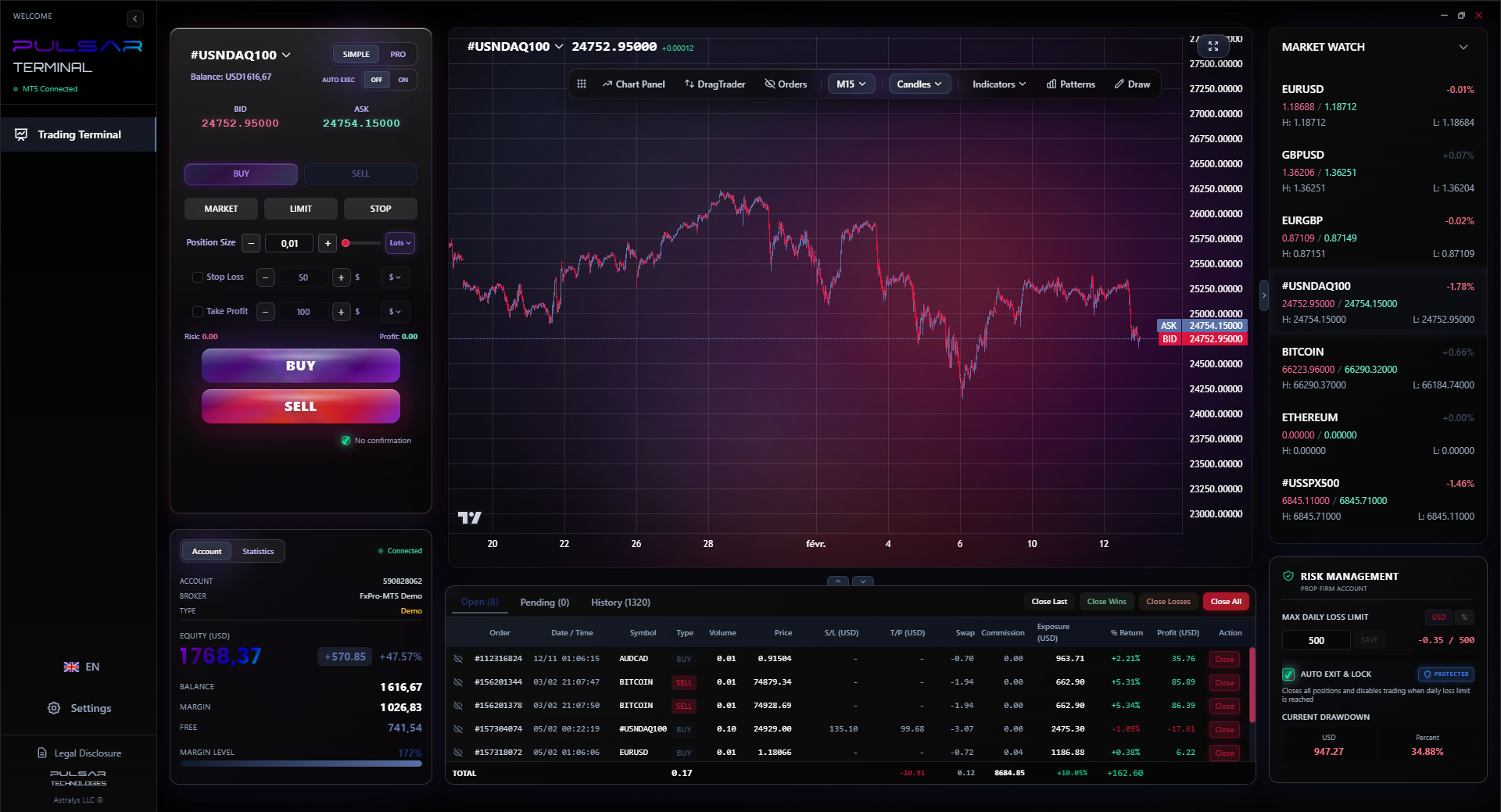
When you're on the phone resolving a platform issue, having a tool like Pulsar Terminal that adds advanced order management and charting to MT5 can prevent many of those calls in the first place.
Pulsar Terminal
The all-in-one MT5 companion: drag-and-drop orders, multi-TP/SL, trailing stop, grid trading, Volume Profile, and prop firm protection. Used by 1,000+ traders daily.
Sometimes, calling isn't the fastest way. Or you need a record. Here's your support toolkit.
Live Chat: For quick, simple questions ("What's your minimum deposit?"), live chat is great. Take a screenshot of the conversation. I use it to confirm fee structures before opening an account.
Email/Ticket System: This is for non-urgent, complex issues that require documentation. Always use the ticket system within your client portal, not a generic Gmail address. This ties the request directly to your account. Describe the issue factually, attach screenshots, note previous communication. This is your evidence if you need to escalate to the FSCA.
Client Portal & FAQ: Often overlooked. Most of your questions about withdrawals, fees, and verification are answered in the portal's FAQ or 'Terms' section. Before you call about a R250 withdrawal fee, check if it's listed. It usually is.
Social Media (Use Caution): A public tweet or Facebook message can get a quick response because it's visible. But never discuss account details publicly. Use it to ask for a support ticket to be escalated, but move the conversation to private email or your portal immediately.
Remember, the goal is resolution. I once spent 45 minutes on hold with a broker's phone line for an issue I later solved myself in 2 minutes via a search in their client portal knowledge base. Pick the right tool.
“No legitimate, reputable broker cold-calls potential clients with bonus offers. It is always a scam.”
If you've called a fake forex phone number, deposited money, and now you can't get it back, here's the cold, hard process. I've helped friends through this. It's grim, but you must act.
- Stop All Communication. Do not engage with the scammers further. They will only weave more lies to extract more money or stall you.
- Gather ALL Evidence. Every email, WhatsApp message, screenshot of the website, call log showing the number they used, bank statement showing the transfer (to whom, reference, date, amount). Compile it in a folder.
- Contact Your Bank IMMEDIATELY. Call your bank's fraud department. Report the transaction as a fraudulent investment scam. Provide all evidence. There's a small chance, if it was very recent, they can attempt a recall or dispute the transfer. Don't get your hopes up, but you must try.
- Report to the Authorities.
- South African Police Service (SAPS): Open a case of fraud at your local police station. Get a case number. This is often needed for other reports.
- Financial Sector Conduct Authority (FSCA): File a formal complaint on their website. If the scammer pretended to be FSCA-regulated, this is crucial.
- The South African Banking Risk Information Centre (SABRIC): Report bank-related fraud.
- Manage Expectations. The likelihood of recovering funds from a sophisticated offshore scam is very, very low. The primary goal now is to stop the bleeding, create an official record, and protect others by raising the alarm.
This process is exhausting and demoralizing. It's why the 30 minutes of verification before you deposit is the most important trade you'll ever make.
💡 Winston's Tip
The most important call you'll make isn't to a broker, but to your bank's fraud line *before* you send money to an unverified entity. That's true risk management.
Based on my experience and the regulatory landscape, these brokers have legitimate FSCA licenses and established operations. This isn't an exhaustive list, and you must still do your own verification.
- IG Markets SA: FSCA regulated. A global giant with a strong local presence, excellent education, and a professional platform. You'll get proper support.
- AvaTrade SA: FSCA licensed (FSP 45984). Offers ZAR accounts, which is a huge plus to avoid conversion fees. Their support has been responsive in my experience.
- Exness (SA): Regulated by the FSCA. Known for very competitive spreads and flexible accounts. They have a dedicated South African entity.
- FP Markets: FSCA regulated. A favorite for raw spread accounts and access to both MT4/MT5 and cTrader. Their support understands active trader needs.
- Tickmill South Africa: FSP 49464. A straightforward, low-cost broker. Good for swing trading strategies where low overnight costs matter.
- Khwezi Trade: A purely local broker, FSCA regulated. Minimum deposit is R500. They offer MT4 and have a physical office. Sometimes, keeping it local is the simplest path.
A final, critical note: Even with these brokers, always use the contact details on their official South African website. Don't Google 'Exness phone number' and call the first result. Go to exness.co.za and find it there. This simple habit blocks 90% of clone scams.
FAQ
Q1Is it safe to trade with a broker that only has an email and no forex phone number?
It's a major red flag, especially in South Africa. While some legitimate international brokers might prioritize ticketing systems, the absence of any phone contact - particularly a local one - suggests a lack of tangible presence and accountability. For a South African trader, an FSCA-regulated broker should provide accessible contact options, including a phone line. If you can't call them, how will you resolve a urgent issue?
Q2What should I say when I call a forex broker's support line for the first time?
Test them. Don't just ask for the website. Ask a specific, technical question like: "Can you explain how your dynamic use works on the USD/ZAR pair during local market hours?" or "What is the process and timeframe for FICA document approval?" A scripted sales line will struggle. Competent support will answer clearly and confidently.
Q3I found an FSCA number on a broker's site. Is that enough to trust them?
No, it's only step one. You must go to the FSCA's official register (www.fsca.co.za) and search that exact number. Verify that the company name matches perfectly, the license status is 'Active,' and the authorized representatives are listed. Scammers often copy real FSP numbers onto fake websites.
Q4A broker called me from a UK number offering amazing bonuses. Should I trust them?
Absolutely not. This is the #1 scam entry point. No legitimate, reputable broker cold-calls potential clients with bonus offers or guaranteed returns. It is always a high-pressure sales tactic from an unregulated bucket shop or outright scam. Hang up immediately and block the number.
Q5What's the difference between an international broker's general number and a South African forex phone number?
The general international line (often based in Cyprus, Australia, etc.) handles global queries. A dedicated South African number should connect you to a team familiar with local issues: FICA requirements, ZAR deposits/withdrawals via local banks, understanding SARB news impact, and operating within FSCA rules like the 30:1 use cap. The local line should provide faster, more relevant support.
Q6Can the FSCA help me get my money back if I'm scammed?
The FSCA's ability to help is limited to entities they regulate. If you deposited with an unregulated offshore scam, the FSCA cannot force them to return your money. They can issue public warnings, which is why reporting to them is vital. Your best hope is immediate action with your bank. The FSCA is a preventative shield, not a recovery tool for offshore fraud.
Q7Are all brokers with a .co.za website and local number safe?
Not necessarily. Clone scams often create .co.za domains that look identical to real brokers. The only way to be sure is the FSCA verification process. The website and number are just the starting point; the FSCA license check is the non-negotiable confirmation.
Prof. Winston's Lesson
Key Takeaways:
- ✓Verify the FSP number on the FSCA website every single time.
- ✓Legitimate brokers don't cold-call you with promises.
- ✓A local SA phone number and address are minimum requirements.
- ✓If support can't answer technical questions, the broker isn't serious.
- ✓Clone websites are common; always navigate to the broker's site yourself.
How useful was this article?
Click a star to rate
Weekly Trading Insights
Free weekly analysis & strategies. No spam.
About the Author
David van der Merwe
Emerging Markets Trader
Johannesburg-based trader with 11 years in emerging market currencies. Specializes in ZAR pairs, FSCA-regulated trading, and South African market analysis.
Comments
Risk Disclaimer
Trading financial instruments carries significant risk and may not be suitable for all investors. Past performance does not guarantee future results. This content is for educational purposes only and should not be considered investment advice. Always conduct your own research before trading.
You Might Also Like

Cara Trading Forex Sukses: 7 Prinsip dari Trader Profesional
Cara trading forex sukses dengan 7 prinsip trader pro: manajemen modal, disiplin, journal trading, backtest. Data nyata, bukan janji profit palsu.
Jam Trading Forex Terbaik untuk Trader Indonesia: Panduan Lengkap dengan Tabel Waktu
Panduan jam trading forex untuk trader Indonesia. Tabel 4 sesi dunia, jam emas 20:00-00:00, sesi mana yang harus dihindari. Data akurat + tips dari trader berpengalaman.
Top 5 Sàn Forex Uy Tín Nhất 2026: Review Jujur dari Trader Indonesia
Top 5 sàn forex uy tín 2026 untuk trader Indonesia. Review jujur: spread, deposit, withdraw, dukungan lokal. Exness, XM, IC Markets & lebih.
Get Pulsar Terminal
All these calculators are built into Pulsar Terminal with real-time data from your MT5 account. One-click position sizing, automatic risk management, and instant calculations.
Get Pulsar Terminal