


I lost R4,200 on a single USD/ZAR trade in 2019 because I didn't use a forex points calculator.

David van der Merwe
Emerging Markets Trader ·  South Africa
☕ 12 min read
What you'll learn:
- 1What Exactly Is a Forex Points Calculator? (It's Not Just Math)
- 2Why This Tool is Non-Negotiable for South African Traders
- 3How to Calculate Pip Value Manually (The "Know Your Tools" Method)
- 4Using the Calculator with South African Brokers: A Reality Check
- 5The Top 3 Mistakes South African Traders Make (I've Made Them All)
- 6Making the Calculator Part of Your Trading DNA
- 7Beyond the Basics: Advanced Uses and What It Can't Do
- 8A Final Word From Someone Who's Been Burned
I lost R4,200 on a single USD/ZAR trade in 2019 because I didn't use a forex points calculator. I thought I had a "small" position. The market moved 150 pips against me, and I watched my account bleed, completely misjudging what each pip was actually costing me in Rand. That humiliation taught me more than any winning streak ever did. In South Africa, where volatility in pairs like USD/ZAR can eat you alive, not knowing your exact pip value isn't just sloppy, it's financial suicide. This guide will show you how to use this simple tool to stop guessing and start calculating your risk like a professional.
Let's cut through the jargon. A forex points calculator, which most people call a pip calculator, does one job: it tells you how much real money you're making or losing for every pip a currency pair moves. It translates abstract pips into hard ZAR, USD, or EUR. For a South African trader, this is your first line of defense. You're not just trading numbers on a screen; you're trading your rent money, your car payment, your savings. A points calculator makes that connection brutally clear.
Think of it as the scale in your kitchen. You wouldn't try to bake a cake by just throwing in "some" flour and "a bit" of sugar, right? You'd measure. Trading without a points calculator is the financial equivalent of guessing the ingredients. You might get lucky once or twice, but eventually, you'll bake a disaster. Every broker's platform has one built in, usually tucked away in the order ticket or as a standalone tool. Your job is to make it the first thing you check before any trade.

Pro Tip: Don't just use the calculator after you've placed a trade. Use it to plan the trade. Decide your maximum loss in Rand first, then use the calculator to work backwards and find the correct position size. This is the core of proper risk management.
I ignored this for years, relying on gut feel for position sizing. My gut, it turns out, was an idiot. The moment I forced myself to calculate the value for every single trade, my consistency improved overnight. It removed the emotion from the equation. A 50-pip stop-loss wasn't just a number; it was a precise, pre-accepted cost of doing business.
Our market has unique quirks that make a points calculator essential, not optional.
ZAR Pairs and the "Pip" Problem
Trading USD/ZAR, EUR/ZAR, or GBP/ZAR? Here's the first trap. For most major pairs, a pip is the 4th decimal place (0.0001). But for ZAR pairs, a pip is typically the 2nd decimal place (0.01). If your calculator is set wrong, your risk calculation will be off by a factor of 100. I've seen traders blow accounts because they thought a 100-pip move in USD/ZAR was R100, when it was actually R10,000. A proper calculator configured for the correct instrument handles this automatically.
Volatility is Your Constant Companion
The Rand is famously jumpy. Political news, load-shedding updates, commodity price swings - they all send USD/ZAR on wild rides. A 200-pip daily range is common. If you don't know what that 200-pip range means for your open trade in Rand terms, you're flying blind in a thunderstorm. A points calculator gives you instant clarity: "If this goes against me by the average daily range, I will lose X Rand." That knowledge alone will stop you from over-leveraging.
Navigating FSCA use Limits
The FSCA's use cap of 30:1 for retail clients is there for a reason. It forces you to use more of your own capital. This makes calculating your exact exposure even more critical. With lower use, a mistake in position sizing hurts your capital directly. The calculator shows you the cold, hard reality of your exposure before you click 'buy' or 'sell'. It's the tool that makes the regulation work for you, not against you.
Using a position size calculator in tandem with your points calculator is the professional's one-two punch for risk management.

💡 Winston's Tip
A pip only has meaning when attached to a Rand value. If you don't know what a pip is worth in your pocket, you're not trading, you're gambling.
“Trading without a points calculator is the financial equivalent of guessing the ingredients for a cake.”
You should know how to do this by hand at least once. It demystifies everything. Let's say your trading account is in South African Rand (ZAR).
Scenario 1: USD/ZAR (Your account is in ZAR) You want to buy 1 standard lot (100,000 units) of USD/ZAR at 18.5000. Formula: (One Pip in Decimal Terms) / (Exchange Rate) * (Trade Size) For USD/ZAR, a pip is 0.01. So: (0.01 / 18.5000) * 100,000 = (0.00054054) * 100,000 = ZAR 54.05 per pip.
Scenario 2: EUR/USD (Your account is in ZAR) This is trickier because the quote currency (USD) isn't your account currency. You need an extra step. You buy 1 mini lot (10,000 units) of EUR/USD at 1.0850. First, find the pip value in USD. Standard formula: (0.0001 / 1.0850) * 10,000 = USD 0.92 per pip. Now, convert to ZAR using the USD/ZAR rate (let's use 18.50). USD 0.92 * 18.50 = ZAR 17.02 per pip.

Example: Trade: 0.5 lots on GBP/ZAR @ 23.4000. Account in ZAR. Calculation: (0.01 / 23.4000) * 50,000 = ZAR 21.37 per pip. A 50-pip stop-loss would therefore risk: 50 * 21.37 = ZAR 1,068.50.
See? Now you understand what the broker's calculator is doing. This knowledge prevents you from being fooled by platform errors or your own misconfigurations. For most pairs, you'll just use the broker tool, but for exotic crosses, this skill is gold. Understanding this math is fundamental before you explore more advanced concepts like scalping strategy, where precise pip values are everything.
Here’s how this plays out in the real world with brokers popular here. Let's compare how understanding pip value affects your cost analysis.
| Broker (FSCA-Regulated) | Sample EUR/USD Spread | Pip Value on 1 Lot (ZAR Account)* | The Real Cost of the Spread |
|---|---|---|---|
| Tickmill (Raw Account) | 0.11 pips + $6 commission | ~ZAR 185 | Spread cost: ~ZAR 20.35. But add the $6 commission (≈ ZAR 111). Total entry cost: ~ZAR 131.35. |
| XM (Standard Account) | 0.8 pips, no commission | ~ZAR 185 | Spread cost: 0.8 * 185 = ZAR 148. Simple, all-in. |
| Exness (Standard) | 1.0 pips, no commission | ~ZAR 185 | Spread cost: ZAR 185. |
*Assuming USD/ZAR at 18.50 for conversion. 1 pip on 1 standard lot of EUR/USD ≈ $10.
Notice the difference? The broker with the tightest raw spread (Tickmill) isn't automatically the cheapest once you factor in the commission and convert it to Rand using your pip value knowledge. The "points calculator" mindset forces you to look at the total cost of entry in your local currency.
Most platforms like MT4/MT5 have the calculator right on the order window. You select your instrument, input your volume (lots), and it shows the pip value in your account currency. Always double-check it. I once had a demo account glitch on a broker (I won't name them) that showed incorrect pip values for ZAR pairs. If I hadn't known the manual calculation, I would have based my practice on flawed data. This is why I always recommend testing the calculator with a simple manual check on your first trade with any new broker, like IC Markets or Pepperstone.
💡 Winston's Tip
The most important number in any trade isn't your entry price or your target. It's the monetary value of your stop-loss. Know it before you click.
“The difference between an amateur and a professional is the boring, careful discipline of risk management.”
-
Ignoring the Account Currency Conversion: This is the big one. You see a pip value of $10 on EUR/USD and think, "Great, that's about R180." But if the USD/ZAR rate moves from 18.00 to 19.00, that same $10 pip is now worth R190. Your risk exposure just changed by over 5% without the underlying trade moving a single pip. Your points calculator gives a snapshot, but you must be aware that your functional risk on non-ZAR pairs fluctuates with the USD/ZAR rate.
-
Confusing Lots, Units, and Contract Sizes: A 'standard lot' is 100,000 units of the base currency. But what's a 'unit'? In EUR/USD, it's Euros. In USD/ZAR, it's US Dollars. Trading 1 lot of each is a completely different monetary commitment. The calculator fixes this, but only if you input the correct volume. I once accidentally traded 10 lots instead of 1.0 lots because I mis-typed. The calculator showed a pip value of ZAR 1,850 instead of ZAR 185. I didn't notice. That was a very expensive 30 seconds before I cancelled the order.
-
Forgetting About the Spread as an Immediate Loss: When you enter a trade, you start at a loss equal to the spread. If the EUR/USD spread is 1 pip (ZAR 185 on 1 lot), and your profit target is only 10 pips, you've already given up 10% of your potential profit before the market even moves. Use the calculator to quantify the spread. Ask yourself: "Is my strategy's average target large enough to comfortably absorb this cost?" If you're aiming for 5-pip scalping profits but the spread is 2 pips, you're fighting a steep uphill battle.

Warning: Never, ever set a stop-loss without first using the points calculator to see what that stop-loss means in Rand. A 50-pip stop on USD/ZAR with a too-large position can trigger a margin call faster than you can say 'load-shedding'.
This isn't a once-in-a-while tool. It should be as routine as checking the chart. Here's my pre-trade checklist, honed from years of mistakes:
- Identify the Setup: I see a potential trade on XAU/USD.
- Determine My Risk in Rand: My rule is never to risk more than 1% of my account on a single trade. My account is R100,000. 1% = R1,000 risk.
- Find My Stop-Loss: The chart tells me my logical stop-loss should be 250 points away from my entry.
- Use the Calculator: I plug XAU/USD into the calculator. I adjust the 'volume' field until the 'Pip Value' multiplied by 250 (my stop in pips) equals R1,000. The calculator tells me the volume should be 0.38 lots.
- Execute: I place the trade at 0.38 lots with a 250-point stop. My risk is mechanically locked at R1,000.
This process eliminates hope, fear, and greed from the sizing equation. It turns trading from an emotional rollercoaster into a managed business operation. When I started swing trading, this discipline was what kept me alive during drawdowns. I knew exactly how much I could lose before I even entered.
The calculator also helps with profit projection. If I'm in that XAU/USD trade and price reaches a key resistance level 500 points away, I can instantly see that my potential profit is R2,000 (500 pips * pip value). This helps in making rational decisions about taking partial profits or moving stops to breakeven.
When you've calculated your precise risk in Rand, tools like Pulsar Terminal let you set and automate your multi-level take-profits and trailing stops directly on MT5, executing your plan flawlessly.
Pulsar Terminal
The all-in-one MT5 companion: drag-and-drop orders, multi-TP/SL, trailing stop, grid trading, Volume Profile, and prop firm protection. Used by 1,000+ traders daily.
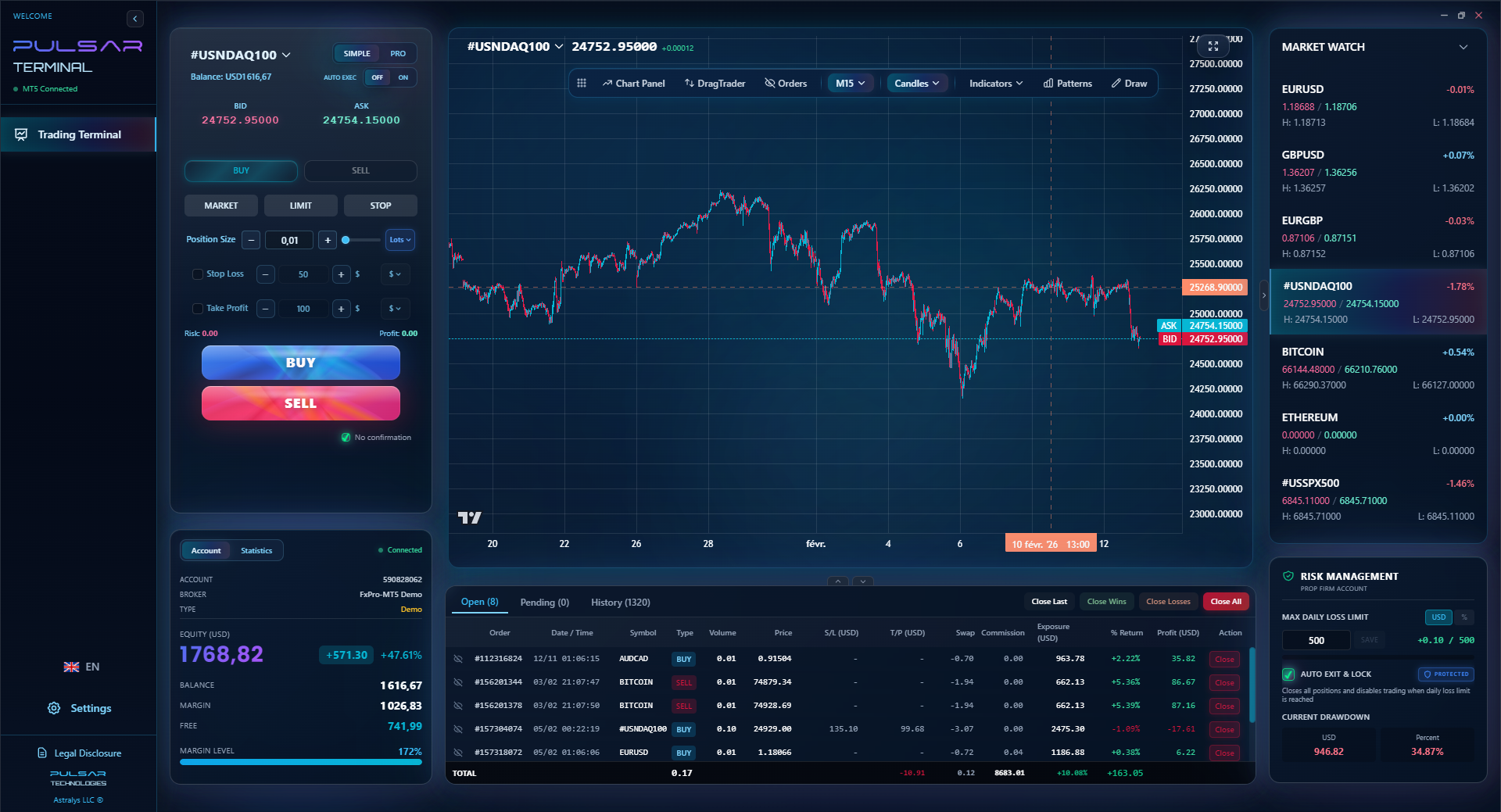
“A 50-pip stop-loss wasn't just a number; it was a precise, pre-accepted cost of doing business.”
Once you've mastered the fundamentals, you can use the calculator for more strategic planning.
Position Sizing for a Portfolio: You're running two trades: one on EUR/USD and one on USD/ZAR. The calculator helps you measure your total exposure. If both trades are betting on USD strength, your combined risk might be much higher than you think. Calculate the ZAR value of each position's potential loss and add them together. You might find you're over-exposed to a single theme.
Planning for Prop Firm Challenges: Many prop firms have strict daily loss limits. Let's say your limit is $2,000. You can't just think in pips. You need to know: "How many pips can I lose on my current position size before I hit that $2,000 limit?" The points calculator gives you that answer instantly. If you're trading 2 lots of EUR/USD, a pip is $20. A $2,000 loss is 100 pips away. This tells you your effective, firm-mandated stop-loss is tighter than your technical stop-loss. You have to adjust your position size down accordingly.
The Limitations: The calculator is dumb. It only knows the numbers you give it.
- It doesn't account for slippage. In fast markets, your fill might be 5 pips worse than your entry, instantly adding to your loss. Your calculated risk of R1,000 could become R1,500 in a blink.
- It doesn't predict volatility. A 50-pip stop on a calm Monday is not the same as a 50-pip stop during a SARB interest rate announcement. The calculator will give you the same monetary value, but the probability of that stop being hit is vastly different.
- It doesn't replace judgment. It tells you the 'what,' not the 'why.' You still need to decide where to place your stop based on the chart, using tools like support/resistance or the RSI indicator. The calculator just tells you the financial consequence of that decision.
💡 Winston's Tip
Your first calculation should always be: 'What is the maximum I am willing to lose?' Let that number dictate your position size, not the other way around.
If you take one thing from this guide, let it be this: the difference between an amateur and a professional isn't the fancy indicators or the secret strategies. It's the boring, careful discipline of risk management. The forex points calculator is the simplest embodiment of that discipline.
My R4,200 lesson was cheap compared to what I've seen others lose. I've mentored traders who've wiped out six-figure Rand accounts because they traded size based on ego, not calculation. They thought, "This is a sure thing," and piled in. The market doesn't care about your certainty.
Start today. Before your next trade, open the calculator. Do the math. See the Rand value of your planned stop-loss. If that number makes you uncomfortable, it should. That's your gut giving you good advice for once. Reduce your position size until the risk feels like a冷静的 business expense, not a heart-pounding gamble.
Tools like this, combined with a solid platform from a reputable FSCA-regulated broker, are what build sustainable careers in this business. It turns trading from a hopeful punt into a skilled profession. Now go calculate your risk, and trade smart.
FAQ
Q1Is a 'pip calculator' the same as a 'forex points calculator'?
For all practical purposes, yes. While 'point' can sometimes refer to a 10th of a pip (a 'pipette'), in the South African context and in most trading platforms, a 'points calculator' is used to calculate the value of a standard pip movement. Always check your broker's terminology, but 99% of the time, they're interchangeable.
Q2My broker's calculator shows pip value in USD, but my account is in ZAR. What do I do?
You need to convert it. First, note the pip value in USD (e.g., $10 for 1 lot of EUR/USD). Then, multiply that by the current USD/ZAR exchange rate. Example: $10 * 18.50 = ZAR 185 per pip. Some advanced broker calculators allow you to set your account currency to ZAR, and they'll do this conversion automatically.
Q3How does use affect the pip value shown in a calculator?
It doesn't. This is a crucial point. use affects how much margin you need to open a position, but it does NOT change the pip value. A 1-lot trade of EUR/USD has a pip value of roughly $10 whether you use 10:1 use or 100:1 use. The calculator only cares about the trade size (lot size), not the use used to fund it.
Q4Why is the pip value different for USD/ZAR and EUR/USD?
Two reasons: 1) The 'pip' is defined differently (0.01 for USD/ZAR vs. 0.0001 for EUR/USD). 2) The quote currency is different. The pip value formula depends on the exchange rate of the pair and your account currency. This is exactly why you use a calculator - to avoid manual errors with these variables.
Q5Can I use a points calculator for cryptocurrencies or CFDs on stocks?
The principle is similar, but the tool might be called a 'profit calculator' or 'CFD calculator.' Instead of pips, you're calculating the value per point (e.g., per $1 move in a US stock, or per 1-cent move in Bitcoin). The core function remains: translating price movement into your local currency profit/loss. Always verify the 'point' or 'tick' size with your broker first.
Q6Do I need a different calculator for mini and micro lots?
No. A good calculator will have a volume field where you input the lot size. 1.00 is a standard lot (100,000 units). 0.10 is a mini lot (10,000 units). 0.01 is a micro lot (1,000 units). The calculator will adjust the pip value accordingly. Just make sure you input the correct decimal.
Prof. Winston's Lesson
Key Takeaways:
- ✓Always convert pips to your account currency (ZAR) before trading.
- ✓A 1-lot trade in USD/ZAR can risk over ZAR 50 per pip.
- ✓The spread is an immediate loss; calculate it as part of your cost.
- ✓Use the calculator to set position size based on a fixed % risk (e.g., 1%).
- ✓use changes margin, not pip value. Don't confuse the two.
How useful was this article?
Click a star to rate
Weekly Trading Insights
Free weekly analysis & strategies. No spam.
About the Author
David van der Merwe
Emerging Markets Trader
Johannesburg-based trader with 11 years in emerging market currencies. Specializes in ZAR pairs, FSCA-regulated trading, and South African market analysis.
Comments
Risk Disclaimer
Trading financial instruments carries significant risk and may not be suitable for all investors. Past performance does not guarantee future results. This content is for educational purposes only and should not be considered investment advice. Always conduct your own research before trading.
You Might Also Like

Cara Trading Forex Sukses: 7 Prinsip dari Trader Profesional
Cara trading forex sukses dengan 7 prinsip trader pro: manajemen modal, disiplin, journal trading, backtest. Data nyata, bukan janji profit palsu.
Jam Trading Forex Terbaik untuk Trader Indonesia: Panduan Lengkap dengan Tabel Waktu
Panduan jam trading forex untuk trader Indonesia. Tabel 4 sesi dunia, jam emas 20:00-00:00, sesi mana yang harus dihindari. Data akurat + tips dari trader berpengalaman.
Top 5 Sàn Forex Uy Tín Nhất 2026: Review Jujur dari Trader Indonesia
Top 5 sàn forex uy tín 2026 untuk trader Indonesia. Review jujur: spread, deposit, withdraw, dukungan lokal. Exness, XM, IC Markets & lebih.
Get Pulsar Terminal
All these calculators are built into Pulsar Terminal with real-time data from your MT5 account. One-click position sizing, automatic risk management, and instant calculations.
Get Pulsar Terminal