


You've opened a demo account, placed a few trades, maybe even watched some YouTube videos.

David van der Merwe
Emerging Markets Trader ·  South Africa
☕ 11 min read
What you'll learn:
- 1Why Your Demo Trading Is Setting You Up to Fail
- 2Building a Professional Practice Routine (The SA Trader's Blueprint)
- 3Simulating Real SA Trading Conditions (Costs, Latency, Psychology)
- 4From Practice to Live: The Transition That Breaks Most Traders
- 5Tools & Platforms for Effective Practice in SA
- 6The Ultimate Practice Challenge: Passing a Prop Firm Test (On Demo)
You've opened a demo account, placed a few trades, maybe even watched some YouTube videos. But why does it still feel like you're just guessing? Most South African traders approach forex practice all wrong. They treat it like a video game instead of the serious financial rehearsal it needs to be. I've seen it a hundred times: the guy who 'kills it' on demo for a month, deposits R20,000, and loses half of it in a week. The problem isn't the market. It's how you practice. Let's fix that.
Here's the uncomfortable truth: demo trading creates bad habits that get you slaughtered with real money. The main issue? There's no psychological consequence. You're playing with Monopoly money. That R100,000 virtual balance? It's meaningless. When it's gone, you just click 'reset.' This completely warps your risk perception.
I made this exact mistake early on. On a demo account with IC Markets, I turned R50,000 into R120,000 in three weeks trading gold (XAU/USD). I felt like a genius. My strategy was simple: buy on every dip near a round number like $1800. It worked perfectly... until it didn't. When I switched to a live account with my own R15,000, that first losing trade hurt in a way the demo never could. I hesitated on my stop-loss, watched it run another $10 against me, and took a loss twice my planned size. The trade was identical. I was not.

Warning: The FSCA reports that between 51% and 89% of retail CFD traders lose money. The single biggest contributor to this statistic is the transition from careless demo trading to emotionally-charged live trading.
Demo accounts also hide real-world friction. You get perfect fills at your exact price. Slippage during news events? Non-existent. The psychological weight of seeing your actual South African Rand balance fluctuate? Absent. You're practicing in a frictionless vacuum, which builds false confidence. To make your forex practice meaningful, you have to simulate reality. That means using a realistic account size (start with the equivalent of R10,000-R20,000, not R1 million), trading your actual planned lot sizes, and most importantly, tracking every single trade as if it were real. Use a position size calculator for every entry, even on demo.
Real forex practice isn't about making fake money. It's about building repeatable skills under controlled conditions. Think of it like a pilot using a flight simulator. They don't just joyride; they drill specific emergency procedures. You need to do the same.
Start With One Pair
Don't jump between USD/ZAR, EUR/USD, and gold. Pick one major pair with good liquidity and lower spreads, like the EUR/USD. Learn its personality. What time does it typically move during the Jo'burg session? How does it react to US data? I spent my first three months of serious practice only trading GBP/USD. Boring? Maybe. But I learned its rhythms better than I know my own neighbourhood.
Define Your Practice 'Drills'
Each practice session should have a specific goal. For example:
- Session 1: Practice identifying and trading only pullbacks to the 20-period EMA on the 1-hour chart. No other setups allowed.
- Session 2: Practice managing a single trade. Once entered, focus solely on adjusting stop-loss to breakeven and taking partial profits.
- Session 3: Practice recovering from a loss. Intentionally take a small, planned loss (on demo), then execute your next three setups perfectly according to your rules.
The Journal Is Non-Negotiable
Your trade journal is your most important tool. For every trade, note:
- Entry/Exit price and time
- Lot size and risk (% of capital)
- The chart pattern or indicator signal (e.g., "RSI indicator divergence on H1")
- Your emotional state (Confident? Hesitant? Greedy?)
- A screenshot of the entry

Pro Tip: Your journal should have more 'no trade' entries than trades. Documenting why you avoided a bad setup is more valuable than logging a winning trade. This builds discipline, which is 80% of the game.
After 50-100 documented demo trades, you'll see your own patterns. Do you consistently exit winners too early? Do you ignore your stop-loss rules when you're down? This data is gold. It tells you exactly what to work on before a single real Rand is on the line.

💡 Winston's Tip
Your first 100 trades are for data collection, not profit. If you learn your true win rate and average loss size, you've won, even if the demo P&L is negative.
“Your journal should have more 'no trade' entries than trades.”
If your demo practice doesn't account for real-world costs and limitations, you're practicing for a market that doesn't exist. Let's get specific for South Africa.
Factor in the REAL Costs: Your broker isn't a charity. On demo, spreads are often artificially tight. Check the live accounts of your chosen broker. If you're planning to use Exness or XM, go to their website right now and note the average spread for EUR/USD during the London session. Let's say it's 1.2 pips. On your demo platform, manually add 1.2 pips to your entry cost for every trade. If you use a commission-based broker like IC Markets on a Raw account, you need to factor in that $3.50 per lot commission. A winning trade that's only 3 pips in profit might actually be a loser after costs. This changes everything.
Understand ZAR Pairs and Liquidity: Trading USD/ZAR might feel patriotic, but you need to know the quirks. The spread is wider, often 50-100 pips compared to 1 pip for EUR/USD. Liquidity can dry up outside major session overlaps. Practice on these pairs means understanding that your stop-loss might get hit more easily due to the spread alone. It's a different beast.
Simulate Internet & Power Issues: We have load-shedding. Period. Your practice should include a drill: "What is my immediate action if my screen freezes during a trade?" Do you have your broker's phone number saved? Do you know how to close a position from your phone app? Practice this. I learned this the hard way during a Stage 4 outage. My open gold trade went deep into the red while I scrambled for a mobile hotspot. Now, I always have a backup device charged and ready.
The 'Real Money' Test: This is the most powerful practice tool no one uses. Once you have 100 consistent demo trades, deposit the SMALLEST amount your broker allows. For Pepperstone, that's about R200 ($10). Trade with 0.01 lots only. The goal is not to make money. The goal is to feel the visceral gut-punch of seeing your actual money at risk. That R20 loss will teach you more about yourself than a R20,000 demo loss ever could.
This is the cliff edge. You've done your 100+ practice trades, your journal shows consistency, and you're ready. Here's how to step off without falling.
The Scaling Plan is Everything: Your first live account should not be your 'real' account. It's your final test. The rule is simple: you must be profitable for two consecutive months trading micro lots (0.01) before you add a single cent more. If you start with R5,000, that's all you get. No 'topping up' after a bad week.
I'll give you my own numbers from my transition year. After demo, I funded a live account with R10,000. My goal was to make 3% per month (R300) trading 0.02 lots on EUR/USD. Month 1: +R280. Month 2: -R150. Month 3: +R310. It was painfully slow. The temptation to triple my lot size to 'catch up' was huge. I didn't. By month 6, I had averaged 2.8% per month. Only then did I add another R10,000 to the account and slightly increased position size. This glacial patience is what separates survivors from the 89%.
Manage the South African Tax Mindset: With real profits comes SARS. The moment you go live, start a simple spreadsheet. Log every closed trade with the profit/loss in Rand. This isn't just for tax time (yes, trading profits are taxable income). It's your ultimate performance record. Seeing your total P&L in your home currency makes it real and keeps you accountable in a way demo never can.

Example: You risk 1% of a R20,000 account per trade (R200). With a 1:30 FSCA use limit, that R200 margin lets you control a position worth R6,000. A 50-pip move on a standard lot is about R7,500. You need to understand this math cold. Use a calculator every time.
The final test? Can you walk away? After a great winning day, can you close the platform and go for a braai? After a losing day, can you do the same without revenge-trading? This emotional control is the final, un-practicable skill. But without the rigorous forex practice that came before, you have no chance of finding it.
💡 Winston's Tip
Practice during load-shedding. If you can't execute your plan with a mobile hotspot and a 20% phone battery, your plan is too fragile for South Africa.
“If you can't pass your own simulated prop challenge on demo, you have no business trading real money.”
Your tools can make or break your practice. You don't need fancy AI, but you do need reliability and the right features.
Choosing a Demo Platform: Use the demo of the broker you actually intend to trade with. Don't practice on MetaTrader 4 if you're going to use XM's own platform. The mechanics need to be identical. Most top brokers like IG, Tickmill, and FP Markets offer unlimited demo accounts that mirror their live environments perfectly.
Essential Practice Features to Look For:
- Historical Data & Replay: The ability to replay past market days is useful. Can you go back to the day of a SARB interest rate decision and practice trading it? This is a superior form of practice than trading live demo.
- Customizable Spreads: Some advanced demo platforms let you manually widen the spreads to simulate real conditions. If yours doesn't, just mentally add the cost.
- Trade Journal Integration: Platforms like TradingView or third-party journals can link directly to your broker API, auto-importing your trades. This saves hours and increases accuracy.
Why Order Management is a Practice Skill: A huge part of practice is mastering your platform's order mechanics. How quickly can you set a stop-loss and take-profit? What about a trailing stop? In a fast market, fumbling with your ticket can cost you. I practiced setting a limit order, stop-loss, and take-profit on a scalping strategy until I could do it blindfolded in under 3 seconds. This mechanical efficiency removes one more variable when you go live.
Manual trailing stops are a common weak point. You get greedy, move the stop too tight, and get taken out before a big move. Or you get scared and never move it at all. Practicing this mechanic - deciding on a logical rule (e.g., move stop to breakeven after 15 pips profit, then trail 1:2) - is a drill in itself.
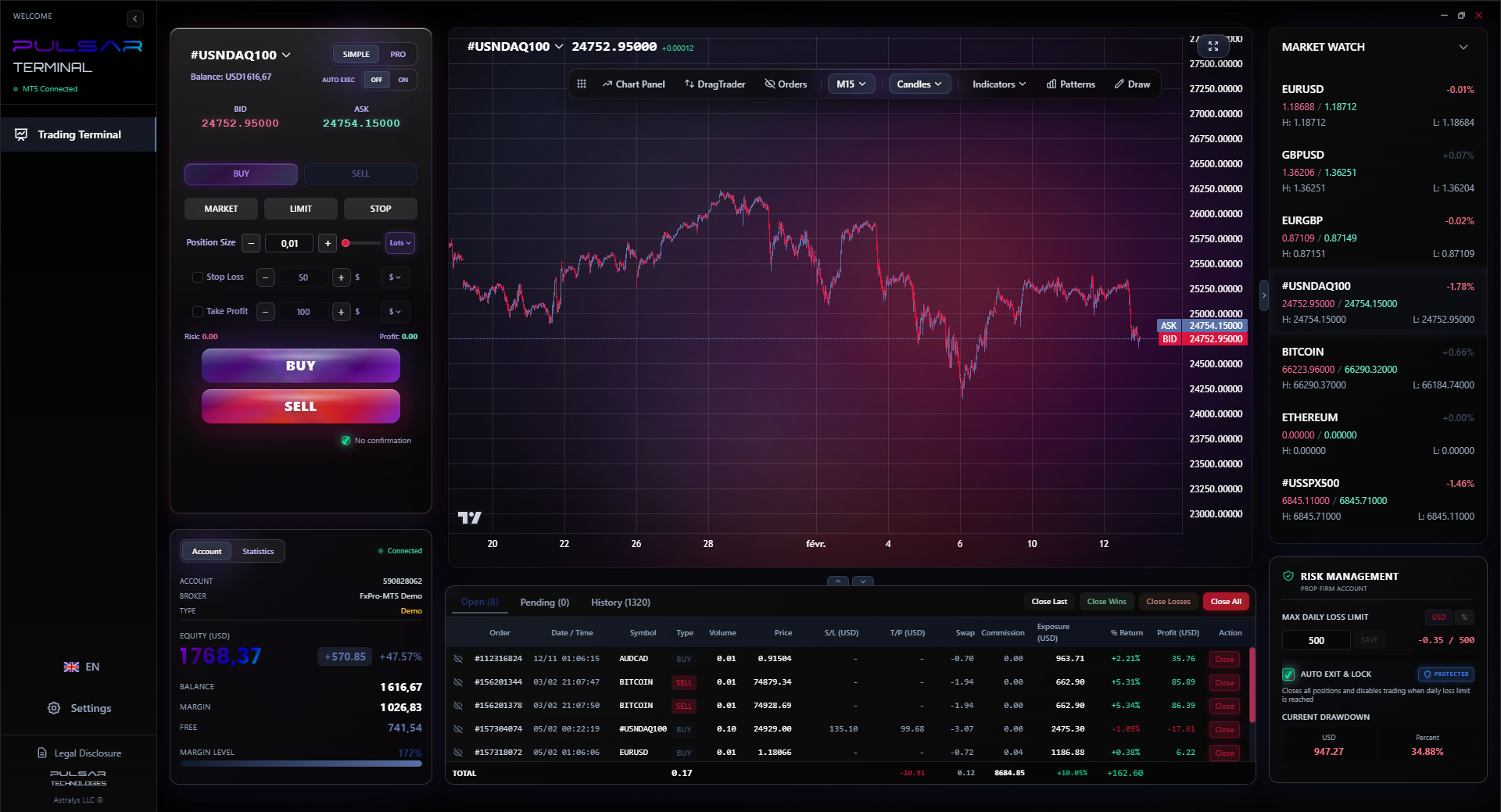
Practicing precise order management and stop-loss mechanics is critical, and tools like Pulsar Terminal let you build and test advanced order templates directly on your MT5 demo before you ever need them live.
Pulsar Terminal
The all-in-one MT5 companion: drag-and-drop orders, multi-TP/SL, trailing stop, grid trading, Volume Profile, and prop firm protection. Used by 1,000+ traders daily.
Here's the most brutal, effective form of forex practice I know: simulate a proprietary trading firm challenge. Prop firms like FTMO or The5%ers give you a demo account with strict rules: hit a profit target (e.g., 10%) within 30 days without breaching a daily loss limit (e.g., 5%) or a max drawdown limit (e.g., 10%).
Why is this the best practice? It imposes external discipline that mimics the pressure of real trading. You can't just YOLO one trade to make up for losses. You have to be consistent and manage risk stringently.
Set Up Your Own Challenge:
- Account: Start a fresh demo account with R100,000.
- Profit Target: 10% = R10,000.
- Max Daily Loss: 5% = R5,000. If you lose R5,000 in a day, you must stop trading for 48 hours.
- Max Total Drawdown: 10% = R10,000. If your account drops to R90,000, you fail.
- Time Limit: 30 calendar days.
- Minimum Trading Days: 10 (to prevent hitting the target in one lucky trade).
I did this three times before I felt ready for a larger live account. I failed the first two. The first time, I blew the daily loss limit on day 3 by letting a single USD/ZAR trade run against me. The second time, I hit the profit target by day 15 but then gave half of it back the next day, violating the consistency rule I'd set. The third time, I passed. That structured, high-stakes practice taught me more about margin call pressure and emotional control than two years of casual demo trading.
This challenge forces you to engage with every critical aspect of trading: risk-per-trade, daily loss limits, emotional composure after a win or loss, and the patience to grind out gains. If you can't pass your own simulated challenge on demo, you have absolutely no business trading real money. It's that simple.
💡 Winston's Tip
The most important line on your demo chart is the 'breakeven' line for your trade. Moving your stop there is a skill. Practice it 50 times before you need it for real.
FAQ
Q1Is forex practice on a demo account really enough to start trading live in South Africa?
No, demo practice is only the first 30%. It teaches you platform mechanics and basic strategy. The crucial next step is trading a very small live account (like R500-R1000) to confront the psychology of real risk. Demo alone misses the emotional component that breaks most new traders.
Q2How long should I practice forex on a demo account before using real money?
There's no set time, but there is a set metric. You should have at least 100 documented trades in your journal showing consistent application of your rules. More importantly, you should be able to pass a self-imposed prop firm challenge (like making 10% in a month with strict loss limits) on demo. That usually takes 3-6 months of dedicated, daily practice.
Q3What's the biggest mistake South African traders make when practicing?
Trading with unrealistic demo capital. Practicing with R1 million when you'll only deposit R20,000 teaches you nothing about position sizing and risk. Always practice with a demo balance that matches your intended live capital. Also, ignoring the cost of the spread definition and commissions, which are very real with brokers like Tickmill or IC Markets.
Q4Can I practice forex trading legally in South Africa without a license?
Yes, absolutely. Practicing on a demo account is completely legal and requires no license. You only need to be licensed by the FSCA if you are managing money or giving advice to others for a fee. Trading your own capital on a live account is also legal, provided you use an FSCA-licensed broker.
Q5What's the best free platform for forex practice in South Africa?
The best platform is the free demo account offered by the broker you plan to use live. This ensures the trading conditions, spreads, and platform features are identical. Most top FSCA-regulated brokers like IG, XM, and Exness offer full-featured, unlimited demo accounts. MetaTrader 4 or 5 demos are also excellent and widely used.
Q6How do I practice trading ZAR currency pairs like USD/ZAR?
Practice on a demo that offers the pair, but be acutely aware of the differences. USD/ZAR has much wider spreads (often 50-100 pips) and can be less liquid. Your practice must account for this. Use wider stop-losses, understand that slippage is more likely, and never practice scalping on ZAR pairs - the costs will eat you alive.
Q7Does profitable demo trading guarantee live trading success?
Not even close. It's a necessary prerequisite, but not a guarantee. The statistic that 51-89% of retail traders lose money is filled with people who were profitable on demo. The guarantee comes from transitioning your demo process to a live account with microscopic size first, to conquer the psychology. Demo proves your strategy can work. Live trading proves you can execute it under fire.
Prof. Winston's Lesson
Key Takeaways:
- ✓Practice with real broker spreads & commissions factored in.
- ✓Document 100+ trades before even considering live money.
- ✓Your first live account should be 90% smaller than your demo.
- ✓Simulate a prop firm challenge: it's the ultimate discipline test.
How useful was this article?
Click a star to rate
Weekly Trading Insights
Free weekly analysis & strategies. No spam.
About the Author
David van der Merwe
Emerging Markets Trader
Johannesburg-based trader with 11 years in emerging market currencies. Specializes in ZAR pairs, FSCA-regulated trading, and South African market analysis.
Comments
Risk Disclaimer
Trading financial instruments carries significant risk and may not be suitable for all investors. Past performance does not guarantee future results. This content is for educational purposes only and should not be considered investment advice. Always conduct your own research before trading.
You Might Also Like

Cara Trading Forex Sukses: 7 Prinsip dari Trader Profesional
Cara trading forex sukses dengan 7 prinsip trader pro: manajemen modal, disiplin, journal trading, backtest. Data nyata, bukan janji profit palsu.
Jam Trading Forex Terbaik untuk Trader Indonesia: Panduan Lengkap dengan Tabel Waktu
Panduan jam trading forex untuk trader Indonesia. Tabel 4 sesi dunia, jam emas 20:00-00:00, sesi mana yang harus dihindari. Data akurat + tips dari trader berpengalaman.
Top 5 Sàn Forex Uy Tín Nhất 2026: Review Jujur dari Trader Indonesia
Top 5 sàn forex uy tín 2026 untuk trader Indonesia. Review jujur: spread, deposit, withdraw, dukungan lokal. Exness, XM, IC Markets & lebih.
Get Pulsar Terminal
All these calculators are built into Pulsar Terminal with real-time data from your MT5 account. One-click position sizing, automatic risk management, and instant calculations.
Get Pulsar Terminal