


Here's a hard truth most trading courses won't tell you: 72% of new forex accounts in South Africa get liquidated within six months.

David van der Merwe
Emerging Markets Trader ·  South Africa
☕ 10 min read
What you'll learn:
Here's a hard truth most trading courses won't tell you: 72% of new forex accounts in South Africa get liquidated within six months. That's not just bad luck, it's a direct result of people trading without a plan. The single most effective tool to beat those odds isn't a secret indicator, it's a simple, brutally honest forex presentation. I'm not talking about a PowerPoint for an audience. I'm talking about the document you create for yourself, your potential investors, or a prop firm that forces you to articulate your edge, your risks, and your numbers before you risk a single cent.
Let's cut through the noise. Trading without a written plan is like trying to build a house without blueprints. You might get a few walls up, but the whole thing will collapse at the first sign of pressure. A forex presentation is your blueprint.
In South Africa, with the FSCA capping use at 30:1 (and heading to 1:200 for majors soon), you can't just throw money at the market and hope for the best. Your margin for error is shrinking. I learned this the hard way in 2018. I had a "feeling" about USD/ZAR and went in heavy. No stop loss, just a hunch. I lost R15,000 in two days. That loss wasn't from a bad trade idea, it was from a complete lack of a plan.
A proper presentation forces you to answer the tough questions before your money is on the line. What's your strategy? How much will you risk per trade? What are your profit targets? When will you walk away? Writing it down makes it real. It turns emotion-driven gambling into a structured business activity. If you can't explain your trading plan clearly on paper, you have no business executing it with real money.

Warning: Don't confuse a trading journal with a trading plan. A journal records what you did. A plan dictates what you will do. You need both, but the plan comes first.
This is especially crucial if you're thinking of trading for a prop firm or seeking capital. They're not looking for geniuses, they're looking for professionals with a repeatable, documented process. Your presentation is your proof.
Your forex presentation doesn't need to be 50 pages. It needs to be clear, concise, and cover the fundamentals. Think of it as a business plan for your trading.
The Executive Summary (Your Elevator Pitch)
Start with one page that summarizes everything. What's your trading style? (e.g., "I am a swing trader focusing on EUR/USD and XAU/USD using price action and the MACD indicator for confirmation.") What's your target return? What's your maximum risk? This is what a busy fund manager or prop firm evaluator will read first.
The Strategy Breakdown
This is the core. Be painfully specific.
- Markets & Instruments: Don't say "I trade forex." Say "I trade EUR/USD, GBP/USD, and XAU/USD during the London-New York overlap." Here's where a guide like our EUR/USD guide can help you understand a specific pair's personality.
- Entry Triggers: What exactly has to happen for you to enter a trade? Is it a breakout of a specific trendline? A candlestick pattern? A cross on the RSI indicator? Write the rule.
- Exit Plan: This is where most fail. Define your stop loss and take profit before you enter. Is it a fixed pip amount? A percentage of account risk? A technical level?
The Risk Management Bible
This section is non-negotiable. It's what separates the 72% who blow up from the survivors.
- Risk Per Trade: I never, ever risk more than 1% of my trading capital on a single trade. For a R10,000 account, that's R100. Use a position size calculator every single time. It's boring, but it keeps you in the game.
- Maximum Daily/Weekly Drawdown: Have a circuit breaker. Mine is 5% of my account. If I lose R500 in a day on my R10k account, I shut it down and walk away. This prevents a bad day from becoming a catastrophic month.
- use Usage: Just because your broker offers 30:1 doesn't mean you use it. State your maximum use per trade type. For my swing trades, I rarely exceed 5:1.

Example: My risk calculation for a recent GBP/USD trade: Account: R20,000 Risk per trade (1%): R200 Entry: 1.2600 | Stop Loss: 1.2570 (30 pips) Pip Value (mini lot): ~R1.50 per pip (varies slightly) Position Size: R200 / (30 pips * R1.50) = 4.44 mini lots. I'd round down to 4 lots. That's the math. No guesswork.

💡 Winston's Tip
A plan you don't follow is just a wish list. Print your risk rules and stick them to your monitor. Your future self will thank you.
“A strategy with a 40% win rate and strong risk/reward is far more believable than a '90% win rate' system. Professionals spot the fake immediately.”
This is where you get honest about the friction in the system. Trading isn't free, and those costs eat into your edge.
Transaction Costs: You must account for the spread and commissions. If your average winning trade aims for 50 pips, but you're paying a 2-pip spread each time, you're giving away 4% of your potential profit before you even start. When I backtest a strategy, I always add the average spread of my broker (like the 0.6 pips average for EUR/USD) to my stop-loss distance. It keeps the analysis realistic.
The Performance Track Record (Be Honest!) If you have a live or demo track record, present it. If you don't, create a simulated one through rigorous backtesting. Show:
- Win Rate (e.g., 40%)
- Average Win vs. Average Loss (e.g., Average Win: 65 pips | Average Loss: 25 pips)
- Expectancy: (Win% * Avg Win) - (Loss% * Avg Loss). This tells you the average pips you can expect per trade.
- Maximum Drawdown: The largest peak-to-trough decline in your equity curve.
Don't fabricate perfect numbers. A strategy with a 40% win rate and a strong risk/reward is far more believable and strong than a "90% win rate" system. Anyone with experience will see through the latter immediately.
Also, factor in the South African context. Are you trading ZAR pairs? The spreads will be wider. Are you funding with ZAR? There might be small bank fees. These tiny details matter in a scalping strategy where profits are thin.
This is where your presentation shifts from a personal guide to a sales document. The goal is to prove you are a manageable risk, not a lottery ticket.
For Prop Firm Challenges: They don't care about your one amazing trade. They care about consistency and discipline. Your presentation must scream control.
- Highlight Your Risk Rules: Bold your maximum daily loss rule. Emphasize your 1% risk per trade. Prop firms live in fear of traders who blow through the challenge in one wild swing. Show them you have a margin call avoidance system built into your plan.
- Match Their Rules: If their challenge has an 8% maximum drawdown limit, show how your 5% rule keeps you well within bounds.
- Be Professional: Use clean formatting, charts, and clear headings. It shows you treat trading as a business.
For Seeking Investment: This is a higher bar. You need to show not just a plan, but a track record.
- Focus on Risk-Adjusted Returns: Talk about your Sharpe Ratio or Calmar Ratio (return vs. drawdown). Investors hate volatility more than they love gains.
- Transparency is Key: Be upfront about past losses and what you learned. I once showed a potential partner a 3-month period where I was flat. I explained it was a range-bound market that didn't suit my trend strategy, and I demonstrated the discipline I had to trade small or not at all. They respected that honesty more than a fake winning streak.
- Detail Your Edge: Why does your strategy work? Is it behavioral? Is it a technical inefficiency? "I trade support and resistance" isn't an edge. "I trade false breakouts of London session highs/lows with a specific volume confirmation" is closer.
Remember, you're not selling a dream of lambos. You're selling a boring, repeatable process that generates returns while rigorously protecting capital.
💡 Winston's Tip
When presenting to others, lead with your risk management, not your potential profits. It immediately signals you understand the real game.
“The single most important part of your presentation is the Risk Management section. Pros are defined by how they manage losses.”
I've seen hundreds of trading plans. Most fail for the same few reasons. Don't be most people.
Pitfall 1: The Over-optimized Fantasy. This is the killer. You tweak your backtest parameters until the equity curve looks like a rocket ship going up. You've "curve-fitted" your strategy to past data, and it will fail miserably in the live market. Your presentation must show robustness. Test your strategy across different market conditions (trending, ranging, volatile). If it only works in a raging bull market, it's not a strategy, it's a bet.
Pitfall 2: Ignoring Psychology. Your plan must account for you. If you know you have a tendency to move stop losses, write a rule forbidding it. My rule is: "Once the stop loss and take profit are set, they can only be moved in the profit direction (trailing stop), never to widen the loss." Simple. Unbreakable.
Pitfall 3: Unrealistic Profit Projections. Promising 20% returns per month is a red flag. A solid, professional swing trading plan might target 10-20% per year, with controlled drawdowns. Sustainable growth beats explosive, risky gains every time. I'd rather present a plan for 15% annual returns with a 10% max drawdown than 100% returns with a 50% drawdown.
Pitfall 4: It's a Static Document. Your first presentation is a starting point. You must review and update it quarterly. Did the market volatility change? Did you discover a flaw in your entry logic? The plan evolves as you learn. I have every version of my plan saved since 2019. Looking back at the early ones is cringe-worthy, but it shows growth.
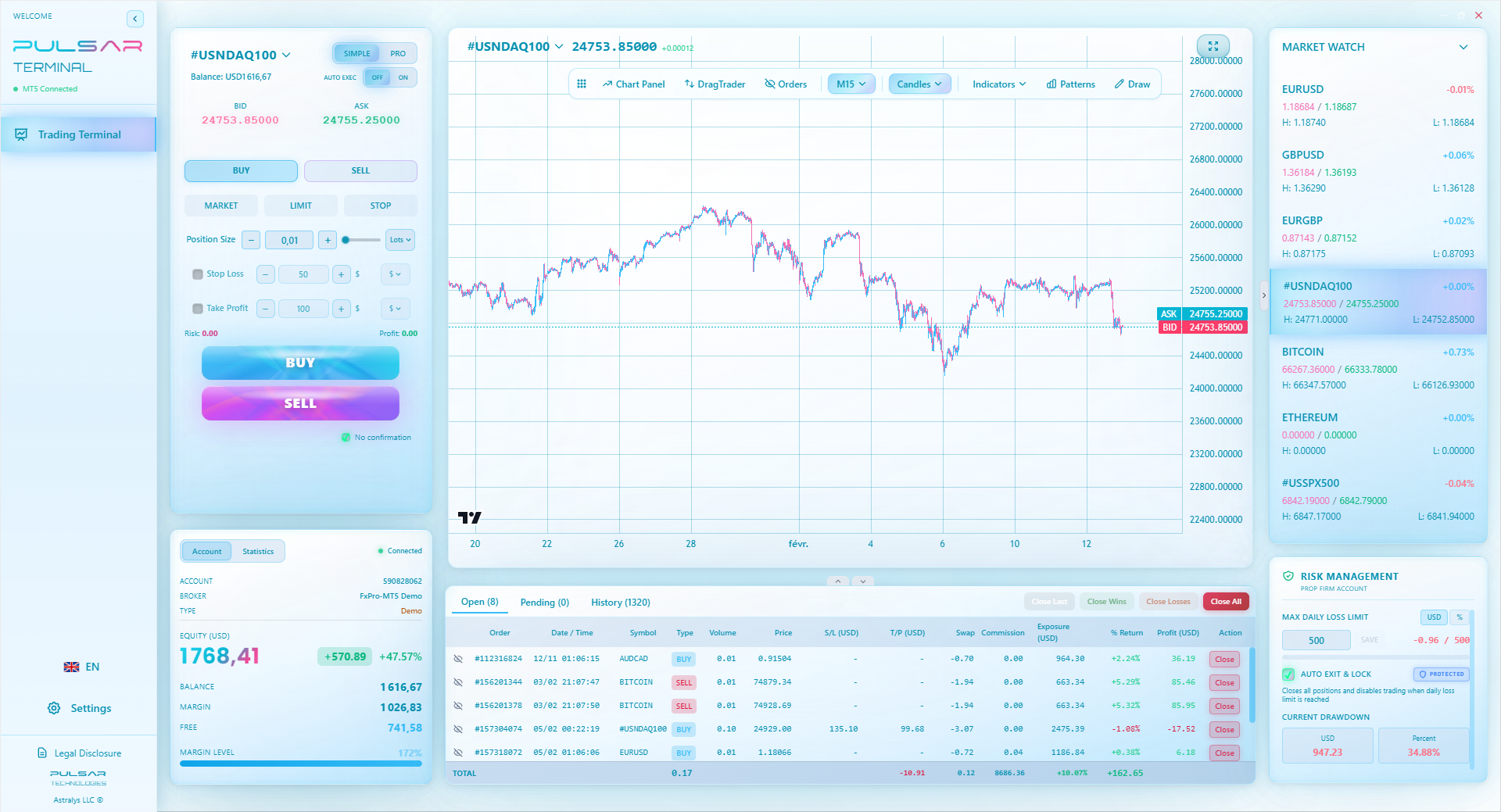
Sticking to your plan's rules is the hardest part, which is why tools like Pulsar Terminal automate risk management features like trailing stops and breakeven orders directly on your MT5 platform.
Pulsar Terminal
The all-in-one MT5 companion: drag-and-drop orders, multi-TP/SL, trailing stop, grid trading, Volume Profile, and prop firm protection. Used by 1,000+ traders daily.
The final step is moving from theory to practice. This is where the rubber meets the road.
The Pre-Trade Checklist: Turn the key sections of your plan into a one-page checklist you review before every trade. Mine has five questions:
- Does this setup match my strategy's entry criteria exactly?
- Have I calculated my position size using the position size calculator?
- Are my stop loss and take profit orders set?
- Does this trade keep me below my 1% risk and 5% daily loss limits?
- What is the market context? (News event? Time of day?)
If I can't tick all five, I don't take the trade. No exceptions.
Using Technology: Don't just write this in a Word doc. Use a trading journal app or even a simple spreadsheet to track your performance against the plan. Every Sunday night, I spend 30 minutes reviewing my trades from the week. Did I follow the plan? Where did I deviate? This review is what turns experience into wisdom.
Finally, practice presenting it. Explain your plan to a friend who knows nothing about trading. If you can make them understand your edge and your risk controls, you truly understand it yourself. That confidence, born from preparation, is the ultimate weapon against market fear and greed. Your forex presentation isn't just a document, it's the foundation of your entire trading identity. Build it well.
FAQ
Q1How long should my first forex presentation be?
Keep it to 5-10 pages maximum. The goal is clarity, not volume. Focus on the core: Strategy, Risk Management, Costs, and Performance Metrics. A 50-page thesis will never get read, especially by a prop firm reviewer.
Q2I'm a beginner with no track record. What do I put in the performance section?
Be transparent. Write "Simulated Performance Based on Backtesting." Detail your backtesting methodology (e.g., "100 trades on EUR/USD daily chart from Jan 2023 - Dec 2024"). Show the results, but clearly label them as simulated. Honesty about a demo track record is far better than making up live results.
Q3What's the single most important part of the presentation?
The Risk Management section. Anyone can have a lucky idea for an entry. Pros are defined by how they manage losses. Your rules for position sizing, maximum drawdown, and daily loss limits are what prove you're serious.
Q4Should I include specific broker details?
Yes, absolutely. Mention the type of account you'll use (ECN, Standard) and the typical spreads/commissions you'll pay. For example, "Execution will be via an ECN account with Broker X, where the average EUR/USD spread is 0.6 pips." This shows you've thought about real-world costs.
Q5How often should I update my trading plan presentation?
Formally review and update it every quarter. However, you should be reflecting on it weekly as part of your trade review. If you find yourself consistently breaking a rule, the rule or your discipline needs to change. The plan is a living document.
Q6Is it worth creating a presentation if I only trade my own small account?
It's more important. When it's just your money, it's easy to get sloppy. The presentation imposes discipline. Writing down "I risk 1% per trade" makes you far more likely to actually do it than just thinking it. It's the cheapest form of accountability you can buy.
Prof. Winston's Lesson
Key Takeaways:
- ✓72% of new SA accounts blow up in 6 months. A plan is your antidote.
- ✓Never risk more than 1% of your capital on a single trade.
- ✓Factor in real spreads & commissions; they destroy thin edges.
- ✓For prop firms, highlight your daily loss limit above all else.
- ✓Update your plan quarterly. It must evolve as you do.
How useful was this article?
Click a star to rate
Weekly Trading Insights
Free weekly analysis & strategies. No spam.
About the Author
David van der Merwe
Emerging Markets Trader
Johannesburg-based trader with 11 years in emerging market currencies. Specializes in ZAR pairs, FSCA-regulated trading, and South African market analysis.
Comments
Risk Disclaimer
Trading financial instruments carries significant risk and may not be suitable for all investors. Past performance does not guarantee future results. This content is for educational purposes only and should not be considered investment advice. Always conduct your own research before trading.
You Might Also Like

Cara Trading Forex Sukses: 7 Prinsip dari Trader Profesional
Cara trading forex sukses dengan 7 prinsip trader pro: manajemen modal, disiplin, journal trading, backtest. Data nyata, bukan janji profit palsu.
Jam Trading Forex Terbaik untuk Trader Indonesia: Panduan Lengkap dengan Tabel Waktu
Panduan jam trading forex untuk trader Indonesia. Tabel 4 sesi dunia, jam emas 20:00-00:00, sesi mana yang harus dihindari. Data akurat + tips dari trader berpengalaman.
Top 5 Sàn Forex Uy Tín Nhất 2026: Review Jujur dari Trader Indonesia
Top 5 sàn forex uy tín 2026 untuk trader Indonesia. Review jujur: spread, deposit, withdraw, dukungan lokal. Exness, XM, IC Markets & lebih.
Get Pulsar Terminal
All these calculators are built into Pulsar Terminal with real-time data from your MT5 account. One-click position sizing, automatic risk management, and instant calculations.
Get Pulsar Terminal