


I was staring at my screen, watching the GBP/NGN rate on a broker like Exness(/en/brokers/exness) jump 50 pips in under a minute.

Olumide Adeyemi
West African Trading Pioneer ·  Nigeria
☕ 11 min read
What you'll learn:
- 1What Exactly Is a Forex Price?
- 2What Actually Moves Forex Prices?
- 3Reading Price Charts: A Practical View from Lagos
- 4Trading Strategies Built on Price Action
- 5Managing Risk with Nigerian Brokers
- 6Choosing a Broker in Nigeria (2026 Realities)
- 7Common Mistakes Nigerian Traders Make (And How to Avoid Them)
- 8Putting It All Together: Your Trading Routine
I was staring at my screen, watching the GBP/NGN rate on a broker like Exness jump 50 pips in under a minute. It was a Tuesday afternoon in Lagos, and the news had just broken about a surprise CBN policy shift. My phone started buzzing with messages from my trading group: "Wetin dey happen?" "Is this a buy or sell?" That moment, where a simple number on a screen dictates profit or loss, is the entire game. This guide isn't about fancy theories. It's about understanding the raw, moving beast that is a forex price, specifically for you trading from Nigeria.
Let's strip it back. A forex price is the exchange rate between two currencies. It tells you how much of one currency you need to buy a single unit of another. When you see EUR/USD = 1.0850, it means 1 Euro costs 1.0850 US Dollars.
For us in Nigeria, you're usually looking at two types of pairs:
- Major Pairs vs. the Dollar: Like EUR/USD, GBP/USD. These are the most liquid and have the tightest spreads.
- Cross Pairs & Exotics: These involve the Naira or other currencies not paired with the USD, like GBP/NGN or EUR/GBP. They can be wilder and have wider spreads.
The price you see is a quote with two parts: the Bid (the price the market will buy from you) and the Ask (the price the market will sell to you). The difference is the spread, which is your immediate cost of doing business. On a pair like EUR/USD, a top-tier broker might offer a 0.7 pip spread, while on GBP/NGN, it could be 50 pips or more. That spread eats into your potential profit before the market even moves.

Warning: Don't confuse the interbank rate you see on Google with your broker's rate. Your broker's price includes their spread. If you're scalping, a wide spread can kill a strategy that works in theory.

💡 Winston's Tip
The spread isn't a fee, it's a toll. You pay it to cross the bridge into a trade. Never enter a trade where the toll is more than 20% of your expected profit.
Prices don't move at random. They're votes on the economic health and future of entire countries. If you're not paying attention to these drivers, you're just gambling.
The Big Three: Economics, Central Banks, and Politics
First, economic data. Strong data typically strengthens a currency. I learned this the hard way early on. I was short on USD/JPY when a monster US jobs report (NFP) hit. The pair ripped 120 pips against me in minutes. I hadn't checked the economic calendar. Key data for Nigeria-focused traders includes:
- US Data: Non-Farm Payrolls, CPI inflation, Fed interest rate decisions.
- EU/UK Data: ECB and BoE decisions, GDP, inflation.
- Local Context: CBN monetary policy announcements, Nigeria's inflation data, and oil prices (since our economy is heavily tied to crude).
Second, central banks. They control interest rates. Higher rates often attract foreign capital, boosting a currency. The chatter from Fed Chair Powell or the CBN Governor can move markets more than the actual data.
Third, geopolitics and sentiment. War, elections, trade deals. These events create risk-on or risk-off moods. During a risk-off period, traders flee to the 'safe-haven' US Dollar or Swiss Franc.
The Myth of 'Manipulation'
You'll hear guys in forums cry 'manipulation!' when a stop-loss gets hit. Mostly, that's nonsense. What they're seeing is liquidity. Big banks and institutions trade in sizes that can temporarily move the price, especially in thinner markets or during off-hours. It's not illegal; it's the reality of a decentralized market. Your job is to avoid placing your stops where everyone else's are.

Pro Tip: Use an economic calendar. Plan your week around high-impact news events. If you don't understand why a forex price is moving, close your trade. It's better to be flat and confused than losing and confused.
“High use from Nigerian brokers is a trap for the inexperienced, not a gift.”
Charts are just a history of prices. Your goal is to spot patterns in the chaos. Most Nigerian traders start with MetaTrader 4 or 5, which is a solid choice.
Timeframes Tell Different Stories
You need to look at multiple timeframes. It's called top-down analysis.
- Daily/Weekly (H4): This shows you the overall trend. Is the market generally going up, down, or sideways? Never take a buy signal on the 15-minute chart if the daily chart is screaming a downtrend.
- 1-Hour (H1): This is your strategic zone. It's where you find key support and resistance levels and plan your trade entry.
- 15-Minute (M15) or 5-Minute (M5): This is for fine-tuning your entry and exit. This is where most scalping happens.
I got burned trading GBP/USD once. The 5-minute chart had a beautiful bullish setup. I bought. What I missed was that on the 4-hour chart, the price had just slammed into a massive resistance level that had held for weeks. My 'beautiful' trade reversed instantly and hit my stop-loss.
Support, Resistance, and Trendlines
These are your foundational tools. Draw them.
- Support: A price level where buying interest is strong enough to overcome selling pressure. It's a floor.
- Resistance: The opposite. A ceiling where selling pressure overcomes buying.
- Trendline: A diagonal line connecting higher lows in an uptrend or lower highs in a downtrend. A break of a key support or resistance level is a big deal. It often means a shift in market sentiment. Don't overcomplicate it. A clean chart with a few key levels is worth more than a mess of 10 indicators.

Example: Let's say EUR/USD has bounced off 1.0700 three times. That's strong support. If the price breaks and closes below 1.0690 on the 1-hour chart, that support has failed. The next target might be 1.0650. The old support (1.0700) now becomes new resistance.
Strategy is how you interact with price. You need one, or your emotions will trade for you. Here are two core approaches.
Price Action Trading
This means making decisions based purely on the price movement and its patterns on the chart, with minimal indicators. You're reading the story the market is telling.
- Key Patterns: Look for pin bars, engulfing candles, and inside bars at those support/resistance levels we talked about. A bullish engulfing candle at a major support level? That's a high-probability buy signal.
- My Experience: My most consistent wins come from simple price action. I waited for USD/JPY to pull back to a rising trendline on the H4 chart. A pin bar formed right on the line. I bought. Entry at 147.80, took half profit at 148.50, let the rest run with a trailing stop. It went to 149.20. The setup was clear, the story was 'uptrend resuming.'
Indicator-Based Trading
Indicators are derivatives of price; they lag. Use them to confirm what price is already suggesting, not as a crystal ball.
- RSI Indicator (Relative Strength Index): Good for spotting overbought (>70) or oversold (<30) conditions. An RSI reading above 70 doesn't mean 'sell now.' It means the move might be exhausted. Wait for price to show weakness, like a bearish candle pattern.
- MACD Indicator: Helps identify trend direction and momentum. A MACD crossover above the zero line can confirm a shift to an uptrend you're seeing on the chart.
The worst thing you can do is use five indicators that all say the same thing. It gives false confidence. Pick one or two, understand them deeply, and use them with price action. Whether you're a scalping fiend or a patient swing trader, your strategy must have clear rules for entry, exit, and risk.
💡 Winston's Tip
Your first loss is your best loss. A small, controlled stop-loss is a professional fee for information. A large, uncontrolled loss is an amateur's tuition.
“Your edge isn't a secret indicator; it's the discipline to follow a boring routine while everyone else panics.”
This is where dreams go to die. You can be right about the direction 60% of the time and still blow your account if your risk management is trash.
The 1% Rule (And Why You'll Ignore It)
Never risk more than 1% of your account balance on a single trade. On a $1,000 account, that's $10. Let's make it real. You want to buy EUR/USD at 1.0850, with a stop-loss at 1.0830 (20 pips risk).
How much can you trade? Use a position size calculator. Risk in Dollars ($10) / (Pips at Risk * Pip Value) = Position Size. For a micro lot (where 1 pip = $0.10 on EUR/USD): $10 / (20 pips * $0.10) = 5 micro lots.
That's it. 5 micro lots. Not 10. Not 20. This rule keeps you in the game after a string of losses. I violated this early on. I risked 5% on a 'sure thing.' It wasn't. I lost $50 in minutes and was too scared to take the next good setup.
Stop-Losses Are Not Optional
Your stop-loss is your lifeline. It's a pre-admission that you can be wrong. Place it at a logical level where your trade idea is invalidated. If you think EUR/USD is bouncing off support at 1.0800, your stop goes below that, maybe at 1.0785. Don't place it arbitrarily because it 'feels' too far.
use: Your Double-Edged Sword
Nigerian brokers like Exness or HF Markets offer crazy use, up to 1:2000. This is a trap for the inexperienced. use amplifies both gains AND losses. With 1:100 use, a 1% move against you wipes out your entire margin. Start low. Use 1:10 or 1:20 max while you're learning. High use is the fastest route to a margin call.
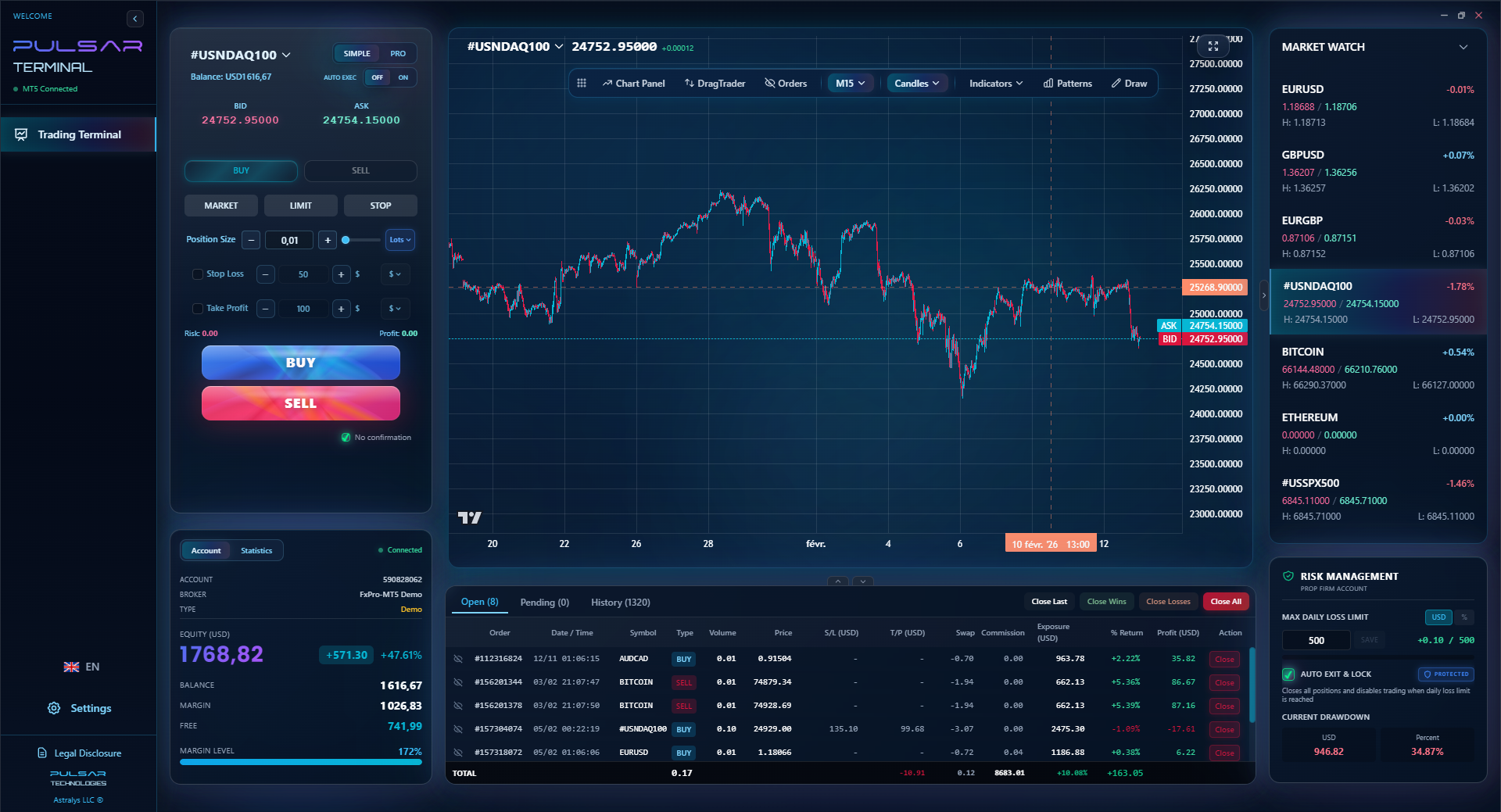
Manually moving stop-losses to breakeven is a hassle; Pulsar Terminal automates breakeven and trailing stops directly on your MT5 chart with one click.
Pulsar Terminal
The all-in-one MT5 companion: drag-and-drop orders, multi-TP/SL, trailing stop, grid trading, Volume Profile, and prop firm protection. Used by 1,000+ traders daily.
Your broker is your gateway. A bad one will cost you money through slippage, requotes, and hidden fees. Here’s what matters for us.
| Priority | What to Look For | Why It Matters |
|---|---|---|
| Regulation | FCA, CySEC, FSCA, ASIC. | Your funds are segregated. There's a higher authority to complain to if things go south. |
| Spreads & Fees | Tight spreads on majors (EUR/USD under 1 pip). No hidden withdrawal fees. | Directly impacts profitability, especially for frequent traders. |
| Deposit/Withdrawal | Local Naira deposits, fast withdrawals, USSD, Fintech wallets. | You need to fund your account and get your profits out without hassle. |
| Platform | MT4/MT5 stability, good mobile app. | You need reliable execution, especially during news events. |
Based on current data, here’s a snapshot:
- For Low Minimum Deposit: XM ($5) or HF Markets ($5/₦4000) are accessible.
- For Tight Spreads: FXTM (0.0 pips on Pro account) or OctaFX (from 0.7 pips) are competitive.
- For High use: Exness and HF Markets offer up to 1:2000 (use with extreme caution).
Test their customer service. Send an email. See how fast they reply. Try a small deposit and withdrawal first. Your broker should be a boring, reliable tool, not a source of stress.
“The market doesn't care about your rent, your ego, or your 'sure thing.' It only cares about price.”
I've made most of these. Let's save you the pain and lost Naira.
Chasing the Price: The market is up 80 pips. You FOMO (Fear Of Missing Out) and buy at the top. It reverses. You're instantly in a loss. Solution: If you missed the move, wait. There will always be another setup. The market doesn't retire.
Averaging Down on a Loser: You buy EUR/USD. It goes down. You buy more 'to lower your average.' This isn't the stock market. You're adding to a losing position, doubling your risk. It's a great way to turn a small loss into an account-blowing one. Only add to winning trades that are moving in your favor.
Trading Too Big, Too Soon: You make 20% in a week. You feel like a genius. You triple your position size. One bad trade wipes out three weeks of gains. Stick to your position size calculator. Discipline is harder than analysis.
Ignoring the Spread: Trying to scalp GBP/NGN with a 50-pip spread is suicide. Your trade needs to move 50 pips just for you to break even. Stick to major pairs with tight spreads for active trading.
Over-trading: Boredom is not a trading signal. Sitting through a slow market is part of the job. If there's no clear setup, stay out. Preserving capital is a win.
💡 Winston's Tip
If you can't explain why a price is at a certain level in one sentence ('bouncing off weekly support', 'breaking post-news resistance'), you have no business being in the trade.
Success is built on routine, not luck. Here’s a sample daily routine for a Lagos trader.
Morning (Before 9 AM WAT):
- Check the economic calendar. What high-impact news is due today? (US session opens at 2:30 PM our time).
- Look at the daily charts of your 3-5 favorite pairs. What’s the overall trend? Note key support/resistance.
Afternoon (Planning Phase):
- Zoom into the 1-hour charts. Are there any price action setups forming near those key levels?
- If yes, plan the trade. Write it down: Entry, Stop-Loss, Take-Profit, Position Size using your 1% rule.
- Set alerts on your phone for your entry levels. Then walk away.
Evening (US Session / Execution):
- If your alert hits, execute your pre-planned trade. Don't hesitate, don't change the plan.
- Manage the trade. If it hits your take-profit, great. If it hits your stop-loss, that's also part of the plan. No emotion.
- After the trade, journal it. Why did you take it? What happened? This is how you learn.
Your edge isn't a secret indicator. It's your discipline. It's your ability to follow a boring routine, trade your plan, and manage risk, day after day, while everyone else is chasing and panicking. Understand the forex price, respect it, and it can work for you.
FAQ
Q1Is forex trading legal in Nigeria?
Yes, it is legal for individuals to trade forex with international brokers. There's no specific Nigerian law banning it. However, you are trading with brokers regulated overseas (like by the FCA or CySEC), not by the CBN. Always choose a properly regulated broker to protect your funds.
Q2What is the best time to trade forex in Nigeria?
The most volatile and liquid sessions overlap with the European session (10 AM - 1 PM WAT) and the US session (2:30 PM - 9 PM WAT). The London-New York overlap (2:30 PM - 5 PM WAT) is often the most active, offering the best opportunities for strategies like scalping.
Q3How much money do I need to start forex trading in Nigeria?
You can start with very little. Brokers like XM or HF Markets allow minimum deposits as low as $5 (about ₦4,000-₦6,000). However, with a small account, you must be extremely careful with use and position sizing. A more realistic starter amount that allows for proper risk management is $100-$200.
Q4Why does the forex price move so fast during news?
Major economic news releases (like US NFP or CPI) instantly change the market's perception of a country's economy and future interest rates. Millions of dollars in automated and institutional trades are executed in milliseconds based on this new data, causing rapid price spikes and volatility. Retail traders should be cautious or avoid trading during these high-impact events.
Q5Can I trade forex with the Nigerian Naira (NGN)?
Yes, but not directly on major pairs. You can fund your trading account in Naira with many brokers (like HF Markets or OctaFX). However, the actual trades are placed in currency pairs like EUR/USD or GBP/USD. Some brokers also offer exotic pairs like GBP/NGN, but these have much wider spreads.
Q6What's more important, technical analysis or fundamental analysis?
For short-term trading (scalping, day trading), technical analysis (reading the chart) is primary. For longer-term swing trading, fundamentals (economic data, central bank policy) provide the direction, and technicals provide the entry timing. You need a basic understanding of both.
Q7How do I withdraw my profits from forex trading in Nigeria?
Reputable brokers offer multiple withdrawal methods back to your local Nigerian bank account or fintech wallet (like Opay, Moniepoint). The process is usually the reverse of your deposit. Withdrawals can take from a few hours to a couple of business days. Always check for any withdrawal fees beforehand.
Prof. Winston's Lesson
Key Takeaways:
- ✓Never risk more than 1% of your account per trade.
- ✓Always use a stop-loss. No exceptions.
- ✓Trade the chart in front of you, not the one you wish was there.
- ✓Choose a regulated broker with tight spreads and local Naira support.
How useful was this article?
Click a star to rate
Weekly Trading Insights
Free weekly analysis & strategies. No spam.
About the Author
Olumide Adeyemi
West African Trading Pioneer
One of Nigeria's most active forex trading educators. 8 years of experience trading from Lagos. Specializes in low-capital strategies and prop firm challenges for African traders.
Comments
Risk Disclaimer
Trading financial instruments carries significant risk and may not be suitable for all investors. Past performance does not guarantee future results. This content is for educational purposes only and should not be considered investment advice. Always conduct your own research before trading.
You Might Also Like

Cara Trading Forex Sukses: 7 Prinsip dari Trader Profesional
Cara trading forex sukses dengan 7 prinsip trader pro: manajemen modal, disiplin, journal trading, backtest. Data nyata, bukan janji profit palsu.
Jam Trading Forex Terbaik untuk Trader Indonesia: Panduan Lengkap dengan Tabel Waktu
Panduan jam trading forex untuk trader Indonesia. Tabel 4 sesi dunia, jam emas 20:00-00:00, sesi mana yang harus dihindari. Data akurat + tips dari trader berpengalaman.
Top 5 Sàn Forex Uy Tín Nhất 2026: Review Jujur dari Trader Indonesia
Top 5 sàn forex uy tín 2026 untuk trader Indonesia. Review jujur: spread, deposit, withdraw, dukungan lokal. Exness, XM, IC Markets & lebih.
Get Pulsar Terminal
All these calculators are built into Pulsar Terminal with real-time data from your MT5 account. One-click position sizing, automatic risk management, and instant calculations.
Get Pulsar Terminal