


I watched the screen as USD/NGN spiked on a rumour in late 2023.

Olumide Adeyemi
West African Trading Pioneer ·  Nigeria
☕ 11 min read
What you'll learn:
- 1use Is Not Free Money (It's a Risk Multiplier)
- 2How use Actually Works in the Calculations
- 3The Real Costs Your Calculator Must Include
- 4Step-by-Step: Using a Calculator the Nigerian Way
- 5Where Nigerian Traders Go Wrong (And Blow Up)
- 6You Need More Than a Basic Calculator
- 7Putting It All Together: Your Survival Plan
I watched the screen as USD/NGN spiked on a rumour in late 2023. My friend in Lagos had a 100:1 leveraged position. His calculator showed a potential profit of ₦450,000. He didn't calculate the other side. When the spike reversed in 90 seconds, his entire ₦150,000 account was gone. The broker's 'profit calculator' only showed the dream. It never showed the nightmare that use creates. This is the reality for most traders here. We get seduced by the big numbers a forex profit calculator with use spits out, forgetting it's a double-edged sword that cuts your account twice as fast.
Let's get this straight first. When a broker like OctaFX or HotForex offers you 1:1000 use, they're not giving you a gift. They're handing you a loaded gun and hoping you don't know how the safety works. That 1:1000 means for every ₦1,000 in your account, you can control a ₦1,000,000 position. Sounds amazing, right?
Here's the catch they don't put in the ads: your losses are also multiplied by 1,000. A 0.1% move against you wipes out your entire capital. I learned this the hard way in 2018. I deposited $500 with a broker offering 1:500 use. I used a basic profit calculator, saw I could make $2,500 on a 1% EUR/USD move, and went all in. What the calculator didn't show was that a 0.2% move the other way would trigger a margin call. That's exactly what happened. I was out in under an hour.

Warning: A high use offer is a marketing tool, not a competitive advantage. Brokers know statistically that higher use leads to faster client losses. They make money whether you win or lose.
Your first job is to stop thinking of use as 'buying power.' Start thinking of it as 'risk amplification.' A proper forex profit calculator with use must show you the loss side first, the profit side second. If you're only looking at the potential gain, you've already lost.
“High use is a marketing tool, not a competitive advantage. Brokers know it leads to faster client losses.”
Most online calculators are black boxes. You put in numbers, magic happens. To survive, you need to know the mechanics. Let's break it down with Nigerian Naira.
The Core Formula (Simplified)
Position Size = (Account Balance × Risk %) / (Stop Loss in Pips × Pip Value)
use doesn't directly appear here. It sneaks in through your 'Account Balance.' Because of use, your balance controls a much larger position, which inflates the pip value. Let's run a real example.
Assume:
- Account Balance: ₦200,000
- use: 1:100
- Risk per Trade: 2% (₦4,000)
- Trade: GBP/USD
- Stop Loss: 20 pips
First, without use, your maximum position size is limited by your actual ₦200k. With 1:100 use, your effective buying power is ₦20,000,000. This tempts you to take a massive position.
Using a proper position size calculator, you'd input your true balance (₦200k) and your 2% risk (₦4k). For a 20-pip stop on GBP/USD, the calculator would output a position size that risks exactly ₦4,000. It automatically accounts for the fact that your leveraged buying power allows this trade, but it bases the size on your real risk capital, not your imaginary leveraged millions.

Example: If you ignore the calculator and use your full leveraged power on a ₦20 million position, a 20-pip move isn't ₦4,000. It's more like ₦400,000. That's 200% of your account, gone in one trade.
The brokers like FXTM or Pepperstone won't stop you from doing this. Their systems will execute it and then liquidate you immediately. The calculator's job is to be the voice of reason your broker doesn't have.

💡 Winston's Tip
A calculator is only as honest as the person using it. If you lie about your risk tolerance to get a bigger position size, the market will discover the truth for you, painfully.
“Your first job is to stop thinking of use as 'buying power.' Start thinking of it as 'risk amplification.'”
Profit isn't just Entry Price minus Exit Price. If you're not factoring in costs, your calculations are fantasy. Here are the silent killers.
The Spread: This is the broker's cut. On EUR/USD, it might be 0.7 pips on a standard account. On USD/NGN or other exotics, it can be 15-30 pips or more. If your profit target is 10 pips and the spread is 5, you're already halfway to your target before the market moves. I got burned on USD/ZAR years ago aiming for a 25-pip scalping strategy. The spread was 18 pips. I needed a massive move just to break even.
Swap Fees (Overnight Financing): Holding a leveraged position overnight isn't free. You're borrowing money from the broker to hold that big position. They charge interest. For some pairs, you might get a small credit. For others, like going long on USD/TRY, the swap can be huge. I once held a USD/TRY trade for a week. I made 120 pips profit, but the swap fees deducted 95 pips. My 'winning' trade netted almost nothing.
Commission (on ECN/Raw Accounts): Accounts with 'raw spreads' charge a commission per lot. It might be $3.50 per 100k lot (side). If you're trading 2 lots, that's $7 in and $7 out. Your trade needs to make 7 pips just to cover round-trip commissions.
A true forex profit calculator with use lets you input these costs. If yours doesn't, you're lying to yourself. Here’s a comparison of how costs eat a 30-pip target trade:
| Cost Type | Typical Charge on EUR/USD | Impact on a 30-pip Target |
|---|---|---|
| Spread | 0.7 pips | Profit now starts at 0.7 pips in. |
| Commission (ECN) | ~$7 per 100k lot | ~2 pips equivalent gone. |
| Total Entry Cost | ~2.7 pips | You need 2.7 pips of move to reach breakeven. |
| Swap (Hold 1 night) | Variable, e.g., -$2 | Another ~0.6 pips gone. |
| Realistic Net Gain | ~26.7 pips | Your 30-pip 'win' is actually 26.7 pips after costs. |
See the difference? That's why your scalping strategy fails. The math doesn't add up after real costs.
“Your first job is to stop thinking of use as 'buying power.' Start thinking of it as 'risk amplification.'”
Forget the generic tutorials. Here’s how we do it with Naira, high use, and our market realities.
- Input Your REAL Balance in Naira: Not your leveraged balance. If you have ₦500,000 with 1:500 use, you put ₦500,000. This is your risk capital. The ₦250,000,000 you could control is irrelevant and dangerous.
- Set Your Risk Percentage (The Golden Rule): Never, ever risk more than 1-2% of your account on a single trade. I use 1.5%. For ₦500k, that's ₦7,500. This number is sacred. It's the maximum you can afford to lose on this trade. Type it into the 'Risk' field.
- Find Your Stop Loss BEFORE Entry: You don't decide where to enter and then figure out the stop. You find a logical, technical level for your stop loss first. Is it 25 pips away on the XAU/USD guide chart? 50 pips on EUR/JPY? Measure it precisely.
- Let the Calculator Give You the Lot Size: Input your account (₦500k), risk (₦7,500), stop loss (e.g., 50 pips), and the pair. The calculator will spit out the correct lot size (e.g., 0.15 lots). This is your position size. Not what your gut says, not what your use allows. This number.
- Calculate Profit Potential Realistically: Now, with your 0.15-lot size locked in, input your take-profit target. See what the potential profit is in Naira. Then, mentally cut it by 30% to account for spreads, slippage, and your own emotional exits. That's your realistic expectation.
This process neuters use. It turns that 1:500 monster into a precise tool. You're using the use to take a sensible, calculated position size that your capital justifies, not a suicidal one that the broker's margin system permits.

Pro Tip: Always run the calculation twice. Once for your planned trade, and once for a 'what if I'm wrong' scenario. If the loss from being wrong makes you feel sick, your position is too big. Cut the lot size in half.
“If you're only looking at the potential gain on a calculator, you've already lost.”
I've seen this pattern a thousand times. It's predictable and heartbreaking.
Mistake 1: Calculating Profit on the Leveraged Balance. 'I have ₦300k and 1:1000 use, so I control ₦300 million! A 1% move is ₦3 million profit!' No. You calculate profit based on the actual position size you open, which should be determined by your risk (1-2% of ₦300k), not your fantasy ₦300 million. This mistake is the number one account killer.
Mistake 2: Ignoring Currency Conversion. You fund your account in Naira, but trade USD pairs. Your broker (like Exness or IC Markets) shows your balance in USD. If you deposited ₦400,000 when USD/NGN was 800, that's $500. If Naira strengthens to 700, your $500 is now only worth ₦350,000, even if your trades break even. Your profit calculations in Naira are constantly shifting. A good calculator lets you set your account currency to see real Naira P&L.
Mistake 3: Chasing Prop Firm Bonuses with use. Many traders use insane use to try and hit the profit targets for prop firm challenges. They'll risk 10-20% per trade because 'it's not real money.' This builds catastrophic habits. When you get the funded account, you'll do the same thing and lose the real money instantly. Passing a challenge requires the same discipline as trading your own capital.
Mistake 4: Not Accounting for Slippage. You set a 20-pip stop loss. News hits, and your order fills at 35 pips away. Your calculator said you'd lose ₦10,000. You just lost ₦17,500. In volatile markets or with low-liquidity pairs, always assume your stop will slip. Add 20-30% to your calculated loss in your head. If you can't stomach that, don't take the trade.
💡 Winston's Tip
The most important number in any calculation is the one you're willing to lose. If that number isn't sacred, every other number is meaningless.
“If you're only looking at the potential gain on a calculator, you've already lost.”
A standalone web calculator is a good start, but it's like learning to drive in a parking lot. Real trading happens on the highway. You need tools integrated into your trading platform.
Trading Platform Calculators: MT4 and MT5 have built-in tools. Right-click on an open order -> 'Modify or Delete Order' often brings up a ticket that shows profit/loss at different prices. Learn this. Better yet, use a trading journal app or a terminal like Pulsar Terminal that can display risk on the chart in real terms before you place the order.
The Importance of a Trading Journal: Your calculator gives you a theoretical outcome. Your journal shows you the reality. You must record every trade: the calculated risk, the actual entry/exit, the slippage, the emotional state. After 50 trades, you'll see a brutal truth: your actual wins are smaller than calculated, and your actual losses are larger. That's the 'execution gap,' and it's where your edge truly lives or dies. Closing that gap is the only way to become profitable.
Automating the Math: The best traders don't do this math manually every time. They use tools that attach a risk profile directly to their chart order. You set your risk percentage and stop loss, and the tool automatically calculates and sets the correct position size. This removes human error and emotion at the critical moment of order entry. It's the ultimate evolution of the forex profit calculator with use.
Manually calculating risk for every trade is error-prone. Pulsar Terminal's drag-and-drop order tickets can display real-time risk/reward and auto-calculate position size based on your stop loss, turning theory into disciplined execution.
Pulsar Terminal
The all-in-one MT5 companion: drag-and-drop orders, multi-TP/SL, trailing stop, grid trading, Volume Profile, and prop firm protection. Used by 1,000+ traders daily.
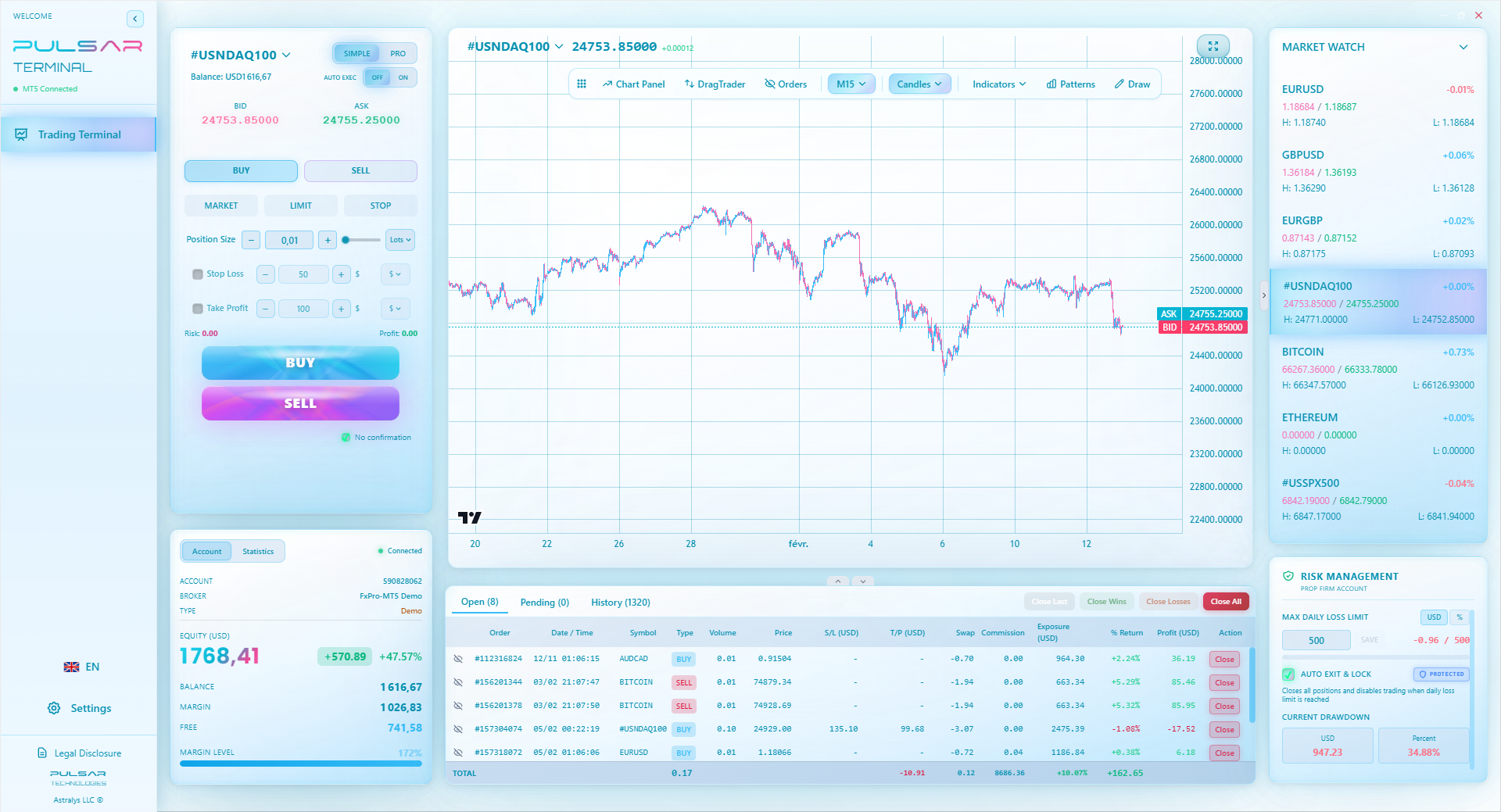
“A 1:1000 use offer means a 0.1% move against you wipes out your entire capital.”
Here's your action plan, starting today.
- Cap Your use: Go into your broker account (XM, Pepperstone, whoever) and manually lower your use from 1:1000 to 1:100 or even 1:50. This is a physical barrier to stupidity. It won't limit your sensible trades, but it will stop you from accidentally taking a position 100 times too big.
- Find and Master One Calculator: Don't jump between five different websites. Pick one strong position size calculator that allows inputs for account currency (NGN), costs, and different lot types. Practice with it on historical trades.
- Run the Calculation for EVERY Trade, No Exceptions: Even if you're 'just scalping 5 pips.' Especially then. The smaller the target, the higher the relative cost of the spread. If the math doesn't show a positive expectancy after costs, you're not trading, you're gambling.
- Backtest Your Strategy with Real Costs: Take your trading idea and apply it to last year's charts. For every entry, use your calculator to determine the position size based on your 1.5% rule. Add in the actual spread and a realistic commission. Write down the P&L. I promise you, most 'profitable' systems turn into losers when you add real transaction costs. Do this before you risk one more kobo.
use is a tool. In the hands of a surgeon, it's precise. In the hands of a gambler, it's a weapon of self-destruction. The forex profit calculator with use is your scalpel. Learn its weight, its sharpness, and use it to make calculated incisions, not reckless stabs. Your account balance will thank you.
FAQ
Q1What's the best use for a beginner forex trader in Nigeria?
Forget what brokers advertise. Start with no use at all on a demo account. When you move to real money, cap yourself at 1:10 or 1:20 maximum. This forces you to focus on building capital through skill, not through reckless magnification of tiny moves. High use (1:500+) is for experienced traders managing precise, small positions on volatile instruments, not for beginners trying to get rich quick.
Q2How do I calculate profit in Naira when my broker account is in USD?
You need to do a two-step conversion. First, calculate your profit/loss in USD using your position size and the pip movement. Second, convert that USD amount to Naira at the current USD/NGN exchange rate. Be aware: this rate fluctuates. A $100 profit when USD/NGN is 1200 is ₦120,000. The same $100 profit when USD/NGN is 1000 is only ₦100,000. Your real Naira returns are tied to two variables: your trading skill and the currency market you're not even directly trading.
Q3Why does my actual loss always seem bigger than what the calculator showed?
Three reasons: Slippage (your stop loss was 20 pips away but filled at 22), the spread (you were 'down 20 pips' but the bid/ask spread was 2 pips wide, so you were actually down 22 from your entry price), and psychological timing. You likely hesitated, moving your stop loss further away 'hoping' it would come back. The calculator assumes perfect, instant execution. The market doesn't work that way. Always add a buffer.
Q4Can I use a forex profit calculator for crypto or gold trading?
The core principle is the same: position size = risk / (stop distance * value per move). However, the calculators are different. Forex uses pips. Gold (XAU/USD) uses cents per ounce. Crypto can use dollars per coin. The value per point movement changes dramatically. Never use a forex calculator for other assets. Use a dedicated XAU/USD guide and calculator for gold, and a crypto-specific one for Bitcoin. Inputting the wrong pip/point value is a surefire way to mis-calculate your risk by a factor of 10 or 100.
Q5Do prop firms provide their own profit calculators?
Some do, but you should never rely solely on theirs. Their calculators are designed to show you how to pass their challenge, which often involves hitting high-profit targets. They might encourage using larger position sizes than a strict 1-2% risk rule would allow. Always cross-check their suggested lot size with your own independent calculator using your personal maximum risk tolerance. Protecting your own rules is more important than passing their test.
Q6Is there a mobile app for a good forex profit calculator?
Yes, many exist. But be very careful. A good mobile calculator must allow you to input all the variables: account currency, use, risk %, stop in pips, and the specific trading instrument. Avoid overly simplistic apps that just multiply your balance by use and a percentage. The best 'app' is often the trading calculator built into your MT4 or MT5 mobile platform. Use that, as it's directly connected to your broker's pricing.
Prof. Winston's Lesson
Key Takeaways:
- ✓Never risk more than 2% of your real capital on a single trade.
- ✓Calculate position size based on your stop loss, not your profit target.
- ✓Always add 20-30% to calculated losses for slippage and spread.
- ✓Real profit is calculated profit minus all transaction costs.
- ✓Cap your usable use at 1:50 as a physical barrier to error.
How useful was this article?
Click a star to rate
Weekly Trading Insights
Free weekly analysis & strategies. No spam.
About the Author
Olumide Adeyemi
West African Trading Pioneer
One of Nigeria's most active forex trading educators. 8 years of experience trading from Lagos. Specializes in low-capital strategies and prop firm challenges for African traders.
Comments
Risk Disclaimer
Trading financial instruments carries significant risk and may not be suitable for all investors. Past performance does not guarantee future results. This content is for educational purposes only and should not be considered investment advice. Always conduct your own research before trading.
You Might Also Like

Cara Trading Forex Sukses: 7 Prinsip dari Trader Profesional
Cara trading forex sukses dengan 7 prinsip trader pro: manajemen modal, disiplin, journal trading, backtest. Data nyata, bukan janji profit palsu.
Jam Trading Forex Terbaik untuk Trader Indonesia: Panduan Lengkap dengan Tabel Waktu
Panduan jam trading forex untuk trader Indonesia. Tabel 4 sesi dunia, jam emas 20:00-00:00, sesi mana yang harus dihindari. Data akurat + tips dari trader berpengalaman.
Top 5 Sàn Forex Uy Tín Nhất 2026: Review Jujur dari Trader Indonesia
Top 5 sàn forex uy tín 2026 untuk trader Indonesia. Review jujur: spread, deposit, withdraw, dukungan lokal. Exness, XM, IC Markets & lebih.
Get Pulsar Terminal
All these calculators are built into Pulsar Terminal with real-time data from your MT5 account. One-click position sizing, automatic risk management, and instant calculations.
Get Pulsar Terminal