


Let's get this straight: most people who try forex proprietary trading firms are just buying an expensive lesson in frustration.

Olumide Adeyemi
West African Trading Pioneer ·  Nigeria
☕ 11 min read
What you'll learn:
- 1What Exactly Is a Forex Prop Firm? (It's Not What You Think)
- 2Trading for a Prop Firm in Nigeria: The Local Realities
- 3The Rulebook: How Prop Firms Set You Up to Fail
- 4Picking a Prop Firm: What Actually Matters
- 5A Realistic Strategy to Pass the Challenge
- 6You Passed. Now What? Life as a Funded Trader
- 7Is It Worth It? Honest Alternatives
Let's get this straight: most people who try forex proprietary trading firms are just buying an expensive lesson in frustration. They see the ads - 'Trade with $100,000 of our capital!' - and ignore the fine print designed to make them fail. I've blown funded accounts and I've passed challenges. The difference isn't just skill; it's knowing how the game is rigged. This guide isn't about selling you a dream. It's about showing you the real numbers, the psychological traps, and the specific strategies that work in Nigeria's unique market so you can decide if this path is for you.
A forex proprietary trading firm gives you access to a larger trading pool, but you don't own the capital. You trade their money, and they take a cut of your profits. The classic model is a two-step challenge: a Evaluation Phase where you hit a profit target without breaking strict rules, followed by a Verification or Funded Phase where you get a live account.
Here's the catch they don't advertise: you are not their client. You are their product. The challenge fees are a huge revenue stream for them. Many firms make more money from people failing and re-taking challenges than they do from successful traders' profits. It's a brutal business model.
In Nigeria, the regulatory picture is fuzzy. The CBN and SEC oversee the broader financial market, but there's no specific watchdog for prop firms. This means you're relying on the firm's own terms and conditions, not local investor protection laws. Your main safeguard is picking a firm with a long, verifiable track record.

Warning: Between 69% and 83% of retail CFD traders lose money. Prop firm challenge failure rates are often higher, by design. The rules (daily loss limits, time limits) push you into high-risk behavior.

💡 Winston's Tip
The prop firm's rulebook isn't a guideline; it's the law. Print it out. Highlight the daily loss and max drawdown. Stare at it before you open your platform every single day.
“You are not the prop firm's client. You are their product. The challenge fees are a huge revenue stream.”
You're not trading in a vacuum. The Nigerian market has its own rhythms and quirks that can make or break a prop challenge.
The Naira and Your Psychology
Your local currency is the Naira (NGN), but you'll be trading majors like EUR/USD and GBP/USD. This creates a psychological disconnect. A 50-pip move on EUR/USD might be $500 on your prop account, but your brain instinctively converts it to Naira (over ₦700,000 at current rates). This can lead to either over-trading to chase a life-changing Naira sum or freezing up because the stakes feel too high. You must think in the base currency of your account (USD, EUR).
Infrastructure is Everything
Power cuts and bad internet aren't excuses to a prop firm. A dropped connection during a volatile news event can trigger a stop-loss and blow your daily drawdown. I learned this the hard way during a CBN policy announcement in 2023. My generator sputtered, my VPN dropped, and I was locked out for 90 seconds. Came back to a losing trade that hit my max daily loss. Game over. Invest in a reliable inverter, a backup mobile data hotspot, and a broker with a solid mobile app as a last resort.
Popular Pairs and Session Times
The most liquid pairs (EUR/USD, USD/JPY, GBP/USD) are your friends in a challenge. They have tighter spreads, which matters when you're scalping to hit a target. The London and New York overlaps (2pm - 5pm WAT) are prime time. Trying to trade exotic pairs or during thin Asian sessions just increases your spread costs and slippage risk, eating into your precious profit target.

Pro Tip: Use a position size calculator religiously. In a prop challenge, a single oversized trade is the fastest route to failure. Your risk per trade should never exceed 1% of the challenge's starting balance, not the target balance.
“A dropped connection during a volatile news event isn't an excuse to a prop firm; it's a failed challenge.”
This is where dreams go to die. You must memorize these rules like your own name.
Profit Target: Usually 8-10% in the evaluation. On a $100,000 account, that's $8,000-$10,000. Seems achievable until you realize you can't just grind it out slowly.
Maximum Daily Loss: Often 5%. Lose $5,000 in a day, account terminated. This includes floating losses. This rule forces you to cut losers immediately - no hoping for a reversal.
Maximum Overall Loss (Drawdown): Typically 10%. This is the big one. It's usually based on your starting balance or your peak equity, whichever is higher. If you start at $100,000 and get to $104,000, your new floor might be $94,000 (peak minus 10%). This trailing drawdown is a silent killer. You can be in profit overall but still get violated if you have a pullback from your high.
Time Limit: Many challenges give you 30 days. This creates urgency, which leads to mistakes. You start forcing trades that aren't there.
Trading Restrictions: Some ban holding trades over weekends or during high-impact news. Others mandate a minimum number of trading days.
My biggest mistake was ignoring the trailing drawdown. In a 2022 challenge, I was up 7%. Got complacent, took a large GBP/USD short without a tight stop. The trade went against me by 120 pips. Even though I was still up 2% overall from my start, my drawdown from the peak equity violated the rule. Account gone. I'd focused on the profit target and forgotten the more dangerous constraint.

Example: $100,000 account, 10% max loss, trailing from peak.
- Day 1: Start at $100,000.
- Day 10: Peak at $106,000. Your allowed floor is now $106,000 - $10,600 = $95,400.
- Day 15: A bad trade drops your equity to $95,200. VIOLATION. You're terminated, even though you're still above your original $90,000 floor. This is the trap.
“A dropped connection during a volatile news event isn't an excuse to a prop firm; it's a failed challenge.”
Forget the shiny marketing. Look at these factors.
Payout Proof & Reputation: Can you find real Nigerian traders on forums like Nairaland or Trader's Lounge who have actually been paid? Not testimonials on the firm's site, but independent proof. A firm's longevity is a good sign.
Profit Split: 80/20 in your favor is standard for the first payout. Some go to 90/10 after consistent performance. Anything less than 80/20 is a red flag.
Challenge Rules: Compare the key numbers. Look for firms with reasonable daily loss limits (5% is standard, avoid anything tighter) and a clear, static drawdown rule (not trailing from peak, if you can find it).
Broker & Platform: They should use a reputable, well-regulated broker like those in our IC Markets review or Pepperstone review. You want low spreads and fast execution. The platform should be MT4 or MT5, which you're familiar with.
Scaling Plan: How do you grow? The best firms have clear plans to increase your capital after you prove yourself over 3-6 months.
Withdrawal Process: How often can you withdraw? Monthly is standard. What are the fees? The process should be straightforward.
I once chose a firm based on a lower challenge fee alone. Big error. Their "raw spread" account had massive hidden commissions, and withdrawals took 45 days with vague "processing fees." I passed the challenge but lost more in fees and frustration than I made. The cheap option is often the most expensive.
| Feature | Good Sign | Red Flag |
|---|---|---|
| Profit Split | 80/20 or better, clearly stated | Vague terms, "up to" language |
| Drawdown | Static (e.g., 10% from start) | Trailing from peak equity |
| Payout Proof | Verifiable, independent testimonials | Only glossy website case studies |
| Withdrawal | Monthly, clear fee structure | Bi-monthly, vague "admin charges" |
💡 Winston's Tip
Your first goal in any challenge is not to make 10%. It's to survive the first week without hitting your daily loss limit. Survival first, profits second.
“The successful trader doesn't revenge trade after a loss. They close the platform and come back tomorrow.”
Forget complex scalping strategies with ten indicators. You need a boring, repeatable process.
Phase 1: Survival (First 50% of Target) Your only goal is not to lose. Risk 0.5% per trade, max. Aim for high-probability, low-reward setups. Think 1:1 or 1.5:1 risk-reward. Use the RSI indicator to spot overbought/oversold conditions on the 1-hour chart, but only take signals in the direction of the daily trend. Your job is to grind out 4-5% slowly and steadily. This builds a buffer against the trailing drawdown.
Phase 2: Capitalizing (Second 50% of Target) Now you have a cushion. You can increase risk slightly to 0.75-1% per trade. Look for stronger trend continuation patterns. Maybe use the MACD indicator on the 4-hour chart to confirm momentum. Do not change your strategy just because you're closer to the target. Greed is the enemy.
Risk Management is Non-Negotiable:
- Every trade has a stop-loss. Before entry, know your exact exit point.
- Never risk more than 1% on any single trade.
- If you hit 50% of your daily loss limit, stop trading for the day. Walk away.
- Your total open risk (all positions) should never exceed 2-3%.
Psychology: The challenge is a test of discipline, not genius. You will have losing days. The successful trader doesn't revenge trade after a loss. They close the platform, go do something else, and come back tomorrow with a clear head.
My first successful pass came from trading only one setup: the London open breakout on EUR/USD. I'd wait for the first hour's range, place a buy stop and a sell stop just outside it with a 1:1.5 risk-reward. Whichever hit, I'd cancel the other order. I traded it every day for three weeks. It was mind-numbingly boring, but it worked. I hit the 10% target with a 67% win rate. Boring is profitable.
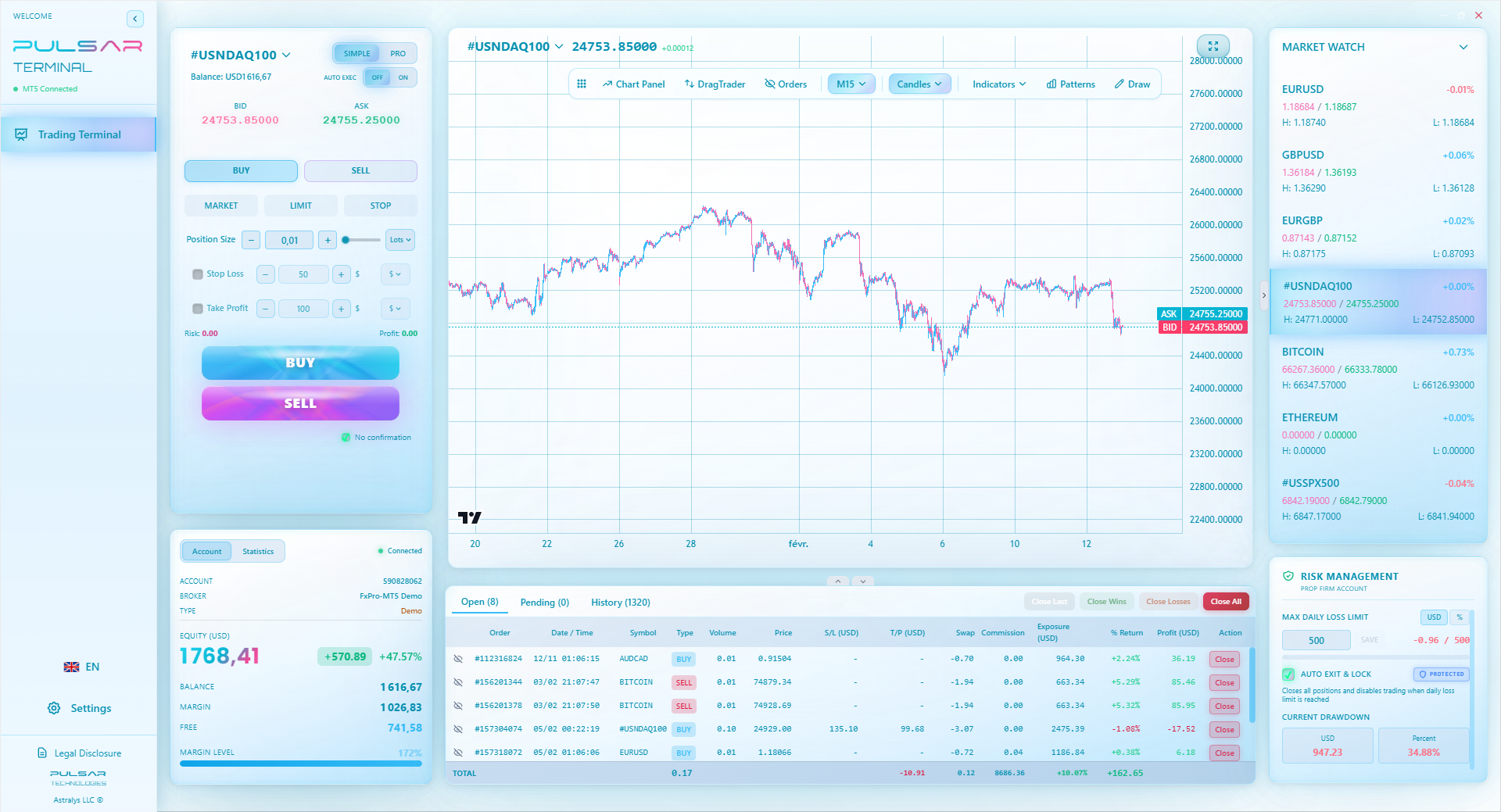
Managing multiple take-profit levels and a trailing stop manually is stressful; Pulsar Terminal automates it all on your MT5 chart, letting you focus on your next setup, not order management.
Pulsar Terminal
The all-in-one MT5 companion: drag-and-drop orders, multi-TP/SL, trailing stop, grid trading, Volume Profile, and prop firm protection. Used by 1,000+ traders daily.
“The successful trader doesn't revenge trade after a loss. They close the platform and come back tomorrow.”
Congratulations. The real work begins now. The pressure should lessen, but the discipline must increase.
The First Payout: Don't plan to buy a new car. Your first withdrawal should be to reimburse yourself for the challenge fee and maybe take a small profit. Leave the vast majority of the capital in the account to compound. This is a business, not a lottery.
Managing the Live Account: The rules are usually slightly relaxed, but the core principles remain. You now have a career to protect. Stick to the strategy that got you here. The temptation to "go big" will be strong. Resist it.
Taxes: Remember, in Nigeria, your trading profits are subject to Capital Gains Tax. The Federal Inland Revenue Service (FIRS) expects 10% of your gross profits. Keep careful records of your withdrawals and challenge fees (which may be deductible as a business expense). This is not optional. Get a local accountant who understands trading income.
The Scaling Plan: Most good firms will increase your capital after 3-6 months of consistent, rule-following profits. Don't rush this. It's better to have three flawless months on a $100k account than one volatile month begging for a $200k account. Consistency is your ticket to more capital.
The mental shift is huge. You're no longer trying to get money; you're trying to keep and grow money. I made the mistake of taking a huge first payout after my first successful month, leaving the account thin. A inevitable losing streak followed, and I came dangerously close to a margin call scenario. I had to rebuild from a weakened position. It was a stupid, avoidable mistake.
💡 Winston's Tip
When you get funded, your first withdrawal should go to the tax man (FIRS). Get that obligation out of the way immediately. Nothing kills a trading career faster than a tax bill you can't pay.
“If you can consistently pass a prop challenge, you can consistently trade your own $500 account.”
Let's be brutally honest. For many Nigerians, the prop firm path is a costly distraction.
The Case Against Prop Firms: You're paying a fee (often $200-$500) to audition for a job with rigid rules. That money could be your own trading capital. If you can consistently pass a challenge, you can consistently trade your own $500 account. The growth might be slower, but you keep 100% of the profits, answer to no one, and have no arbitrary rules. The Nigerian market's growth (turnover up 56.4% to $8.6 billion in 2025) means there's opportunity for the disciplined solo trader.
A Better Path for Most:
- Start Small with a Reputable Broker: Use a broker from our XM review or Exness review that accepts Naira deposits. Start with the minimum, maybe ₦50,000.
- Prove Your Strategy Live: Trade your own capital with the same discipline a prop firm would demand. Aim for 3-6 months of consistent, documented profitability. Use a journal.
- Compound or Seek Investors: Once you have a track record, you have options. You can slowly compound your own account, or you might attract private capital from friends/family on your own terms. Your proven record is more valuable than any passed challenge.
Prop firms make sense for one type of person: the trader with a solid, proven edge but absolutely zero capital. If you have some capital, even ₦100,000, you're often better off building your own empire, one pip at a time. The discipline you learn will be the same, but the freedom and full profit potential are yours.
FAQ
Q1Are forex prop firms legal in Nigeria?
Yes, but they operate in a regulatory grey area. The CBN and SEC regulate the financial sector broadly, but there's no specific license for prop trading firms. Your protection comes from the firm's own terms and international reputation, not strong local investor protection laws. Always verify a firm's track record independently.
Q2How much does it cost to join a prop firm challenge in Nigeria?
Challenge fees typically range from $50 to $500, depending on the account size you're trying for ($10k to $200k+). You pay this fee upfront, and it's usually non-refundable. This is their primary business model, so factor this cost into your decision. It's not an 'investment'; it's an audition fee.
Q3What is the best prop firm for Nigerian traders?
There's no single 'best.' Look for firms with: 1) Verifiable payout proof from Nigerian traders, 2) Use of reputable brokers (like IC Markets or Pepperstone), 3) Clear, reasonable rules (avoid extreme trailing drawdowns), and 4) A straightforward withdrawal process. Do your own research on forums; don't believe the ads.
Q4What is the biggest mistake traders make in prop challenges?
Oversizing trades. They see a $100,000 balance and trade 5 lots, risking 5% per trade. One loss blows their daily limit. The second biggest mistake is not understanding the trailing drawdown rule. You can be in profit and still fail if your equity pulls back from its peak. Use a position size calculator on every single trade.
Q5Do I pay taxes on prop firm profits in Nigeria?
Yes. The Federal Inland Revenue Service (FIRS) considers trading profits as capital gains, taxable at 10% of your gross profits. You are responsible for declaring this income and paying the tax. Keep all your withdrawal statements and challenge fee receipts for your records.
Q6Can I use Expert Advisors (EAs) or copy trading in a prop challenge?
Almost always, NO. Most prop firms explicitly forbid the use of EAs, copy trading, or any form of automated trading during their evaluation challenges. They want to assess your personal skill and discipline. Using one is a guaranteed way to get your account terminated without a refund.
Q7Is it better to trade my own money or join a prop firm?
If you have a proven, disciplined strategy and at least $500-$1000 of risk capital, trading your own account is almost always better. You keep all profits, have no rules, and build your own asset. Prop firms are for traders with a solid edge but literally zero capital to start. For most, building slowly with your own money is the smarter, more sustainable path.
Prof. Winston's Lesson
Key Takeaways:
- ✓Risk never more than 1% per trade in a challenge.
- ✓The trailing drawdown rule is the #1 account killer.
- ✓10% Capital Gains Tax applies to your prop profits.
- ✓Boring, repeatable strategies pass challenges. Excitement fails them.
How useful was this article?
Click a star to rate
Weekly Trading Insights
Free weekly analysis & strategies. No spam.
About the Author
Olumide Adeyemi
West African Trading Pioneer
One of Nigeria's most active forex trading educators. 8 years of experience trading from Lagos. Specializes in low-capital strategies and prop firm challenges for African traders.
Comments
Risk Disclaimer
Trading financial instruments carries significant risk and may not be suitable for all investors. Past performance does not guarantee future results. This content is for educational purposes only and should not be considered investment advice. Always conduct your own research before trading.
You Might Also Like

Cara Trading Forex Sukses: 7 Prinsip dari Trader Profesional
Cara trading forex sukses dengan 7 prinsip trader pro: manajemen modal, disiplin, journal trading, backtest. Data nyata, bukan janji profit palsu.
Jam Trading Forex Terbaik untuk Trader Indonesia: Panduan Lengkap dengan Tabel Waktu
Panduan jam trading forex untuk trader Indonesia. Tabel 4 sesi dunia, jam emas 20:00-00:00, sesi mana yang harus dihindari. Data akurat + tips dari trader berpengalaman.
Top 5 Sàn Forex Uy Tín Nhất 2026: Review Jujur dari Trader Indonesia
Top 5 sàn forex uy tín 2026 untuk trader Indonesia. Review jujur: spread, deposit, withdraw, dukungan lokal. Exness, XM, IC Markets & lebih.
Get Pulsar Terminal
All these calculators are built into Pulsar Terminal with real-time data from your MT5 account. One-click position sizing, automatic risk management, and instant calculations.
Get Pulsar Terminal