


I stared at the MT4 terminal on a Tuesday afternoon in March 2025.

David van der Merwe
Emerging Markets Trader ·  South Africa
☕ 11 min read
What you'll learn:
- 1Why Profit is a Liar (And What to Measure Instead)
- 2Building Your SA Forex Rating System (The Spreadsheet)
- 3The Broker Factor in Your Rating
- 4Rating Your Mind: The Psychology Score
- 5From Rating to Action: The Improvement Cycle
- 6Common SA Pitfalls That Wreck Your Rating
- 7Tools to Automate Your Forex Rating
- 8The Ultimate Goal: Beyond the Score

I stared at the MT4 terminal on a Tuesday afternoon in March 2025. My account was up R4,200 for the week. By all normal measures, I was 'winning.' But a cold knot in my gut told me otherwise. The profit was from a single, reckless ZAR/JPY trade where I'd quadrupled my usual position size out of frustration. I'd broken every rule in my plan. That was the day I realized 'profit' is a terrible scorecard. I needed a real forex rating - a system that measured how I traded, not just the rand amount in the account. This is how you build one.
We're conditioned to look at the bottom line. It's the first thing you check, the number you brag about (or hide). But here's the brutal truth: profit, especially over a short period, is mostly noise. Luck. A few good trades can mask a dozen terrible decisions. I learned this the hard way in early 2024. I had a stellar month, netting over R15,000. I felt invincible. The next month, I gave back R18,000. Why? Because my 'winning' month was built on two massive, high-risk EUR/USD gambles that happened to pay off. My process was garbage.
Your forex rating shouldn't start with money. It should start with behavior. Think of it like a report card for your trading psychology and discipline. What metrics actually tell you if you're improving? Your win rate is one, but it's overrated. A 60% win rate sounds great until you realize your losing trades are three times the size of your winners. That's a losing strategy.
You need to track your average winner vs. your average loser. You need to know your risk-to-reward ratio on every trade entered, not just the ones that hit take profit. Most importantly, you need to track your adherence to your own rules. Did you use your position size calculator for every trade? Did you move to breakeven when the plan said to? Did you avoid trading during the JSE open if your strategy is based on London sessions? These are the real grades.

Warning: A profitable month with poor discipline is more dangerous than a losing month with good discipline. The first teaches you bad habits that will eventually bankrupt you.
Forget fancy software for now. Open Google Sheets. This is your journal and your rating calculator. You need columns that go far beyond 'Pair' and 'P/L'.
The Mandatory Columns
- Trade Date & Session: Was it Asian, London, or New York? I found 70% of my failed trades happened when I was bored during the thin Asian session, trying to force action.
- Instrument: Note if it's a major, minor, or exotic. Your performance will differ.
- Setup Trigger: What exactly prompted the entry? (e.g., 'Daily support bounce,' '15-min MACD indicator crossover'). Be painfully specific.
- Planned R:R: This is critical. Before you enter, note your target risk-to-reward. 1:2? 1:3?
- Actual R:R: What did it actually end up being? The discrepancy between these two columns is a goldmine of information on your exit psychology.
- Position Size (% Risk): Did you risk 1% as per your plan, or did you 'eyeball' it?
- P/L in Rands & Pips: Both matter. Pips show the market's movement; Rands show the impact.
- Emotional State: Honest one-word answers: 'Calm,' 'Frustrated,' 'Greedy,' 'Revenge.'
- Rule Breaks: This is the most important column. 'Increased size,' 'Ignored stop loss,' 'Traded outside strategy.'
The Weekly Scorecard
At the end of each week, create a summary box. Calculate:
- Win Rate: (Number of winning trades / Total trades) * 100.
- Profit Factor: (Gross Profit / Gross Loss). Anything above 1.2 is decent. Above 1.5 is strong. This tells you more than win rate.
- Average Win (R) / Average Loss (R): Aim for this ratio to be greater than 1, ideally aligned with your planned R:R.
- Rule Adherence Score: (Trades with zero rule breaks / Total trades) * 100. This is your true forex rating. My goal is to keep this above 90%. If it dips below 80%, I stop live trading and go back to demo.

Example: Week Summary: Trades: 10. Win Rate: 40%. Profit: R2,100. Profit Factor: 1.8. Rule Adherence: 70%. Verdict? A profitable week with terrible discipline. Rating: F. Must review.

💡 Winston's Tip
A student once showed me a profitable month. I made him highlight every trade where he broke his own rules in yellow. The page looked like a sunflower field. We framed it. His most valuable chart wasn't his equity curve; it was that yellow-smeared journal page.

“Your broker's reliability is a foundational part of your overall trading health. Don't ignore it.”
Your broker isn't just a platform; they're a business partner. Their performance directly affects your rating. A great trade idea can be ruined by terrible execution. In South Africa, we have a mix of international brokers and local CFD providers. You need to rate them too.
How does your broker's average spread definition on EUR/USD during the London open affect your scalping strategy? If you're paying 1.8 pips on a major pair when the global standard is 0.8, you're starting every trade in a hole. That directly hurts your profit factor, a key part of your rating.
Execution speed and slippage are huge. I once had a perfect setup on Gold (XAU/USD). My stop was 5 pips away. The news hit, and my stop was filled 12 pips away. That one event turned a 1% risk into a 2.4% loss. It destroyed my weekly rating. I started logging 'Slippage Events' as a separate metric. After three instances in a month with one broker, I left. I moved to a broker known for tighter spreads and better execution, like IC Markets or Pepperstone, and my rating on trade execution improved immediately.
Also, consider the ease of use. Does withdrawing your profits feel like pulling teeth? A good weekly rating is soured if you can't access your money. Your broker's reliability is a foundational part of your overall trading health. Don't ignore it.
This is the hardest part to quantify, but the most important. Your mental state is your edge. Or your downfall. I now give myself a daily 'Mind Rating' out of 10 before I even look at the charts.
- Am I tired or stressed from work? If below 6/10, I don't trade. Full stop.
- Did I sleep poorly? Sleep deprivation has the same effect as being drunk on decision-making.
- Am I chasing losses or chasing profits? Both are deadly forms of greed.
I track this in my journal. Over time, I saw a direct correlation. My 'Mind Rating' days of 8 or higher had a rule adherence score of 95%. My P/L was consistently positive. Days where I forced a trade with a 5/10 mind rating? Rule adherence plummeted to 50%, and losses followed.
One technique I stole from a mentor: The 'Post-Trade 60-Second Review.' After every trade closes, win or lose, sit for 60 seconds. No clicking, no looking for the next trade. Just feel. What's the dominant emotion? Relief? Euphoria? Anger? Write it down. A feeling of 'relief' after a winning trade is a red flag. It means you were over-leveraged or emotionally over-invested. A feeling of 'calm satisfaction' after a loss (where you followed the plan) is a green light. It means your system is working, even when the market doesn't pay you. That's an A+ psychology rating.
“A feeling of 'relief' after a winning trade is a red flag.”
A rating is useless if it doesn't lead to change. Your weekly review is where the magic happens. This isn't about patting yourself on the back. It's a forensic audit.
Step 1: Aggregate the Data. Look at your weekly summary. Ignore the P/L for a moment. What does the Rule Adherence score say? What does the Profit Factor say?
Step 2: Find the Pattern. Are all your losses coming from a specific setup? For me, it was false breakouts. My rating for 'Breakout Trades' was consistently D or F. The data didn't lie. So, I either had to improve that strategy dramatically or remove it from my playbook. I removed it. My overall rating climbed.
Step 3: Set ONE Improvement Goal. Don't try to fix everything. If your rule adherence was 75%, the goal for next week is 80%. If your average win is only 0.8x your average loss, the goal is to adjust your take-profit placement to get it to 1.0x. One goal. That's it.
Step 4: The Consequence. This is key. My rule is: if I have two consecutive weeks with a rule adherence below 80%, I am mandated to trade on a demo account for the next week. No arguments. It turns the rating from a abstract concept into a real, operational boundary. It protects my capital from myself.
This cycle turns trading from a guessing game into a process of deliberate practice. You're not just waiting for profits; you're engineering a more competent trader.
💡 Winston's Tip
You wouldn't trust a surgeon who only tracked his 'successful operations' but not his infection rate or procedure times. You are the surgeon of your account. Rate the entire operation.
Trading from South Africa comes with unique psychological traps. Being 6-8 hours ahead of the US means we often see the results of overnight moves when we wake up. This creates a dangerous FOMO (Fear Of Missing Out). You see a big move on the EUR/USD guide that happened while you slept, and you jump in late, chasing the tail end. This almost always results in a low-rated trade: poor entry, higher risk, and emotional desperation.
Another one: the 'ZAR Hedge' obsession. We naturally look at USD/ZAR. When the rand is getting hammered, there's a visceral urge to 'protect' your wealth by going long USD. This isn't trading; it's emotional hedging. It rarely aligns with a clean technical setup, and it leads to over-leveraging on a volatile exotic pair. I've blown up a small account doing exactly this. It scored a 0 on my rating scale - no plan, pure emotion.
Liquidity is also a factor. Trading during the Johannesburg session can be tricky for major pairs. Spreads widen, and moves can be erratic. If your strategy is built for London volatility, forcing trades in the early SA afternoon will generate poor performance data. Know your strategy's 'active hours' and have the discipline to wait. A blank trading day with no entries is often a higher-rated day than one with three forced, low-probability trades.
“The ultimate goal isn't a perfect score. It's consistency.”
Manually logging everything in a spreadsheet is the best way to start - it forces mindfulness. But as you grow, automation helps. Many brokers offer detailed trade history reports you can export. Some third-party platforms like Tradervue or Edgewonk allow you to import your statements and automatically calculate your profit factor, win rate, and other metrics.
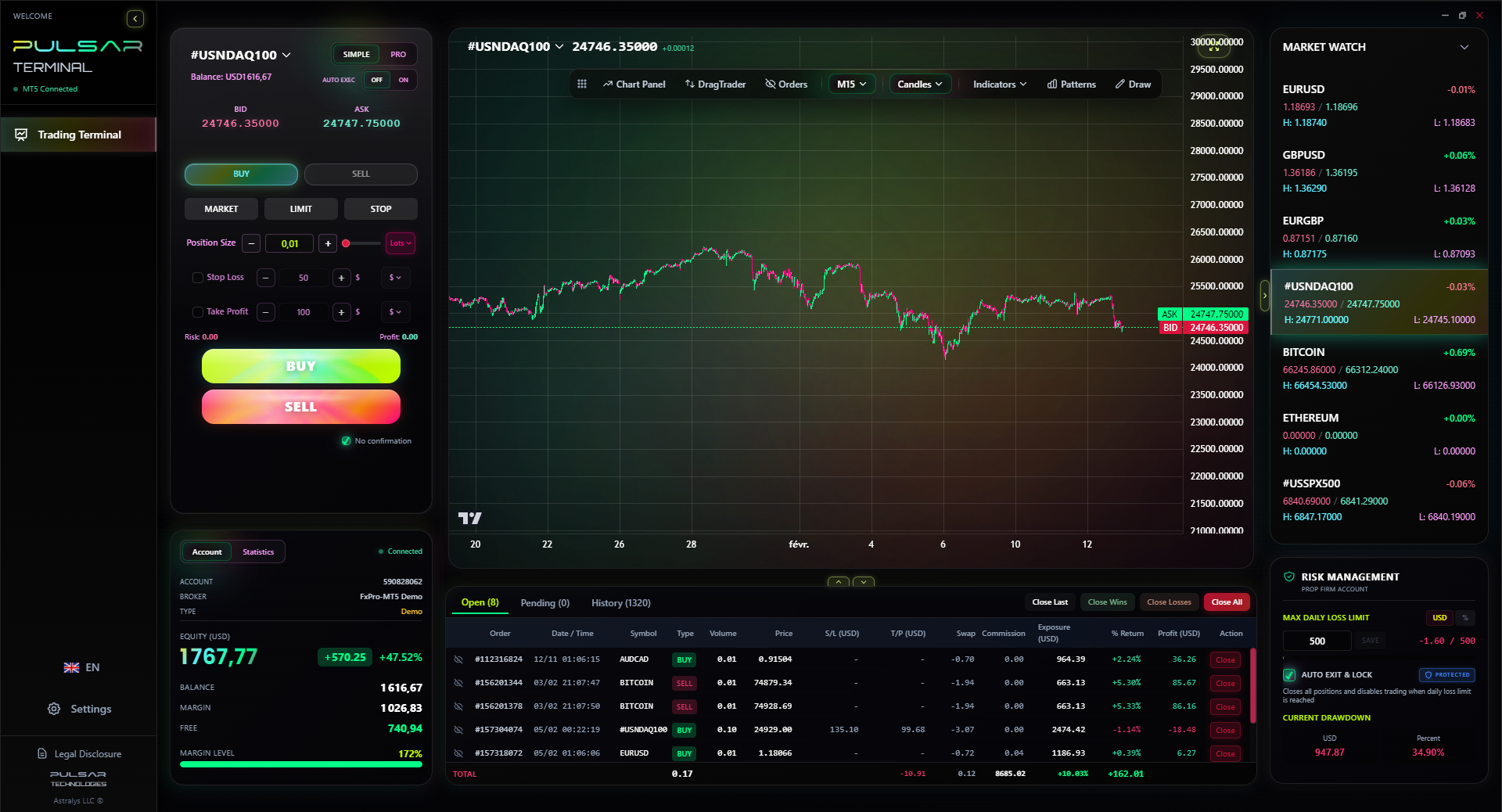
For active management, a tool that enforces discipline is worth its weight in gold. This is where a platform companion like Pulsar Terminal shines. Let's say your rating system shows you keep missing your breakeven moves or you let winners turn into losers. Manually moving stops is a psychological battle. A tool that lets you set a multi-tiered trade plan with automatic breakeven and trailing stop orders before you even enter removes that emotional hurdle. It ensures the trade is managed according to your system's rules, not your gut in the moment. This directly boosts your Rule Adherence score.
Similarly, if you're testing a grid strategy, manually placing 10 orders is a chore and error-prone. Automation ensures the strategy is executed exactly as planned, giving you clean data to rate. The goal is to offload the mechanical, emotion-prone tasks so you can focus on analysis and maintaining the right mindset. Your tools should work to improve your rating, not complicate it.

Building a high forex rating requires flawless trade execution according to your plan, which is exactly what Pulsar Terminal's automated order and risk management tools are designed to enforce on your MT5 platform.
Pulsar Terminal
The all-in-one MT5 companion: drag-and-drop orders, multi-TP/SL, trailing stop, grid trading, Volume Profile, and prop firm protection. Used by 1,000+ traders daily.
After three years of using this rating system, something shifted. I stopped caring about my weekly P/L. Seriously. I'd open my weekly summary and look straight at the Rule Adherence and Profit Factor. If those were strong, I felt calm and successful, even if the rand amount was negative. If they were weak, I felt concerned, even if I was up money.
The ultimate goal isn't a perfect score. It's consistency. It's building a process so strong that luck is removed from the equation. Your forex rating becomes a compass. When the market gets chaotic - and it will - you don't panic. You just return to your process. You check your metrics. You trust the system you've built and rated over hundreds of trades.
I remember a period in late 2025 where I had six losing trades in a row. A few years prior, that would have sent me into a spiral of revenge trading. This time, I checked my rating. My rule adherence was 98%. My entries were valid, my risk was capped at 1%. The market was just noisy. I took a day off, came back, and the next five trades were winners. The losing streak didn't hurt my account much, and it didn't hurt my confidence, because my rating told me I was trading well. That's the real power. It's not about judging yourself. It's about giving yourself the data to trust yourself.
FAQ
Q1What's the single most important metric in a personal forex rating?
Forget win rate. It's Profit Factor (Gross Profit / Gross Loss). A profit factor above 1.2 means your system makes money. Above 1.5 is excellent. It encapsulates both how often you win and the size of your wins vs. losses. A high win rate with a low profit factor means your losses are too big.
Q2I'm a beginner in South Africa. How do I start?
Start on a demo account, but treat it like real money. Use a simple spreadsheet from day one. Your only goal for the first 100 trades is to achieve a Rule Adherence score above 90%. Don't focus on profit. Focus on executing a simple plan - any plan - perfectly. This builds the discipline muscle before real rand is on the line.
Q3How often should I review my full forex rating?
Log every trade immediately. Do a quick daily review of your 'Mind Rating' and any rule breaks. Then, do a full, uncompromising weekly review every Friday after markets close. This weekly rhythm is perfect - it's long enough to gather meaningful data but short enough to correct course quickly.
Q4My rule adherence is low because I keep moving my stop loss. How do I fix this?
This is the most common leak. First, understand you're trying to avoid pain. The fix is mechanical: place your stop loss and then delete the pending order from your terminal. If you can't see it easily, you can't change it. Alternatively, use a tool that allows you to set the stop and then 'locks' it, or move to a broker platform where modifying orders is less intuitive. Out of sight, out of mind.
Q5Does my broker choice really affect my performance rating?
Absolutely. Consistently wide spreads lower your potential profit on every winning trade and increase every loss. Frequent slippage or requotes destroy your planned risk-to-reward. If your trade log shows consistent issues with execution, it's not you - it's them. Part of a professional's rating includes broker performance. Consider switching to a globally-trusted, low-latency broker like Exness or XM for better raw data.
Q6Can a good forex rating prevent a margin call?
It's your best defense. A proper rating system forces you to use a position size calculator every time (rule adherence). It makes you aware of your losing streak statistics. If you know your max historical drawdown is 15%, and you have a rule to stop at 10% drawdown for the month, you'll never get near a margin call. Margin calls happen to traders who aren't measuring anything.
Prof. Winston's Lesson
Key Takeaways:
- ✓Track Rule Adherence, not just P/L.
- ✓Profit Factor > Win Rate. Aim for 1.5+.
- ✓Do a full forensic weekly review.
- ✓Automate emotion out of trade management.
How useful was this article?
Click a star to rate
Weekly Trading Insights
Free weekly analysis & strategies. No spam.
About the Author
David van der Merwe
Emerging Markets Trader
Johannesburg-based trader with 11 years in emerging market currencies. Specializes in ZAR pairs, FSCA-regulated trading, and South African market analysis.
Comments
Risk Disclaimer
Trading financial instruments carries significant risk and may not be suitable for all investors. Past performance does not guarantee future results. This content is for educational purposes only and should not be considered investment advice. Always conduct your own research before trading.
You Might Also Like

Cara Trading Forex Sukses: 7 Prinsip dari Trader Profesional
Cara trading forex sukses dengan 7 prinsip trader pro: manajemen modal, disiplin, journal trading, backtest. Data nyata, bukan janji profit palsu.
Jam Trading Forex Terbaik untuk Trader Indonesia: Panduan Lengkap dengan Tabel Waktu
Panduan jam trading forex untuk trader Indonesia. Tabel 4 sesi dunia, jam emas 20:00-00:00, sesi mana yang harus dihindari. Data akurat + tips dari trader berpengalaman.
Top 5 Sàn Forex Uy Tín Nhất 2026: Review Jujur dari Trader Indonesia
Top 5 sàn forex uy tín 2026 untuk trader Indonesia. Review jujur: spread, deposit, withdraw, dukungan lokal. Exness, XM, IC Markets & lebih.
Get Pulsar Terminal
All these calculators are built into Pulsar Terminal with real-time data from your MT5 account. One-click position sizing, automatic risk management, and instant calculations.
Get Pulsar Terminal