


I remember watching my screen in late 2023, a short EUR/NGN position open.

Olumide Adeyemi
West African Trading Pioneer ·  Nigeria
☕ 11 min read
What you'll learn:
- 1What Forex Risk Really Means for a Nigerian Trader
- 2The 3 Costliest Mistakes I See Nigerian Traders Make
- 3Your Risk Management Blueprint: No Theory, Just Rules
- 4The Nigerian Broker Minefield: Regulation, Deposits, and Reality
- 5Tools That Actually Help (And Ones That Don't)
- 6The Mental Game: How to Not Lose Your Mind
- 7Building for the Long Term: Beyond the First Trade
I remember watching my screen in late 2023, a short EUR/NGN position open. The CBN had just announced another policy shift. In the space of an hour, what was a comfortable 1.5% profit turned into a 4% loss that triggered my stop-loss. I didn't just lose dollars; I lost Naira purchasing power in a market I thought I understood. That's forex risk in Nigeria. It's not just about pips and percentages; it's about your money evaporating in a system that's fundamentally stacked against the unprepared. Let's strip away the hype and talk about what you're really up against.
Forget the textbook definitions. In Nigeria, forex risk has layers a London or New York trader never considers. The first layer is market risk: your trade going against you. That's universal. The second, more vicious layer is currency risk on your own capital. You fund your account in Naira (often at a terrible rate), the broker holds it in USD, and you're trading EUR/USD or GBP/JPY. If the Naira strengthens unexpectedly - like it did in early 2026, gaining over 7% - the dollar value of your Naira deposit shrinks before you've even placed a trade. You start in a hole.
Then there's liquidity risk. During major CBN announcements or when the parallel market gap widens (think N1,430 official vs. N1,475 black market), the spreads on exotic pairs involving NGN can blow out. Your broker's quoted price might not be executable, or your stop-loss gets filled at a much worse price than you set. This isn't a glitch; it's the market pricing in pure uncertainty.
Finally, there's the omnipresent country risk. Regulatory changes aren't gentle tweaks here. When the CBN unified exchange rate windows in 2023 or jacked up IMTO license fees by nearly 1900% over a decade, it caused seismic shifts. Your clever carry trade strategy can be obliterated by a single circular from Abuja. This isn't pessimism; it's the baseline reality you must plan for. Your first job isn't to pick tops and bottoms; it's to survive the structural chaos.

Warning: Never conflate trading USD/NGN on a CFD platform with actually accessing the official Nigerian Foreign Exchange Market (NFEM). You're betting on a price quote from your broker, not exchanging currency with the CBN. The spreads are wider, the liquidity is synthetic, and you have zero influence on the rate.

💡 Winston's Tip
Risk isn't a spreadsheet concept. It's the sick feeling in your gut when a trade moves against you and you don't have a plan. Build the plan first.
“Your first job isn't to pick tops and bottoms; it's to survive the structural chaos.”
After mentoring traders here for years, the failures are painfully predictable. If you avoid these, you're ahead of 80% of the crowd.
1. Trading With Emotion, Not a Plan
You see the Naira is N1,475/$ on the street and the news is screaming about depreciation. So you rush to sell USD/NGN, expecting it to go higher. That's not trading; that's gambling on headlines. In 2026, the Naira strengthened by over N110 at the official window. That rally would have wiped out anyone short without a plan. You need a written strategy that dictates your entry, exit, and position size calculator before you click buy or sell. Your gut is a liar when Lagos traffic is bad and your data is slow.
2. Overleveraging the Naira Deposit
This is the killer. You deposit N500,000. At your broker's rate, that's maybe $333. Then you use 1:100 use and buy 2 standard lots of GBP/USD. That's a $200,000 position controlling your $333. A 17-pip move against you - a tiny blip - wipes out 100% of your capital. I've done it. In 2021, I got cocky on a USD/ZAR trade, used excessive use, and turned a N200,000 account into N38,000 in two days. A margin call isn't a suggestion; it's an eviction notice. use magnifies your losses faster than your gains.
3. Ignoring the True Cost of Trading
You look at the spread definition on EUR/USD - 1 pip! - and think it's cheap. But are you paying a commission? What's the swap fee for holding an overnight position? If you're scalping strategy, those 1-pip spreads eat your profits alive. I once tried a scalping system on USD/JPY with a broker charging a 3-pip spread during Asian sessions. I needed to be right 65% of the time just to break even. I wasn't. You must know all fees (spread, commission, swap, withdrawal) and factor them into your profit targets. Nothing is free.

Example: You buy 1 mini lot (10,000 units) of USD/NGN at a quoted rate of N1,450. The spread is 50 pips (N5). Your trade is instantly down N5,000 (50 pips * 10,000 units / 100). You need the market to move N5 in your favor just to reach breakeven. That's a huge hurdle.
“use magnifies your losses faster than your gains.”
Here's what you actually do, starting today.
Rule 1: The 1% Rule is Your Bible. Never, ever risk more than 1% of your trading account capital on a single trade. If your account is N1,000,000, your maximum risk per trade is N10,000. This isn't a suggestion for beginners; it's the law for anyone who wants to be here next year. Calculate your position size based on the distance between your entry and your stop-loss. If that distance implies a risk of N15,000 on your N1M account, your position is too big. Scale down.
Rule 2: Stop-Loss Orders Are Not Optional. Your stop-loss is a pre-planned admission of being wrong. Place it at a level that, if hit, proves your trade idea was invalid. Don't place it based on how much money you're willing to lose. In 2024, I went long on XAU/USD (gold) based on a support level at $1980. My stop was at $1975, a $5 risk. The level broke, my stop was hit, and gold plunged to $1950. That N50,000 saved me from a N250,000 loss. Use a trailing stop to lock in profits as a trade moves your way, a feature good trading tools can automate for you.
Rule 3: Know Your Ratios. Aim for a risk-to-reward ratio of at least 1:2. You risk N10,000 to make a potential N20,000. This means you can be wrong more often than you're right and still be profitable. If your win rate is 40%, but your average winner is twice the size of your average loser, you're in the green. This forces you to hunt for quality setups, not just frequent ones.
Rule 4: Keep a Trading Journal. Not a notepad. A detailed log: date, instrument, entry/exit price, position size, reason for trade, screenshot of chart, emotional state. Review it weekly. You'll see your own stupid patterns emerge. I found I lost 70% of my trades entered after 10 PM Lagos time. I was tired and impulsive. I stopped. Problem solved.
“use magnifies your losses faster than your gains.”
This is the murkiest part. The CBN regulates the broader FX market, but its direct oversight of international retail forex brokers serving Nigerians is not always crystal clear. You won't find a CBN license number on the website of Exness review, IC Markets review, or XM review. They operate under offshore licenses (CySEC, ASIC, FSA). This isn't inherently bad, but it changes your recourse if something goes wrong.
Your main risks are:
- Deposit/Withdrawal Friction: Converting Naira to USD. Some brokers offer local bank transfers, but the exchange rate applied is rarely the official CBN rate. You might lose 2-5% on the conversion alone. Others use payment processors that can be slow or incur extra fees.
- Platform Stability: During high volatility (like after a CBN MPC meeting), does the trading platform freeze? Do requotes become constant? A broker with poor infrastructure is a direct forex risk.
- Customer Service: Can you get someone on the phone or WhatsApp when you need to? A Lagos-based support office is a huge plus.
My advice? Stick with large, internationally recognized brokers with a long track record and a physical presence or dedicated support for Africa. Test their withdrawal process with a small amount first. Read our Pepperstone review to see how one major broker handles these issues. Never deposit more than you can afford to lose with a new broker. Consider them a counterparty risk until proven otherwise.
💡 Winston's Tip
If you can't explain your stop-loss level in one clear sentence ('It's below yesterday's low'), you don't have a reason for the trade. Close it.
“A well-executed trade that loses money is a good trade. A sloppy trade that makes money is a disaster.”
Indicators and platforms are not magic. Used wrong, they increase risk by giving you false confidence.
Useful Tools:
- A Reliable Platform: MetaTrader 5 (MT5) is the standard for a reason. It's stable and allows for complex order types.
- Volume Data: Understanding where large orders sit can show real support/resistance. This is more valuable than a lagging indicator.
- Economic Calendar: Marking CBN MPC meeting dates, US NFP, and inflation releases. Don't trade during these events unless it's your specific strategy. The MACD indicator won't save you from a central bank shock.
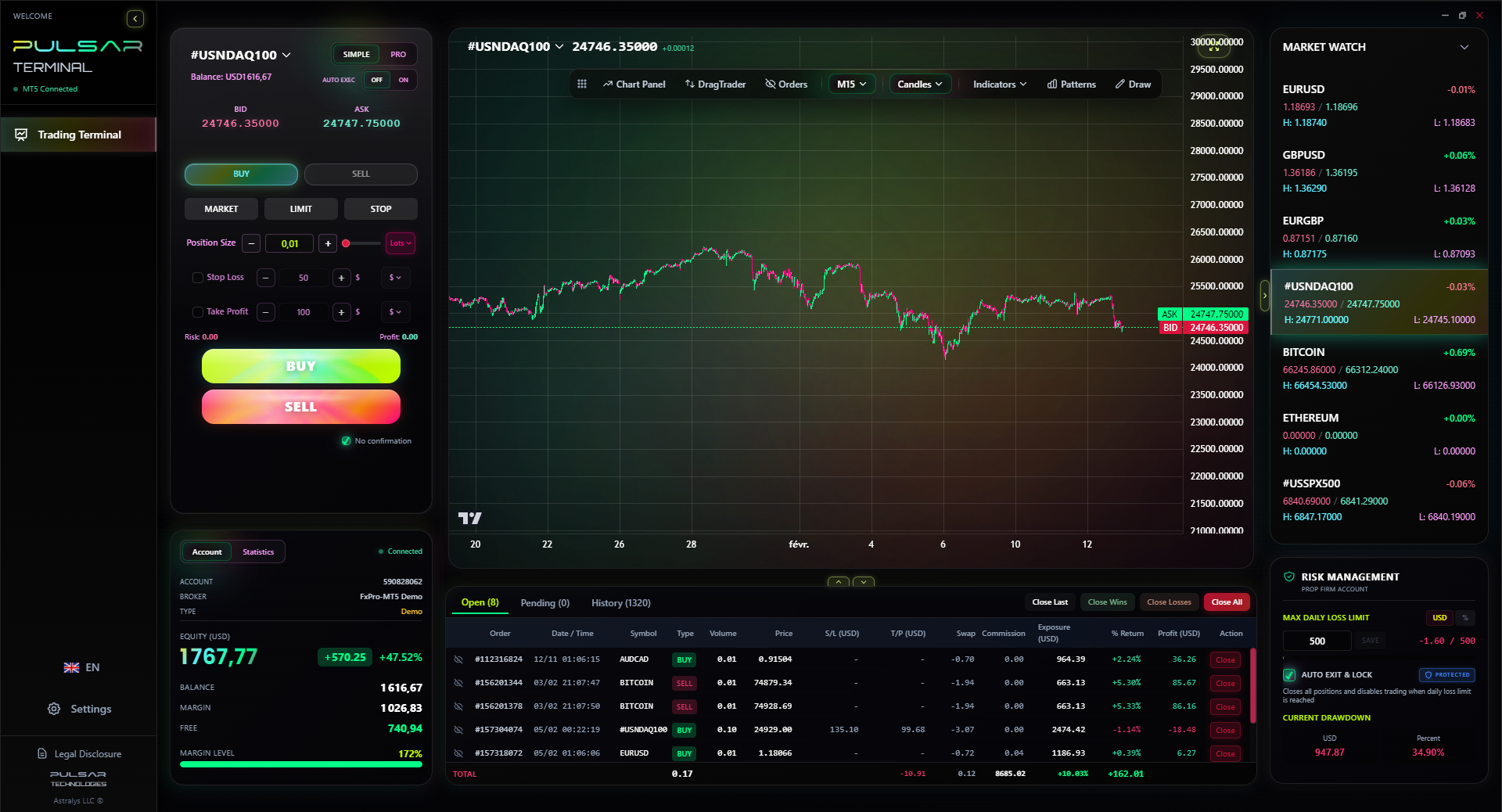
- A Proper Terminal: Basic MT5 is good, but a companion app that lets you drag-and-drop orders, set multiple take-profits with partial closures, and automate trailing stops directly on the chart is a game-saver. It turns complex risk management plans into one-click actions, reducing emotional mistakes.
Mostly Useless for Risk Management:
- Overloading Charts: Putting 10 different indicators on your screen. They'll all say the same thing (they're derived from price) and just confuse you. Pick one or two you understand deeply, like the RSI indicator for spotting overbought/oversold conditions within a trend.
- "Sure Profit" Signals: Any service promising guaranteed returns is stealing from you. Full stop.
The best tool is your own discipline, codified by the technology. Automation executes your plan without hesitation.
Executing complex risk management rules like multiple take-profits and trailing stops manually is prone to error, especially in a volatile market; a tool that automates this directly on your MT5 chart turns your plan into disciplined action.
Pulsar Terminal
The all-in-one MT5 companion: drag-and-drop orders, multi-TP/SL, trailing stop, grid trading, Volume Profile, and prop firm protection. Used by 1,000+ traders daily.
“A well-executed trade that loses money is a good trade. A sloppy trade that makes money is a disaster.”
Trading psychology in Nigeria is uniquely stressful. You're battling NEPA, expensive data, family pressure for quick returns, and a cultural obsession with 'hustle' that glorifies reckless bets. Here's how to cope.
Detach Your Self-Worth from Your P&L. You are not a genius when you're up N500,000, and you are not a fool when you're down N200,000. You are a probability-based operator. Review trades based on whether you followed your plan, not the outcome. A well-executed trade that loses money is a good trade. A sloppy trade that makes money is a disaster waiting to happen.
Create a Ritual. Trade from a specific space, at specific times. Start with a market review. Check the calendar. This creates a boundary between trading and the chaos of daily life. It tells your brain, "We are in work mode now."
Take Breaks. If you take three losing trades in a row, or you feel that hot, frantic urge to 'get back' at the market, walk away. Shut the laptop. Go outside. The market will be there tomorrow. Revenge trading is the fastest path to a blown account. I had a rule: after a 3% daily drawdown, I'm done. No arguments. It saved me from doubling down on idiocy more times than I can count.
Find a Community (Carefully). Not Telegram groups full of signal spammers. Find a small group of serious traders who talk about process, risk, and psychology. Accountability helps.
💡 Winston's Tip
The market doesn't care about your rent, your school fees, or your ego. Trade the price you see, not the outcome you need.
“Your biggest forex risk is yourself, not the market.”
Surviving the first year is the goal. Thriving comes after. Think in phases.
Phase 1: Preservation (Months 1-6). Your only goal is to not blow up. Use a demo account until your strategy is mechanically flawless. Then switch to a live account with the absolute minimum deposit. Practice executing your risk management rules with real money, but tiny stakes. Your success metric is consistency of process, not profit.
Phase 2: Gradual Growth (Months 6-18). Once you have 3 consecutive months of following your rules (even if you're barely profitable), you can consider a slight increase in position size. Maybe you move from risking 0.5% per trade to 0.7%. This is slow. This is boring. This is how you build real capital.
Phase 3: Scaling (Year 2+). Now you might have a track record. You can look at more capital-efficient strategies or adding another instrument. Perhaps you branch from just EUR/USD guide into XAU/USD guide if your strategy fits. The key is that scaling is a function of proven performance, not hope.
Throughout all this, keep funding your account from a separate income source. Never pour your savings or business capital into trading. It must be risk capital you can afford to lose without changing your life. That's the only way to make clear-headed decisions. This is a marathon on a bumpy road. Prepare the vehicle accordingly.
FAQ
Q1What is the single biggest forex risk for a Nigerian beginner?
Overleveraging. The temptation to turn a small Naira deposit into a huge position is immense, especially when you see big dollar figures. A 1:500 use offer is a trap, not an opportunity. It allows a minuscule market move to wipe you out. Your biggest risk is yourself, not the market.
Q2Is forex trading legal in Nigeria?
Trading forex CFDs (Contracts for Difference) with international brokers is a legal grey area that many Nigerians participate in. The CBN regulates currency exchange but does not explicitly license or ban retail forex trading platforms. However, you have no CBN protection if you have a dispute with an offshore broker. You are operating at your own risk, so broker due diligence is critical.
Q3How much money do I need to start trading forex in Nigeria?
Technically, some brokers allow you to start with as little as $10 (about N14,300). Practically, you need enough to survive the learning curve. A more realistic starter amount is N300,000 - N500,000. This allows you to trade sensible micro-lot sizes, absorb inevitable losses from your early mistakes, and practice proper risk management without being one bad trade away from zero.
Q4How do I handle Naira volatility when my account is in USD?
You have two choices. 1) Accept it as a systemic cost. Deposit and withdraw when you must, and focus on growing your account in USD terms. Your Naira-equivalent value will fluctuate. 2) Factor it into your strategy. If you believe the Naira will strengthen significantly (as projected for 2026), you might hold more of your capital in USD for longer. But this is itself a currency speculation. Most serious traders treat their trading capital as a separate USD pool and convert only when necessary.
Q5What's better for managing risk: scalping or swing trading?
It's about your personality, not which is 'safer'. Scalping strategy has tight stop-losses but requires intense focus and is murdered by high spreads. Swing trading allows wider stops and more breathing room but requires patience to sit through drawdowns. For most Nigerians with jobs and unreliable internet, swing trading often poses less execution risk. Try both on demo for a month and see which one you can follow consistently without stress.
Q6Can I use forex trading as a hedge against Naira devaluation?
In theory, yes. If you hold assets in Naira, going long on a USD/NGN CFD could profit if the Naira falls, offsetting your loss in purchasing power. In practice, it's extremely risky. The CFD price may not track the parallel market rate you're worried about, and you're adding leveraged speculation on top of your existing risk. It's not a hedge; it's doubling down. A safer 'hedge' is simply diversifying some savings into stable foreign assets through official channels, if you can.
Prof. Winston's Lesson
Key Takeaways:
- ✓Never risk more than 1% of capital per trade.
- ✓A stop-loss is a non-negotiable admission of being wrong.
- ✓Factor in Naira-USD conversion costs as a direct trading expense.
- ✓Choose brokers with proven stability, not just the biggest use.
How useful was this article?
Click a star to rate
Weekly Trading Insights
Free weekly analysis & strategies. No spam.
About the Author
Olumide Adeyemi
West African Trading Pioneer
One of Nigeria's most active forex trading educators. 8 years of experience trading from Lagos. Specializes in low-capital strategies and prop firm challenges for African traders.
Comments
Risk Disclaimer
Trading financial instruments carries significant risk and may not be suitable for all investors. Past performance does not guarantee future results. This content is for educational purposes only and should not be considered investment advice. Always conduct your own research before trading.
You Might Also Like

Cara Trading Forex Sukses: 7 Prinsip dari Trader Profesional
Cara trading forex sukses dengan 7 prinsip trader pro: manajemen modal, disiplin, journal trading, backtest. Data nyata, bukan janji profit palsu.
Jam Trading Forex Terbaik untuk Trader Indonesia: Panduan Lengkap dengan Tabel Waktu
Panduan jam trading forex untuk trader Indonesia. Tabel 4 sesi dunia, jam emas 20:00-00:00, sesi mana yang harus dihindari. Data akurat + tips dari trader berpengalaman.
Top 5 Sàn Forex Uy Tín Nhất 2026: Review Jujur dari Trader Indonesia
Top 5 sàn forex uy tín 2026 untuk trader Indonesia. Review jujur: spread, deposit, withdraw, dukungan lokal. Exness, XM, IC Markets & lebih.
Get Pulsar Terminal
All these calculators are built into Pulsar Terminal with real-time data from your MT5 account. One-click position sizing, automatic risk management, and instant calculations.
Get Pulsar Terminal