


You've seen the ads, haven't you? The ones promising a forex robot academy that will make you R50,000 a month while you sleep.

David van der Merwe
Emerging Markets Trader ·  South Africa
☕ 9 min read
What you'll learn:
- 1What Even Is a 'Forex Robot Academy'? (Spoiler: It's Usually Marketing)
- 2The Real Rand and Cents of Forex Robots in SA
- 3How to Pick a Robot (That Doesn't Blow Up Your Account)
- 4Setting Up Your Robot: The Boring (But Critical) Stuff
- 5Why Most Robots Fail (And What to Do Instead)
- 6FSCA Rules & Scam Red Flags Every South African Must Know
- 7Building Your Own Automated Edge: A Practical Path
You've seen the ads, haven't you? The ones promising a forex robot academy that will make you R50,000 a month while you sleep. Maybe a WhatsApp group from 'DrillionSignals' or a slick Instagram page. As a trader here for over a decade, I've bought the bots, joined the 'academies', and learned the hard way. This isn't another sales pitch. It's the truth about automated trading in South Africa: what's legal, what's a straight-up scam, and how you can actually use technology to trade smarter without getting your fingers burned.
Let's cut through the jargon. A 'forex robot academy' typically isn't a real school. It's a marketing funnel. It starts with free signals or a cheap 'course', then upsells you to a monthly subscription for a trading bot (called an Expert Advisor or EA) that supposedly does the work for you. They often use testimonials with flashy cars and talk about 'passive income'.
Here's my experience: In 2019, I paid $997 (about R18,000 at the time) for a robot from an international 'academy'. It was a grid martingale EA - a strategy that averages down on losing trades. It made small profits for three weeks, then a single USD/ZAR news event wiped out the entire account and triggered a margin call. The 'academy' support just said 'market conditions changed' and offered me a 'discount' on their next, more expensive robot. Lesson learned.
In South Africa, the FSCA has been cracking down. They've warned against entities like Blueway Trades (August 2024) and 'Money Teddy' (April 2025) for offering robots and signals without a license. Providing these services without an FSP license is a criminal offense. So, if someone's selling you a robot from a Sandton office block or a WhatsApp group, your first question should be: 'What's your FSCA license number?'
Let's talk numbers, because the price tag is just the start. Based on current rates, here’s what you’re really looking at.
The Robot Itself:
- 'Free' Robots: Often basic, sometimes just a demo to hook you. Quality? Questionable.
- Basic Bots (R500 - R2,000): These are usually simple, single-strategy EAs you find on marketplaces. Might work in specific, calm markets.
- Mid-Range (R2,000 - R10,000): This is where most 'academy' bots sit. They promise more but are often repackaged old code.
- Premium (R10,000 - R50,000+): Truly custom algorithms. You're paying for developer time. Unless you're running a large capital pool, the ROI is tough.
The Hidden Costs That Get You:
- VPS Hosting: Your robot needs to run 24/7. Your home PC and internet aren't reliable enough. A Virtual Private Server (VPS) costs R150 to R500+ per month. Non-negotiable.
- Broker Spreads & Commissions: A robot making 20 trades a day amplifies costs. A 1.5 pip spread on EUR/USD is R75 per lot on a standard account. On an ECN account like IC Markets or Pepperstone, you might pay R30 in commission for the same trade. Your bot's strategy must overcome this friction.
- The Drawdown: This is the big one. No robot wins all the time. If it goes into a 25% drawdown (very common), you need enough capital not to panic and shut it off. That's tied-up money.

Warning: If a robot seller says there are 'no hidden costs' or doesn't mention a VPS, walk away. They either don't know how to run a bot properly, or they're lying.

💡 Winston's Tip
A robot is only as good as the market regime it was built for. If the market changes character, your brilliant bot can turn into a stubborn idiot. Always know what environment your strategy needs to survive.
“Automation should be your tireless, emotionless assistant - not your mysterious, uncontrollable boss.”
Forget the sales page. You need a forensic investigator's mindset. Here’s my checklist, born from painful experience.
Demand a Verified Track Record
A 'MyFXBook' or 'FxBlue' statement is the bare minimum. It must be LIVE, not a demo or 'backtest'. Backtests are fairy tales; they assume perfect liquidity and no slippage. Look for at least 6-12 months of real, verified performance. Check the metrics: Profit Factor (above 1.5 is decent), Max Drawdown (if it's over 30%, it's a rollercoaster), and Average Win vs. Average Loss.
I once tested a popular momentum robot. Its track record showed a 45% gain in 4 months. Sounds great, right? I dug deeper. The 'Average Win' was 8 pips. The 'Average Loss' was 65 pips. It was winning 90% of trades but the few losses were catastrophic. It was a slow bleed waiting for a disaster.
Understand the Strategy
You must know what you're buying. Common types:
- Grid/Martingale: Opens more trades as price moves against it. Can produce steady small wins for months, then one bad move wipes you out. I lost R12,000 this way.
- Trend-Following: Uses indicators like the MACD or moving averages. Works great in strong trends, loses in choppy, sideways markets.
- Arbitrage/High-Frequency: Tries to exploit tiny price differences. Requires ultra-low latency (expensive VPS) and a broker with razor-thin spreads like Exness or XM.
If the seller won't explain the core logic in simple terms ("It buys when the market is going up" is not an explanation), it's a black box. Never trust a black box with your money.
Start with a Demo, Then a Cent Account
Run the robot on a demo account for a full month. See every trade. Then, move to a live Cent account (where 1 lot = 1,000 units). This turns R1,000 into 100,000 'cent' units. You can test live market execution and emotions with real, but tiny, money. Most good brokers offer these.
Buying the robot is 10% of the work. Setting it up correctly is the other 90%. Here's the drill.
- Choose an FSCA-Regulated Broker that Supports EAs. This is non-negotiable for peace of mind. Brokers like FP Markets, AvaTrade, and Tickmill are regulated here and support MetaTrader. If you go with an international broker's offshore entity for higher use, know you're sacrificing local regulatory protection.
- Get a Reliable VPS. I use a local South African VPS provider with a data center in Johannesburg. Latency to the broker's server is critical. Pay the R250/month. It's cheaper than a failed trade because of load-shedding.
- Configure Risk Settings RELIGIOUSLY. This is where most fail. The robot might have a 'Lot Size' setting. DO NOT use a fixed lot. Use a risk-based percentage. In your MT4/MT5 terminal, set it so the robot never risks more than 1-2% of your account balance per trade. Use a position size calculator to get this right. A robot set to trade 1.0 lots on a R10,000 account is a suicide mission.
- Monitor, But Don't Meddle. Set up email or SMS alerts for daily profit/loss and margin level. Check it once a day. Do not interfere because you 'have a feeling'. You hired the robot to remove emotion. Let it work, unless it hits its pre-defined monthly loss limit.

Pro Tip: Before going live, test your entire setup - VPS, broker connection, robot activation - for 48 hours on a demo. I once lost a week of trading because I'd misnamed the EUR/USD symbol in the settings ('EURUSDm' vs 'EURUSD'). The robot couldn't find the chart and did nothing.
💡 Winston's Tip
The most important line of code in any robot is the one that says 'IF Loss > X, THEN STOP.' Your primary job as the human is to set that line and have the discipline to let it work.
“The harsh truth is that over 90% of bought robots fail in the long run. Not because they're all scams, but because markets evolve.”
The harsh truth is that over 90% of bought robots fail in the long run. Not because they're all scams, but because markets evolve. A robot coded in 2022 to trade during low volatility gets shredded by 2024's geopolitical news cycles.
The market's structure changes. The EUR/USD might shift from trending to ranging. A scalping robot that relied on tight 1-pip spreads becomes unprofitable if broker spreads widen permanently.
So, what's the alternative? Become the academy yourself.
Instead of buying a 'black box' robot, learn to build your own trading rules and then automate the execution. This is the real power. You develop a swing trading strategy based on support/resistance and the RSI indicator. Once it's profitable manually, you can hire a coder on a site like Upwork for R5,000-R15,000 to turn your exact rules into an EA. You own the logic. You can adjust it.
This is what finally worked for me. I have a simple EA for XAU/USD that just automates my entries, exits, and stop-losses based on my manual system. It doesn't 'think'. It just executes perfectly, every time, without hesitation. I sleep better.
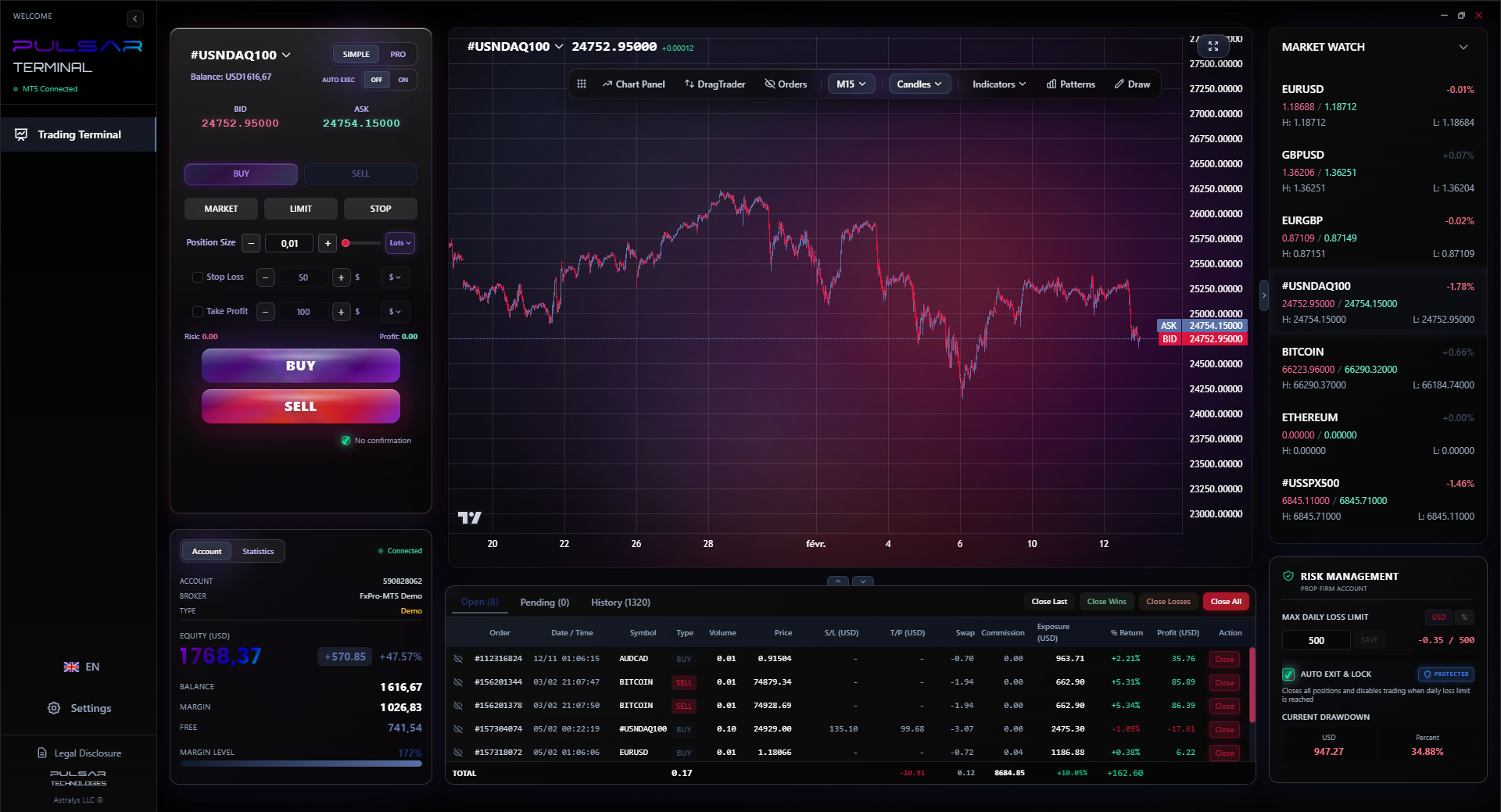
When you graduate from bought robots to building your own rules, a tool like Pulsar Terminal lets you visually design, test, and manage complex multi-take-profit and trailing stop strategies directly on MT5, turning your manual edge into automated precision.
Pulsar Terminal
The all-in-one MT5 companion: drag-and-drop orders, multi-TP/SL, trailing stop, grid trading, Volume Profile, and prop firm protection. Used by 1,000+ traders daily.
The FSCA is your friend here. They're actively hunting down the bad guys. Use their warnings as your cheat sheet.
Bright Red Flags:
- Promises of fixed, high returns: "Make 20% per month guaranteed!" The FSCA warned about TRABOT PTY for this in 2021. It's mathematically impossible to guarantee profits in a volatile market.
- Pressure to act fast: "Offer closes tonight!" This is pure sales manipulation.
- Payment in crypto or to a personal account: Legitimate businesses have company bank accounts.
- No physical address or FSP number: Any real financial service provider in SA must have this on their website.
- The seller uses a personal WhatsApp/Social Media: Like 'Money Teddy' did. This is the hallmark of an unlicensed, fly-by-night operation.
The Legal Bottom Line: If someone is providing individual, tailored trading signals or discretionary management of your account via a robot, they MUST have an FSP license (Category I or II). Selling a generic software tool (the robot itself) is a murkier area, but if it's bundled with 'signals' or 'management', it's regulated. When in doubt, check the FSCA's warning list and their public register of authorized firms.
Your best defense is a healthy dose of skepticism. If it sounds too good to be true in the forex market, it's not just too good to be true - it's probably illegal.
“Your best defense is a healthy dose of skepticism. If it sounds too good to be true in the forex market, it's not just too good to be true - it's probably illegal.”
Let's end on a constructive note. Here's a realistic, step-by-step path to using automation wisely.
Phase 1: Learn to Trade Manually (6-12 months). You cannot automate what you don't understand. Paper trade a simple strategy. Get consistently profitable on a demo. This is your foundation.
Phase 2: Document Your 'Business Rules'. Write down every rule: Entry condition (e.g., "Daily candle closes above 50-period EMA, and 4-hour RSI crosses above 30 from below"). Exit condition ("Take profit at 1.5x risk, stop loss at previous swing low"). Position sizing rule ("Risk 1.5% per trade").
Phase 3: Hire a Coder. Take your documented rules to a freelance platform. Be specific. The cost will be similar to a mid-range robot, but you get custom code that matches YOUR brain.
Phase 4: Rigorous Testing. Backtest (cautiously), then forward-test on a demo for 2-3 months, then a Cent account for 1-2 months. Only then, fund a live account with capital you can afford to lose.
Phase 5: Manage and Review. Once a month, review the performance. Is the strategy still working? Do the market conditions match its design? Be ready to pull the plug or go back to Phase 2 for tweaks.
This path isn't sexy. There's no 'academy' certificate at the end. But it gives you control, understanding, and a fighting chance. Automation should be your tireless, emotionless assistant - not your mysterious, uncontrollable boss.
FAQ
Q1Are forex robots legal in South Africa?
Yes, using forex robots (Expert Advisors) is legal. However, the entity SELLING you the robot or managing trades for you may be breaking the law if they don't have the required FSCA Financial Service Provider (FSP) license. Always check the FSCA register before paying anyone.
Q2What is the best broker for running a forex robot in SA?
The 'best' broker is one that is FSCA-regulated for your protection, offers stable MT4/MT5 platforms, has low and consistent spreads (crucial for bots), and supports 24/7 VPS hosting. Brokers like IC Markets, Pepperstone, and FP Markets are popular among automated traders for their raw spreads and reliable infrastructure.
Q3How much money do I need to start with a forex robot?
Realistically, you need enough capital to survive the robot's drawdown. If a robot has a historical 20% max drawdown, you need an account where a 20% loss won't force you to stop trading or violate your broker's margin rules. As an absolute minimum, R10,000, but R25,000-R50,000 is more prudent to allow for proper risk management of 1-2% per trade.
Q4Can a forex robot make me a consistent income?
It's possible, but it's not the 'passive income' dream sold online. It requires significant upfront research, continuous monitoring, and capital to withstand losing periods. Think of it as running a small automated business with tech overheads (VPS) and financial risk, not buying a lottery ticket.
Q5What's the difference between a forex robot and a signal service?
A forex robot (EA) is software that automatically opens and closes trades on your MT4/MT5 account. A signal service sends you alerts (e.g., via WhatsApp) telling you when to trade, and you manually execute. Both require FSCA licensing if tailored to you. The FSCA has warned against unlicensed signal providers like 'DrillionSignals'.
Q6I got scammed by a robot seller. What can I do?
First, report it to the FSCA with all the details (company name, contact info, transaction records). Second, report it to the South African Police Service (SAPS) as fraud. While recovering funds is difficult, reporting helps the authorities track and shut down these operations.
Prof. Winston's Lesson
Key Takeaways:
- ✓Verify FSCA licensing before buying any robot or signals.
- ✓Budget for hidden costs: VPS (R150-R500/pm) and trading costs.
- ✓Demand a verified, live track record, not backtests.
- ✓Never let a robot risk more than 2% of your capital per trade.
How useful was this article?
Click a star to rate
Weekly Trading Insights
Free weekly analysis & strategies. No spam.
About the Author
David van der Merwe
Emerging Markets Trader
Johannesburg-based trader with 11 years in emerging market currencies. Specializes in ZAR pairs, FSCA-regulated trading, and South African market analysis.
Comments
Risk Disclaimer
Trading financial instruments carries significant risk and may not be suitable for all investors. Past performance does not guarantee future results. This content is for educational purposes only and should not be considered investment advice. Always conduct your own research before trading.
You Might Also Like

Cara Trading Forex Sukses: 7 Prinsip dari Trader Profesional
Cara trading forex sukses dengan 7 prinsip trader pro: manajemen modal, disiplin, journal trading, backtest. Data nyata, bukan janji profit palsu.
Jam Trading Forex Terbaik untuk Trader Indonesia: Panduan Lengkap dengan Tabel Waktu
Panduan jam trading forex untuk trader Indonesia. Tabel 4 sesi dunia, jam emas 20:00-00:00, sesi mana yang harus dihindari. Data akurat + tips dari trader berpengalaman.
Top 5 Sàn Forex Uy Tín Nhất 2026: Review Jujur dari Trader Indonesia
Top 5 sàn forex uy tín 2026 untuk trader Indonesia. Review jujur: spread, deposit, withdraw, dukungan lokal. Exness, XM, IC Markets & lebih.
Get Pulsar Terminal
All these calculators are built into Pulsar Terminal with real-time data from your MT5 account. One-click position sizing, automatic risk management, and instant calculations.
Get Pulsar Terminal