


I remember staring at my screen in my Sandton apartment back in October 2022, watching the USD/ZAR rip through R18.50.

David van der Merwe
Emerging Markets Trader ·  South Africa
☕ 11 min read
What you'll learn:
I remember staring at my screen in my Sandton apartment back in October 2022, watching the USD/ZAR rip through R18.50. The news was all about load shedding and a cabinet reshuffle, and the chart was just... gapping. My short position, which I'd held for a few days expecting a pullback, was suddenly deep in the red. That was the moment I truly learned that trading the Rand from Sandton City isn't just about charts, it's about understanding the local context that moves them. This guide is what I wish I'd known then: how to trade forex properly from South Africa, with all its unique rules, costs, and opportunities.
Let's clear something up first. When you hear 'forex Sandton City,' you might picture glass towers filled with traders shouting orders. The reality is quieter, but just as powerful. Sandton is the symbolic heart of SA's finance, home to the JSE and countless corporate HQs. The 'trading' that happens here is more about institutional flows and corporate treasury deals moving billions of Rand. For you and me, the action is online.
That doesn't make Sandton irrelevant. Being in the environment means you feel the market's pulse. You hear the chatter about Eskom, you see the traffic patterns shift with business confidence, and you're in the same timezone (SAST) as the major market moves for the ZAR pairs. But your broker isn't down the road in Sandton City. It's a global entity, regulated and accessed through your laptop. The key is linking that global access to your local insight. I once made a decent profit shorting the ZAR against the Aussie dollar simply because I saw the commodity price reports hitting the local financial news wires in Sandton hours before it made major international headlines.

Pro Tip: Use your local presence as an information edge. Follow South African financial news on BizNews, Moneyweb, or even the Business Day headlines. The local reaction to a political statement or economic data can give you a 15-30 minute head start on how the ZAR might move before the broader forex market fully prices it in.
“Trading the Rand from Sandton City isn't just about charts, it's about understanding the local context that moves them.”
You can't trade seriously here without understanding the rulebook. The Financial Sector Conduct Authority (FSCA) calls the shots. Trading with an FSCA-licensed broker isn't just a good idea, it's your main layer of protection. It means they have to segregate your funds, adhere to fair practice, and operate under South African law.
The 30:1 use Cap
This is a big one. Since 2021, the FSCA capped use for retail traders at 30:1 on major forex pairs. Coming from brokers who offered 500:1, this felt like a handbrake. But honestly, it probably saved my account a few times early on. It forces you to use proper position size calculator and not over-use on a whim. If you're used to trading 0.1 lots with $200, you'll need to adjust your capital expectations.
The SARS Conversation
This is where many new traders get a nasty surprise. The South African Revenue Service (SARS) views your trading profits as income, full stop. It's added to your other income and taxed at your marginal rate (18% to 45%). You need to register for provisional tax and make bi-annual payments. I learned this the hard way after a good year in 2021. I hadn't kept clean records of every trade, and my accountant had a nightmare reconciling it. Now, I use a simple spreadsheet logging every entry, exit, and the reasoning.
You can deduct legitimate expenses: a portion of your internet bill, trading software subscriptions, even courses that improve your skills. Keep those receipts. The goal isn't to evade tax, but to accurately report your net profit. I made the mistake of thinking my net profit was just my withdrawal amount, forgetting to account for the losing trades I'd closed throughout the year.

Warning: Don't be tempted by offshore brokers promising 'tax-free' profits. If you're a South African tax resident trading from your home in Sandton City (or anywhere in SA), you are liable for tax on your worldwide income, including forex gains. SARS is getting much better at data sharing.

💡 Winston's Tip
The 30:1 use cap isn't a limit, it's a teacher. It forces you to build skill, not just bet big. Real money is made in the pips, not the use.
“The 30:1 use cap forces you to use proper position sizing and not over-use on a whim.”
Picking a broker isn't just about who has the prettiest platform. For us in South Africa, specific features make life infinitely easier.
First, ZAR-denominated accounts. This is non-negotiable for me now. If your account is in USD and you fund it with Rand, you get hit with a conversion fee (often around 1.2%) twice - on deposit and on withdrawal. A ZAR account eliminates that. You see your profit and loss in Rand, which makes managing your tax obligations far simpler.
Second, local payment methods. You want EFT (Electronic Funds Transfer) support from major SA banks. Deposits should be same-day or next-day, and withdrawals shouldn't take a week. Brokers like XM and Khwezi Trade (a local FSCA broker) excel here. I once used an international broker that only accepted wire transfers; a R500 withdrawal fee on a R2000 profit stung badly.
Here’s a quick comparison of popular brokers accessible in SA:
| Broker | FSCA Licensed? | Min. Deposit (Approx.) | Key Feature for SA Traders |
|---|---|---|---|
| IG | Yes | R0 | Excellent research & proprietary platform. |
| XM | Yes | ~R90 ($5) | Very low minimum, good ZAR support. |
| AvaTrade | Yes | ~R1800 ($100) | Wide range of instruments, fixed spreads. |
| Tickmill | Yes | ~R1800 ($100) | Raw spreads, low commissions. |
| Khwezi Trade | Yes | R500 | Local SA broker, MT5 only, good spreads. |
Third, platform choice. MT4 is still king, but MT5 is gaining ground for its better back-testing and more asset classes. Most brokers offer both. If you're into scalping strategy, check the broker's policy on it and their typical spreads during your trading hours.
My personal journey? I started with a big international name, struggled with funding, switched to a broker with ZAR accounts and local EFT, and never looked back. The convenience is worth any slight difference in spreads.
“The 30:1 use cap forces you to use proper position sizing and not over-use on a whim.”
Trading USD/ZAR or EUR/ZAR is a different beast to trading EUR/USD. It's an emerging market currency, which means it's more volatile and reacts heavily to local sentiment.
The Big Drivers:
- Commodity Prices: We're a resource economy. Strong platinum, gold, and coal prices typically strengthen the Rand. I watch the XAU/USD guide not just for gold trades, but as a leading indicator for ZAR strength.
- Eskom & Load Shedding: This is uniquely South African. Announcements of higher stages of load shedding directly impact business confidence and can cause the ZAR to sell off within minutes. It's a tangible, recurring local risk factor.
- US Dollar Strength: As a USD-paired currency, general greenback strength will push USD/ZAR higher. You need to separate broad USD moves from ZAR-specific weakness.
- Local Politics & Policy: Budget speeches, cabinet announcements, and SARB (South African Reserve Bank) interest rate decisions are huge. The SARB is often hawkish to defend the Rand, so rate decisions are critical.
A trade example: In November 2023, ahead of a SARB meeting, there was fear they'd hold rates despite high inflation. I saw USD/ZAR creeping up from R18.20. I entered a long at R18.35, placing a stop at R18.15. The SARB surprised the market by hiking 50bps, more than expected. The ZAR spiked stronger, and I was stopped out for a R2000 loss. The lesson? Don't bet against the SARB's tendency to prioritize currency stability. I should have waited for the announcement.
Pairs to consider: USD/ZAR (the most liquid), EUR/ZAR, GBP/ZAR. Also consider AUD/ZAR as a commodity pair play. The spreads are wider than majors like EUR/USD, so factor that into your strategy, especially for short-term trades.
💡 Winston's Tip
Your local knowledge about load shedding or a mine strike is a form of fundamental analysis. That's your edge over a trader in London staring at the same USD/ZAR chart. Use it.
“Your local knowledge about load shedding is a form of fundamental analysis. That's your edge.”
You can't just copy a strategy from a YouTube trader in London and expect it to work flawlessly on ZAR pairs during load shedding. You need to adapt.
Time Your Trades: The most liquid times for ZAR pairs are during the Johannesburg stock exchange hours (9am-5pm SAST) and when London overlaps (10am-1pm SAST is often peak volatility). Trading at 2am SAST on USD/ZAR is asking for wide spreads and erratic moves.
Volatility Adjustments: The ZAR can move 200-300 pips in a day easily. That's huge. Your stop-losses need to be wider to avoid being taken out by normal noise. Using a percentage-based stop (e.g., 1% of account risk) with a position size calculator is safer than a fixed 20-pip stop.
Use Indicators Wisely: Basic trend and momentum tools work. I combine a simple 50 and 200-period EMA on the 4-hour chart for trend direction. On the 1-hour, I use the RSI indicator to look for overbought/oversold conditions, but I only take signals that align with the higher-timeframe trend. The MACD indicator can help confirm momentum shifts, especially on daily charts around major news events.
Strategy Styles:
- Swing Trading: This suits the ZAR well. Holding a position for several days to catch a larger commodity or political trend. It requires patience and ignoring the intraday noise. Check out our guide on swing trading for a framework.
- Day Trading: Possible, but you need to be focused during the high-volume windows. The wider spreads mean your profit targets need to be larger.
- Avoid Scalping on ZAR pairs unless you have a razor-sharp edge and a broker with ultra-tight spreads. The costs will eat you alive.
My most consistent results have come from swing trading based on a weekly chart trend, using daily closes for entries, and fundamentally being on the right side of the commodity cycle.
“Your local knowledge about load shedding is a form of fundamental analysis. That's your edge.”
I've made most of these mistakes so you don't have to.
Pitfall 1: Ignoring the Cost of Conversion. Trading a USD account with Rand. That hidden 1-2% fee on every deposit and withdrawal adds up to a huge annual drag on your returns. Solution: Use a ZAR account.
Pitfall 2: Over-leveraging on Low Margin. Even at 30:1, you can blow up an account. A R10,000 account with a 1-lot position on USD/ZAR (where 1 pip is about R75) is insane risk. A 40-pip move against you is a R3000 loss. Solution: Use a position size calculator religiously. Risk no more than 1-2% of your account on any single trade.
Pitfall 3: Trading Around Major News Unprotected. SARB announcements or budget speeches can cause 100-pip gaps in seconds. I once had a profitable trade turn into a margin call overnight because of a gap. Solution: Either close positions before high-impact local news, or use guaranteed stop-loss orders (if your broker offers them), understanding you'll pay a premium for them.
Pitfall 4: Not Keeping Trading Records. When tax season comes, you'll be scrambling. Solution: Your broker provides statements. Download them monthly. Keep a simple journal: Date, Pair, Long/Short, Entry, Exit, P/L, Reason for Trade. It's for SARS and, more importantly, for reviewing your own performance.
Pitfall 5: Chasing 'Prop Firm' Dreams with Poor Risk Management. The allure of prop firms is big. But their challenges require strict daily loss limits. A tool that can automate this protection is useful for not blowing a challenge on one bad trade.

Example: Let's say you have a R20,000 account and decide to risk 1.5% per trade. That's R300. If you're trading USD/ZAR and your stop-loss is 50 pips away from your entry, your position size must be small enough that a 50-pip loss equals R300. (50 pips * R value per pip = R300). This keeps you in the game.
💡 Winston's Tip
If you can't explain your last three trades to me in one clear sentence each, you're gambling, not trading. Clarity of thought precedes profitability.
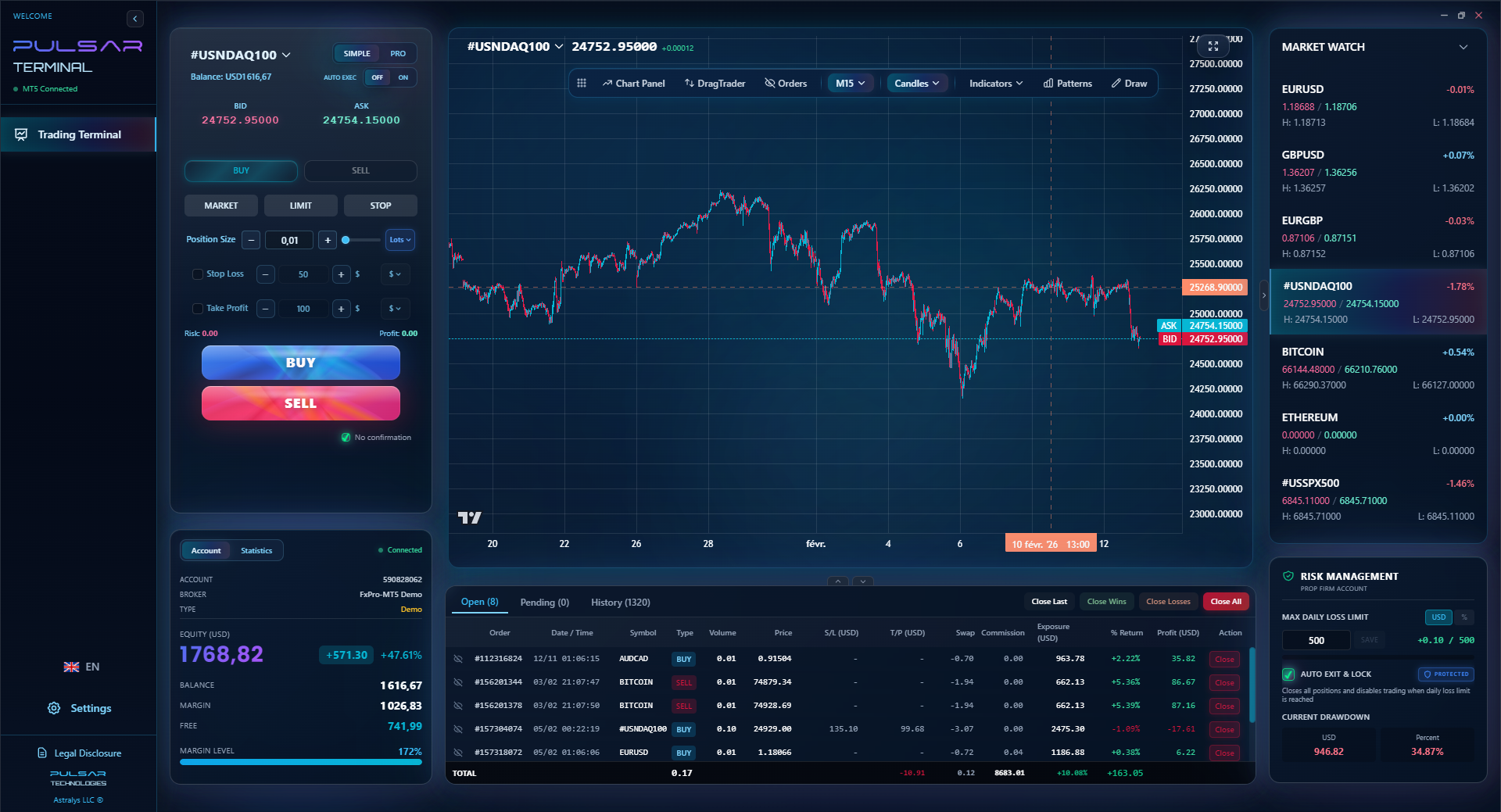
Managing risk around volatile ZAR pairs and prop firm challenges requires iron discipline, which is where automating your stop-loss and daily loss limits with a tool like Pulsar Terminal becomes a game-saver.
Pulsar Terminal
The all-in-one MT5 companion: drag-and-drop orders, multi-TP/SL, trailing stop, grid trading, Volume Profile, and prop firm protection. Used by 1,000+ traders daily.
“A ZAR-denominated account eliminates conversion fees and makes managing your tax obligations far simpler.”
Alright, you're in Sandton City, you're fired up, and you want to start. Here's a sensible path:
- Educate First, Deposit Later: Spend a month on demo. Not just clicking buttons, but practicing your strategy, journaling, and getting a feel for the platform. Learn what a pip definition really means in Rand terms.
- Pick a Regulated Broker: Choose one from the list above that offers ZAR accounts and local EFT. Open a demo and a live account simultaneously.
- Start Small, Really Small: Fund your live account with an amount you can afford to lose completely - maybe R2000-R5000. Your goal for the first six months isn't to make a million, it's to not lose your deposit while you learn live market psychology.
- Develop a Simple Plan: Choose one or two pairs (start with USD/ZAR). Define your trading hours, your risk per trade (1%), and a simple entry/exit rule based on support/resistance or a moving average crossover. Back-test it on old data.
- Integrate with Your Life: Set alerts on your phone for SARB meetings or Stage 6 load shedding announcements. Let the market come to you; don't sit glued to the screen all day.
Forex trading from Sandton City offers a unique vantage point. You have local knowledge, access to global markets, and a regulated environment that, while restrictive in some ways (like use), is designed to protect you. It's a marathon, not a sprint. Be patient, be disciplined, and always keep learning.
FAQ
Q1Is forex trading legal in Sandton City, Johannesburg?
Yes, absolutely. Forex trading is completely legal throughout South Africa. It's regulated by the FSCA (Financial Sector Conduct Authority). While Sandton City is the financial hub, the trading itself happens online with brokers who are licensed, many of which are FSCA-regulated for your protection.
Q2Can I open a forex trading account in South African Rand (ZAR)?
Yes, and I highly recommend you do. Many brokers catering to the South African market, like XM, Khwezi Trade, and others, offer ZAR-denominated accounts. This saves you currency conversion fees on every deposit and withdrawal, and makes tracking your profit/loss for SARS much simpler.
Q3How much tax will I pay on my forex trading profits in South Africa?
SARS treats your net forex trading profits as taxable income. This income is added to your other income (like your salary) and taxed at your marginal tax rate, which can range from 18% to 45%. You must register for provisional tax and make bi-annual payments. Remember, you can deduct legitimate trading expenses to reduce your taxable profit.
Q4What is the maximum use I can use in South Africa?
For retail traders, the FSCA has capped use at a maximum of 30:1 on major currency pairs. This has been in effect since 2021. It's lower than some international offers, but it's a risk-management rule designed to protect traders from excessive losses.
Q5What is the best trading platform for beginners in SA?
MetaTrader 4 (MT4) is still the most widely used and beginner-friendly platform. It's familiar, has tons of free indicators and expert advisors (EAs), and is supported by almost every broker. Once you're comfortable, you can explore MT5 or proprietary platforms from brokers like IG.
Q6What are the most important news events for trading the South African Rand?
Focus on: 1) South African Reserve Bank (SARB) interest rate decisions and MPC statements, 2) South African inflation (CPI) and budget data, 3) Eskom and load shedding announcements, 4) Global commodity prices (gold, platinum), and 5) General US dollar strength, as USD/ZAR is the most traded pair.
Q7What is a realistic starting amount for forex trading in South Africa?
You can start with as little as R500-R1000 with some brokers. However, to trade comfortably with proper risk management (not over-leveraging a tiny account), a starting capital of R5,000 to R10,000 is more realistic. This allows you to take small position sizes and survive the inevitable learning-curve losses.
Prof. Winston's Lesson
Key Takeaways:
- ✓Always use an FSCA-regulated broker with ZAR accounts.
- ✓Risk a maximum of 1-2% of your capital per trade.
- ✓SARS taxes net profit as income (18-45%); keep detailed records.
- ✓Trade ZAR pairs during JSE/London overlap for best liquidity.
- ✓Wider stops (50-100 pips) are normal for volatile EM pairs.
How useful was this article?
Click a star to rate
Weekly Trading Insights
Free weekly analysis & strategies. No spam.
About the Author
David van der Merwe
Emerging Markets Trader
Johannesburg-based trader with 11 years in emerging market currencies. Specializes in ZAR pairs, FSCA-regulated trading, and South African market analysis.
Comments
Risk Disclaimer
Trading financial instruments carries significant risk and may not be suitable for all investors. Past performance does not guarantee future results. This content is for educational purposes only and should not be considered investment advice. Always conduct your own research before trading.
You Might Also Like

Cara Trading Forex Sukses: 7 Prinsip dari Trader Profesional
Cara trading forex sukses dengan 7 prinsip trader pro: manajemen modal, disiplin, journal trading, backtest. Data nyata, bukan janji profit palsu.
Jam Trading Forex Terbaik untuk Trader Indonesia: Panduan Lengkap dengan Tabel Waktu
Panduan jam trading forex untuk trader Indonesia. Tabel 4 sesi dunia, jam emas 20:00-00:00, sesi mana yang harus dihindari. Data akurat + tips dari trader berpengalaman.
Top 5 Sàn Forex Uy Tín Nhất 2026: Review Jujur dari Trader Indonesia
Top 5 sàn forex uy tín 2026 untuk trader Indonesia. Review jujur: spread, deposit, withdraw, dukungan lokal. Exness, XM, IC Markets & lebih.
Get Pulsar Terminal
All these calculators are built into Pulsar Terminal with real-time data from your MT5 account. One-click position sizing, automatic risk management, and instant calculations.
Get Pulsar Terminal