


Let's be honest, the search for a decent 'forex school online' in South Africa is a minefield.

David van der Merwe
Emerging Markets Trader ·  South Africa
☕ 10 min read
What you'll learn:
- 1What a Real Forex Education Actually Is (And Isn't)
- 2The South African Rules You Can't Ignore
- 3Breaking Down the Real Costs of Trading Here
- 4Choosing Your Broker and Platform (The Practical Stuff)
- 5The Core Skills a Real School Teaches
- 6Red Flags: How to Spot a Scam or Useless Course
- 7Putting It All Together: Your Learning Path
Let's be honest, the search for a decent 'forex school online' in South Africa is a minefield. You're one click away from a 'guru' promising a Lamborghini and the next from a confusing, overpriced course that teaches you nothing practical. I've been there, wasted the money, and made the mistakes so you don't have to. This isn't about finding a magic bullet; it's about building a real education that works under our local rules, with our brokers, and for our wallets. I'll walk you through what a proper South African forex education actually looks like, from the FSCA's rulebook to SARS's tax man.
A real forex school online isn't a single course or a secret indicator. It's a structured process of building knowledge, discipline, and a personalized system. The YouTube guy selling a '100% win rate strategy' for R5000? That's a product, not an education.
An education gives you the tools to build your own edge. It covers the boring but critical stuff: how the market actually works (liquidity, order flow), how to manage your risk so you don't blow your account in a week, and how to handle your psychology when a trade goes against you. I learned this the hard way. Early on, I bought a fancy course on a specific candlestick pattern. I'd see the pattern, enter, and get stopped out constantly. I was following the 'school' but losing money. Why? The course never taught me about overall market context or how to use a proper position size calculator. I was trying to use a single tool to build an entire house.

Warning: Any 'school' that focuses more on potential profits than on managing losses is setting you up for failure. Your first goal isn't to make money; it's to not lose your capital.
A proper foundation includes understanding local specifics. You need to know what 30:1 use from the FSCA really means for your risk, why trading USD/ZAR is different from EUR/USD, and how to read the spread on your broker's platform. This context is what separates a global generic course from a relevant South African forex education.

💡 Winston's Tip
Your broker's fee schedule is your first textbook. Master it before you place a single trade. If you don't know your break-even point, you're gambling.
Trading here isn't the wild west. We have a solid regulatory framework, and pretending it doesn't exist is a fast track to trouble. Your forex school online must address this head-on.
The FSCA is Your Friend (Seriously) The Financial Sector Conduct Authority is the main player. They cap retail use at 30:1. That might sound low compared to brokers like XM offering 1:1000 internationally, but it's a lifesaver for new traders. It forces you to use sensible position sizes. A broker must be FSCA-licensed to legally offer you services here. Always check their FSP number on the FSCA's website. Trading with an unregulated offshore broker might offer higher use, but if something goes wrong, you're on your own.
SARS Wants Its Share This is the big one most 'gurus' gloss over. SARS views frequent trading as income, not capital gains. That means your net profit (after deducting losses and expenses) is added to your other income and taxed at your marginal rate. You need to keep careful records: every trade statement from your broker (whether it's Exness or IC Markets), all deposit/withdrawal slips, and even receipts for trading-related expenses (internet, courses, software). I got a nasty surprise in my third year of trading when I had to back-calculate two years of trades. It took a week of my life. Don't be me.
Client Money Protection FSCA-regulated brokers must keep your money in segregated accounts. This means if the broker goes bankrupt, your funds are separate and should be returned to you. It's a basic layer of security you should never compromise on.
“A real forex education gives you the tools to build your own edge, not a single 'secret' strategy destined to fail.”
If your education doesn't make you a spread and commission expert, it's useless. Your profit starts after these costs. Let's talk real numbers from our market.
Spreads: Your Silent Partner (Taking Your Money) The spread is the difference between the buy and sell price. For EUR/USD, you might see:
| Broker | Account Type | Typical Spread (EUR/USD) |
|---|---|---|
| Tickmill | Raw Account | 0.11 pips + commission |
| AvaTrade | Standard | Fixed from 0.9 pips |
| Pepperstone | Razor Account | 0.0 pips + commission |
That's for majors. Now try a local favorite: USD/ZAR. The spread can easily be 5-10 pips or more. If you're scalping and need the price to move 10 pips just to break even, your strategy is dead on arrival. A good education teaches you to factor the spread into your profit target and stop-loss from the very beginning.
Commissions, Swaps, and Fees
- Commissions: Often charged on 'raw' spread accounts. It might be $7 per lot traded. If you're trading 0.1 lots, that's $0.70 per trade.
- Swap Rates: Holding a trade overnight? You'll pay or earn interest. For some pairs, it can be significant. I once held a long AUD/JPY position for a week during a slow trend, and the negative swap ate nearly 40% of my paper profits. I didn't factor it in.
- Deposit/Withdrawal: Many brokers now offer free Instant EFT or credit card deposits. But always check.

Example: You buy 0.5 lots of EUR/USD on a commission account. Spread is 0.2 pips ($1), commission is $3.5. Your cost to enter is $4.50. Your trade needs to gain over 1 pip just to cover costs. This is why understanding the pip definition and cost structure is lesson one.
Your broker is your gateway, and your platform is your cockpit. Your forex school online should help you evaluate these, not just tell you to 'use MT4'.
The Broker Checklist for South Africans
- FSCA Regulation: Non-negotiable.
- ZAR Accounts: Does the broker offer a Rand-denominated account? This saves you from double currency conversion on every deposit and withdrawal. Brokers like Pepperstone and IG offer this.
- Local Payment Methods: Look for Instant EFT, SID Instant EFT, or easy bank transfers. It makes funding and withdrawing a breeze.
- Costs on YOUR Pairs: Don't just look at EUR/USD spreads. Check the spreads on USD/ZAR, EUR/ZAR, or any other pair you plan to trade. If you're interested in gold, check their XAU/USD conditions.
The Platform Decision
MT4 and MT5 are the standards here for a reason. They're strong, support automated trading, and have a huge community. Most local brokers offer them. cTrader is another excellent choice, known for its clean interface and superior order execution. Some brokers, like IG and Plus500, have their own powerful platforms.
The key is to pick one and learn it inside out. A proper education will have you practicing on a demo account, placing different order types, setting stop-losses, and understanding the trade terminal. Which brings me to a crucial tool...

Pro Tip: Before you risk a cent, open a demo account with at least two FSCA-regulated brokers. Test their platform speed, execution, and see the real spreads during volatile market opens (like London at 10 AM our time). It's the best free research you can do.
💡 Winston's Tip
Open a separate spreadsheet for SARS on day one. Log every deposit, withdrawal, and trade. Future-you will thank present-you profusely.
“If your education doesn't make you a spread and commission expert, it's useless. Your profit starts after these costs.”
Forget the flashy stuff. These are the pillars. If your chosen forex school online doesn't drill these, walk away.
1. Risk Management (Your #1 Skill) This is the entire game. It means never risking more than 1-2% of your account on a single trade. It means knowing where your stop-loss goes before you enter. It means understanding what a margin call is and how to avoid it. I have a rule: if I can't draw my stop-loss and profit target on the chart and explain why they're there, I don't take the trade. Period.
2. Price Action & Market Structure Learn to read the naked chart. Support and resistance, trend lines, higher highs, lower lows. This is how you understand where the market might go. Then you can use indicators like the RSI indicator or MACD indicator to help with the when. Indicators are seasoning, not the main meal.
3. Building & Testing a Trading Plan A trading plan is your business plan. It states: What pairs do I trade? What time of day? What's my strategy for entering? Where is my stop-loss? Where is my take-profit? What's my maximum daily loss? You then take this plan and test it ruthlessly on a demo account, then with tiny live amounts. My first profitable plan was a simple swing trading strategy on EUR/USD that only looked for pullbacks in a strong trend. It wasn't exciting, but it was structured.
4. Trading Psychology This is the final boss. It's handling the greed after three winning trades in a row (don't double your size!). It's handling the fear after a loss (don't revenge trade!). It's having the discipline to follow your plan even when you have a 'gut feeling.' Journaling every trade - including your emotional state - is the best training for this.
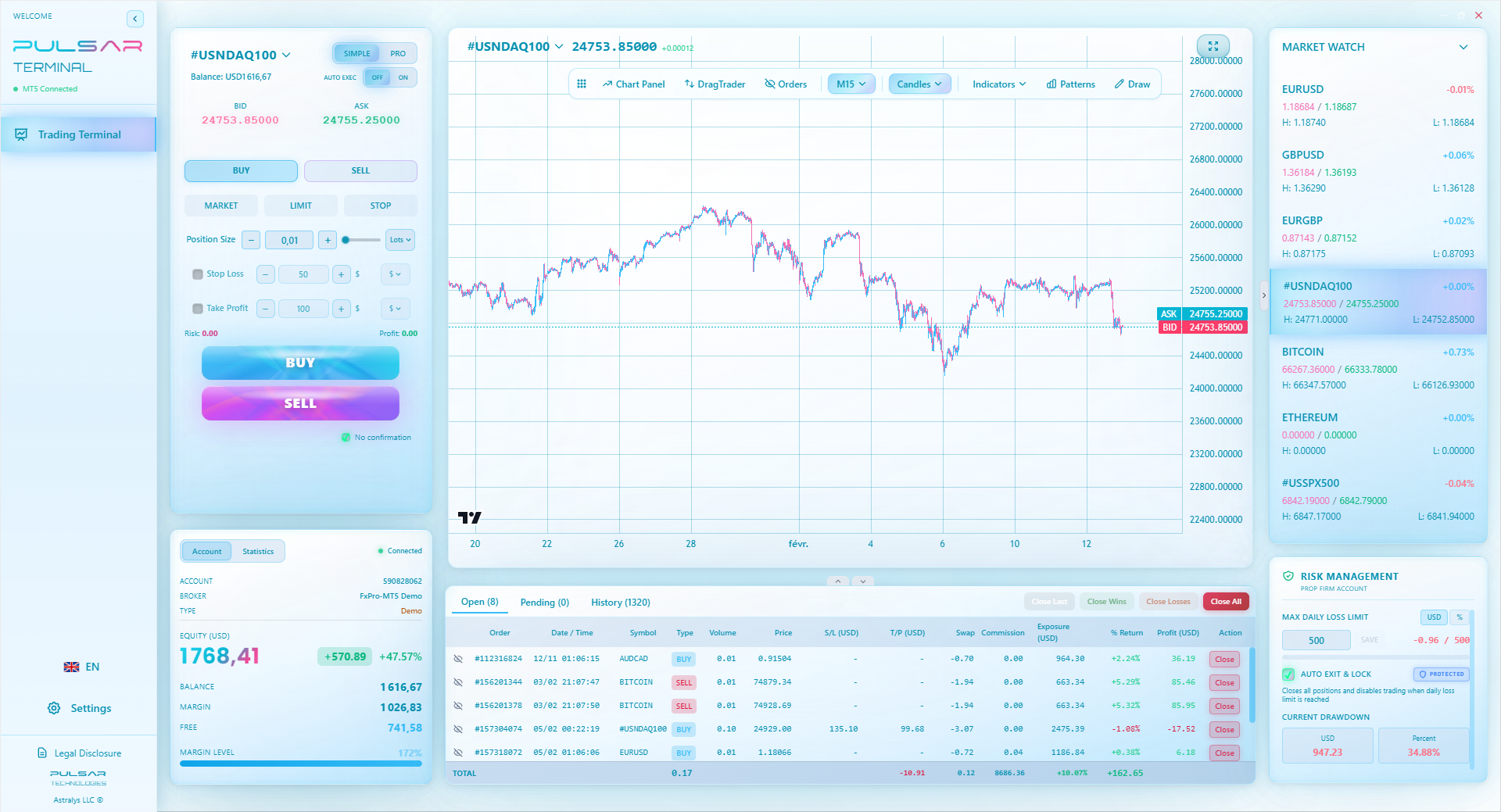
When you're ready to move beyond basic platform mechanics, a tool like Pulsar Terminal can help you execute complex risk management rules—like multi-level take-profits or automatic trailing stops—directly on your MT5 charts, turning your trading plan into automated actions.
Pulsar Terminal
The all-in-one MT5 companion: drag-and-drop orders, multi-TP/SL, trailing stop, grid trading, Volume Profile, and prop firm protection. Used by 1,000+ traders daily.
The market is flooded with this nonsense. Here’s how to protect yourself and your money.
- Guaranteed Profits or High Win Rates: Anyone guaranteeing results is lying. The market is probabilistic, not certain.
- Focus on Lifestyle Marketing: Lambos, watches, stacks of cash in the promo video. This is targeting your greed, not your intellect.
- Pressure to Sign Up: 'Limited time offer!' 'Discount expires tonight!' A real educational service doesn't need high-pressure sales tactics.
- Vague on Details: They talk about 'their proprietary system' but never show a real, recent trade history with entries and exits. They can't explain how it handles spreads or different market conditions.
- Requires You to Use a Specific (Often Unknown) Broker: This is a huge one. They might be getting a kickback (an introducing broker fee) for signing you up, regardless of whether that broker is right for you or even properly regulated.
I fell for one early on. The guy was charismatic, had a slick website, and promised a 'banking strategy.' The course cost R8000. The 'strategy' was a basic moving average crossover that he'd over-complicated with terrible risk management rules. It was worthless. The real lesson was learning to spot the hype.
“The goal with your first live account isn't to get rich; it's to learn to execute your plan under real market conditions.”
So what does a sensible, self-directed forex school online look like for a South African? Here's a roadmap.
Phase 1: Foundations (Months 1-3)
- Goal: Don't lose money. Learn the basics.
- Actions: Read the free guides on major broker sites (IG, AvaTrade have good ones). Learn platform mechanics on a demo account. Understand pips, lots, use, orders. Study the FSCA and SARS rules. Paper trade a simple idea.
Phase 2: Strategy & Practice (Months 4-6)
- Goal: Develop and demo-test a simple trading plan.
- Actions: Choose one market (e.g., EUR/USD). Learn basic support/resistance and one or two indicators. Define your risk per trade (e.g., 1%). Back-test and forward-test on demo. Keep a detailed trading journal. This is where a focused, paid course from a reputable educator (who trades live) can be valuable.
Phase 3: Live Trading & Refinement (Month 6+)
- Goal: Achieve consistent, small-scale profitability.
- Actions: Fund a live account with the minimum amount (e.g., $100). Trade your plan with micro lots (0.01). The goal is to make the mistakes with real money on a tiny scale. Focus on executing your plan perfectly, not on the profit amount. Review your journal weekly. Gradually scale up as you prove consistency.
Remember, this is a skill like any other. You wouldn't expect to play a Chopin ballad after three piano lessons. Don't expect to profit consistently from the forex market after a few weeks. Be patient, be disciplined, and focus on the process. The profits are a byproduct of doing everything else right.
FAQ
Q1Is forex trading legal and taxable in South Africa?
Yes, it's completely legal when using an FSCA-regulated broker. And yes, it's absolutely taxable. SARS treats net profits from frequent trading as income, taxed at your marginal rate. You must declare it and keep detailed records of all trades, deposits, and withdrawals.
Q2What's the best forex trading platform for beginners in SA?
MetaTrader 4 (MT4) is often the best starting point. It's offered by almost every local broker, has a familiar interface, tons of free indicators, and a massive support community. It's more than enough to learn the ropes. Once you're comfortable, you can explore MT5 or cTrader.
Q3How much money do I need to start forex trading in South Africa?
You can start with very little. Brokers like Exness or XM allow minimum deposits of $10-$50. However, I strongly recommend you start with a few hundred dollars at most. The goal with your first live account isn't to get rich; it's to learn to execute your plan under real market conditions without risking significant capital. Use a position size calculator to ensure you're trading micro lots (0.01) with proper risk.
Q4Can I use international brokers like Pepperstone or IC Markets?
You can, and many South Africans do for their competitive spreads. However, if they are not FSCA-regulated, you forfeit the local legal protections (like segregated accounts under SA law and easier dispute resolution). Many top international brokers like Pepperstone and IC Markets do have FSCA licensing, so you can get the best of both worlds - always verify their FSP number.
Q5What's the biggest mistake new South African traders make?
Two tied for first: 1) Using way too much use, ignoring the FSCA's 30:1 limit for a reason, and blowing up their account quickly. 2) Not accounting for taxes. They have a good run, spend the money, and then get a nasty shock from SARS with penalties and interest. Plan for taxes from trade one.
Q6Are free demo accounts worth it?
They are the single most valuable tool for a beginner. They're not for 'pretending to be rich.' They're for learning platform mechanics, testing strategies risk-free, and getting a feel for live spreads and execution speed. Live trading psychology is different, but you should never make your first platform mistake with real money.
Prof. Winston's Lesson
Key Takeaways:
- ✓FSCA regulation & segregated funds are non-negotiable for safety.
- ✓Risk never more than 1-2% of capital per trade.
- ✓SARS taxes profits as income - keep careful records.
- ✓Master spreads & costs before developing a strategy.
- ✓Demo trade first to learn mechanics without financial risk.
How useful was this article?
Click a star to rate
Weekly Trading Insights
Free weekly analysis & strategies. No spam.
About the Author
David van der Merwe
Emerging Markets Trader
Johannesburg-based trader with 11 years in emerging market currencies. Specializes in ZAR pairs, FSCA-regulated trading, and South African market analysis.
Comments
Risk Disclaimer
Trading financial instruments carries significant risk and may not be suitable for all investors. Past performance does not guarantee future results. This content is for educational purposes only and should not be considered investment advice. Always conduct your own research before trading.
You Might Also Like

Cara Trading Forex Sukses: 7 Prinsip dari Trader Profesional
Cara trading forex sukses dengan 7 prinsip trader pro: manajemen modal, disiplin, journal trading, backtest. Data nyata, bukan janji profit palsu.
Jam Trading Forex Terbaik untuk Trader Indonesia: Panduan Lengkap dengan Tabel Waktu
Panduan jam trading forex untuk trader Indonesia. Tabel 4 sesi dunia, jam emas 20:00-00:00, sesi mana yang harus dihindari. Data akurat + tips dari trader berpengalaman.
Top 5 Sàn Forex Uy Tín Nhất 2026: Review Jujur dari Trader Indonesia
Top 5 sàn forex uy tín 2026 untuk trader Indonesia. Review jujur: spread, deposit, withdraw, dukungan lokal. Exness, XM, IC Markets & lebih.
Get Pulsar Terminal
All these calculators are built into Pulsar Terminal with real-time data from your MT5 account. One-click position sizing, automatic risk management, and instant calculations.
Get Pulsar Terminal