


Here's the hard truth: most traders use a forex screener backwards.

David van der Merwe
Emerging Markets Trader ·  South Africa
☕ 9 min read
What you'll learn:
- 1What a Forex Screener Actually Does (And What It Doesn't)
- 2Setting Up Your First Screener: A South African Filter
- 3The Unique Challenge of Screening ZAR Pairs
- 4Three Screener Mistakes That Blow Up South African Accounts
- 5Building a Screening Routine That Works
- 6Choosing Your Tools: Platform Screeners vs. Standalone
- 7From Scan to Trade Plan: The Missing Link
Here's the hard truth: most traders use a forex screener backwards. They treat it like a slot machine that spits out 'buy' signals, not as a risk management tool. In South Africa's regulated market, where the FSCA caps your use at 30:1, you can't afford to chase every blip on a scanner. I've blown up an account doing exactly that. This guide isn't about finding more trades; it's about using a screener to find better trades and, more importantly, to avoid the bad ones that will wipe you out.
A forex screener is a filter. You tell it what you're looking for, and it scans hundreds of instruments to show you the ones that match your criteria. Think of it like a search engine for charts.
In South Africa, this is crucial because you're not just looking at majors like EUR/USD. You need to watch ZAR crosses like USD/ZAR, EUR/ZAR, and GBP/ZAR, which have their own volatile personalities. A good screener lets you monitor all of them at once.
What it doesn't do is think. It doesn't know about SARB interest rate announcements or local political risk. It just crunches numbers. The biggest mistake I see? Traders set a screener to find 'oversold' pairs using the RSI indicator, see 10 results, and feel compelled to trade them all. That's a fast track to a margin call. The screener gives you a list of candidates, not a list of orders.

Warning: A screener signal is the beginning of your analysis, not the end of it. Never place a trade based solely on a screener alert without checking the actual chart context.
Forget the default settings. Let's build a screener that makes sense for our market. Your first filter should be liquidity. There's no point scanning exotic pairs with massive spreads that'll eat your profit before you start.
Start With Your Watchlist
Don't scan the entire universe. Create a focused watchlist. Mine always includes:
- Majors: EUR/USD, GBP/USD, USD/JPY
- Key ZAR Pairs: USD/ZAR, EUR/ZAR, GBP/ZAR
- One Commodity: XAU/USD (gold)
This keeps you from getting overwhelmed. You can learn more about specific instruments in our EUR/USD guide and XAU/USD guide.
Apply Realistic Technical Filters
This is where most go wrong. They set filters too tight. If you ask for an RSI below 20 on a 1-hour chart, you might get one signal a week. That's okay! Better a few quality signals than constant noise.
A simple starter setup for potential long setups could be:
- Average True Range (ATR): Less than its 20-day average (filtering out abnormally high volatility).
- Price: Above the 200-period Simple Moving Average (for a basic trend filter).
- Candlestick: A bullish engulfing or pin bar pattern on the daily chart.
This won't catch every move, but it will highlight pairs that are in a trend and showing a potential reversal signal. That's a much stronger starting point than just 'RSI is low'.

Pro Tip: Always include a volatility filter like ATR. In 2021, I got a screener signal on USD/ZAR. The setup looked perfect, but I didn't check volatility. The ATR was at a 3-month high. I entered, and a sudden SARB comment spiked volatility further, hitting my stop loss in minutes. The trade was technically right but volatiity-killed.

💡 Winston's Tip
A screener finding 50 trades a day is useless. One that finds 3 high-probability setups a week is a goldmine. Quality over quantity, always.
“Your edge won't come from a more expensive screener; it'll come from how you interpret its output within our local context.”
Trading USD/ZAR is a different beast to trading EUR/USD. Your screener settings must reflect that.
First, spreads. The spread on USD/ZAR can be 50-100 pips during normal hours. A 10-pip move is noise. So, your profit targets and stop-loss distances need to be wider. Don't use the same 20-pip stop you'd use on EUR/USD. I learned this the expensive way, getting stopped out repeatedly before the pair even began its real move.
Second, liquidity dries up around South African bank holidays and after local market close (5pm SAST). A screener might show a breakout at 6pm, but it's likely false because the real market makers are offline. I adjust my screener to ignore signals between 5:30pm and 7am SAST for ZAR pairs specifically.
Third, interest rate differentials (carry trade) matter hugely. A screener that can filter by swap rate is gold. You might find a technically neutral USD/ZAR, but if the swap for holding it long is deeply negative, it erodes any swing trade profit. Some brokers, like those in our Exness review or IC Markets review, show swap rates directly in their platform tools.

Example: On a $10,000 position in USD/ZAR with a -$5 daily swap, you're paying R90 (roughly) per day just to hold the trade open over a weekend. A 3-day weekend costs R270. That can turn a winning trade into a loser if you're not careful.
I've made all of these. Let's save you the tuition.
1. Over-optimization (Curve-Fitting): You spend hours tweaking your MACD indicator settings until the screener perfectly highlights every past winner on USD/ZAR. Congratulations, you've built a machine that works perfectly on historical data and will fail miserably on tomorrow's. Markets change. Keep your filters simple and strong.
2. Ignoring the Macro Filter: This is the big one. Your screener flags a beautiful breakout on EUR/ZAR. But you didn't filter for news. That breakout happens 5 minutes before a major US inflation print. The news hits, reverses the move, and slaughters your position. Most platforms have an economic calendar. Cross-reference every screener signal with it.
3. Confirmation Bias Engine: You're bullish on gold, so you set your screener to only find bullish signals on XAU/USD. It becomes an echo chamber, reinforcing your bias while blinding you to clear bearish divergences. Force yourself to run a bearish scan too. Look for the reasons not to take the trade.
A practical tip? I run two separate screeners: one for my primary swing trading strategy and one that purely looks for excessive volatility (high ATR) to tell me what not to trade. The second one has saved me more money than the first has made me.
💡 Winston's Tip
Backtest your screener settings on ZAR pairs specifically. What works on EUR/USD often fails on USD/ZAR due to spread and volatility differences.
“A screener signal is the beginning of your analysis, not the end of it.”
A screener isn't a once-a-day thing. It's part of a process. Here's my daily routine, adapted for SA time zones.
7:00 AM SAST (Pre-Market): Run my primary swing scan on the daily and 4-hour charts. This gives me a list of 3-5 candidates. I note them, but I don't trade. I'm just seeing what the longer-term momentum is doing.
9:00 AM SAST (London Open): Run a shorter-term scan on the 1-hour chart. This is where I look for entries on the candidates from my morning scan. Liquidity is now good. I combine screener signals with manual chart analysis.
2:00 PM SAST (After Lunch Lull): Quick scan. This is often a consolidation period. I'm mostly checking that none of my open trades have triggered any "exit" filters I have running in the background (like volatility spiking above a threshold).
10:00 PM SAST (After US Close): Final scan on the daily candles, which are now closed. This is for planning the next day. I update my watchlist.
The key is that the screener does the heavy lifting of scanning, but I make the final decision. I never let it auto-trade. Ever. Using tools that allow for precise order management, like setting multiple take-profit levels, is crucial once you've found a trade. This is where a platform's advanced features come in handy for managing the trade after the screener has done its job.
You have two main choices, each with pros and cons for a South African trader.
Built-in Platform Screeners (MT4/MT5, TradingView):
- Pros: Integrated, no extra cost. Data is direct from your broker. TradingView's screener is particularly powerful and visual.
- Cons: Often less customizable than standalone tools. MT4's built-in scanner is very basic.
Standalone Software/Websites:
- Pros: More powerful filters, can scan multiple broker feeds, often have better alert systems.
- Cons: Subscription cost. Potential delay vs. your broker's data. Another platform to manage.
For most South African traders starting out, I recommend mastering the tools you already pay for. If you use XM or Pepperstone, learn their platform's scanner inside out. If you chart on TradingView, its screener is more than enough for retail purposes.
Before paying for a fancy standalone screener, ask: does it truly understand ZAR pair quirks? Can it filter by South African-specific data? Most can't. Your edge won't come from a more expensive screener; it'll come from how you interpret its output within our local context.
I used a paid standalone service for a year. It gave me 50 signals a day. I was overtrading and stressed. I went back to a simple TradingView screener with 4 filters. My profitability improved because I was forced to be selective.
💡 Winston's Tip
The most important screener filter is the one that says 'No News Today'. Macro events override all technical signals.
Once your screener identifies a high-probability setup, tools like Pulsar Terminal let you manage the trade with precision, using features like multi-take-profit orders and trailing stops directly on your MT5 chart.
Pulsar Terminal
The all-in-one MT5 companion: drag-and-drop orders, multi-TP/SL, trailing stop, grid trading, Volume Profile, and prop firm protection. Used by 1,000+ traders daily.
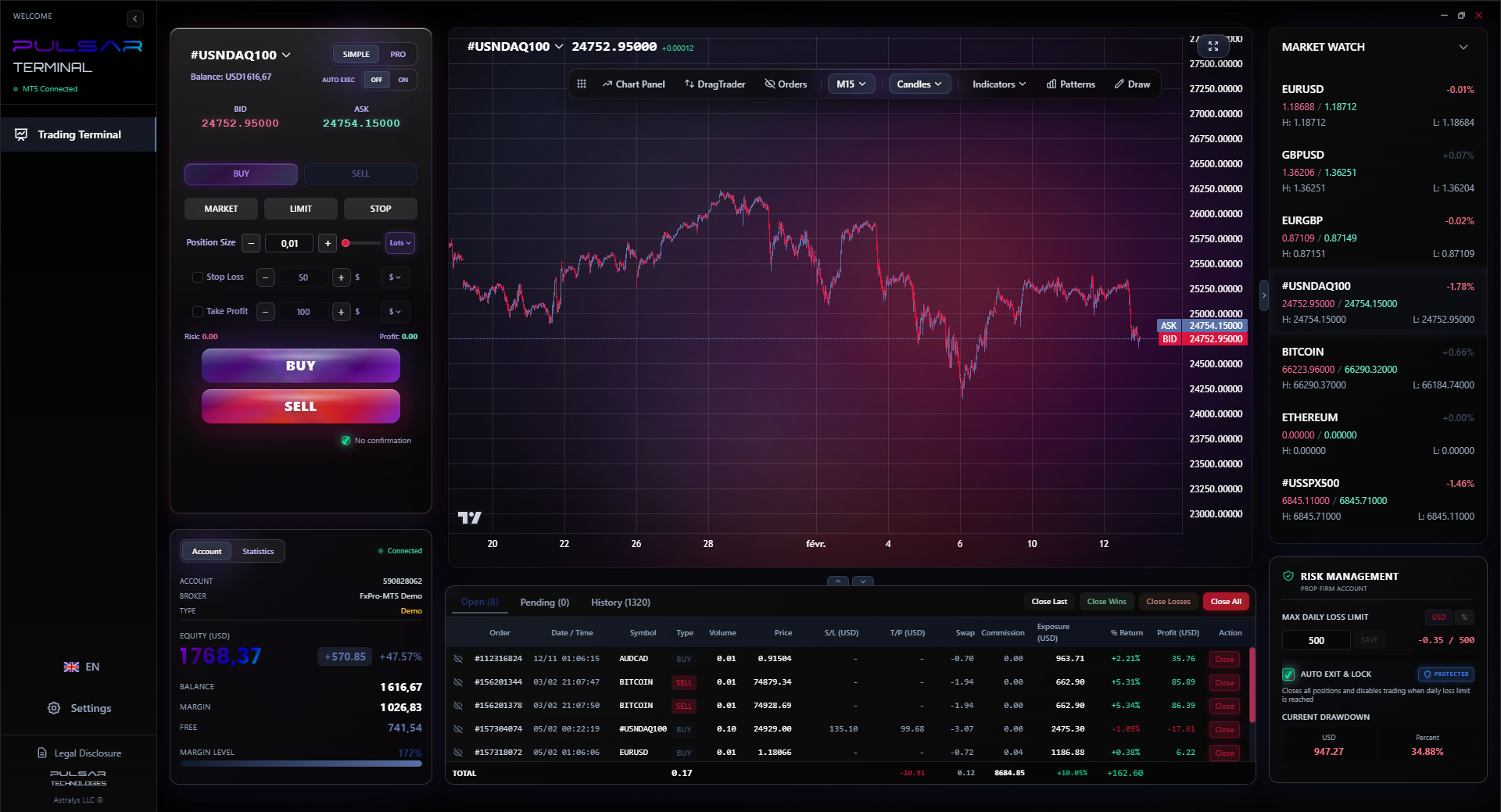
“The screener does the heavy lifting of scanning, but I make the final decision. I never let it auto-trade. Ever.”
This is the critical step most miss. Your screener pings: "USD/ZAR Bullish Engulfing on Daily." Now what?
Step 1: The Manual Audit. Go to the actual chart. Zoom out. Is this pattern at a key support level? Or is it in the middle of nowhere? Check for nearby resistance. I can't tell you how many screener signals I've killed at this stage.
Step 2: Size for the Volatility. Use the position size calculator. Don't just use your standard 1% risk. Look at the current ATR. If USD/ZAR's ATR is 800 pips, a 100-pip stop is likely too tight. Adjust your position size so that your monetary risk (in Rands) stays constant, even with a wider stop. This is non-negotiable.
Step 3: Define the Failure. Before you enter, know what would make the trade wrong. Is it a break below the low of the engulfing candle? Is it a specific moving average? That's your stop loss. The screener suggested an entry; your job is to define the exit.
Step 4: The Macro Check. One last look at the calendar. Any SARB speeches? US Non-Farm Payroll? If yes, you might decide to pass, or to use a wider stop. This discipline turns a screener from a gambling tool into a professional workflow.
A screener finds opportunities. A trader's skill is in discarding 95% of them and executing flawlessly on the remaining 5%. That's where the money is made, especially under the FSCA's 30:1 use limit that prevents you from just muscling through bad trades.
FAQ
Q1Is there a free forex screener that works well for South African traders?
Yes. TradingView offers a very capable free forex screener. While the free plan has some limitations, it's more than enough to start. You can create watchlists for ZAR pairs and set basic technical filters. The key is learning to use it well, not paying for it.
Q2How do I screen for low-spread pairs in South Africa?
Most screeners don't have a live spread filter. The best practice is to know your broker's typical spreads. Majors (EUR/USD, GBP/USD) will always have the tightest spreads. For ZAR pairs, USD/ZAR is usually the most liquid. Use your screener for technical setups, but manually filter out exotics and pairs you know have consistently high costs.
Q3Can I use a forex screener for scalping?
You can, but it's tricky. Scalping requires ultra-fast execution and very tight spreads. A screener on a 1-minute or 5-minute chart will generate massive noise and likely lag. For scalping, a screener is better used to pre-select 2-3 liquid pairs that are in a clear intraday trend, then you trade them manually off lower timeframes.
Q4My screener gives different signals than my broker's charts. Why?
This is usually a data feed issue. Standalone screeners might use a generic feed, while your trading platform uses your broker's specific feed. There can be slight price differences. Always trust the data on the platform where you will execute the trade. Use the screener for initial scanning, but confirm everything on your broker's charts.
Q5How many filters should I use on my screener?
Start with 2-3. More than 5 is usually overkill and leads to over-optimization. A classic combo is: 1) Trend filter (e.g., price > 200 SMA), 2) Momentum filter (e.g., RSI in a specific zone), 3) Volatility filter (e.g., ATR not at extreme high). This balances signal quality with having enough opportunities to review.
Q6Does the FSCA regulate forex screeners?
No. The FSCA regulates brokers and financial service providers. A forex screener is considered an analytical tool. However, if a company is providing trading signals based on a screener for a fee, that activity may require an FSP license. As a trader using the tool yourself, you're in the clear.
Prof. Winston's Lesson
Key Takeaways:
- ✓Use volatility filters to avoid ZAR pair noise traps.
- ✓Always cross-reference screener signals with the economic calendar.
- ✓Limit your watchlist to 8-10 pairs you understand deeply.
- ✓Size positions based on current ATR, not a fixed pip stop.
How useful was this article?
Click a star to rate
Weekly Trading Insights
Free weekly analysis & strategies. No spam.
About the Author
David van der Merwe
Emerging Markets Trader
Johannesburg-based trader with 11 years in emerging market currencies. Specializes in ZAR pairs, FSCA-regulated trading, and South African market analysis.
Comments
Risk Disclaimer
Trading financial instruments carries significant risk and may not be suitable for all investors. Past performance does not guarantee future results. This content is for educational purposes only and should not be considered investment advice. Always conduct your own research before trading.
You Might Also Like

Cara Trading Forex Sukses: 7 Prinsip dari Trader Profesional
Cara trading forex sukses dengan 7 prinsip trader pro: manajemen modal, disiplin, journal trading, backtest. Data nyata, bukan janji profit palsu.
Jam Trading Forex Terbaik untuk Trader Indonesia: Panduan Lengkap dengan Tabel Waktu
Panduan jam trading forex untuk trader Indonesia. Tabel 4 sesi dunia, jam emas 20:00-00:00, sesi mana yang harus dihindari. Data akurat + tips dari trader berpengalaman.
Top 5 Sàn Forex Uy Tín Nhất 2026: Review Jujur dari Trader Indonesia
Top 5 sàn forex uy tín 2026 untuk trader Indonesia. Review jujur: spread, deposit, withdraw, dukungan lokal. Exness, XM, IC Markets & lebih.
Get Pulsar Terminal
All these calculators are built into Pulsar Terminal with real-time data from your MT5 account. One-click position sizing, automatic risk management, and instant calculations.
Get Pulsar Terminal