


You're sitting in Joburg or Cape Town, charts open, wondering when the real action happens.

David van der Merwe
Emerging Markets Trader ·  South Africa
☕ 10 min read
What you'll learn:
- 1Why Session Timing Isn't Just Theory – It's Your Edge
- 2The South African Trading Clock: Your Daily Schedule
- 3Trading ZAR Pairs: Your Local Knowledge Edge
- 4FSCA Rules, Taxes, and the Legal Reality
- 5Brokers, Costs, and What You Actually Pay
- 6My Personal Routine (And The Mistakes I Built It On)
- 7Putting It All Together: Your Action Plan
You're sitting in Joburg or Cape Town, charts open, wondering when the real action happens. Is it worth staying up late? Should you trade before work? I asked the same questions when I started. Getting the timing wrong cost me money, plain and simple. This guide isn't about theory; it's about lining up your clock with the market's pulse, understanding our unique rules here, and finding those windows where profit isn't just possible, it's probable.
Early on, I treated the market like a 24-hour shop. I'd trade USD/JPY at 2 AM SAST because I couldn't sleep. The spreads were wide, the moves were sluggish, and I was basically paying the broker for the privilege of watching paint dry. I learned the hard way that liquidity – the volume of trades happening – is everything. No liquidity means your orders get filled at worse prices, and your stop-losses become suggestions rather than guarantees.
For us in South Africa, we're in a unique spot. We're not in Asia, Europe, or the US, but we're perfectly positioned to catch the tail end of one major session and the entire overlap of the two biggest ones. Ignoring this is like a fisherman ignoring the tides. The London-New York overlap, from 3 PM to 7 PM our time, is where over 70% of all daily forex trades happen. That's not a random stat; that's where the money moves. If you're serious about pairs like EUR/USD or GBP/USD, this is your office hours.

Example: Trading EUR/USD at 11 AM SAST might give you a 1.2 pip spread. The same pair at 4 PM SAST during the overlap? That spread can tighten to 0.2 pips. On a standard lot, that's a $10 saving before you've even made a cent. It adds up fast.
“The London-New York overlap isn't just a busy time; it's where the market's true character is revealed.”
Let's translate global sessions into our time (SAST, GMT+2). Forget GMT; this is your daily planner.
The Morning Grind (6 AM – 10 AM SAST)
The Tokyo session is winding down, and London is just waking up. It's quiet. I use this time for analysis, reviewing my swing trading positions, and planning. Trading here is possible, especially on Asian pairs like AUD/JPY, but it's often low volatility. Don't force it.
The London Power Hours (10 AM – 7 PM SAST)
The engine starts. European banks and institutions are active, bringing real volume. This is when trends on EUR, GBP, and CHF pairs often establish themselves. From 10 AM, I'm at my desk. My first serious trades of the day usually go live here.
The Golden Overlap (3 PM – 7 PM SAST)
This is it. London is still open, New York has just started. Liquidity and volatility peak. News from both continents hits the wires. This 4-hour window is where I've made most of my intraday profits. Price moves are cleaner, reactions are sharper. It's also the most dangerous if you're not disciplined. I never enter a trade here without a clear plan and a tight stop-loss.
The New York Session & Evening (7 PM – 12 AM SAST)
London closes at 7 PM, volume drops a notch, but New York keeps things moving, especially around US economic data. After 9 PM, it can get choppy. I usually close out my day trades by 8:30 PM. Holding speculative positions late into the thin New York session is a gamble I stopped taking years ago.

Warning: The market 'opens' Sunday around 11 PM SAST. This opening gap can be wild, especially after a geopolitical weekend. I never hold risky positions over the Sunday open. The first hour is for watching, not trading.

💡 Winston's Tip
Your most powerful tool is a clock. If you're not making money between 3 PM and 5 PM SAST, your strategy is flawed. That's when the market gives its clearest signals.
“Trading USD/ZAR with a 50-pip stop is like bringing a knife to a gunfight. You need the right tools for the volatility.”
This is where you, as a South African, have an innate advantage. You feel the load-shedding schedule, you hear the political talk, you understand the economic mood in a way a trader in London never will. That's an edge. Pairs like USD/ZAR and EUR/ZAR are incredibly volatile and can be brutally profitable.
I remember one trade on USD/ZAR in late 2022. There was talk of a major cabinet reshuffle, and the rand was weakening on the rumor. I shorted EUR/ZAR (betting the rand would weaken further against the Euro) at R18.42. The news broke, chaos ensued, and I took profit at R18.91 two days later. That was a 490 pip move. But here's the lesson from a loss: a week later, I tried the same thing on GBP/ZAR. I got in, the volatility spiked against me, and I was stopped out for a 220 pip loss before the price reversed and went my way. I was too eager, ignored my own position size calculator, and got whipped out.
ZAR pairs have wide spreads compared to majors – sometimes 50-100 pips on USD/ZAR. This means your trading style must adapt. Scalping is very difficult. It's a swing trader's game. You need wider stops, patience, and a focus on the bigger picture. Economic releases like SARB interest rate decisions, CPI data, and national budget speeches are non-negotiable events on your calendar.

Pro Tip: When trading USD/ZAR, also watch XAU/USD (Gold). They often have an inverse relationship. A strong spike in gold can signal risk-off sentiment that weakens the ZAR. It's a great confirmation tool.
“Trading USD/ZAR with a 50-pip stop is like bringing a knife to a gunfight. You need the right tools for the volatility.”
Let's be blunt about the rules because they directly impact your money.
Regulation: The FSCA is our watchdog. Only use brokers they license. You can check their register online in two minutes. I learned this after an early scare with an unregulated ‘bucket shop’ that made withdrawing profits a nightmare. A regulated broker like those reviewed on this site (Exness review, IC Markets review) provides a basic level of security.
use: The FSCA caps it at 30:1 for retail clients. This is a good thing. My biggest ever loss came from using 100:1 use on a small account. A 1% move wiped me out. 30:1 forces a bit of discipline. Some international brokers might offer more, but you step outside the FSCA's direct protection.
Taxes – The Big One: SARS views frequent trading profits as income, not capital gains. That means it's added to your salary and taxed at your marginal rate (up to 45%). You must keep impeccable records: every trade confirmation, every deposit and withdrawal slip, monthly statements. I use a simple spreadsheet and save PDFs of everything. If you trade through an offshore broker, you still have to declare that income here. SARS is getting very good at tracking this. The cost of getting it wrong is far higher than any spread.
Getting Money In & Out: You can fund international broker accounts, but there are annual limits (R1 million Single Discretionary Allowance, R10 million Foreign Investment Allowance, with tax clearance). For larger amounts, you need a form from your bank. It's a hassle, but it's the system. I keep my trading capital offshore to avoid constant currency conversion fees.
💡 Winston's Tip
The ZAR is a moody beast. Trade it like you're tracking a wild animal, not a currency. Patience and decisive action are the only ways to survive.
“SARS doesn't care if your broker is in Cyprus or Mauritius. Your trading profit is income, and they want their share.”
The ‘cost’ of a trade isn't just the spread. It's spreads, commissions, swaps, and conversion fees. Let's break down what matters for a South African.
Account Currency: If you can, open a ZAR-denominated account. It eliminates the bank's forex fee every time you deposit or withdraw. Not all brokers offer it, but many like XM and Pepperstone do.
Real Cost Examples:
| Broker Account Type | Avg. EUR/USD Spread | Commission (per lot, round turn) | Effective Cost |
|---|---|---|---|
| Standard/No Commission | 0.9 pips | $0 | 0.9 pips ($9 per lot) |
| Raw/ECN Account | 0.1 pips | $7 | 0.8 pips ($8 per lot) |
Notice that? The ‘raw’ account isn't always cheaper on majors. But on volatile days, the ECN spread can go to 0.0, making it cheaper. For ZAR pairs, the spread is the main cost, as commissions often don't apply.
Minimum Deposits: They range from $5 (FBS Cent account) to $200+. Start small. I began with a $500 account at a broker with a $100 minimum. That was more than enough to learn real stakes without catastrophic risk.
Overnight Fees (Swaps): If you hold a position past 10 PM SAST (broker's rollover time), you pay or earn a swap. These rates change based on central bank interest rate differentials. Holding a USD/ZAR short (betting against the Rand) often has a negative swap because of South Africa's higher interest rates. That cost eats into your profit if you swing trade for weeks. You must factor it in.
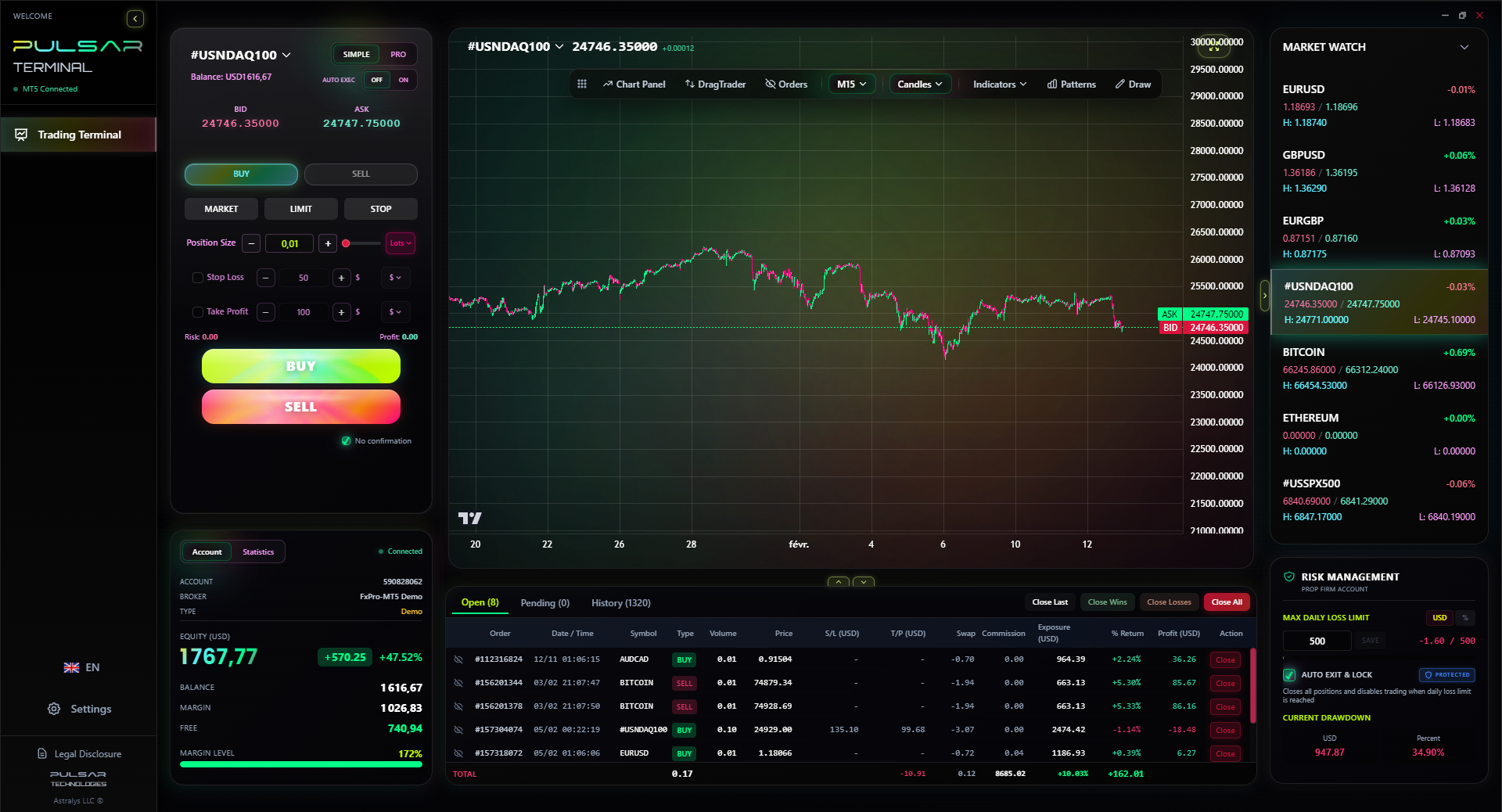
Managing multiple trades and tight stops during the volatile 3 PM overlap is stressful; Pulsar Terminal's drag-and-drop orders and multi-TP/SL features let you adjust your entire plan in seconds directly on your MT5 chart.
Pulsar Terminal
The all-in-one MT5 companion: drag-and-drop orders, multi-TP/SL, trailing stop, grid trading, Volume Profile, and prop firm protection. Used by 1,000+ traders daily.
“SARS doesn't care if your broker is in Cyprus or Mauritius. Your trading profit is income, and they want their share.”
Here’s what a typical trading day looks like for me now, forged from years of errors.
6:30 AM: Wake up, check any swing trade positions from Asia. Scan headlines. No trading.
8:00 AM – 10:00 AM: Deep analysis. I draw my levels, check the MACD indicator and RSI indicator on higher timeframes. I plan 2-3 potential setups for the London open. My early mistake was trying to find setups here. Now I plan for them.
10:00 AM – 12:00 PM: London open. I execute planned trades if levels are hit. I am patient. If nothing triggers, I do nothing. This discipline took years. I used to see movement and jump in, often getting caught in false breakouts.
2:30 PM: Prep for the overlap. Review economic calendar for US news at 3:30 PM or 4:00 PM SAST. Adjust or remove pending orders if needed. I never hold a reckless position into major news.
3:00 PM – 7:00 PM: In the chair, focused. This is execution time. I might use a scalping strategy here on very clear momentum. I trail stops aggressively on winning trades. My worst mistake in this window was adding to a losing position, trying to ‘average down.’ The volatility during the overlap will destroy that strategy.
7:30 PM: Review. Journal all trades. Why did I enter? Why did I exit? Did I follow my plan? This 15-minute habit improved my trading more than any indicator.
The Weekend: No trading. Charts are closed from Friday night to Sunday evening. The brain needs a reset. I used to stare at weekly charts all weekend, which just led to overtrading on Monday.
“My biggest losses always came from trades placed outside the golden hours, when I was bored, not when the market was alive.”
So, where do you start tomorrow?
- Sync Your Life to the Overlap: If you have a day job, the 3 PM - 7 PM window is your prime time. Structure your workday if you can to be free for at least the first hour of it. If you can't trade then, focus on the London morning (10 AM - 1 PM) for swing trade entries.
- Pick Your Battles: Don't trade everything. If you're new, stick to EUR/USD during the overlap. Its pip value is clear, and liquidity is best. Once profitable, then consider GBP/USD or a ZAR pair.
- Start with a Demo, But Not for Too Long: Use a demo account to practice the schedule for two weeks. Place trades only at 10 AM, 3 PM, etc. Get a feel for the rhythm. Then, switch to a small live account. The psychological difference is the real teacher.
- Build Your Buffer: Your first goal isn't a Lamborghini. It's to grow your account by 5% without blowing it up. That builds confidence and a track record. Risk no more than 1% per trade. Use a calculator, every single time.
- Embrace the SA Context: Follow local news. Understand what moves the Rand. That knowledge on USD/ZAR is a tangible edge you have over 90% of other traders in that market.
The forex sessions South Africa has access to are a gift. We get the best of Europe and America in our afternoon. It's a logistical advantage. But without the discipline, the risk management, and respect for our local rules, it's just a faster way to lose. Map your time, know your costs, trade your plan. The market will be there tomorrow, same time, same place. Will you be ready?
FAQ
Q1What is the absolute best time to trade forex in South Africa?
The London-New York overlap, from 3:00 PM to 7:00 PM SAST. This 4-hour window has the highest liquidity and volatility, offering the cleanest price action and tightest spreads, especially on major pairs like EUR/USD and GBP/USD.
Q2Can I legally use international brokers like Exness or IC Markets?
Yes, it's legal. However, if they are not FSCA-licensed, you fall outside direct South African regulatory protection. The FSCA can't help you if you have a dispute. It's safer to use their South African entities (if offered) or other FSCA-regulated brokers. Always check the specific entity you're signing up with.
Q3How are my forex trading profits taxed by SARS?
SARS typically treats profits from frequent trading as ordinary income, taxed at your marginal income tax rate (up to 45%). It is not usually considered capital gains. You must declare all profits, even from offshore accounts, and keep detailed records of every trade, deposit, and withdrawal.
Q4Why are the spreads on USD/ZAR so wide?
ZAR pairs are less liquid than majors like EUR/USD. Fewer banks and institutions trade them globally, so the bid-ask spread is wider to compensate market makers for the higher risk. This makes scalping difficult and favors swing trading strategies with wider stop-losses.
Q5Is the 30:1 use limit from the FSCA a problem?
It's a protection, not a problem. While it limits potential returns on tiny accounts, it drastically reduces the risk of a rapid margin call. Most retail traders blow accounts by using excessive use. 30:1 forces more sensible position sizing, which is a key to long-term survival.
Q6What's a common mistake South African traders make with session times?
Trying to trade actively during the late New York session or the Asian session (our early morning). The low liquidity leads to choppy, unpredictable price action and wider spreads. It's far better to use those times for analysis and planning, then trade when London and New York are active.
Q7Should I trade on a Sunday when the market re-opens?
Generally, no. The Sunday open (around 11 PM SAST) is known for gaps and erratic price spikes due to weekend news. Liquidity is thin. It's a high-risk, low-reward environment. It's better to watch and let the market settle for a few hours before considering any new positions.
Prof. Winston's Lesson
Key Takeaways:
- ✓Trade the London-NY overlap (3-7 PM SAST) or don't trade intraday at all.
- ✓Risk max 1% per trade on ZAR pairs due to wild volatility.
- ✓Treat all trading profits as taxable income for SARS.
- ✓Use FSCA-regulated brokers or understand you're unprotected.
- ✓Wider spreads on ZAR pairs require swing, not scalp, strategies.
How useful was this article?
Click a star to rate
Weekly Trading Insights
Free weekly analysis & strategies. No spam.
About the Author
David van der Merwe
Emerging Markets Trader
Johannesburg-based trader with 11 years in emerging market currencies. Specializes in ZAR pairs, FSCA-regulated trading, and South African market analysis.
Comments
Risk Disclaimer
Trading financial instruments carries significant risk and may not be suitable for all investors. Past performance does not guarantee future results. This content is for educational purposes only and should not be considered investment advice. Always conduct your own research before trading.
You Might Also Like

Cara Trading Forex Sukses: 7 Prinsip dari Trader Profesional
Cara trading forex sukses dengan 7 prinsip trader pro: manajemen modal, disiplin, journal trading, backtest. Data nyata, bukan janji profit palsu.
Jam Trading Forex Terbaik untuk Trader Indonesia: Panduan Lengkap dengan Tabel Waktu
Panduan jam trading forex untuk trader Indonesia. Tabel 4 sesi dunia, jam emas 20:00-00:00, sesi mana yang harus dihindari. Data akurat + tips dari trader berpengalaman.
Top 5 Sàn Forex Uy Tín Nhất 2026: Review Jujur dari Trader Indonesia
Top 5 sàn forex uy tín 2026 untuk trader Indonesia. Review jujur: spread, deposit, withdraw, dukungan lokal. Exness, XM, IC Markets & lebih.
Get Pulsar Terminal
All these calculators are built into Pulsar Terminal with real-time data from your MT5 account. One-click position sizing, automatic risk management, and instant calculations.
Get Pulsar Terminal