


Let's be blunt: most forex signal indicators you see advertised on Instagram or WhatsApp are designed to take your money, not make it.

Olumide Adeyemi
West African Trading Pioneer ·  Nigeria
☕ 13 min read
What you'll learn:
- 1What Exactly Is a Forex Signal Indicator? (No Fluff)
- 2The Most Common Types & How They Actually Work
- 3The Nigerian Trader's Reality: Data, Costs, and Scams
- 4How to Build a Strategy Around an Indicator (The Right Way)
- 5Pitfalls I Fell Into (So You Don't Have To)
- 6Free vs. Paid Indicators: The Real Cost
- 7Putting It All Together: A Daily Routine
- 8The Final Verdict: Are They Worth It?
Let's be blunt: most forex signal indicators you see advertised on Instagram or WhatsApp are designed to take your money, not make it. I've lost more than ₦500,000 over the years chasing '100% accurate' signals before I figured out the truth. A forex signal indicator is just a tool, and like any tool, it's useless in the wrong hands. This guide isn't about selling you a magic box. It's about showing you, from one Naija trader to another, how to separate the real tools from the scams and integrate the good ones into a strategy that survives the market's chaos.
A forex signal indicator is a piece of software, usually added to a chart, that analyzes price data and tries to predict future movement. It gives you a visual or auditory 'signal' - like an arrow, a color change, or a pop-up alert - suggesting when to buy or sell.
That's the simple part. The complicated part is understanding what it's actually doing. It's not a crystal ball. It's applying a mathematical formula to past price data. Whether it's calculating averages, momentum, or volatility, it's always looking backward to guess forward. The biggest mistake I made early on was treating these signals like divine commands. I'd see a green 'BUY' arrow on EUR/USD and jump in without a second thought, ignoring the broader market context. That's a surefire way to blow your account.
Think of it like a weather forecast app. It can tell you there's a 70% chance of rain based on atmospheric data. A good trader packs an umbrella. A bad trader, seeing the prediction, sells all his sunblock and then gets angry at the app when he gets wet. The indicator gives you a probability, not a promise.

Warning: Any vendor who claims their indicator has '90% win rate' or 'no losses' is lying. Full stop. If it were that good, they'd be trading it themselves on a private island, not selling it for ₦20,000 on Telegram.

💡 Winston's Tip
An indicator is a lamp post for a drunk man: useful for support, not for illumination. Don't expect it to light your entire path.
You'll see hundreds of fancy-named indicators, but most are variations of a few core types. Knowing the engine under the hood is key.
Trend-Following Indicators
These assume a trend in motion will stay in motion. The most famous is the Moving Average. A common signal is when a short-term MA (like the 50-period) crosses above a long-term MA (like the 200-period) - a 'golden cross' suggesting an uptrend. I used to love these for swing trading pairs like GBP/JPY. The problem? In a ranging market, they give terrible 'whipsaw' signals, buying at the top and selling at the bottom. You need to confirm the trend exists first.
Momentum Indicators
These measure the speed of price movement. The RSI indicator (Relative Strength Index) is the king here. It oscillates between 0 and 100. A classic signal is an RSI reading above 70 (overbought, potential sell) or below 30 (oversold, potential buy). Early in my career, I got burned selling every time EUR/USD hit RSI 70. The trend was powerfully bullish, and the pair just stayed 'overbought' for weeks. I learned that an overbought reading in a strong uptrend isn't a sell signal; it's a sign of strength.
Volatility Indicators
These, like Bollinger Bands, measure how much the price is swinging. The bands widen during volatile periods and contract during calm ones. A signal might be price touching the lower band as a potential bounce point. They're great for identifying periods of consolidation before a big break, which is useful for planning a scalping strategy around key news events.
Volume-Based Indicators
Less common in forex (since there's no central exchange volume), but some brokers offer tick volume. The idea is that price movement with high volume is more significant. I find them more reliable in futures markets than in spot forex.
Here’s a quick comparison of the two you’ll use most:
| Indicator Type | Best For | Biggest Pitfall |
|---|---|---|
| Trend (e.g., MA) | Riding sustained moves in pairs like XAU/USD during a clear trend. | Giving late entries and fake signals in a sideways market. |
| Momentum (e.g., RSI) | Spotting potential reversals or exhaustion during swing trading ranges. | Giving premature signals in a strong, trending market. |
“A forex signal indicator gives you a probability, not a promise.”
Trading from Nigeria adds unique layers of complexity that those YouTube gurus in London never mention.
First, internet stability. An indicator that repaints (changes its past signals) might look perfect on a chart after the fact, but in real-time, with our occasional network lag, the signal you get at 2:01 PM might be completely different by 2:02 PM. I learned this the hard way with a fancy 'Fibonacci predictor' indicator. I'd get a sell signal, place the trade, and watch the signal disappear and turn into a buy signal 30 seconds later. By then, I was already in a losing position.
Second, broker execution. The spread is your first cost. Using a forex signal indicator that generates lots of short-term signals on a broker with wide spreads will kill your profits. If your strategy needs tight spreads for scalping, you must use a broker known for it, like IC Markets or Pepperstone. I once tried a scalping signal system with a local broker offering 'zero spread' but huge commission. The signals were marginally profitable, but the commission turned it into a net loser. Always factor in the total cost.
Finally, the scam environment is rampant here. The WhatsApp broadcast promising 'daily signals from our master analyst' for a weekly fee? It's almost always a scam. They'll send out vague signals ('watch GBP pairs') or send a winning trade after it happens. I paid for one such service early on. The 'analyst' would send a message: "We took 50 pips on EUR/USD today." But he never sent the entry signal before the move. When confronted, he blocked me. Protect your capital fiercely. No legitimate service guarantees profits.

Pro Tip: Before buying any signal service or indicator, ask for a verified, real-time track record from a third-party platform like Myfxbook. If they can't or won't provide it, walk away.
An indicator should be a component of your system, not the entire system. Here’s the framework I finally settled on after years of trial and error.
Step 1: Define Your Market Context. Is the market trending strongly, ranging, or volatile? Use a simple trend filter. I often use the 200-period EMA on the H4 chart. If price is above it, I only look for buy signals from my main indicator. This one filter saved me from countless losing counter-trend trades.
Step 2: Choose Your Primary Signal Generator. Pick ONE main forex signal indicator you understand deeply. Don't clutter your chart with 10 different ones. If they all say 'buy,' it feels convincing, but they're often all reading the same price data differently. I primarily use the MACD indicator histogram for momentum and crossover signals on daily charts.
Step 3: Add a Confirmation Filter. Use something from a different category to confirm. If my MACD gives a buy signal (momentum), I'll check if price is at a key support level (price action) or if the Stochastic is also rising from oversold (another momentum, but different calculation). This confluence increases the probability.
Step 4: Ruthlessly Define Your Risk. This is where 90% of Nigerian traders fail. Before you take any signal, you must know your exact entry, stop-loss, and take-profit. Use a position size calculator to determine your lot size based on your account balance and the distance to your stop. I never risk more than 1% of my account on a single trade. On a ₦500,000 account, that's ₦5,000. This discipline is the only reason I'm still trading.
Step 5: Manage the Trade. A signal gets you in. Your plan keeps you in. Will you move your stop to breakeven after a certain point? Take partial profits? This is where trade management tools are useful.
Let me give you a real example from last month on USD/NGN (I trade the futures proxy). My trend filter (H4 chart) showed a mild bullish bias. My primary indicator (a custom volume-weighted MA) gave a buy signal at 1480.50. Price was also bouncing off a previous resistance-turned-support level. Confluence. I entered at 1481.00 (slippage), placed my stop at 1475.00 (60 pip risk), and my first take-profit at 1495.00. I used a trailing stop after it hit 1490.00. The trade ran to 1502.00 before the trailing stop took me out. A solid win, but it was the plan, not just the initial signal, that captured the full move.
“The hidden cost of paid indicators is the psychological dependency they create.”
Learning what not to do is sometimes more valuable than learning what to do.
Chasing Perfection: I spent years and thousands of naira searching for the 'holy grail' indicator. I'd buy one, use it for two weeks, have a losing trade, and abandon it for the next shiny thing. This cycle prevents you from ever learning an indicator's true personality - its strengths and weaknesses in different market conditions. Pick one or two and stick with them for at least 100 trades. Journal the results.
Ignoring the Higher Timeframe: This was my most expensive mistake. I'd get a beautiful buy signal on the 15-minute chart and pile in, only to see the trade reverse because on the 4-hour chart, price was slamming into a massive resistance level I was completely blind to. Always, always zoom out. A signal on the M15 is just noise if it's against the H4 or Daily trend.
Over-Optimizing (Curve Fitting): You can tweak an indicator's settings to perfectly fit past data. Make the moving average a 13-period instead of a 14-period and suddenly every past peak is caught. It feels like genius. But that setting is now tuned to past noise and will likely fail miserably on future data. Use default settings or make only minor adjustments based on a currency pair's average volatility.
Letting a Signal Override Your Rules: I had a rule: no trading during major US news events. One day, a 'perfect' indicator signal flashed right before the Non-Farm Payrolls report. I broke my rule, entered, and got stopped out in the 30 seconds of insane volatility that followed. The loss wasn't the indicator's fault. It was mine for abandoning my risk management rules. The indicator is a servant to your strategy, not the master of it.

Example: I once optimized a Stochastic indicator for GBP/USD on 2022 data. It showed a 75% win rate. In live trading in Q1 2023, that win rate dropped to 42%. The market regime had changed, and my over-fitted settings were useless.
💡 Winston's Tip
The only indicator worth paying for is one that saves you time, not one that promises profits. Automation for order entry or management can be valuable; a magic prediction is not.
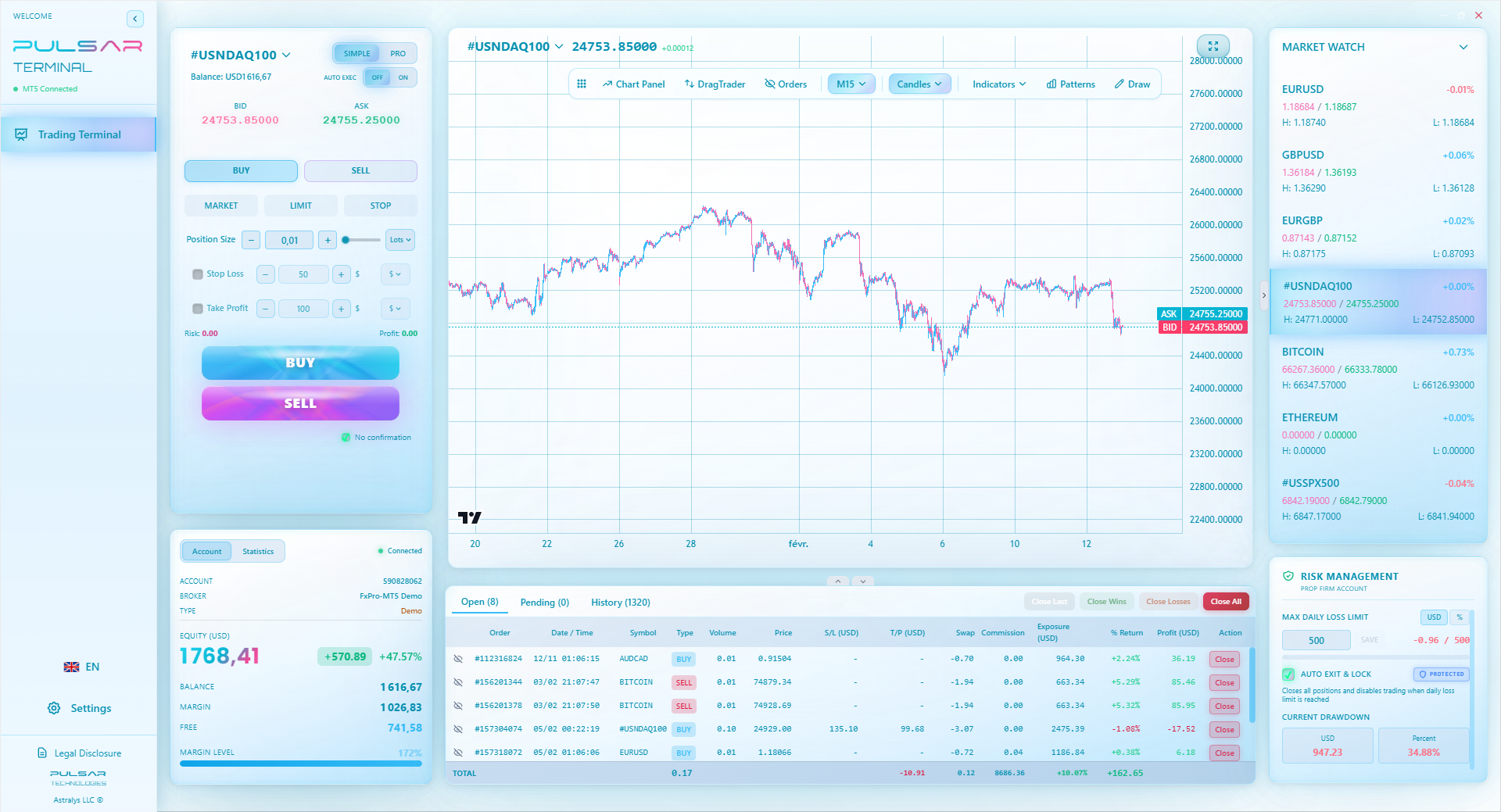
Managing multiple take-profit levels and moving stops to breakeven manually is stressful and error-prone, which is why tools like Pulsar Terminal automate this directly on your MT5 charts.
Pulsar Terminal
The all-in-one MT5 companion: drag-and-drop orders, multi-TP/SL, trailing stop, grid trading, Volume Profile, and prop firm protection. Used by 1,000+ traders daily.
Your MT4/MT5 platform comes packed with powerful, free indicators. The MACD, RSI, Moving Averages, Bollinger Bands - these are the tools used by professional fund managers. The fancy paid indicators you see? Most are just repackaged versions of these free ones with a flashy interface.
I've bought my share of paid indicators. One 'GTO Forex Prophet' package cost me $250 (about ₦350,000 at the time). It plotted arrows and channels. After a month of testing, I reverse-engineered its main logic: it was a Heiken Ashi smoothed moving average with a standard deviation channel. I could recreate 90% of its signals with free tools already on my MT5.
When should you consider a paid indicator? Only if it provides a genuinely unique calculation or data aggregation that you cannot replicate and you fully understand its methodology. Even then, treat it as a beta test. Never risk real money on a new paid indicator immediately. Demo trade it for a minimum of two months across different market conditions.
The hidden cost of paid indicators isn't just the price. It's the psychological dependency they create. You start to trust the 'black box' more than your own analysis. When it fails, you're left with no understanding of why, which means you can't adapt. With free, standard indicators, their logic is well-documented. You know why an RSI divergence signal failed - because the underlying trend was too strong. That's a learning moment you can bank for the future.
“The goal isn't to find the perfect signal. The goal is to become the trader who doesn't need one.”
Here’s a practical, no-nonsense routine for a Nigerian trader using indicators.
Morning (Before 9 AM WAT):
- Scan the High Timeframes: Open the Daily and H4 charts for your 3-5 major pairs (like EUR/USD, GBP/USD, XAU/USD). Identify the clear trend using your 200 EMA. No indicator signals yet, just get the context.
- Check Economic Calendar: Note high-impact news events for the day. I mark these times in red on my chart. No new trades 15 minutes before or after.
Trading Session (London/New York Overlap is often best):
- Drop to Your Trading Timeframe: For me, that's often the H1 or M30 chart.
- Apply Your Signal & Confirmation: Let's say I use a Moving Average Crossover as my signal and RSI as confirmation. I only look for trades in the direction of my H4 trend. A buy signal requires: MA crossover up, price above H4 200EMA, and RSI not above 75 (to avoid overbought entry).
- Plan the Trade: If all boxes are ticked, I mark my exact entry, stop-loss (based on a recent swing low/high), and take-profit (using a 1:1.5 or 1:2 risk-reward ratio). I calculate my position size using my 1% risk rule.
- Execute and Walk Away: I place the trade with a pending order if possible. I set my stop-loss and take-profit immediately. I then close the platform or switch to a different chart. Obsessing over an open trade leads to emotional decisions like moving stops or taking early profits.
End of Day:
- Journal: This is non-negotiable. Record the trade: pair, signal used, entry/exit, P/L in pips and naira, and most importantly, what you learned. Was the signal clear? Did your confirmation work? Did you follow your rules?
This routine removes emotion and turns trading from a guessing game into a structured process. The forex signal indicator has a specific, limited role within that process.
💡 Winston's Tip
Your first 100 trades with a new indicator should be in a journal, not on a live account. You're learning its language, not making money.
Yes, but not in the way you probably think.
A well-understood, classic forex signal indicator is worth its weight in gold as a component of a broader system. It can help objectify your analysis, remove some hesitation, and provide clear entry criteria. The free ones that come with your platform are more than sufficient for this.
The expensive, secretive, 'guaranteed profit' indicators and signal services are almost always worthless scams. Their real product is hope, sold to desperate traders. I bought that hope for years.
The true value doesn't come from the indicator itself. It comes from the hundreds of hours you spend learning how it behaves, where it fails, and how it interacts with price action and market context. That knowledge becomes your edge. No one can sell you that. You have to earn it through screen time, losses, and relentless self-honesty.
Start with the RSI and a Simple Moving Average on a demo account. Learn them inside out. Build simple rules around them. Practice until your decisions are mechanical. That foundation will serve you far better than any magical black box ever could. Remember, the goal isn't to find the perfect signal. The goal is to become the trader who doesn't need one.
FAQ
Q1What is the most accurate free forex signal indicator?
There's no single 'most accurate' indicator. Accuracy depends entirely on the market condition. For trending markets, Moving Average crossovers can be effective. For ranging markets, oscillators like RSI or Stochastic can help identify reversals. The key is to learn which indicator works best in the current market context, not to search for a universal winner.
Q2Can I make money in Nigeria just by following forex signals?
It's highly unlikely and extremely risky. Signals don't include risk management, which is 90% of trading. A signal might be right 60% of the time, but if you risk ₦10,000 on every losing trade and only take ₦2,000 profits, you'll lose money overall. You must know how to size your positions, set stops, and manage trades. Blindly following signals is a recipe for a margin call.
Q3How do I know if a paid indicator is a scam?
Major red flags: 1) Guaranteed profits or a near-100% win rate. 2) No verified, real-time track record. 3) Vague explanations of how it works ('proprietary algorithm'). 4) Pressure to buy now with a 'limited-time offer.' 5) Testimonials that look fake. Always demand a one-month trial on a demo account before paying a single kobo.
Q4Should I use multiple indicators on one chart?
Less is more. Using too many indicators leads to 'analysis paralysis' where they give conflicting signals. I recommend a maximum of two or three: one for trend/momentum (like MACD), one for overbought/oversold levels (like RSI), and perhaps a volatility gauge (like Bollinger Bands). They should complement, not duplicate, each other.
Q5Why do my indicator signals work in demo but fail in live trading?
This is usually due to psychology, not the indicator. In demo, you trade without fear or greed. In a live account with real money, emotions cause you to hesitate on entries, move stop-losses, or take profits too early, breaking your system's rules. The indicator is the same; your execution isn't. Practice on demo until your actions are mechanical, then start with a very small live account.
Q6What timeframes are best for forex signal indicators?
It depends on your trading style. For day trading and scalping, M5 to M30 charts are common. For swing trading, H1 to H4 charts are better. However, you should always check the next higher timeframe for trend direction. A buy signal on the M15 chart is much stronger if the H1 chart is also bullish.
Prof. Winston's Lesson
Key Takeaways:
- ✓No indicator has a 90% win rate. Anyone claiming so is lying.
- ✓Always confirm a signal with a higher timeframe trend analysis.
- ✓Never risk more than 1% of your account on a single trade.
- ✓Free platform indicators (RSI, MACD) are more than enough to succeed.
How useful was this article?
Click a star to rate
Weekly Trading Insights
Free weekly analysis & strategies. No spam.
About the Author
Olumide Adeyemi
West African Trading Pioneer
One of Nigeria's most active forex trading educators. 8 years of experience trading from Lagos. Specializes in low-capital strategies and prop firm challenges for African traders.
Comments
Risk Disclaimer
Trading financial instruments carries significant risk and may not be suitable for all investors. Past performance does not guarantee future results. This content is for educational purposes only and should not be considered investment advice. Always conduct your own research before trading.
You Might Also Like

Cara Trading Forex Sukses: 7 Prinsip dari Trader Profesional
Cara trading forex sukses dengan 7 prinsip trader pro: manajemen modal, disiplin, journal trading, backtest. Data nyata, bukan janji profit palsu.
Jam Trading Forex Terbaik untuk Trader Indonesia: Panduan Lengkap dengan Tabel Waktu
Panduan jam trading forex untuk trader Indonesia. Tabel 4 sesi dunia, jam emas 20:00-00:00, sesi mana yang harus dihindari. Data akurat + tips dari trader berpengalaman.
Top 5 Sàn Forex Uy Tín Nhất 2026: Review Jujur dari Trader Indonesia
Top 5 sàn forex uy tín 2026 untuk trader Indonesia. Review jujur: spread, deposit, withdraw, dukungan lokal. Exness, XM, IC Markets & lebih.
Get Pulsar Terminal
All these calculators are built into Pulsar Terminal with real-time data from your MT5 account. One-click position sizing, automatic risk management, and instant calculations.
Get Pulsar Terminal