


Let me guess.

Olumide Adeyemi
West African Trading Pioneer ·  Nigeria
☕ 11 min read
What you'll learn:
- 1What Are Forex Signals on Telegram, Really?
- 2How to Spot a Scam Signal Service (Nigerian Edition)
- 3The Real Costs (in Naira and Sanity)
- 4How to Use Signals Without Blowing Your Account
- 5Honest Alternatives to Telegram Signals
- 6The Legal & Tax Stuff You Can't Ignore
- 7My Personal Framework for Using Signals Today
Let me guess. You've seen the screenshots on WhatsApp and Telegram. The Lamborghinis, the mansion keys, the 'verified' payout of $50,000 in a week from following some guru's signals. Here's the myth: that joining the right Telegram channel is a shortcut to forex riches. The truth? It's the fastest way to blow your account if you don't know what you're doing. I've been there, I've paid for signals, and I've learned the hard way. Let's set the record straight on what forex signals on Telegram really mean for a Nigerian trader.
At its core, a forex signal is just a trade suggestion. Someone, or some algorithm, says 'Buy EUR/USD at 1.0850, stop loss at 1.0820, take profit at 1.0900.' On Telegram, these get blasted out to thousands of subscribers in channels or groups. Sounds simple, right?
The reality is more complicated. In Nigeria, these channels range from one guy with a laptop in Lagos running a 'prop firm challenge' service, to sophisticated operations using copy-trading software. The appeal is obvious: you get the trade idea without doing the analysis. You don't need to understand why the RSI indicator is oversold or what the Fed chair said. You just copy the trade.
But here's where it gets messy. There's zero regulation for signal providers in Nigeria. The CBN and SEC are focused on banks and licensed brokers, not some 'Forex Kingpin' on Telegram. That means no one is checking if their results are real, if they're actually trading their own signals, or if they're just selling you hopium. I once paid ₦25,000 for a month of 'VIP signals' from a popular channel. The first week had two winners. The next three weeks were a string of losses that would have wiped out 40% of my account if I'd followed them all. The provider's excuse? 'Market volatility.' Always the market's fault, never theirs.

Warning: A screenshot of a trading terminal showing profit is the easiest thing in the world to fake with a demo account or photo editing software. Never trust a signal provider based on images alone.

💡 Winston's Tip
A signal without a clear risk management plan is just a recommendation to gamble. Always know your exit before your entry.
Nigerian scammers are world-class, and the forex signal space is a playground for them. They know our pain points: wanting fast money, distrust of complex systems, and the appeal of a 'plug.' Here’s what to look for.
The Guarantee: Any service that guarantees profits or a specific monthly return (e.g., 'Make 50% monthly GUARANTEED!') is lying. Forex is probabilistic, not certain. The market doesn't give guarantees.
The Lifestyle Flex: Channels filled with pictures of cars, stacks of dollars, and luxury watches are selling a dream, not a service. Real traders are usually too busy analyzing charts or managing risk to pose with rented supercars. I fell for this once early on, attracted to the glamour. It cost me.
The Vague Strategy: Ask them how they generate signals. If the answer is 'proprietary algorithm' or 'insider info' with no further explanation, run. A legitimate provider should be able to explain their general approach (e.g., 'We use price action on the 4H chart combined with liquidity sweeps').
No Verified Track Record: A real track record is a verified, third-party audited history of trades. MyFfxbook or something similar where you can see every trade, the drawdown, the win rate. A Telegram channel posting only the winners is a huge red flag.
Pressure to Deposit More: 'Brother, to get these high-probability signals, you need to upgrade to our Diamond package for ₦100k.' This is a classic upsell trap. Your success should not depend on you paying them more money.
Let's talk numbers from that 'VIP' service I used. They claimed an 80% win rate. Over the month I tracked them, they issued 47 signals. Only 28 were winners. That's a 59.5% win rate. Not terrible, but not 80%. More importantly, their average loser was -35 pips, while their average winner was +22 pips. That's a terrible risk/reward ratio. You can win more often than you lose and still lose money overall. That's why you must check the details, not just the hype.
“The price of a signal subscription is nothing compared to the cost of the losses you'll take by following it blindly.”
Everyone talks about the subscription fee, but the hidden costs will kill you.
Subscription Fees: These vary wildly. I've seen everything from 'free' channels (they make money from affiliate broker links) to ₦10,000/month for basic, to over ₦150,000 for 'mastermind' groups. The price rarely correlates with quality.
The Slippage Tax: This is the big one nobody mentions. When a signal goes out to 5,000 people at once, and they all rush to buy EUR/USD, what happens? The price moves against you before your order fills. You might get in 2, 3, or even 5 pips worse than the signal price. On a standard lot, that's $20-$50 gone before the trade even starts. This is especially brutal for scalping strategies where profit targets are small.
The Psychological Cost: This is the worst. You become passive. You stop learning to read the charts yourself. Your emotional state is tied to some stranger's analysis. When a losing streak hits (and it will), you have no understanding of why to hold or cut the trade. You're just gambling on someone else's call. I became a better trader the day I stopped blindly following signals and started using them only as a second opinion for my own analysis.

Example: Let's say you take a signal on a 0.1 lot EUR/USD trade. Signal says entry at 1.0850, SL at 1.0820 (30 pips risk). Due to slippage and a slightly wider spread from your broker, you get in at 1.0853. Your real risk is now 33 pips. That's $33 risk, not $30. A 10% increase in your risk before you begin. Now multiply that across 20 trades a month.
If you're going to use signals, you have to be smart about it. Don't just be a copy-paste robot.
Do Your Own Broker Homework
The signal provider might recommend a broker, but you must verify it yourself. Check if they are regulated by a reputable authority like the FCA, ASIC, or FSCA. For us in Nigeria, brokers like Exness or IC Markets are popular for good reason: they have decent regulation and access for Nigerians. But always check the spread definition and execution speed yourself on a demo. A broker with slow execution will murder a signal-based strategy.
Manage Your Own Risk
The signal says 'risk 2%'. What does that mean? It means YOU need to calculate your position size based on your account balance and the distance to the stop loss. Never let a signal tell you what lot size to trade. Use a position size calculator every single time. I once saw a signal that said 'Buy Gold, lot size 1.0'. For my $1,000 account, that would have been suicidal. I calculated it properly for a 2% risk and traded 0.05 lots instead.
Use Signals as a Confluence Tool
This is the professional way. Don't take the signal in isolation. When you get a 'BUY' signal on GBP/USD, pull up your own chart. Does it align with your support level? Is the MACD indicator showing bullish momentum on your timeframe? If your own analysis agrees, it's a stronger trade. If it contradicts, maybe skip it. This turns you from a follower into a thinker.
Start with a Demo
Before you pay one kobo, follow the signals on a demo account for at least a month. Track every entry, exit, slippage, and the emotional toll. Does it fit your life? If you're a swing trading person, a channel that spits out 10 scalps a day will drive you mad.
💡 Winston's Tip
The most valuable signal you'll ever get is the one your own analysis confirms. Trust your chart over a stranger's chat.
“In Nigeria's market, the only 'insider info' you need is how to manage your risk.”
Relying on Telegram signals forever is a dead-end strategy. Here are paths that actually build your skills.
Learn Price Action: This is the foundation. Understanding candlestick patterns, support/resistance, and market structure will make you less dependent on anyone. It's hard work, but it's yours forever.
Use Social Trading Platforms Wisely: Platforms like eToro or some broker-specific copy trading features show you the verified historical performance of real traders. You can see their max drawdown, risk score, and copy them transparently. It's more regulated than a random Telegram channel.
Join Educational Communities, Not Signal Groups: Look for groups that focus on teaching: weekly webinars, chart breakdowns, Q&A sessions. The value is in understanding the 'why,' not just the 'what.'
Build Your Own Scanner: With a bit of learning, you can use TradingView's Pine Script or other tools to create alerts for your own strategy. This is the ultimate goal: your system, your alerts. You become the signal provider for yourself.
The biggest shift for me was moving from seeking signals to seeking understanding. I spent six months focusing solely on the EUR/USD guide, learning its personality. Now, when a signal comes in for it, I immediately have a context for whether it makes sense or not.
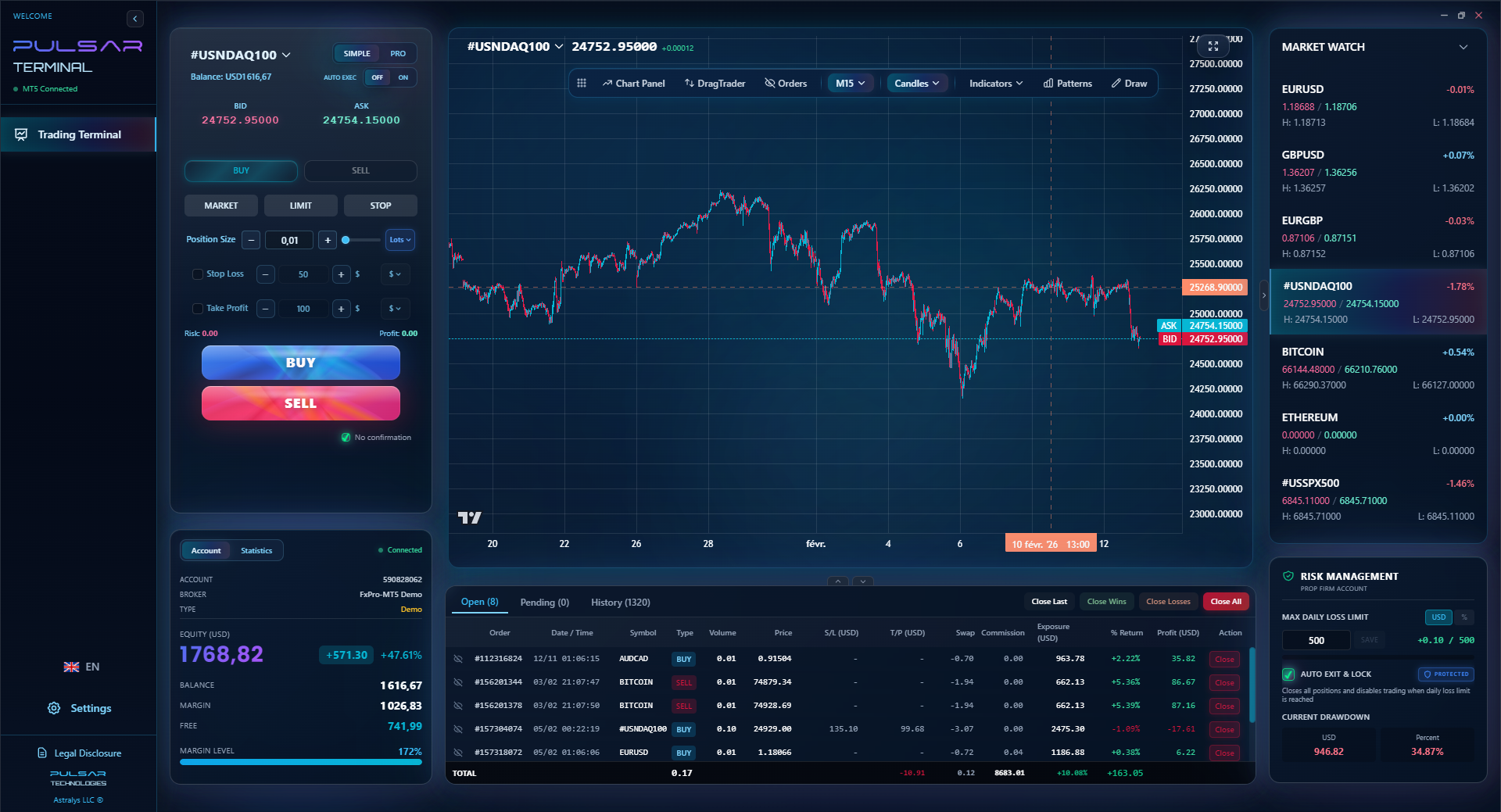
When you're managing multiple trades from signals or your own analysis, a tool that lets you set advanced take-profit and stop-loss orders directly on your MT5 chart is a game-saver.
Pulsar Terminal
The all-in-one MT5 companion: drag-and-drop orders, multi-TP/SL, trailing stop, grid trading, Volume Profile, and prop firm protection. Used by 1,000+ traders daily.
This is the boring but crucial part. Trading forex is legal in Nigeria. But making money from it comes with responsibilities.
Taxes: Yes, you have to pay. Profits from forex trading are subject to Capital Gains Tax (CGT). The current rate is 10%. You are responsible for declaring this to the Federal Inland Revenue Service (FIRS). If you're following signals and making profits, keep immaculate records. The government isn't checking Telegram, but they can check your bank account when you try to withdraw a large sum.
Broker Regulations: While the CBN has been cleaning up the FX market (revoking thousands of BDC licenses, launching the new FX code), their focus isn't on retail signal providers. Their focus is on the source of your trading funds. You cannot use official CBN windows to fund your international broker account. You'll use your card, bank transfer, or crypto. This is why using a reputable international broker is key – they handle this process daily.
Where Your Money Is: When you deposit with a broker like XM or Pepperstone, your money is held in a segregated account under their regulator's jurisdiction (e.g., Cyprus, Australia). This offers some protection. Your money with a Telegram signal provider? It's gone the second you pay the subscription. You have zero recourse if they vanish.
The new Nigerian FX Code promotes ethics and transparency. Holding yourself to that standard - by keeping records, paying taxes, and dealing with legitimate companies - is how you stay on the right side of the law while navigating this wild west.
“Telegram signals teach you dependency. Reading the charts teaches you freedom.”
After years and many mistakes, here's my exact process if I ever look at a signal now. I might check one or two channels a week, not for copying, but for market sentiment.
- The Source Check: Who is this person? Do they trade live on video? Do they have a multi-year, verified track record? If no, I close the tab immediately.
- The 'Why' Check: Does the signal come with a brief rationale? 'Buy because of daily demand zone' is better than just 'BUY NOW.'
- The Confluence Check: I pull up my chart on XAU/USD guide or whatever the instrument is. I look at my key levels. Does the signal entry align with a level I already have marked? I check volume and maybe one oscillator. This takes me 90 seconds.
- The Risk Check: I calculate my position size based on my rules, not theirs. I always use a stop loss. I sometimes even adjust their take profit to a logical resistance level I see.
- The Journal Entry: Win or lose, I note down: 'Took signal from X. Their reason was Y. My analysis showed Z. Outcome: ...' This keeps me accountable.
This framework turned signals from a crutch into a minor tool. The last time I used one successfully was about 4 months ago. A channel I respect (run by an actual fund manager who streams his analysis) flagged a short on USOIL. It lined up perfectly with a rejection at a major Fibonacci level I had. I took it, risked 0.5% of my account, and made a 1.8% return. The signal gave me the idea, but my confirmation made the trade.

Pro Tip: The best signal in the world is useless if you don't have the discipline to manage the trade. Fear and greed will make you move the stop loss or close early. Work on your psychology more than you hunt for signals.
💡 Winston's Tip
If you wouldn't risk your own money on the trade, why would you risk someone else's signal? The capital is always yours.
FAQ
Q1Are free forex signals on Telegram any good?
Sometimes, but usually not. Free channels often make money by getting you to sign up with a specific broker (they get a kickback), not from your trading success. The signals can be low-quality or designed to churn your account (generate lots of trades for the broker). Tread very carefully.
Q2How much should I pay for a forex signal service in Nigeria?
There's no right answer, but I'm suspicious of anything over ₦30,000 per month unless it's from a globally recognized, verified institution. A high price tag is often just marketing. Start with a free trial or a one-week pass if offered, and test it on demo first. The value should be in education, not just trade alerts.
Q3Can I get rich from following forex signals?
The short answer is no. Getting rich in forex requires significant capital, impeccable risk management, and deep market understanding - things a signal can't provide. Signals might help you make some profitable trades, but they won't build the skill or discipline needed for long-term, life-changing wealth. They are a tool, not a magic bullet.
Q4What's the #1 red flag for a scam signal provider?
The guaranteed profit. The market offers no guarantees. Any provider who promises a specific monthly return (e.g., '20% monthly guaranteed') is fundamentally dishonest. Run, don't walk, away.
Q5Do I need to pay tax on profits made from following signals?
Yes. It doesn't matter how you generate the trading profit - through your own analysis or by copying signals. In Nigeria, it is considered a capital gain. You are legally required to declare it and pay the 10% Capital Gains Tax to the FIRS. Keep a detailed trade journal for your records.
Q6Is it better to use a copy-trading platform instead of Telegram?
Generally, yes. Reputable copy-trading platforms (offered by some brokers) provide verified performance statistics, show drawdown, and automate the trade copying seamlessly. It's more transparent and regulated than most Telegram channels. However, you still must do your due diligence on the trader you're copying.
Prof. Winston's Lesson
Key Takeaways:
- ✓Test every signal on demo for one month minimum.
- ✓Calculate your own position size; never use theirs.
- ✓Pay your 10% capital gains tax to FIRS.
- ✓A 59% win rate with poor risk/reward still loses money.
How useful was this article?
Click a star to rate
Weekly Trading Insights
Free weekly analysis & strategies. No spam.
About the Author
Olumide Adeyemi
West African Trading Pioneer
One of Nigeria's most active forex trading educators. 8 years of experience trading from Lagos. Specializes in low-capital strategies and prop firm challenges for African traders.
Comments
Risk Disclaimer
Trading financial instruments carries significant risk and may not be suitable for all investors. Past performance does not guarantee future results. This content is for educational purposes only and should not be considered investment advice. Always conduct your own research before trading.
You Might Also Like

Cara Trading Forex Sukses: 7 Prinsip dari Trader Profesional
Cara trading forex sukses dengan 7 prinsip trader pro: manajemen modal, disiplin, journal trading, backtest. Data nyata, bukan janji profit palsu.
Jam Trading Forex Terbaik untuk Trader Indonesia: Panduan Lengkap dengan Tabel Waktu
Panduan jam trading forex untuk trader Indonesia. Tabel 4 sesi dunia, jam emas 20:00-00:00, sesi mana yang harus dihindari. Data akurat + tips dari trader berpengalaman.
Top 5 Sàn Forex Uy Tín Nhất 2026: Review Jujur dari Trader Indonesia
Top 5 sàn forex uy tín 2026 untuk trader Indonesia. Review jujur: spread, deposit, withdraw, dukungan lokal. Exness, XM, IC Markets & lebih.
Get Pulsar Terminal
All these calculators are built into Pulsar Terminal with real-time data from your MT5 account. One-click position sizing, automatic risk management, and instant calculations.
Get Pulsar Terminal