


I stared at my screen, watching the USD/ZAR tick up relentlessly.

David van der Merwe
Emerging Markets Trader ·  South Africa
☕ 11 min read
What you'll learn:
- 1What Does 'Forex Sold' Actually Mean? It's Not What You Think
- 2Short Selling in South Africa: The SARB Rules You Can't Ignore
- 3How to Execute a 'Sold' Trade: A Step-by-Step Walkthrough
- 4The Unique Risks of Selling Forex (Why It Feels Different)
- 5Strategies for Trading 'Sold' Positions in the SA Context
- 6Tax Implications for South African Traders: SARS is Watching
- 7Choosing a Broker for Short Selling: FSCA vs. International
- 8Common Mistakes to Avoid (From My Trading Journal)
I stared at my screen, watching the USD/ZAR tick up relentlessly. My account was down R15,000. I was 'short' the dollar, convinced it would fall. The problem? I didn't truly grasp what 'forex sold' meant in the context of my trade and South Africa's rules. I thought I was just betting on a price drop. In reality, I had sold a currency I didn't own, against regulations I barely understood, using use that magnified every pip against me. That loss wasn't just bad analysis; it was a fundamental misunderstanding of the mechanics and the law. Let's break down what 'forex sold' actually means, so you don't make the same expensive error.
When you see 'forex sold' on your platform, it doesn't mean you've physically sold rand for dollars at a bank. In trading, 'sold' refers to opening a short position. You're making a contract with your broker: you agree to sell a currency at today's price, with the obligation to buy it back later. You profit if you can buy it back cheaper.
Think of it like this: you borrow your friend's Krugerrand, sell it for R38,000 today, and promise to return a coin later. If the price drops to R36,000, you buy a coin back for that price, give it to your friend, and keep the R2,000 difference. That's the profit from a 'sold' position. Your broker facilitates this 'borrowing'.
This is crucial for South Africans because of SARB's Exchange Control Regulations. While you can use your foreign capital allowance to fund an international trading account, you are not permitted to speculate against the Rand from within South Africa. This means a local broker cannot legally let you short the ZAR directly (like in a EUR/ZAR pair where you sell the ZAR). However, when you trade major pairs like GBP/USD or USD/ZAR on an international platform, you're often trading CFDs, which are contracts for difference based on the price. The 'sold' action is on the contract, not the physical currency, but the tax and legal implications are very real.

Warning: Just because your international broker's platform lets you click 'sell' on USD/ZAR doesn't make it automatically compliant with SARB's view on speculation against the Rand. The onus is on you to understand and adhere to the rules regarding your capital allowances and taxable income.

💡 Winston's Tip
A short position is a bet on human fear and economic decay. It requires colder nerves and tighter stops than going long. The market can stay irrational longer than you can stay solvent, especially when you're short.
This is where many traders, including a younger version of myself, get tripped up. We focus on the chart and forget the rulebook.
The South African Reserve Bank's primary concern is the stability of the Rand and controlling capital flows. Their rule against residents speculating against the ZAR is a protective measure. In practice, this means:
- Trading ZAR Pairs: If you're with an FSCA-licensed South African broker (like Blackstone Futures), your ability to short ZAR-based pairs (e.g., selling EUR/ZAR) will be restricted or outright blocked. They enforce the rule on their platform.
- Trading with International Brokers: When you use your R10 million annual foreign capital allowance to fund an account with a broker like IC Markets or Pepperstone, you are technically moving funds offshore. The platform is global, so you can short USD/ZAR. However, SARS still expects you to declare all profits as taxable income. The legality resides in a grey area interpreted by your use of the capital allowance for 'investment'.
- The Practical Reality: Most South African traders I know access global markets via international CFD brokers. They short USD/ZAR when they believe the Rand will strengthen. While common, it's not explicitly endorsed. You must keep careful records for SARS.
I learned this the hard way after that R15,000 loss. I was short USD/ZAR via an international broker. When I tried to withdraw my remaining profits months later, my local bank asked for proof of the source of funds. I hadn't kept proper trade statements or calculated my tax liability. It caused a lengthy, stressful delay.
“My R15,000 loss wasn't just bad analysis; it was a fundamental misunderstanding of the mechanics and the law.”
Let's make this concrete. Say you're using MetaTrader 5 and you believe the US Dollar is going to weaken against the Euro. You want to 'sell' the EUR/USD pair. This means you are selling Euros and buying US Dollars.
Placing the Order
- You open the EUR/USD chart.
- You click 'New Order'.
- A ticket pops up. For 'Type', you select 'Sell by Market'.
- You choose your volume (e.g., 0.10 lots, which is 10,000 units).
- You set your Stop Loss (SL) and Take Profit (TP) levels. This is non-negotiable. My R15k mistake had a stop loss that was far too wide, based on hope, not calculation.
- You click 'Sell'.
Your platform now shows an open short position. You are 'short EUR/USD'. The P&L will move in your favor if the price (the quote) goes DOWN. If EUR/USD is at 1.0850 and falls to 1.0800, you've made 50 pips.
Managing the Trade
This is where the real work begins. A 'sold' position is inherently more stressful for many traders because markets can rise (sometimes irrationally) longer than they can fall. You need a plan for moving your stop loss to breakeven or using a trailing stop to lock in profits. I used to just set and forget, which is how winning trades turned into losers.

Example: Selling 0.10 lots of EUR/USD at 1.0850 with a stop at 1.0900 (50 pips risk). Each pip on EUR/USD for a 0.10 lot is worth roughly $1. So, your max risk is about $50 (50 pips x $1). If your account is $2,000, that's a 2.5% risk, which is sane. I was risking over 7% on my fateful trade. Use a position size calculator every single time.
Going short carries psychological and practical risks that buying doesn't.
1. Unlimited Theoretical Risk: When you buy a currency (go long), the lowest it can go is zero. Your risk is capped at your investment. When you sell short, the price can theoretically rise to infinity. Your stop loss is your only lifeline. A 'short squeeze' - where rapid buying forces short sellers to cover their positions - can cause catastrophic, rapid losses.
2. Cost of Carry (Swap Rates): Because you've 'borrowed' one currency to sell it, you often pay or receive a daily interest fee called a swap. If you are selling a currency with a higher interest rate against one with a lower rate, you will likely pay a daily fee to hold the position overnight. This can eat into profits on longer-term swing trades. You must check the swap rates on your platform before holding a short trade for days or weeks.
3. Psychological Bias: Humans are wired for optimism. We see rising markets as 'normal' and falling markets as 'problems.' Holding a short position during a counter-trend rally requires serious conviction and discipline. It's easy to panic and close too early. My failed trade? I held on too long during a rally, convinced it was a 'fakeout,' only to watch it blow through my stop.
4. Regulatory Shift: Especially for ZAR pairs, a change in SARB's interpretation or enforcement of the rules could impact your ability to hold or open certain short positions. It's a low-probability but high-impact risk.
💡 Winston's Tip
The swap fee isn't a minor detail; it's the cost of your trade's lease. On a short carry trade, a negative swap is like paying rent on a property that's losing value. It must be factored into your expected return.
“Trying to hide trading income from SARS is a surefire way to get into deep trouble with penalties and audits.”
You can't just short randomly. You need a methodology. Here are two I've used, one that failed me and one that saved me.
Failed Strategy: Shorting Based on 'Overbought' News. When the US Fed would make a hawkish statement, the USD would spike. I'd see a tall green candle on USD/ZAR, think 'it's gone too far too fast,' and sell into the strength. My RSI indicator would be over 70. I'd get in. Then the momentum would continue for another 200 pips against me. I was trying to pick a top, which is a great way to get run over. I lost money on this approach more times than I care to admit.
Working Strategy: Selling into Confirmed Weakness on a Higher Timeframe. I switched my approach. Now, I use the daily chart to determine the overall trend. If USD/ZAR is in a clear downtrend (making lower highs and lower lows), I wait for a pullback up to a key resistance level - like a previous swing high or a major moving average (e.g., the 50-day EMA). Then, on the 4-hour or 1-hour chart, I look for a sign of rejection at that level: a bearish pin bar, a divergence on the MACD indicator, or a simple failure to break higher. That's where I enter the 'sold' position, with a stop loss just above the resistance. I'm not trying to catch a falling knife; I'm waiting for the market to bounce and show me it's tired, then joining the established downtrend.
This approach requires patience. You might watch for days without a signal. But the win rate and risk/reward improved dramatically for me. It turns short-term scalping stress into a more manageable process.
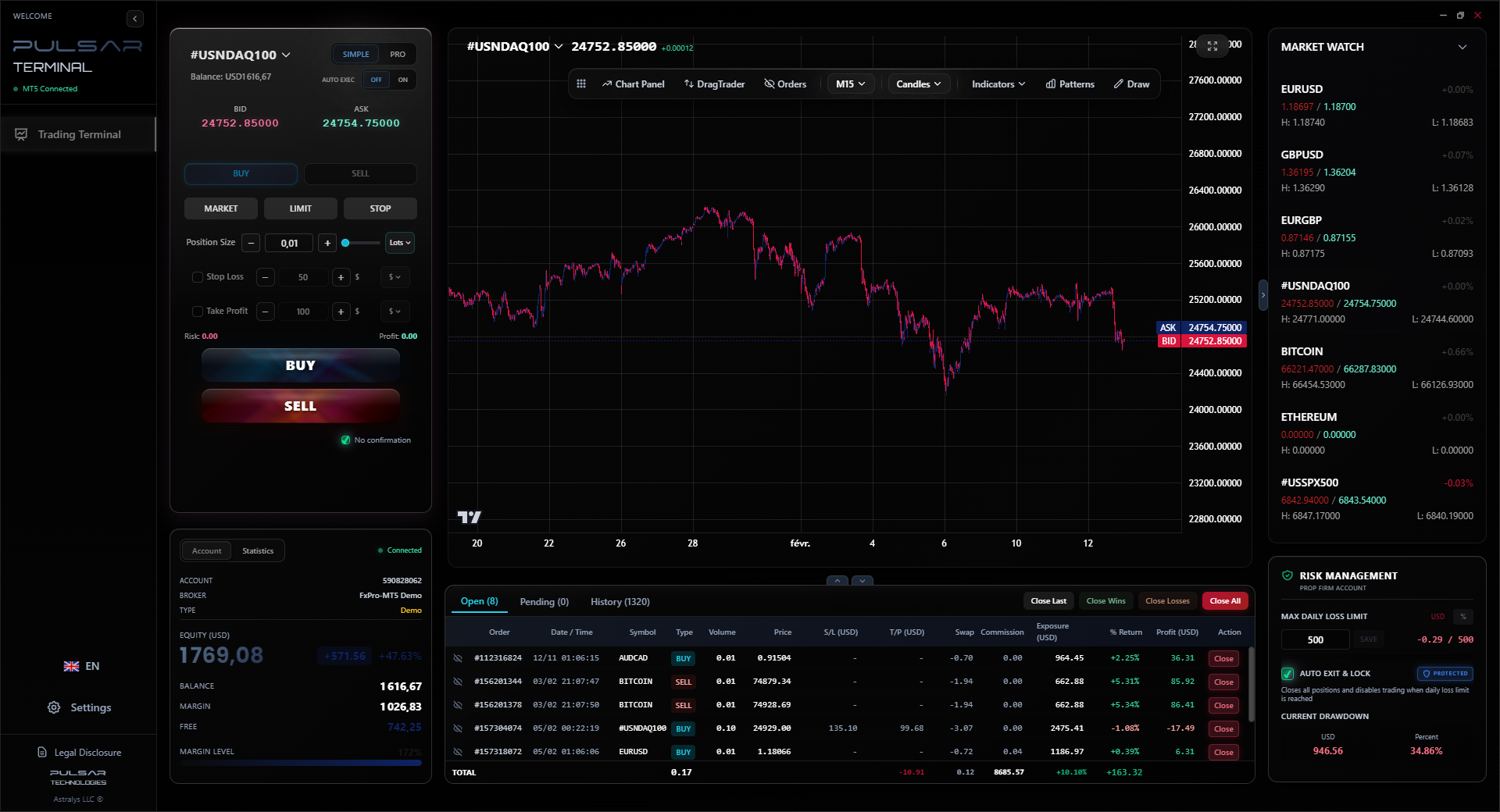
Managing multiple take-profit levels and a trailing stop on a short trade is complex, but Pulsar Terminal automates it all directly within your MT5 platform.
Pulsar Terminal
The all-in-one MT5 companion: drag-and-drop orders, multi-TP/SL, trailing stop, grid trading, Volume Profile, and prop firm protection. Used by 1,000+ traders daily.
This is the part everyone wants to ignore. Don't. Whether you're 'buying' or 'selling' forex, the South African Revenue Service views your net profits as taxable income. It's not capital gains from a long-term investment; it's revenue. You must declare it in your annual tax return.
- Keep Every Single Statement: Your broker's monthly statements and trade history are your proof. Download them regularly.
- Calculate Your Net Profit: Add up all your winning trades, subtract all your losing trades, and subtract all your trading costs (commissions, spreads, swap fees). That's your taxable income.
- It's Based on Residence: You are tax-resident in South Africa if you live here more than 91 days a year. You pay tax on your worldwide income, including profits from your international trading account.
- Losses Can Be Deducted: Trading losses can be offset against other income, but you need to prove trading is a regular activity and not a hobby. Consistent, documented activity is key.
After my big loss year, I had a net negative. I still declared it to SARS with all my statements. It was a hassle, but it established a record that I was a serious trader, which helped when I had profitable years later. Trying to hide trading income is a surefire way to get into deep trouble with penalties and audits.
“Use the lowest use that allows your strategy to work. A 1:500 use on a short trade is a recipe for a margin call.”
Your choice of broker dictates your access and your protections.
| Feature | FSCA-Licensed Broker (e.g., Vantage SA) | International Broker (e.g., Exness, XM) |
|---|---|---|
| Shorting ZAR Pairs | Restricted/Blocked (per SARB rules) | Usually Allowed |
| Client Fund Protection | Segregated accounts, FSCA ombudsman | Varies by jurisdiction (often less strong) |
| use on Majors | Capped by FSCA (e.g., 1:30 for retail) | Can be much higher (1:500, 1:1000+) |
| Deposit/Withdrawal | Easy local EFT, ZAR accounts | International transfer, uses your capital allowance |
| Primary Regulation | Financial Sector Conduct Authority (FSCA) | CySEC (Cyprus), ASIC (Australia), FSA (Seychelles) |
My path? I started with an international broker for the higher use and asset access. After a few painful lessons (including the R15k one), I moved a portion of my capital to an FSCA-licensed broker for its lower, safer use and local support. I use the international account for specific strategies where I need the flexibility. Having both gives me options and forces me to be more deliberate with my risk on the high-use account.

Pro Tip: Before you deposit a cent, test a broker's execution on short sales. Open a demo account and place some 'sell' orders during volatile news events. See if your orders get slipped or rejected. Slippage on a short entry can ruin your risk calculation from the get-go.
💡 Winston's Tip
Your broker's 'sell' button is a legal contract, not just a prediction. In South Africa, that contract intersects with SARB's capital controls. Understand the jurisdiction you're trading under before you click.
Let my losses be your lessons. Here are the entries I wish I could erase:
- Shorting Without a Clear Trend: Jumping into a short because the price 'looks high' on a 5-minute chart, while the daily chart is screaming a bull trend. This is gambling, not trading.
- Ignoring the Swap: Holding a short EUR/AUD (where you typically pay a hefty negative swap) for a week on a tiny 20-pip profit target. The fees wiped out the gain.
- Using Excessive use on Shorts: A 1:500 use on a short trade means a 0.2% move against you can trigger a margin call. I've been there. The feeling is sickening. Use the lowest use that allows your strategy to work.
- Moving Stops Further Away: 'It'll come back,' I'd tell myself as a loss grew. I'd move my stop loss down, increasing my risk, trying to avoid being wrong. This is how R5,000 losses become R15,000 losses. Let your original stop be sacred.
- Not Accounting for SA Bank Fees: Withdrawing $1,000 profit only to find a R250 international payment fee and a 1.5% currency conversion spread from your bank. Your net take-home is less than you planned. Factor these costs into your profit targets.
The core lesson? 'Forex sold' is a powerful tool, but it's a precision instrument, not a blunt weapon. Respect it, understand the local rules that frame its use, and always, always know your exact risk before you click that button.
FAQ
Q1Is it illegal for South Africans to short the Rand?
The South African Reserve Bank (SARB) prohibits residents from speculating against the Rand. In practice, FSCA-licensed local brokers will block you from shorting ZAR pairs. If you use an international broker via your foreign capital allowance, the technical ability exists, but it operates in a regulatory grey area. The profits remain fully taxable by SARS.
Q2What is the difference between 'sell' and 'short' in forex?
In the context of opening a trade, they mean the same thing: initiating a position that profits if the price falls. 'Sell' is the button you click. 'Short' describes the type of position you now hold. You have sold a currency pair with the intention of buying it back later at a lower price.
Q3Do I pay more fees for holding a short position overnight?
Often, yes. You may pay a daily 'swap' or 'rollover' fee, which is the interest rate differential between the two currencies. If you are selling a currency with a higher interest rate, you will typically pay a fee. Your trading platform shows the exact swap rates for long and short positions for each pair.
Q4How do I calculate profit on a sold forex trade?
Profit = (Sell Price - Buy Price) x Lot Size. If you sold 1 standard lot (100,000 units) of EUR/USD at 1.0850 and bought it back to close at 1.0800, your profit is (1.0850 - 1.0800) = 0.0050. That's 50 pips. The cash value depends on the pair; for EUR/USD, 1 pip on 1 lot is $10, so 50 pips = $500 profit.
Q5Can I use a trailing stop loss on a short trade?
Absolutely, and it's highly recommended. A trailing stop for a short trade is set at a fixed distance above the current market price. As the price falls, the stop follows it down, locking in profit. If the price reverses and rises, the stop stays put, protecting your gains. It's a crucial tool for managing risk on winning short trades.
Q6What's the biggest risk when selling forex?
Unlimited theoretical upside risk. Since a price can rise indefinitely, a short trade gone wrong has no natural ceiling for losses. This is why a disciplined stop loss is non-negotiable. A 'short squeeze,' where rapid buying forces shorts to cover, can cause violent, fast moves against you.
Q7How does SARS treat profits from short selling forex?
SARS treats net profits from all forex trading (whether from long or short positions) as ordinary taxable income. You must declare it on your annual tax return (ITR12). Keep all your trading statements as proof. Losses can be deducted if you can demonstrate you are trading as a business.
Prof. Winston's Lesson
Key Takeaways:
- ✓'Sell' means opening a short CFD contract, not physically selling currency.
- ✓SARB rules prohibit residents from speculating against the ZAR.
- ✓Short trades carry swap fees & theoretically unlimited risk.
- ✓All trading profits are taxable income for SARS.
- ✓Use confirmed weakness, not overbought signals, to enter shorts.
How useful was this article?
Click a star to rate
Weekly Trading Insights
Free weekly analysis & strategies. No spam.
About the Author
David van der Merwe
Emerging Markets Trader
Johannesburg-based trader with 11 years in emerging market currencies. Specializes in ZAR pairs, FSCA-regulated trading, and South African market analysis.
Comments
Risk Disclaimer
Trading financial instruments carries significant risk and may not be suitable for all investors. Past performance does not guarantee future results. This content is for educational purposes only and should not be considered investment advice. Always conduct your own research before trading.
You Might Also Like

Cara Trading Forex Sukses: 7 Prinsip dari Trader Profesional
Cara trading forex sukses dengan 7 prinsip trader pro: manajemen modal, disiplin, journal trading, backtest. Data nyata, bukan janji profit palsu.
Jam Trading Forex Terbaik untuk Trader Indonesia: Panduan Lengkap dengan Tabel Waktu
Panduan jam trading forex untuk trader Indonesia. Tabel 4 sesi dunia, jam emas 20:00-00:00, sesi mana yang harus dihindari. Data akurat + tips dari trader berpengalaman.
Top 5 Sàn Forex Uy Tín Nhất 2026: Review Jujur dari Trader Indonesia
Top 5 sàn forex uy tín 2026 untuk trader Indonesia. Review jujur: spread, deposit, withdraw, dukungan lokal. Exness, XM, IC Markets & lebih.
Get Pulsar Terminal
All these calculators are built into Pulsar Terminal with real-time data from your MT5 account. One-click position sizing, automatic risk management, and instant calculations.
Get Pulsar Terminal