


Here's a hard truth most South African trading 'gurus' won't tell you: over 80% of retail traders lose money.

David van der Merwe
Emerging Markets Trader ·  South Africa
☕ 12 min read
What you'll learn:
- 1What a Forex System Actually Is (And Isn't)
- 2The 5 Non-Negotiable Components of Your System
- 3Building Your First System: A ZAR-Centric Example
- 4Why Most South African Traders' Systems Fail
- 5Backtesting & Forward Testing: Proving It Works
- 6Choosing a Broker That Doesn't Break Your System
- 7The Final Hurdle: Your Psychology
- 8Your Action Plan for the Next 90 Days
Here's a hard truth most South African trading 'gurus' won't tell you: over 80% of retail traders lose money. The primary reason isn't a lack of skill, but a lack of system. Trading without a defined forex system is like trying to build a house without a blueprint. You might get lucky with a wall or two, but the whole thing will collapse eventually. This guide isn't about giving you a magical set of indicators. It's about teaching you how to build your own repeatable, mechanical process for the ZAR pairs and majors, so you can stop gambling and start executing.
Let's clear the air first. A forex system is not a secret indicator you buy for R500 from a guy on Facebook. It's not a vague feeling you get when looking at a chart. A real system is a documented, unambiguous set of rules that governs every single aspect of your trading. It tells you what to look for, when to enter, where to place your stop loss, where to take profit, and most importantly, how much of your capital to risk. It removes emotion and guesswork.
Think of it as your personal trading constitution. If a trade doesn't meet every single criteria laid out in your system's 'laws,' you don't take it. No debates, no 'just this once.' I learned this the expensive way. Early on, I'd see a nice setup on USD/ZAR, but my rules said wait for a London session confirmation. I'd jump in early anyway, get stopped out, and then watch the trade play out perfectly without me. That frustration is a tax on indiscipline.

Warning: A collection of indicators is not a system. A system tells you how to use those indicators together to make a clear decision. Without the 'how,' you're just decorating your chart.

💡 Winston's Tip
Your first 100 trades with a new system are for data collection, not for getting rich. If you can't afford to lose on 100 test trades, you can't afford to trade the system live.
Every single profitable system I've seen or built rests on these five pillars. Miss one, and you're building on sand.
1. The Market Filter
This defines which markets you'll even look at. Are you trading EUR/USD and GBP/USD during London? Or are you focusing on USD/ZAR and EUR/ZAR around South African market hours? You can't watch everything. Your filter might be based on session times, volatility (Average True Range), or correlation. My filter for years has been simple: I only trade the 6 major pairs and USD/ZAR, and only when the 1-hour ATR is above its 20-period average. No volatility, no trade.
2. The Entry Trigger
This is the specific condition that tells you, "Place the order now." It must be objective. Not "the trend looks strong," but "the 20-period EMA is above the 50-period EMA, and price has pulled back to the 20 EMA, and the 1-hour candle has closed above it." See the difference? One is an opinion, the other is a checklist. For a practical example of a common trigger, look at how the MACD indicator can be used to signal momentum crosses.
3. Risk Management Rules
This is the king. Your entry gets you into the game, but your risk management keeps you in it. This component has three parts:
- Position Size: How many lots or units are you trading? This must be calculated based on the distance to your stop loss and the percentage of your account you're willing to risk (usually 1-2%). Never guess. Use a position size calculator every single time.
- Stop Loss Placement: Your stop isn't a suggestion; it's a lifeboat. It should be placed at a logical level where your trade idea is proven wrong. If you're buying a support level on GBP/USD, your stop goes below that support.
- Risk-to-Reward Ratio: Before you enter, you must know your minimum acceptable reward relative to your risk. A 1:1.5 ratio means for every R100 you risk, you target R150 in profit. I won't take a trade under 1:1.5. Period.
4. The Exit Strategy
Knowing when to get out with a profit is harder than getting in. Your system must define this. Is it a fixed take-profit level? A trailing stop? Exiting when an indicator reverses? For my swing trading system, I use a multi-level exit: I close half my position at 1:1 risk-reward, move my stop to breakeven, and let the rest run with a trailing stop. This is where tools that automate partial closures become useful.
5. The Trade Journal Protocol
This is the feedback loop. Every trade, win or lose, gets logged. Entry price, exit price, reason for entry (which system rule), screenshots, and most importantly, your emotional state. Did you break a rule? Why? Reviewing this weekly is what turns a system from a theory into a refined machine.
“Your entry gets you into the game, but your risk management keeps you in it.”
Let's build a simple, mechanical system a South African trader could use. We'll call it the "Volatility Breakout System" for USD/ZAR.
Market Filter: We trade only USD/ZAR, Monday to Friday, between 9:00 AM and 5:00 PM SAST (local liquidity hours).
Entry Trigger (Buy Example):
- Price must be above the 200-period Simple Moving Average (SMA) on the 1-hour chart (defining a longer-term uptrend).
- The 1-hour Average True Range (ATR) must be above 0.0150 (ensuring enough movement to make it worthwhile).
- We wait for a 15-minute candle to close above the high of the previous 4-hour candle (a volatility breakout).
- We enter a BUY order at the market price immediately after that 15-minute candle closes.
Risk Management:
- Stop Loss: Placed 1.5 x ATR (15-min) below the entry candle's low.
- Take Profit: Set at 2.5 x ATR (15-min) above entry. This gives a risk-to-reward ratio of roughly 1:1.67.
- Position Size: We risk 1.5% of our account on this trade. If our account is R10,000, that's R150 risk. If our stop loss is 150 pips away, we calculate the lot size so that 150 pips = R150 loss.
Why This Works (And Doesn't): This system is purely mechanical. It waits for specific conditions and then acts. It will have losing streaks. The key is that over 20-30 trades, if the logic is sound, it should be profitable. The biggest hurdle? Sitting on your hands for days waiting for all the stars to align. That's the discipline part.

Example: Account: R20,000. Risk per trade: 1.5% = R300. USD/ZAR entry at 18.5000. Stop Loss at 18.4850 (150 pips risk). Pip value for a standard lot on USD/ZAR is roughly $10, but with ZAR as the quote, you must check your broker's calculator. To risk R300 (~$16), you'd trade a micro lot (0.01). This is why understanding pip definition value is critical for local pairs.
I've coached dozens of local traders. Their system failures are remarkably consistent.
Pitfall 1: Over-optimization (Curve-Fitting). They test their system on last year's USD/ZAR data, tweak every parameter until it's 95% profitable, and then deploy it. It fails immediately. Why? They've built a system perfectly tailored to past noise, not future market conditions. Your system should be strong and simple, not a Rube Goldberg machine of indicators.
Pitfall 2: Ignoring Transaction Costs. With ZAR pairs, the spread definition can be wide. If your average profit target is 50 pips and the average spread on USD/ZAR is 15 pips, you've lost 30% of your potential profit before you even start. Your system must account for this. This is a key reason I recommend brokers with consistently tight spreads for major pairs, like IC Markets or Pepperstone.
Pitfall 3: No Loss Streak Protocol. Every system has drawdowns. What's your plan when you hit 5 consecutive losses? Most traders panic, abandon the system, and change the rules right before it would have turned around. Your system document should have a rule: "After 5 consecutive losses, I will reduce position size by 50% for the next 5 trades and review the journal for external factors."
Pitfall 4: Timeframe Mismatch. Using a daily chart for trend direction but a 1-minute chart for entries is a recipe for whiplash. The noise on the lower timeframe will trigger you out of a valid daily trend. Align your timeframes. If you're a swing trader, your entry trigger shouldn't be on a chart below 1-hour.
My own worst pitfall was revenge trading after a loss. I'd break every rule of my system to 'get my money back,' which always led to a bigger loss. The system is there to protect you from yourself.
💡 Winston's Tip
The most important line in your trading journal is 'Mistake Made.' If that column is empty, you're lying to yourself.
“You can have the best system in the world, and still blow up your account. How? By not following it.”
You wouldn't drive a car without testing the brakes. Don't trade a system without testing it.
Step 1: Backtesting (The History Exam). Go back in time on your chart. Start at a point 6-12 months ago. Move forward candle by candle, and whenever your system's entry trigger appears, mark the trade. Record the hypothetical outcome based on your fixed stop loss and take profit. Do this for at least 50-100 trades. Use a spreadsheet. The goal isn't to find a 90% win rate. The goal is to see if the system has a positive expectancy.
Expectancy = (Win Rate % * Average Win) - (Loss Rate % * Average Loss)
A positive number means the system has an edge over many trades.
Step 2: Forward Testing (The Learner's Licence). This is crucial. Now, trade your system in a demo account, or with a tiny real account (what I call 'Rands for data'), for at least 2-3 months. The goal is to see if you can follow the rules mechanically in real-time, with real emotions (even if small) and real market delays. This is where you'll find the practical flaws - like an entry that happens too fast for you to manually execute, which is a common issue with scalping strategy systems.
Only after a successful forward test should you consider scaling up your capital. I forward-tested my current primary system for 4 months and 87 trades before letting it touch my main account. The patience paid off.
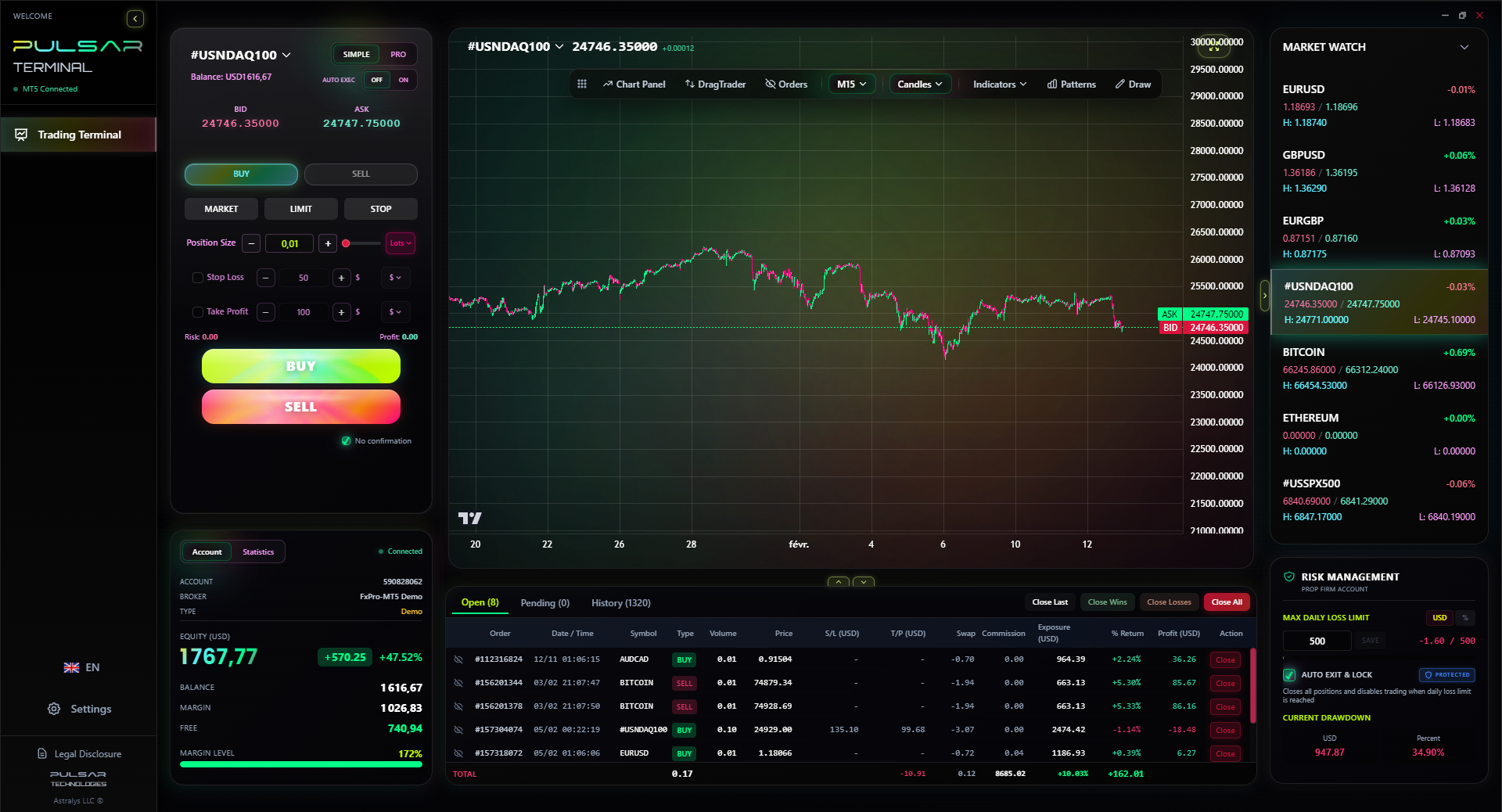
Manually moving stops to breakeven and managing multiple take-profit levels is tedious and error-prone; Pulsar Terminal automates these exact system rules directly on your MT5 charts.
Pulsar Terminal
The all-in-one MT5 companion: drag-and-drop orders, multi-TP/SL, trailing stop, grid trading, Volume Profile, and prop firm protection. Used by 1,000+ traders daily.
Your brilliant system means nothing if your broker's execution is slow, spreads are criminal, or they reject your stop loss during volatility. For South Africans, you need to consider:
- Regulation & Safety of Funds: This is non-negotiable. Are they regulated by a reputable body (like the FSCA in SA, or ASIC, FCA internationally)? Where is your money held? I've always preferred globally regulated brokers with a local presence for support.
- Spreads & Commissions on ZAR Pairs: Compare! The cost of trading USD/ZAR can vary wildly. Some brokers offer tight spreads but charge a commission. Others have wider spreads but no commission. You need to calculate the total cost per round turn and factor it into your system's profit targets. Check our detailed reviews for specifics on Exness and XM, which are popular choices locally.
- Execution Type & Slippage: Does the broker use a dealing desk (Market Maker) or are they an STP/ECN broker? For systematic trading, I lean towards STP/ECN models as they generally have less conflict of interest and faster execution, which is vital for precise entries and exits.
- Platform & Tools: You'll likely use MetaTrader 4 or 5. Does your broker support it? More importantly, do they allow third-party tools that can automate parts of your system? Automating things like moving stops to breakeven can be the difference between a small win and a breakeven trade.

Pro Tip: Open small demo accounts with 2-3 shortlisted brokers. Run the same 10 system trades on each one. Compare the actual fill prices, slippage, and total cost. The numbers don't lie.
“The moment you feel an impulse to deviate from your system, that's the moment you should step away from the computer.”
You can have the best system in the world, and still blow up your account. How? By not following it. Trading psychology is the art of following your plan when every fiber of your being is screaming to do otherwise.
The Two Big Enemies:
- Fear: This causes you to move your stop loss wider 'to give the trade room' (violating your risk management), or to take profit too early out of fear it will reverse.
- Greed: This causes you to double your position size because you 'feel really good about this one' (violating your position sizing), or to let a winning trade turn into a loser because you're waiting for more.
Your system is the antidote. It is the pre-written script. When fear or greed hits, you don't have to think. You just execute the script. I treat it like I'm a pilot running a pre-flight checklist. I don't debate the checklist. I just run it.
The moment you feel an impulse to deviate from your system, that's the moment you should step away from the computer. Go for a walk. The system works on its own. Your job is to not break it. Remember, a margin call is almost always preceded by a series of small psychological compromises.
💡 Winston's Tip
A system that generates 3 signals a week you can follow is infinitely better than one that generates 10 signals a day you can't.
Reading this is step one. Now, do this:
Week 1-2: Choose ONE simple system concept (like the example earlier). Write down every single rule in a Google Doc or physical journal. Leave no room for interpretation.
Week 3-6: Backtest it on at least 6 months of data for one or two pairs, like EUR/USD and USD/ZAR. Record every trade in a spreadsheet. Calculate the win rate, average win/loss, and most importantly, the expectancy.
Week 7-12: Forward test it on a demo account. Treat it like real money. Execute every signal, no exceptions. Keep your detailed trade journal. Your goal is not profit; your goal is 100% adherence to the rules.
After 90 days, you'll have one of two things: a statistically validated system you can trust and begin scaling with real capital, or clear data showing why an idea doesn't work, which is equally valuable. You've saved yourself real money by using time as your testing currency.
Building a forex system is a grind. It's unsexy. But it's the only thing that separates the consistent professional from the hopeful amateur. Now, go build yours.
FAQ
Q1How much starting capital do I need for a forex system in South Africa?
You can start testing a system with a few thousand Rand, but for serious trading with proper risk management (risking 1-2% per trade), a minimum of R20,000-R50,000 is more realistic. This allows for meaningful position sizes on ZAR pairs without being wiped out by a normal 5-7 trade losing streak. Start smaller for forward testing.
Q2Is automated trading (Expert Advisors) better than manual system trading?
Not necessarily better, just different. EAs are fantastic for executing a mechanical system without emotional interference. However, they can fail during unexpected news events or if market dynamics change. A disciplined manual trader can adapt slightly better. The best approach is often a hybrid: use an EA for execution, but maintain manual oversight.
Q3How many pairs should my forex system cover?
Start with ONE. Master it. Adding pairs dilutes your focus and makes it harder to spot if your system is working or if you're just getting lucky. Once you have 6 months of consistent results on one major pair (like EUR/USD) or a ZAR cross, then consider adding a second, uncorrelated pair.
Q4What's a good win rate for a forex system?
Stop obsessing over win rate. A system with a 40% win rate and a 1:2 risk-reward ratio can be highly profitable. A system with a 70% win rate and a 1:0.5 risk-reward ratio can lose money. Focus on the overall expectancy and your comfort with drawdowns.
Q5How often should I tweak or change my trading system?
Far less often than you think. Change your system only after a statistically significant number of trades (e.g., 50-100) show a clear, persistent degradation in performance. Tweaking it after every few losses is called curve-fitting and guarantees future failure. Your system must survive periods where it doesn't work.
Q6Can I use the same system for gold (XAU/USD) as for forex?
Sometimes, but not blindly. Gold has different volatility patterns, margin requirements, and often reacts to different drivers. You can use the same framework (e.g., a volatility breakout system), but you must adjust the parameters (like ATR multiples for stops) and test it separately on gold data. Check our XAU/USD guide for specifics on trading gold.
Prof. Winston's Lesson
Key Takeaways:
- ✓A system is a set of unambiguous rules, not a feeling.
- ✓Risk management is 80% of the battle; never risk more than 2%.
- ✓Test for 50-100 trades before believing in an edge.
- ✓Broker costs on ZAR pairs can kill a good system.
- ✓Psychology is following the plan when you want to break it.
How useful was this article?
Click a star to rate
Weekly Trading Insights
Free weekly analysis & strategies. No spam.
About the Author
David van der Merwe
Emerging Markets Trader
Johannesburg-based trader with 11 years in emerging market currencies. Specializes in ZAR pairs, FSCA-regulated trading, and South African market analysis.
Comments
Risk Disclaimer
Trading financial instruments carries significant risk and may not be suitable for all investors. Past performance does not guarantee future results. This content is for educational purposes only and should not be considered investment advice. Always conduct your own research before trading.
You Might Also Like

Cara Trading Forex Sukses: 7 Prinsip dari Trader Profesional
Cara trading forex sukses dengan 7 prinsip trader pro: manajemen modal, disiplin, journal trading, backtest. Data nyata, bukan janji profit palsu.
Jam Trading Forex Terbaik untuk Trader Indonesia: Panduan Lengkap dengan Tabel Waktu
Panduan jam trading forex untuk trader Indonesia. Tabel 4 sesi dunia, jam emas 20:00-00:00, sesi mana yang harus dihindari. Data akurat + tips dari trader berpengalaman.
Top 5 Sàn Forex Uy Tín Nhất 2026: Review Jujur dari Trader Indonesia
Top 5 sàn forex uy tín 2026 untuk trader Indonesia. Review jujur: spread, deposit, withdraw, dukungan lokal. Exness, XM, IC Markets & lebih.
Get Pulsar Terminal
All these calculators are built into Pulsar Terminal with real-time data from your MT5 account. One-click position sizing, automatic risk management, and instant calculations.
Get Pulsar Terminal