


So you've downloaded MT4, opened an account with a few hundred Rand, and now you're staring at the charts wondering how to turn this into a real forex system.

David van der Merwe
Emerging Markets Trader ·  South Africa
☕ 10 min read
What you'll learn:
- 1What Actually Is a Forex System on MT4?
- 2Building Your System: A Step-by-Step Blueprint
- 3The South African Context: Costs, Pairs & Pitfalls
- 4Testing and Backtesting: Don't Trust, Verify
- 5Common MT4 System Mistakes South Africans Make
- 6Moving from Demo to Live: The Psychological Leap
- 7Advanced Tools: EAs, Scripts & When to Use Them

So you've downloaded MT4, opened an account with a few hundred Rand, and now you're staring at the charts wondering how to turn this into a real forex system. You're not alone. Most South African traders I've mentored start exactly there - full of hope, armed with a platform, but completely lost on what to do next. Let's cut through the noise. A 'forex system MT4' isn't just about installing indicators; it's a complete, repeatable plan for making and keeping money in the ZAR, USD, and EUR markets. I'll show you how to build one that actually works for our local context, including the FSCA rules you can't ignore and the real costs that eat into your profits.
Forget the fancy sales pages. A forex system on MT4 is simply your personal rulebook. It's the exact set of instructions you follow to decide when to buy, when to sell, how much to risk, and when to call it quits. The platform is just the tool; the system is the craftsperson using it.
In South Africa, this needs extra layers. Your system must account for our unique market hours (when London and New York overlap is prime time), our currency (ZAR pairs like USD/ZAR are wildly volatile), and our regulatory reality. Trading with an FSCA-regulated broker isn't a suggestion; it's your first line of defence. Your system is useless if your broker disappears with your deposit.
A proper system has three core parts: 1) A clear signal for entry, 2) A predefined stop loss to protect your capital, and 3) A take profit target to lock in gains. Most beginners only focus on the first part, which is why they blow up. I learned this the hard way in 2015. I had a great entry strategy for gold (XAU/USD), but my stop losses were arbitrary. One bad trade wiped out two weeks of careful gains. That loss taught me more than any win.

Warning: If your 'system' is just guessing where price will go based on a hunch or a single indicator, you don't have a system. You have a gambling habit with a fancy charting software wrapper.
“A forex system on MT4 is simply your personal rulebook for when to buy, sell, and how much to risk.”
Start With Your Personality
Are you patient or impulsive? Can you sit through a 50-pip drawdown without sweating? If not, a scalping strategy that requires lightning-fast decisions will destroy you. I'm a swing trader by nature. I tried day-trading the EUR/USD for a month, staring at the screen for 8 hours. My accuracy was terrible, and I was exhausted. My personality needed the slower pace of holding trades for days.
Choose Your Core Components
You don't need 20 indicators cluttering your MT4 chart. Pick a few that serve distinct purposes. I run a simple, effective system based on two things:
- Price Action & Support/Resistance: I mark key levels on my chart. These are where big buyers and sellers have stepped in before.
- One Momentum Confirmation Indicator: I use the MACD indicator on a 4-hour chart. It helps me see if the move has any strength behind it.
My rule is simple: I only look for buys near a strong support level when the MACD histogram is ticking up from below its zero line. For sells, I look at resistance with the MACD ticking down. That's it. No chaos.
Define Your Rules in Writing
This is non-negotiable. Write down every rule. Example from my journal: "Enter long USD/ZAR only on a 1-hour candle close above 18.500, with MACD crossover above signal line. Stop loss: 50 pips below entry. Take profit: 100 pips above entry. Risk: 1.5% of account per trade." This clarity removes emotion. You can learn more about managing that risk with a position size calculator.

Pro Tip: Backtest your written rules on MT4's Strategy Tester. Don't just look at the profit. Look at the maximum drawdown. If your system would have lost 40% of its value historically, you need to adjust it before risking real Rands.

💡 Winston's Tip
Your first R10,000 in the market is tuition, not investment. Expect to pay for your education. The goal is to learn, not get rich.
“Trading from SA isn't the same as trading from the UK or US. Your bottom line is in Rands, and local factors matter.”
Trading from SA isn't the same as trading from the UK or US. Your bottom line is in Rands, and the local factors matter more than you think.
The Real Cost of Trading Here: When brokers advertise 'spreads from 0.0 pips', read the fine print. That's usually on a Raw/ECN account where they charge a commission. Let's do the math with a local broker like Exness or IC Markets.
| Cost Type | Typical Example (EUR/USD) | Impact on a R10,000 Account |
|---|---|---|
| Spread | 0.7 pips on ECN account | R7 cost per mini lot (0.1 lot) |
| Commission | $3.50 per lot round turn | ~R65 commission per standard lot |
| Swap Fee | Variable, can be +/- | Can add up on swing trading positions held for days |
On a R10,000 account, a single standard lot trade with a 0.7 pip spread and commission costs you about R72 just to break even. That's 0.72% of your account gone before the market even moves. You need a system that accounts for this friction.
Trading ZAR Pairs: Pairs like USD/ZAR or EUR/ZAR are tempting. The moves are huge! But the spread definition tells the real story. Where EUR/USD might have a 1-pip spread, USD/ZAR can have a 50-100 pip spread. That's R500-R1000 of immediate loss on a standard lot. Your system must have a much wider stop loss and profit target to overcome this, which means risking more capital. For most beginners, I say avoid ZAR pairs until you're consistently profitable on the majors.
Payment Realities: Depositing and withdrawing Rands via EFT can take 1-3 business days. Factor this into your capital management. Don't plan to withdraw profits to pay a bill due tomorrow.

“Trading from SA isn't the same as trading from the UK or US. Your bottom line is in Rands, and local factors matter.”
Hope is not a strategy. You must prove your system works before you fund it. MT4 has a built-in Strategy Tester. Use it.
How to Backtest Properly:
- Go to View > Strategy Tester.
- Select your EA or set model to 'Every tick' for most accuracy.
- Choose a currency pair and a solid chunk of time (at least 2 years of data).
- Run the test.
Don't just look at the net profit. The critical metrics are:
- Maximum Drawdown: The biggest peak-to-trough loss. If it's 25%, ask yourself: could I emotionally handle watching a quarter of my account vanish?
- Profit Factor: (Gross Profit / Gross Loss). Anything above 1.2 is decent. Above 1.5 is good. My current swing system has a profit factor of 1.67 over 3 years of backtested data.
- Total Trades: A system with only 10 trades in 2 years isn't statistically reliable.
Forward Testing (Demo): After backtesting, run it on a demo account for at least a month. This is where psychology kicks in. In 2022, I had a system that backtested beautifully but failed in demo. Why? The entries happened at 10 PM SA time. I was asleep and kept missing them. The system was logically sound but practically impossible for my lifestyle. I had to scrap it.

Example: I backtested a simple moving average crossover system on GBP/USD from 2020-2023. Net profit: $2,400. Looks great! But the max drawdown was $1,100. That means to make $2,400, I had to endure a $1,100 losing streak. For a $5,000 account, that's a 22% loss. Could you stick with the system through that?
💡 Winston's Tip
If you can't explain your system in two sentences to a 10-year-old, it's too complicated. Complexity is the enemy of execution.
“Hope is not a strategy. You must prove your system works before you fund it.”
I've seen these errors destroy accounts time and again.
Over-optimization (Curve-fitting): This is the biggest one. You tweak your indicators' settings so they fit past data perfectly. Your backtest shows a 90% win rate! But in live markets, it fails immediately because it was only fitted to old noise, not future price action. Your system should be strong, not perfect.
Ignoring Swap Rates: As a swing trader, holding positions for days, swap fees matter. Going long on a currency with a high-interest rate against one with a low rate can earn you a small credit each night. The reverse can cost you. Check the 'Swap' column in MT4's Market Watch before you enter a multi-day trade.
No Disaster Plan: What happens when loadshedding hits and your internet dies? Or your laptop battery dies? Your system must include a plan for this. Always have stop losses set on the server (not just on your local chart). Brokers like XM and Pepperstone allow this. If your connection drops, your stop loss is still active, protecting you from a margin call.
Changing Systems Every Week: You have a losing week, so you abandon your system for a new 'magic' indicator you saw on a forum. This guarantees failure. Every system has losing periods. You need a statistically significant sample size (at least 30-50 trades) to judge it.
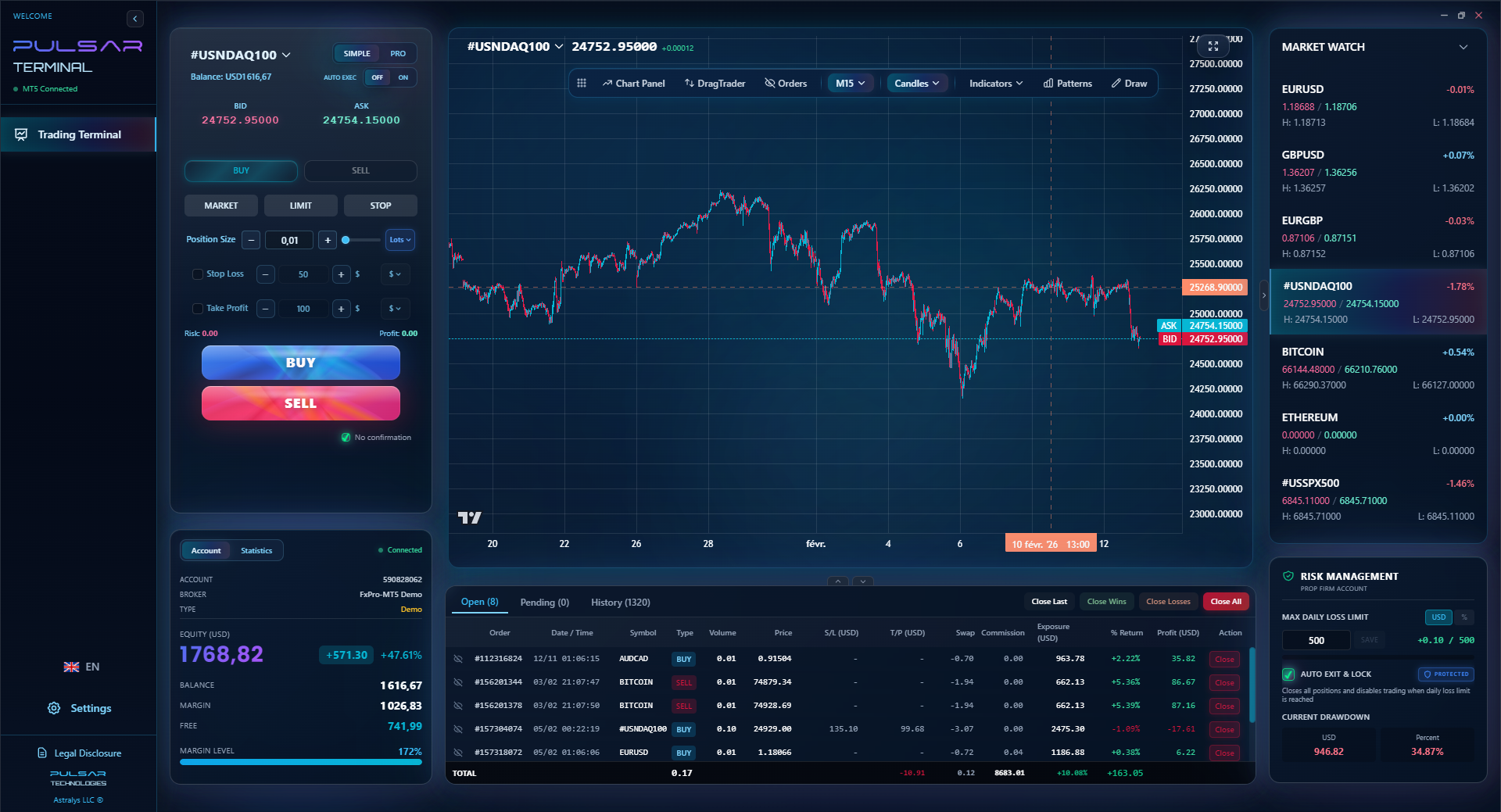
Manually moving stop losses to breakeven and managing multiple take-profit levels on MT4 is tedious and error-prone, which is where a tool like Pulsar Terminal automates it all with a single click.
Pulsar Terminal
The all-in-one MT5 companion: drag-and-drop orders, multi-TP/SL, trailing stop, grid trading, Volume Profile, and prop firm protection. Used by 1,000+ traders daily.
“Hope is not a strategy. You must prove your system works before you fund it.”
This is where the rubber meets the road. Your demo account is up 30%? Great. Now prepare to see 50% of that skill evaporate when real Rands are on the line. The fear of loss and the greed for gain will distort your judgment.
Start Stupidly Small. When you go live, risk 0.5% of your account per trade, not the 2% your backtest allowed. For a R5,000 account, that's R25 per trade. The goal for your first 20 live trades isn't to get rich. It's to prove to yourself that you can follow your own rules when real money is involved. The profit is a secondary bonus.
I remember my first live trade on MT4. It was a short on EUR/USD based on my system. I was up 15 pips, then it reversed. I watched it hit my stop loss, and I felt a physical pang in my stomach. That R120 loss felt like R12,000. But I followed the rule. I took the loss. That was the real win.
Keep a Trading Journal in MT4. Use the built-in journal feature or a simple spreadsheet. Note the entry, exit, pips gained/lost, and - most importantly - your emotional state. Did you deviate from the plan? Why? Review this weekly. Your journal will show you your true weaknesses.
💡 Winston's Tip
The most important button in MT4 isn't 'New Order'. It's 'Strategy Tester'. Prove it works in the past before you bet on the future.
“Your demo account is up 30%? Great. Now prepare to see 50% of that skill evaporate when real Rands are on the line.”
Expert Advisors (EAs) are automated trading robots for MT4. They can be powerful or disastrous.
The Good: They remove emotion. If you have a rock-solid, simple system, an EA can execute it 24/7, even while you sleep. They're also great for repetitive tasks. I use a simple script to close all my trades at Friday's market close, so I never hold risky positions over the weekend.
The Bad & The Ugly: The internet is flooded with 'guaranteed profit' EAs for sale. 99.9% are scams. They're over-optimized on past data and will fail with your money. If you buy an EA, you are buying a black box. You have no idea how it works, which means you have no faith in it. The first drawdown will cause you to shut it off.
My Stance: Learn to trade manually first. Build and trust your own system. Then, if you want, learn MQL4 coding to automate your own proven system. That's the only safe path. Automation should be the final step, not the first.
Using tools like the RSI indicator or MACD indicator within an EA you've coded yourself is fine. Buying a 'Martingale Grid Hedge EA' from a random website is a fast track to a zero balance.
FAQ
Q1Is MetaTrader 4 (MT4) legal for forex trading in South Africa?
Yes, absolutely. MT4 is just a software platform. The legality depends on using it with a broker regulated by the Financial Sector Conduct Authority (FSCA). Trading forex itself is legal for South African residents through FSCA-licensed entities. Always verify your broker's FSCA license number on the regulator's official website.
Q2What is a good starting capital for a forex system on MT4 in South Africa?
There's no magic number, but you need enough to survive inevitable losses. With many brokers offering mini and micro lots, you can start with R2,000-R5,000. The key is your risk per trade. On a R5,000 account, risking 1% means you can only lose R50 per trade. After accounting for spreads and commissions, you need a very accurate system. Realistically, R10,000 gives you more breathing room to implement proper risk management without being wiped out by a few bad trades.
Q3Can I trade the South African Rand (ZAR) on MT4?
Yes, many FSCA-regulated brokers offer ZAR pairs like USD/ZAR, EUR/ZAR, and GBP/ZAR on MT4. However, I caution beginners against starting with them. The spreads are significantly wider (often 50-100 pips vs. 1 pip on EUR/USD), meaning the market has to move a lot just for you to break even. This requires wider stops and more risk. Master your system on major pairs first.
Q4How do I know if my MT4 broker is legit in South Africa?
Check the FSCA's official website. They have a register of authorised financial services providers. Get the broker's claimed FSCA license number and cross-check it there. Be wary of brokers only regulated in offshore jurisdictions with weak oversight. Using a locally regulated broker like those in our XM review or Exness review ensures they comply with South African client fund segregation and dispute resolution rules.
Q5What's more important for a forex system: the entry strategy or the exit strategy?
The exit strategy, 100%. A mediocre entry with a brilliant exit (tight stop loss, smart take profit) can be profitable. A brilliant entry with a terrible exit (no stop loss, moving stops further away) will destroy you. Your stop loss and take profit rules are what manage risk and preserve capital. Focus on them first.
Q6Should I upgrade from MT4 to MT5 for my trading system?
Not necessarily. MT4 is perfectly adequate for forex and CFDs. MT5 offers more timeframes, more order types, and access to more asset classes like stocks. However, the MT4 community, library of indicators, and EAs is still vastly larger. If you only trade forex and are comfortable with MT4, there's no urgent need to switch. The platform doesn't make you profitable; your system does.
Prof. Winston's Lesson
Key Takeaways:
- ✓Write down every rule of your MT4 system before placing a single trade.
- ✓Account for ZAR spreads and commissions; they're higher than you think.
- ✓Backtest for at least 2 years of data, focusing on maximum drawdown.
- ✓Start live trading by risking 0.5% per trade, not 2%.
- ✓Never buy a 'black box' EA; automate only your own proven system.
How useful was this article?
Click a star to rate
Weekly Trading Insights
Free weekly analysis & strategies. No spam.
About the Author
David van der Merwe
Emerging Markets Trader
Johannesburg-based trader with 11 years in emerging market currencies. Specializes in ZAR pairs, FSCA-regulated trading, and South African market analysis.
Comments
Risk Disclaimer
Trading financial instruments carries significant risk and may not be suitable for all investors. Past performance does not guarantee future results. This content is for educational purposes only and should not be considered investment advice. Always conduct your own research before trading.
You Might Also Like

Cara Trading Forex Sukses: 7 Prinsip dari Trader Profesional
Cara trading forex sukses dengan 7 prinsip trader pro: manajemen modal, disiplin, journal trading, backtest. Data nyata, bukan janji profit palsu.
Jam Trading Forex Terbaik untuk Trader Indonesia: Panduan Lengkap dengan Tabel Waktu
Panduan jam trading forex untuk trader Indonesia. Tabel 4 sesi dunia, jam emas 20:00-00:00, sesi mana yang harus dihindari. Data akurat + tips dari trader berpengalaman.
Top 5 Sàn Forex Uy Tín Nhất 2026: Review Jujur dari Trader Indonesia
Top 5 sàn forex uy tín 2026 untuk trader Indonesia. Review jujur: spread, deposit, withdraw, dukungan lokal. Exness, XM, IC Markets & lebih.
Get Pulsar Terminal
All these calculators are built into Pulsar Terminal with real-time data from your MT5 account. One-click position sizing, automatic risk management, and instant calculations.
Get Pulsar Terminal