


Let's be brutally honest: as a Nigerian trader, you're playing a game where the rules are written by the CBN and the pitch is tilted against you.

Olumide Adeyemi
West African Trading Pioneer ·  Nigeria
☕ 10 min read
What you'll learn:
Let's be brutally honest: as a Nigerian trader, you're playing a game where the rules are written by the CBN and the pitch is tilted against you. The Naira's value is a political tool, and funding your account feels like a covert operation. So why bother with forex technical analysis? Because it's the only piece of the puzzle you can actually control. It's your map through the chaos. Forget the guru nonsense. I've been trading through multiple CBN policies, EFCC crackdowns, and the recent ISA 2025 changes. This guide will show you how to use charts to find real edges, not just draw pretty lines, while keeping your head down and your profits safe from the taxman and the regulators.
Most people get this wrong from the start. Technical analysis isn't about predicting the future. Anyone who tells you they can do that is selling you a course. It's about measuring probabilities. You're looking at a chart and asking one question: based on where price has been, where is it most likely to go next?
It's pure psychology, painted in candlesticks. Fear, greed, hope, and panic - they all leave footprints. Your job is to learn to read them. In Nigeria, where fundamental news can be delayed, manipulated, or just plain confusing, a solid read of the chart can be your first and best source of truth.
Forget the 50-indicator setups you see on Instagram. That's noise. Real forex technical analysis is about price action, structure, and volume. It's a skill, not a magic trick. I learned this the hard way in 2018. I was long on USD/NGN (on a CFD, of course) based on some 'fundamental' news about oil prices. The chart, however, was showing clear distribution and a break of a key trendline. I ignored it, convinced my logic was superior. The pair reversed, and I watched a 150,000 Naira position turn into a 40,000 Naira loss. The chart was screaming at me, and I wasn't listening.

Warning: No indicator, no pattern, no guru signal has a 100% win rate. If someone claims it does, run. Technical analysis gives you a framework for making disciplined decisions, not a crystal ball.
“Technical analysis is about measuring probabilities, not predicting the future.”
You don't need much. A cluttered chart is a confused mind. Here are the only tools you need to master.
Price Action & Support/Resistance
This is the foundation. Everything else is built on it. Support is where buying pressure historically overwhelms selling pressure, causing price to bounce. Resistance is the opposite. Draw these levels on your chart. Watch how price reacts there. In volatile pairs like GBP/NGN or EUR/NGN, these levels are often respected with shocking precision because everyone is looking at them.
Candlestick Patterns
Learn the major ones: Doji, Hammer, Engulfing patterns. They tell you who's winning the battle between bulls and bears at key moments. A bullish engulfing pattern at a major support level? That's a high-probability signal worth risking some capital on.
Moving Averages
I only use two: a fast one (like the 20-period) and a slow one (like the 50-period). They help define the trend. When the fast MA is above the slow MA, the trend is generally up. It's that simple. They also act as dynamic support and resistance. Don't overcomplicate it.
Key Indicators
I keep two on my chart at all times. The RSI indicator for spotting overbought and oversold conditions, and the MACD indicator for confirming trend changes and momentum. That's it. I don't use anything else for my core swing trading decisions.

Example: Let's say you're looking at XAU/USD (Gold). Price approaches a clear horizontal resistance level at $2050 that it has failed at three times before. The 20 MA is curling down below the 50 MA, and the RSI is hitting 70 (overbought) as price touches $2050. The probability of a rejection and move lower is high. That's technical analysis in action.

💡 Winston's Tip
A clean chart is a smart chart. If you can't explain your setup in two sentences, you don't have a setup.
“In Nigeria, a 10% capital gains tax means your profit must be big enough to survive the government's bite.”
Trading pairs like USD/NGN, GBP/NGN, or EUR/NGN is a different beast. You're not just trading forex; you're trading CBN policy. Technical analysis still works, but you must layer in a huge dose of context.
The charts for these pairs often show massive gaps and extreme volatility around CBN announcements or interventions. A perfect head-and-shoulders pattern can be obliterated in seconds by a central bank circular. So, how do you trade it?
- Use Wider Timeframes: Don't bother with 5-minute charts. Focus on the 4-hour and daily charts. The longer-term trends, often driven by macro factors like oil prices, are harder for even the CBN to fight indefinitely.
- Identify Intervention Zones: Through chart analysis, you can often spot price levels where the CBN has stepped in before. These become super-charged support or resistance zones. Trading near them requires extreme caution and tiny position sizes.
- Follow the Official Rate (Sort of): While the parallel market rate is the 'real' one, large moves in the official I&E window rate can spill over. Use technical analysis on the official rate chart to gauge potential pressure points.
I once shorted USD/NGN on a CFD platform after a massive spike. The technicals showed exhaustion - a long wick on the daily candle and a bearish divergence on the RSI. Fundamentally, I knew the CBN couldn't sustain defending that level forever. I entered, set a tight stop, and rode it down for about two weeks. It wasn't a clean move (it never is), but the technical setup gave me the confidence to hold through the noise for a gain that covered three months of subscription fees for my data feeds.
“In Nigeria, a 10% capital gains tax means your profit must be big enough to survive the government's bite.”
All the fancy analysis in the world is useless if you blow up your account. In Nigeria, with a 10% capital gains tax waiting to take a bite, you can't afford to be sloppy. Your profit must be big enough to survive the tax hit and still be worth it.
This starts with your position size. Never, ever risk more than 1-2% of your trading capital on a single trade. I use a simple position size calculator before every entry. If my stop loss is 50 pips away, I calculate exactly how many units to buy or sell so that a 50-pip loss equals 1% of my account. This is boring. It's also the reason I'm still trading after 12 years.
Understand your broker's terms inside out. Know what a margin call level is and stay far away from it. With brokers like Exness or IC Markets, their platforms will show you this clearly. Ignore it at your peril.

Pro Tip: Your stop loss is your best friend. Place it at a level that, if hit, proves your technical analysis wrong. If you're buying at a support level, your stop should be below that level. If price goes there, the support broke, and your thesis is invalid. Take the loss and move on. Hoping and praying is not a strategy.
💡 Winston's Tip
Your first profit target should always be to move your stop loss to breakeven. Protecting capital is job one.
“The biggest mistake is jumping from a 15-minute chart review straight into a trade with no plan. That's gambling.”
Your analysis is only as good as your ability to execute it. For most Nigerians, MT4 or MT5 is the go-to. They're stable, universally supported, and have all the tools you need. I personally use MT5 for the better charting and hedging capabilities.
The real challenge isn't the platform; it's the infrastructure. Internet drops, power outages (no matter how many inverters you have), and payment delays can kill a good trade.
- Broker Choice: You need a broker that is reliable during volatility and offers local payment methods. I've had good execution experiences with Pepperstone and XM for international brokers, but always check their current deposit/withdrawal options for Nigeria. Since ISA 2025, also keep an eye out for SEC-registered local platforms - they should, in theory, offer smoother Naira transactions.
- Dealing with Spreads: Know the typical spread for your chosen pair. During major news or CBN announcements, spreads on Naira pairs can widen to 100 pips or more. If you're scalping, this will destroy you. Either avoid trading during these times or switch to major pairs like EUR/USD where liquidity is deeper.
- The Funding Headache: Factor in the cost and time of funding. If you're using crypto or P2P, account for the fees and the rate difference. That's part of your trading cost. A trade that makes a 1% profit before fees might actually be a loss after you've paid to get your money in and out.
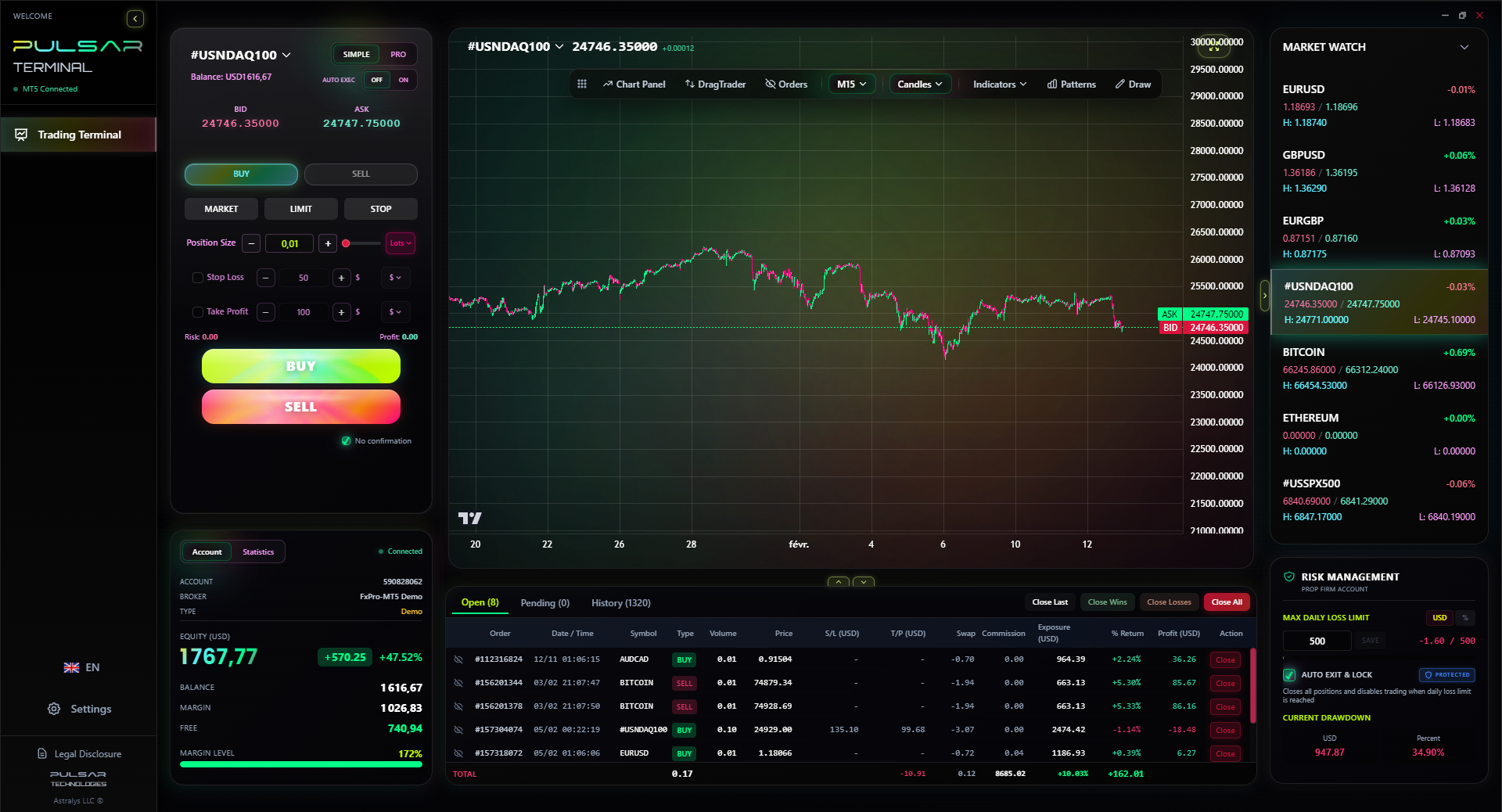
Executing a disciplined trade plan requires precise order management, which is where a tool like Pulsar Terminal for MT5 shines, letting you set multi-level take-profits and trailing stops with a single click.
Pulsar Terminal
The all-in-one MT5 companion: drag-and-drop orders, multi-TP/SL, trailing stop, grid trading, Volume Profile, and prop firm protection. Used by 1,000+ traders daily.
“The biggest mistake is jumping from a 15-minute chart review straight into a trade with no plan. That's gambling.”
Success in trading is a boring routine, repeated daily. Here's mine:
- Morning Review (15 mins): I scan the daily charts of my 10 watchlist pairs (including 2-3 Naira pairs). I'm not looking for trades yet. I'm updating key support/resistance levels and noting the overall trend. Has anything structurally changed overnight?
- Analysis & Planning (30-45 mins): This is where I do my real work. On the 4-hour and 1-hour charts, I look for setups that align with the daily trend. I write down my plan: Pair: XAU/USD. Idea: Buy on retest of broken resistance-turned-support at $2015. Stop: $2007. Target: $2035. Risk: 0.75% of capital. I enter this into my trading journal before I even open the order window.
- Execution & Monitoring: I place the trade according to plan. I set the stop and target immediately. I do not move the stop further away unless I'm moving it to breakeven after a favorable move (a trailing stop tool is great for this). Then I walk away. I might check in a few times, but I don't hover.
- End-of-Day Review (10 mins): Win or lose, I review every trade. Did I follow my plan? Did my technical analysis hold up? What did I miss? This feedback loop is how you improve.
The biggest mistake new traders make is jumping from the 15-minute review straight into a trade, with no plan. That's gambling, not trading.
“Sometimes the best technical analysis tells you to do nothing for days.”
I've fallen into every one of these. Learn from my losses.
- Over-trading: This is the #1 account killer. You feel you need to be in the market to make money. Wrong. You need to be in the right trades. Sometimes, the best technical analysis tells you to do nothing for days.
- Revenge Trading: You take a loss, get angry, and jump right back in with a bigger size to 'make it back.' This is how you lose 20% in an afternoon. After a loss, shut down the platform. Go outside.
- Ignoring the Higher Timeframe: You see a beautiful buy signal on the 15-minute chart, but the daily chart is in a crushing downtrend. That 15-minute signal is a trap 9 times out of 10. Always trade in the direction of the higher timeframe trend.
- Chasing the News: You see a headline: 'CBN to Inject $500 Million.' You immediately buy USD/NGN. By the time you've entered, the price has already spiked and is reversing. The market discounts news instantly. Your technical analysis should prepare you for potential volatility zones, not tell you to chase a moving headline.
- Tax Amnesia: Remember, 10% of your gross profit belongs to the FIRS. Factor this into your profit targets. A trade that nets you 8% before tax is actually a loser after tax and fees. Aim for larger, higher-probability moves to make the tax bite manageable.
💡 Winston's Tip
The market doesn't care about your rent, your bills, or your pride. Trade the price you see, not the price you need.
FAQ
Q1Is forex technical analysis legal in Nigeria?
Yes, absolutely. Using charts and indicators to analyze the forex market is a skill, not a regulated activity. The trading itself is legal for individuals. The new ISA 2025 law regulates the platforms offering the trading, not your personal analysis. Just ensure you're using a reputable platform, especially now that SEC registration is becoming a requirement for operators.
Q2What's the best timeframe for a beginner in Nigeria to start with?
Start with the 4-hour chart. It's slow enough to filter out market noise (which is plentiful with Naira pairs) but fast enough to give you several potential setups per week. It forces patience and helps you see the real trend. Avoid the 1-minute and 5-minute charts like the plague when you're starting.
Q3How do I handle CBN intervention when it ruins my technical setup?
First, accept it will happen. It's a cost of doing business here. Second, your risk management is your shield. If you're only risking 1% per trade, an intervention that triggers your stop loss is a minor setback, not a disaster. Third, use wider stops on Naira pairs to account for this extra volatility. Finally, sometimes the smartest trade is to avoid Naira pairs altogether and focus on major pairs like EUR/USD or XAU/USD where the rules are more consistent.
Q4Do I need to pay tax on my forex trading profits?
Yes. The law is clear. Capital Gains Tax is 10% on your gross profits. You are responsible for declaring and paying this. Keep careful records of all your trades, deposits, and withdrawals. A good trading journal isn't just for analysis; it's for the taxman.
Q5Can I make a living from forex technical analysis in Nigeria?
It's possible, but it's a marathon, not a sprint. You need a substantial, risk-proofed capital base (money you can afford to lose), years of disciplined practice, and a business mindset. Most people fail because they underestimate the psychological grind and overestimate their early results. Treat it as a serious side business for at least 3-5 years before even considering quitting your day job.
Q6With the new SEC rules (ISA 2025), should I switch to a local broker?
Not immediately. Let the new regulatory framework bed in. Watch which platforms get registered and what their terms are. For now, established international brokers with strong regulation (like FCA, ASIC) still offer a high level of security for client funds. The ideal future scenario is a locally-registered platform with strong oversight, but we're not there yet. Keep your options open and do your due diligence.
Prof. Winston's Lesson
Key Takeaways:
- ✓Risk only 1-2% of capital per trade.
- ✓Always trade with a written plan.
- ✓Master support/resistance and price action first.
- ✓Factor the 10% capital gains tax into all targets.
How useful was this article?
Click a star to rate
Weekly Trading Insights
Free weekly analysis & strategies. No spam.
About the Author
Olumide Adeyemi
West African Trading Pioneer
One of Nigeria's most active forex trading educators. 8 years of experience trading from Lagos. Specializes in low-capital strategies and prop firm challenges for African traders.
Comments
Risk Disclaimer
Trading financial instruments carries significant risk and may not be suitable for all investors. Past performance does not guarantee future results. This content is for educational purposes only and should not be considered investment advice. Always conduct your own research before trading.
You Might Also Like

Cara Trading Forex Sukses: 7 Prinsip dari Trader Profesional
Cara trading forex sukses dengan 7 prinsip trader pro: manajemen modal, disiplin, journal trading, backtest. Data nyata, bukan janji profit palsu.
Jam Trading Forex Terbaik untuk Trader Indonesia: Panduan Lengkap dengan Tabel Waktu
Panduan jam trading forex untuk trader Indonesia. Tabel 4 sesi dunia, jam emas 20:00-00:00, sesi mana yang harus dihindari. Data akurat + tips dari trader berpengalaman.
Top 5 Sàn Forex Uy Tín Nhất 2026: Review Jujur dari Trader Indonesia
Top 5 sàn forex uy tín 2026 untuk trader Indonesia. Review jujur: spread, deposit, withdraw, dukungan lokal. Exness, XM, IC Markets & lebih.
Get Pulsar Terminal
All these calculators are built into Pulsar Terminal with real-time data from your MT5 account. One-click position sizing, automatic risk management, and instant calculations.
Get Pulsar Terminal