


Here's a fact that'll mess with your head: most Nigerian traders lose money trading the London open at 9 AM WAT.

Olumide Adeyemi
West African Trading Pioneer ·  Nigeria
☕ 9 min read
What you'll learn:
- 1Why Time Zones Are Your Secret Weapon (Or Your Biggest Cost)
- 2The Major Sessions: WAT Timings & What Really Happens
- 3Setting Up Your Converter: A Practical Walkthrough
- 4Session-Specific Strategies for Nigerian Traders
- 5The Nigerian Trader's Top 3 Time Zone Blunders
- 6Advanced Tools: Beyond the Basic Converter
- 7Making It Stick: Integrating the Converter Into Your Daily Routine
Here's a fact that'll mess with your head: most Nigerian traders lose money trading the London open at 9 AM WAT. Why? Because they're trading the idea of the London open, not the actual liquidity. The real move often happens 30-90 minutes later, when the big European banks have finished their morning coffee and risk meetings. A forex time zone converter isn't just a clock; it's your map to the only thing that matters in this market: other people's money moving. Get the timing wrong, and you're just paying spreads in a ghost town.
Trading from Nigeria on West African Time (WAT) gives you a unique, often misunderstood advantage. You're awake and alert for the tail end of Asia, the entirety of Europe, and the opening of America. But if you don't plan it, you'll burn out chasing ghosts.
The core value of a forex time zone converter is aligning your screen time with market liquidity, not just market 'open' times. High liquidity means tighter spreads and cleaner price action. Low liquidity means wider spreads, more slippage, and choppy, meaningless price moves that can stop you out on noise.
I learned this the hard way in 2018. I'd set an alarm for 7:30 AM WAT to 'catch' the Tokyo session. I'd trade USD/JPY, paying a 1.8 pip spread, watching paint dry for two hours. The real move? It often came post-9 AM WAT, when London traders started interacting with the Asian price action. I was paying for dead time. A proper converter shows you the overlap periods - that's where the magic happens.

Warning: Don't confuse your local broker's server time with market session times. Your MT4/MT5 platform likely runs on GMT+2 or GMT+3 (broker time). A session converter aligns market hours to your local WAT, so you're not doing mental gymnastics at 5 AM.

💡 Winston's Tip
The market doesn't pay you for hours logged; it pays you for being right at the right time. Your converter finds those times.
Forget the generic 'London opens at 8 AM.' Let's get specific for Lagos, Abuja, and Port Harcourt. All times are West Africa Time (GMT+1).
Sydney / Asia Session (Late Night - Early Morning WAT)
This kicks off the new trading day, but it's often the quietest. It runs from about 10 PM WAT until 7 AM WAT. Don't expect massive trends here. It's a range-bound session, great for certain types of scalping strategy if you like tight ranges, but the liquidity is thin. Pairs like AUD/USD and NZD/USD will see action.
Tokyo Session (Early Morning WAT)
The action picks up. Tokyo is open from roughly 12 AM (midnight) to 9 AM WAT. The most active period is usually between 2 AM and 7 AM WAT. This is where you'll see the Japanese banks and institutions move. USD/JPY, GBP/JPY come alive. A good converter will highlight this core window.
London Session (The Main Event for Nigeria)
This is your bread and butter. London opens at 8 AM WAT and closes at 5 PM WAT. The first two hours (8 AM - 10 AM WAT) are pure gold - volatility spikes, spreads on majors like EUR/USD tighten to their daily lows (often sub-0.6 pips on good ECN accounts), and big directional moves establish themselves. If you only trade one session, make it this one.
New York Session (Afternoon WAT)
New York opens at 1 PM WAT and overlaps with London until 5 PM WAT. This 1 PM - 5 PM WAT window is the most liquid period of the entire 24-hour cycle. Massive volume, news releases, and the day's trend often accelerates or reverses here. It closes at 10 PM WAT.

Example: Let's say you're using Exness with its tight spreads. At 1:30 PM WAT (NY open + London overlap), the EUR/USD spread might be 0.1 pips on a Raw account. That same pair at 3 AM WAT might have a 1.2 pip spread. The converter tells you when to hunt for those conditions.
“A forex time zone converter isn't just a clock; it's your map to the only thing that matters: other people's money moving.”
You don't need fancy software. You need a system. Here’s mine.
First, I use a free website like WorldTimeBuddy or Forex Market Hours. I set one column to ‘London’ and another to ‘Lagos.’ This gives me the visual overlap instantly. I then create a simple cheat sheet on a sticky note next to my monitor:
- High Probability Window 1: 8:00 AM - 10:00 AM WAT (London Open)
- High Probability Window 2: 1:30 PM - 4:00 PM WAT (London/NY Overlap)
- Avoid Trading: 10:00 PM - 2:00 AM WAT (Sydney/Thin Liquidity)
Second, and this is critical, I adjust my trading platform charts. Most platforms like MT5 allow you to change the chart’s time zone. I set mine to GMT+1 (WAT). This means my 1-hour candle closing at 9 AM WAT actually represents 8 AM to 9 AM WAT, aligning perfectly with the London open candle. No more guesswork.
Third, I use this timing to manage my trades. If I enter a trade during the London open, I know I have at least 4-5 hours of solid liquidity for the trade to develop. I’m not leaving a trade to drift aimlessly in the dead Tokyo afternoon. This discipline alone saved me thousands in 2022 when I stopped trying to swing trade through low-volume periods where reversals were common and vicious.
Your strategy should change with the session. Here’s how I approach it.
London Open (8-10 AM WAT): Breakout & Momentum. I look for currency pairs that have been consolidating during the Asian session. I place buy-stop and sell-stop orders just outside the Asian range about 10 minutes before 8 AM WAT. The explosion of volume often triggers one of these orders for a clean breakout trade. Pairs: EUR/USD, GBP/USD. Indicators: I keep it simple - just horizontal support/resistance lines. The MACD indicator on a 15-minute chart can help confirm momentum.
London/NY Overlap (1:30-4 PM WAT): News & Trend Continuation. This is when major US economic data drops. I’m not a news gambler, but I watch for the initial spike and then the retracement. Often, after a big news number, price will overextend and then pull back to a key level before resuming the trend. I wait for that pullback. This is also prime time for XAU/USD (gold) to make its big daily moves.
Tokyo Session (2-7 AM WAT): Range Trading. If I’m up early, I’ll trade USD/JPY or AUD/JPY. I identify the high and low of the first few hours of the Tokyo session and then look to sell near the top and buy near the bottom of that range. The RSI indicator is useful here to spot overbought/oversold conditions within the range. Stops are tight, and I’m out before London wakes up to potentially blow through my levels.

Pro Tip: Your broker matters here. During these volatile overlaps, you need fast execution. I’ve found brokers like IC Markets and Pepperstone consistently offer the best execution during these windows, with minimal requotes compared to some others I’ve tried.
💡 Winston's Tip
If your trading session plan fits on a sticky note, you'll actually follow it. Complexity fails at 5 AM.
“Most Nigerian traders lose money trading the London open at 9 AM WAT because they're trading the idea of it, not the actual liquidity.”
I’ve made all of these. Don't be like me.
- Trading the 'Calendar' Open, Not the 'Liquidity' Open: Just because your converter says London opens at 8 AM WAT doesn’t mean you hit buy at 8:00:01. The first 15-30 minutes can be messy. I enter between 8:20 and 8:45 AM WAT, once a clear direction is established. The initial spike is often a fakeout.
- Ignoring Daylight Saving Time (DST): This is the killer. Europe and the US spring forward/fall back on different dates than we do. For about 3 weeks in March and October, your converter will be ONE HOUR OFF if it doesn’t auto-adjust. I once missed a perfect setup because I was an hour early. Double-check your converter settings during these periods.
- Overtrading the Dead Zones: The urge to ‘do something’ between 10 PM and 2 AM WAT is strong. Resist it. You’re not missing anything except an opportunity to lose money to wide spreads and random walks. Use this time for analysis, planning, or sleep. Your position size calculator won't save you from a 2-pip spread on a 5-pip target.
Once you’ve mastered basic session timing, level up.
Economic Calendar Integration: The best converters integrate an economic calendar. You can see not just that London is open, but that at 1:30 PM WAT, US CPI data is due. This tells you volatility will spike, and you should adjust your risk (or stay out entirely).
Market Profile & Volume Tools: This is where professional software shines. Tools like Volume Profile show you where most trading activity occurred at different times of day. You might see that 90% of the day’s volume in GBP/USD traded between 8 AM and 10 AM WAT (London open), creating a key price level. Trading without this in later sessions is blind.
Automating Session-Based Rules: Why stare at a clock? You can code simple Expert Advisors (EAs) in MT4/MT5 that only trade during your specified high-probability windows. Or, use a trade management tool that can automatically move stops to breakeven or trail profits when a new session begins, locking in gains before a shift in momentum.
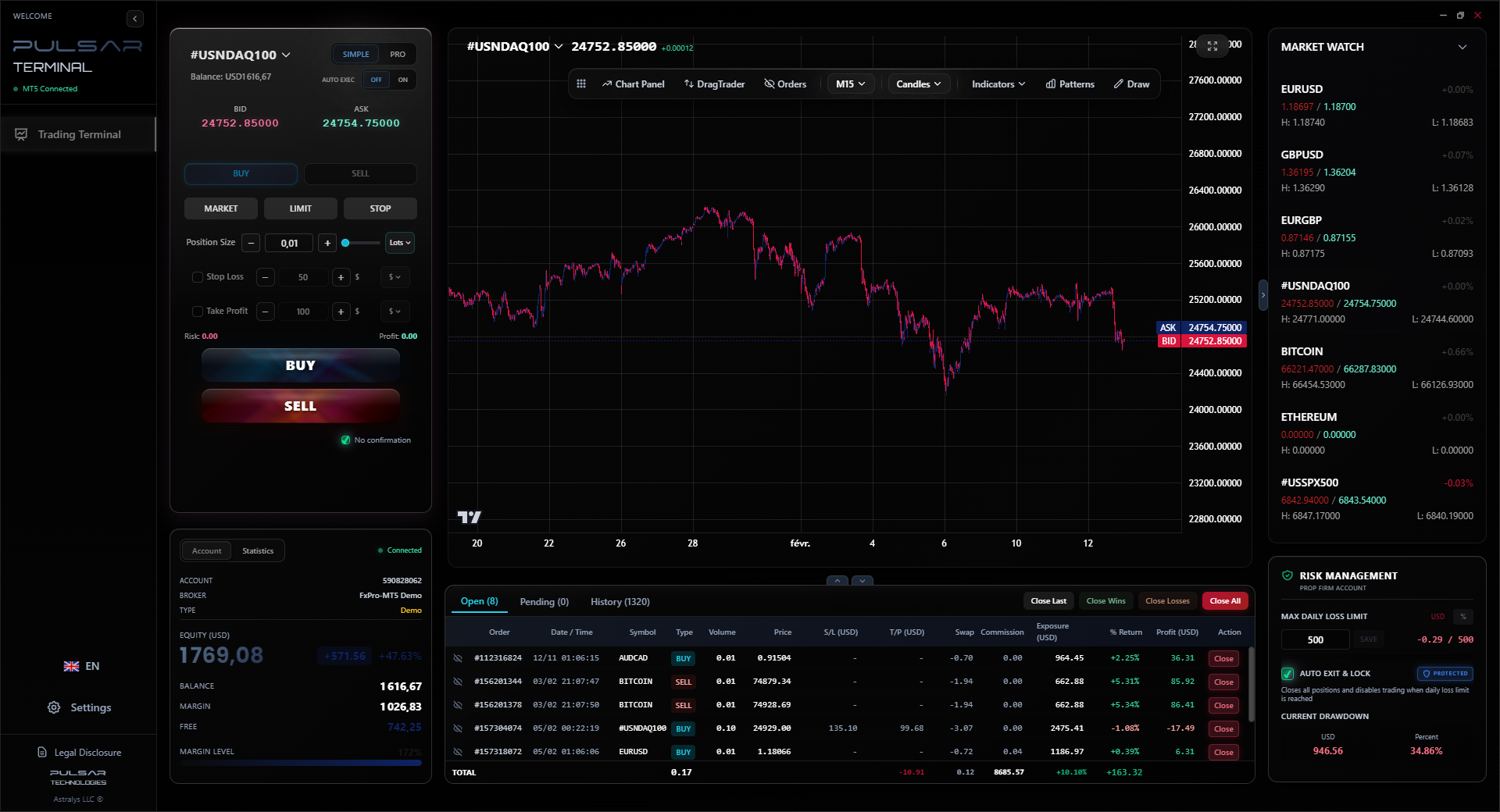
Managing multiple trades across sessions manually is a headache. I used to manually draw lines for partial take-profits, which was error-prone. Now, I use tools that let me set a multi-level exit plan on a single order.
Manually managing trades across different session volatilities is a chore; Pulsar Terminal lets you set multi-level take-profits and auto-breakeven rules that trigger based on price action, not just the clock.
Pulsar Terminal
The all-in-one MT5 companion: drag-and-drop orders, multi-TP/SL, trailing stop, grid trading, Volume Profile, and prop firm protection. Used by 1,000+ traders daily.
“Your strategy should change with the session. Trading a London breakout like a Tokyo range is a surefire way to blow an account.”
Knowledge is useless without habit. Here’s a sample daily schedule for a Lagos-based trader:
- 6:45 AM WAT: Wake up. Check the Asia session close on my phone. Any unexpected breaks? Note key levels.
- 7:30 AM WAT: At my desk. My converter cheat sheet is up. I plan trades for the London open based on the Asia session range. I set alerts.
- 8:00 AM - 10:00 AM WAT: Active trading window. Execute London open strategy.
- 10:01 AM WAT: If I’m in trades, I manage them. If not, I step away for 3 hours. No new entries.
- 1:15 PM WAT: Back at desk. Prepare for NY open/London overlap. Review US news calendar.
- 1:30 PM - 4:00 PM WAT: Second active trading window.
- 4:01 PM WAT: All new trade entries are done. I only manage existing positions.
- 10:00 PM WAT: London is closed. I do a daily review, update my journal, and shut down. No analysis of the dead Sydney session.
This discipline protects your capital and your sanity. It forces you to trade only when the odds are in your favor, not when you’re bored. Remember, a margin call doesn't care what time it is in Lagos.
FAQ
Q1What is the best free forex time zone converter for Nigerian traders?
WorldTimeBuddy.com is my go-to. It's free, simple, and lets you permanently set Lagos (GMT+1) alongside London, NY, Tokyo, and Sydney. You can visually see the overlaps instantly. For a more forex-specific view, BabyPips has a good market hours tool that color-codes the sessions.
Q2Does Daylight Saving Time (DST) affect my trading times from Nigeria?
Absolutely, and it's a major trap. Nigeria does NOT observe DST. However, the UK, US, and Europe do. This means for roughly 3 weeks in March-April and October-November, the London open will shift from 8 AM WAT to 7 AM WAT. Your converter must adjust for this, or you'll be completely out of sync.
Q3I have a day job in Lagos. What is the best session for me to trade?
The London open (8-10 AM WAT) is your golden window. It's before most day jobs kick into high gear, and it's the most volatile and liquid period of the day. You can plan and execute 1-2 high-quality trades in this window and then let them run with stops in place while you work. Avoid trying to trade during your lunch break in the early NY session unless you can give it full focus.
Q4My broker's platform shows a different time. What should I do?
Your broker's server time (often GMT+2 or +3) is for their internal operations. Do not use it for market session analysis. Use your independent forex time zone converter set to WAT (GMT+1) for planning. You can usually change the chart time zone in MT4/MT5 settings to GMT+1 to align candles with your local session times.
Q5Are there certain currency pairs I should avoid during specific sessions?
Yes. Avoid trading EUR/USD during the dead heart of the Tokyo session (3-6 AM WAT) - the spreads are wide and moves are erratic. Similarly, avoid trading AUD/JPY during the London/NY overlap unless you're experienced, as the cross-winds from multiple markets can make it whip violently. Stick to the major pairs aligned with the active session (e.g., EUR/USD in London, USD/JPY in Tokyo).
Q6How does knowing the session times help with risk management?
It's everything. You should use a wider stop-loss during low-liquidity sessions (like late Sydney) because price can slip more. During the London/NY overlap, you might use a tighter stop because moves are more decisive and liquid. Your position size calculator input should account for the typical volatility (Average True Range) of the session you're trading, not just the pair.
Prof. Winston's Lesson
Key Takeaways:
- ✓London Open (8-10 AM WAT) offers the cleanest volatility.
- ✓Always adjust for Daylight Saving Time shifts.
- ✓Wider spreads in dead zones (10 PM-2 AM WAT) kill scalps.
- ✓Use a visual converter, not mental math.
How useful was this article?
Click a star to rate
Weekly Trading Insights
Free weekly analysis & strategies. No spam.
About the Author
Olumide Adeyemi
West African Trading Pioneer
One of Nigeria's most active forex trading educators. 8 years of experience trading from Lagos. Specializes in low-capital strategies and prop firm challenges for African traders.
Comments
Risk Disclaimer
Trading financial instruments carries significant risk and may not be suitable for all investors. Past performance does not guarantee future results. This content is for educational purposes only and should not be considered investment advice. Always conduct your own research before trading.
You Might Also Like

Cara Trading Forex Sukses: 7 Prinsip dari Trader Profesional
Cara trading forex sukses dengan 7 prinsip trader pro: manajemen modal, disiplin, journal trading, backtest. Data nyata, bukan janji profit palsu.
Jam Trading Forex Terbaik untuk Trader Indonesia: Panduan Lengkap dengan Tabel Waktu
Panduan jam trading forex untuk trader Indonesia. Tabel 4 sesi dunia, jam emas 20:00-00:00, sesi mana yang harus dihindari. Data akurat + tips dari trader berpengalaman.
Top 5 Sàn Forex Uy Tín Nhất 2026: Review Jujur dari Trader Indonesia
Top 5 sàn forex uy tín 2026 untuk trader Indonesia. Review jujur: spread, deposit, withdraw, dukungan lokal. Exness, XM, IC Markets & lebih.
Get Pulsar Terminal
All these calculators are built into Pulsar Terminal with real-time data from your MT5 account. One-click position sizing, automatic risk management, and instant calculations.
Get Pulsar Terminal