


Here's the biggest myth about UK forex trade brokers: that all FCA-regulated ones are basically the same.

Sarah Collins
Trading Strategist ·  United Kingdom
☕ 11 min read
What you'll learn:
- 1The FCA Rulebook: Your Safety Net (And Its Limits)
- 2The Real Cost of Trading: Spreads, Commissions & The Silent Killers
- 3Platforms & Execution: Where Your Strategy Lives or Dies
- 4A Real Look at Top UK Forex Trade Brokers
- 5Funding, Taxes, and Other UK Specifics
- 6Red Flags & How to Avoid the Next Scandal
- 7Pulling the Trigger: A Step-by-Step Checklist
Here's the biggest myth about UK forex trade brokers: that all FCA-regulated ones are basically the same. That's how you end up paying twice as much in hidden costs or stuck with a platform that moves like treacle. I've watched traders chase 'the best' broker for years, ignoring the one that actually fits their strategy. Let's cut through the marketing fluff. I'll show you what really matters when picking a broker in London, from the non-negotiable regulations to the sneaky fees that'll eat your profits.
Trading in the UK without an FCA-regulated broker is like skydiving without checking your parachute. It might work, but the landing will be messy. The FCA isn't just a logo on a website; it's a set of enforceable rules that fundamentally change your risk profile.
The big three protections are non-negotiable. First, client money segregation. Your funds are held in separate accounts at top-tier banks. If the broker goes bust (it happens), your money isn't part of their bankruptcy estate. Second, negative balance protection. As a retail client, you can't lose more than you deposited. I remember a wild swing on CHF pairs years ago; this rule saved thousands of traders from owing their broker money. Third, the Financial Services Compensation Scheme (FSCS). It guarantees up to £85,000 if your broker fails and can't return your segregated cash.
But here's the catch everyone misses: these protections come with strings. The FCA's retail use caps (30:1 on majors, 20:1 on minors) are a double-edged sword. They protect you from blowing up in seconds, but they also limit the strategic use of use for certain approaches, like specific hedging strategies I used to run. You can apply for 'professional' status to get higher use, but you voluntarily give up the FSCS protection and negative balance cover. It's a trade-off, not an upgrade.

Warning: The FCA's ban on trading bonuses and incentives is absolute. If a 'UK broker' is offering you a 100% deposit bonus, run. They're either not properly regulated or blatantly breaking the rules. Your first check should always be the FCA Register.

💡 Winston's Tip
Your broker's customer service is their real product. Test it with a tricky question on a Sunday night before you deposit a penny.
Forget the advertised 'from' spreads. They're a marketing tool. You need to look at the average spread under normal market conditions, and more importantly, how it widens during news events or low liquidity. That's where your profit gets shredded.
The Spread vs. Commission Trade-Off
You have two main pricing models. The first is a wider, commission-free spread. Think 1.0 to 1.5 pips on EUR/USD. This is simple: you see the cost built into the price. The second is a raw spread + commission. Here you might see a spread of 0.1 pips, but you pay a commission per lot traded. For example, a common rate is £2.25 per lot per side (£4.50 round turn).
Which is cheaper? It depends entirely on your trade size and frequency. Let's do the math everyone avoids.

Example: Trading 1 standard lot (100,000 units) of EUR/USD.
- Broker A (Wider Spread): 1.2 pip spread. Cost = 1.2 pips * £8 per pip (approx for EUR/USD) = £9.60 per round turn.
- Broker B (Raw + Commission): 0.1 pip spread + £4.50 commission. Cost = (0.1 * £8) + £4.50 = £5.30 per round turn.
For a scalper making 20 trades a day, Broker B saves nearly £90 daily. For a swing trader making 2 trades a week, the difference is negligible, and the simplicity of Broker A might win. Use a position size calculator to model this for your own strategy.
The Silent Fee Killers
These hurt more than spreads.
- Inactivity Fees: OANDA charges $10/month after a year of no login. It's a tax on taking a break.
- Withdrawal Fees: A flat £5-£10 fee per withdrawal punishes you for taking profits. Many top brokers like Pepperstone or IG have free withdrawals.
- Currency Conversion Fees: Funding in GBP but trading USD pairs? If the broker auto-converts at a 1-2% markup, that's a huge, silent drain. Some brokers offer multi-currency accounts to avoid this.
The bottom line? Your broker's pricing page is a legal document. Read it.
“The FCA's protections are a double-edged sword: they save you from catastrophe but also limit your strategic tools.”
A broker can have the tightest spreads on earth, but if their platform freezes during the NFP report, you're toast. The platform is your cockpit; it needs to be an extension of your thinking.
In the UK, you're generally choosing between a broker's proprietary platform or the industry standards (MT4/MT5, cTrader).
Proprietary Platforms (IG, CMC Markets): These are often beautifully designed, integrated with news and research, and packed with unique tools. IG's platform, for instance, has pattern recognition scanners that are genuinely useful. The downside? You're locked in. If you leave the broker, you lose all your custom indicators, templates, and automated scripts.
MT4/MT5: The old warhorses. Ubiquitous, stable, and supported by an army of third-party developers. Every indicator, Expert Advisor (EA), or script you can imagine exists for MT4/5. The charting is functional, not flashy. For algorithmic or scalping strategy traders, MT4/5 is often the only choice due to its scripting language (MQL) and reliable back-testing environment. I run all my automated systems on MT5 for this reason.
cTrader: The sleek modern alternative. Its charting and order entry are, in my opinion, superior to MT5 out of the box. It's built for discretionay traders who value clean execution and advanced chart tools. Brokers like Pepperstone offer it with excellent pricing.
Execution is the invisible metric. Does your broker act as a market maker (taking the other side of your trade) or an STP/ECN broker (routing your order to liquidity providers)? In practice, with major FCA brokers, this matters less for most retail sizes than their requote policy and slippage. During volatile events, do you get re-quoted at a worse price, or does your market order slip through? I once had a stop-loss on GBP/USD during Brexit volatility slip 15 pips on a poor execution broker. On a major position, that was a £1,200 lesson. Look for brokers with transparent execution reports and a 'no requote' policy.
Let's move past reviews and look at practical profiles. These are based on my experience and constant monitoring of the market.
| Broker | Best For | Key Strength | The Catch | My Experience |
|---|---|---|---|---|
| Pepperstone | Active traders, algo traders. | Consistently top-tier raw pricing on MT5, cTrader. Great execution. | Their standard account spreads aren't the most competitive. | My main broker for 5 years. The Razor account with 0.0 pip raw spreads + commission saved me thousands vs my old broker. |
| IG | Beginners, all-markets traders. | Unbeatable trust (listed since 1974), superb proprietary platform, massive range of markets. | Spreads on the standard account are wider than raw brokers. You pay for the brand and security. | I keep an account here for long-term swing trading ideas and share CFDs. The research is excellent. |
| CMC Markets | Charting enthusiasts, professional traders. | the best proprietary charting package in the business. 330+ FX pairs. | Can be overwhelming for a newbie. Platform has a learning curve. | Used for a year. Their advanced charting tools (like pattern recognition) helped spot a clean head-and-shoulders on EUR/GBP for a 180-pip win. |
| OANDA | Beginners, micro-lot traders. | Low $10 minimum deposit, great educational content, trusted name. | Spreads are not the tightest. Charges inactivity and withdrawal fees. | Perfect for a friend I mentored. He started with £100, trading 0.01 lots on their platform without feeling intimidated. |
| Eightcap | TradingView integration fans. | Seamlessly trade directly from TradingView charts. Very tight raw spreads. | Smaller brand than IG or CMC. Primarily a platform rather than a research hub. | Tested their raw account. The TradingView integration is flawless. Executed a gold trade on XAU/USD directly from my TradingView layout. |
There's no single 'best' broker. IC Markets and XM also have strong UK offerings. It's about fit. Are you a high-volume scalper? Pepperstone's raw account. A visual trader who lives on TradingView? Eightcap. Someone who values the solidity of a FTSE 250 company above all else? IG.
💡 Winston's Tip
The 'slippage' on your stop-loss during news is more important than the spread 90% of the time. Demo trade volatile events.
“Forget advertised 'from' spreads. Your real cost is the average spread plus how badly it widens when you need to get out.”
The boring admin stuff. Get it wrong, and it costs you.
Funding Your Account: Most UK brokers accept bank transfer (BACS/Faster Payments), which is free but can take a few hours. Debit/Credit card deposits are instant. E-wallets like PayPal and Skrill are common. A crucial tip: if you're funding in GBP but trading USD pairs like EUR/USD, check your broker's conversion rate. It's often better to use a service like Wise to convert GBP to USD cheaply, then deposit USD directly to avoid a 1-2% hidden fee on every trade's conversion.
Taxes (This Is Not Advice, Talk to an Accountant): This is the big one. In the UK, forex trading profits are generally subject to Capital Gains Tax (CGT), not Income Tax. You have an annual CGT allowance (it was £3,000 in the 2025/26 tax year). Only profits above this allowance are taxed.
However, if the FCA deems your trading to be a 'business' (very high frequency, organized, seeking to make a living), it could be considered trading income and subject to Income Tax. This is a grey area. The key is keeping careful, professional records of every trade. Your broker's statement is your starting point, but you need to track it yourself.
The Prop Firm Caveat: The rise of prop firm challenges is huge. Remember, if you're trading a prop firm's capital from the UK, the FCA rules on use and negative balance protection still apply to you as the retail client. The prop firm itself may be based elsewhere. Also, payouts from prop firms are typically considered income, not capital gains. Keep every statement. Tools that help manage prop firm rules, like daily loss limits, are becoming essential.
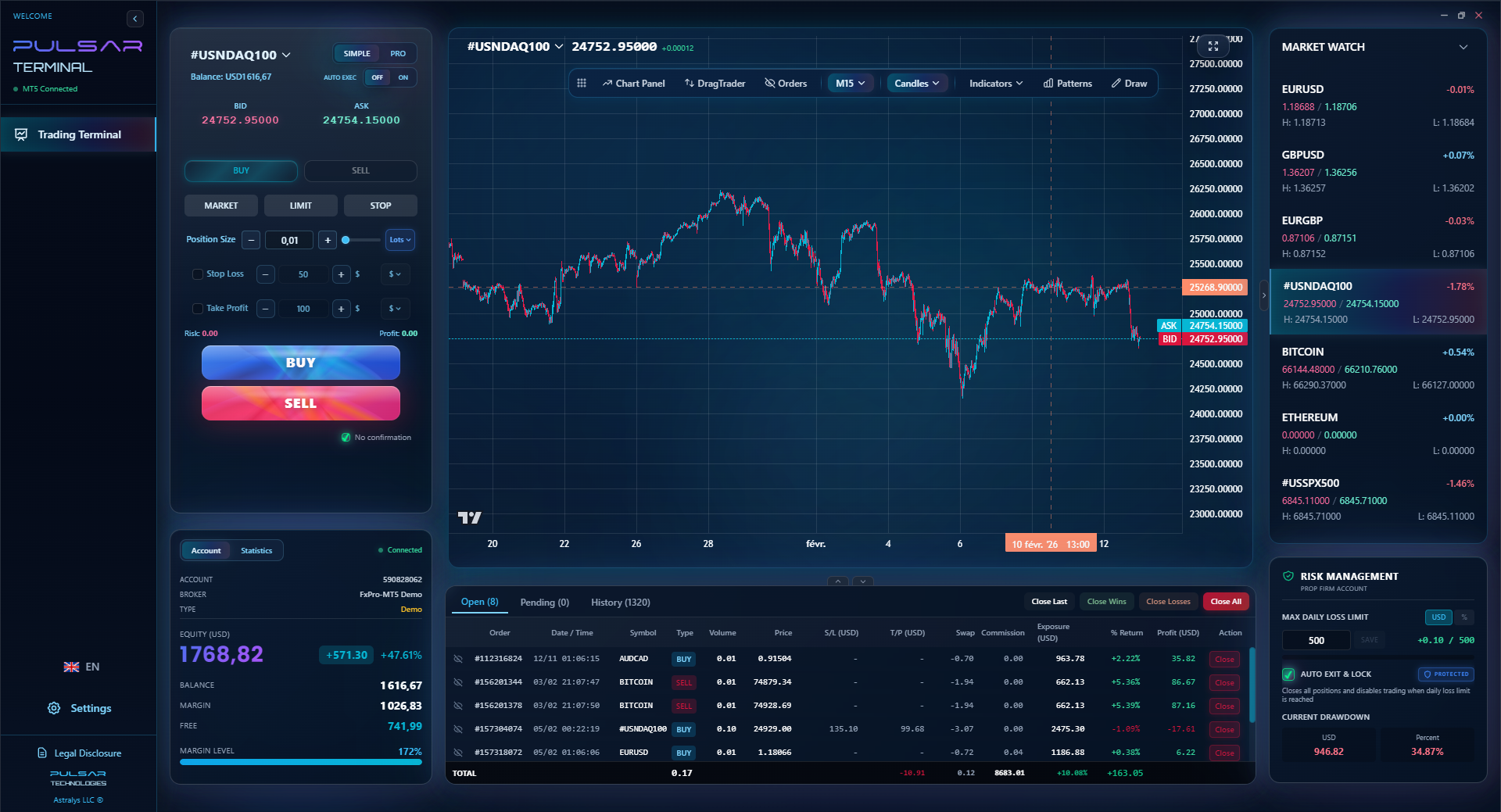
Managing complex trades and prop firm rules manually is a headache; Pulsar Terminal automates trailing stops, breakeven moves, and daily loss limits directly on your MT5 platform.
Pulsar Terminal
The all-in-one MT5 companion: drag-and-drop orders, multi-TP/SL, trailing stop, grid trading, Volume Profile, and prop firm protection. Used by 1,000+ traders daily.
The UK market is clean compared to many, but pitfalls exist. Here's what should make you hit the back button immediately.
- Unregulated 'Associates' or 'Introducers': A common scam is a 'regulated UK broker' outsourcing account management to an unregulated firm abroad. You're protected by the FCA for the funds held with the broker, but not from the bad advice or fraud of the third party. If someone calls you unsolicited about managing your forex account, it's a scam. Full stop.
- Guaranteed Profits or 'Low-Risk' Strategies: The FCA mandates that all brokers display the percentage of retail clients that lose money (it's between 51% and 89%). Any broker or associated educator downplaying this risk is lying.
- Difficulty Withdrawing Profits: This is the ultimate test. If a broker makes you jump through hoops, demands more 'verification' out of the blue, or delays withdrawals for weeks, it's a major red flag. Reputable FCA brokers process withdrawals in 1-3 business days.
- Offshore 'UK' Brands: Some large international brokers have a proper FCA entity and an offshore entity (like in the Seychelles). They might offer the same platform but with higher use and bonuses. You might be automatically signed up to the offshore one. Always, always confirm you are opening an account under their FCA regulatory license number.
- Slippage Only in Their Favor: Notice your stop-losses always seem to get a little extra slippage, but your take-profits get filled exactly? That's not bad luck; it's a sign of a dishonest execution model. A good broker will have positive and negative slippage.
Your due diligence is your last line of defense. Check the FCA register. Read the full terms. Start with a small deposit and make a test withdrawal before committing serious capital.
💡 Winston's Tip
Keep a separate spreadsheet of every trade, including the broker's stated spread at entry. After 100 trades, you'll see who's really cheap.
“A broker is a utility provider, not a partner. Loyalty doesn't pay a dividend here.”
Alright, time to choose. Don't overthink it, but do this methodically.
- Define Your Profile: Are you a scalper, swing trader, algorithmic, or beginner? This dictates your need for tight spreads, specific platforms (MT4/5), or educational resources.
- Regulation First: Shortlist only brokers with a clean, current FCA license. Verify it yourself.
- Cost Analysis: Use your typical trade size and frequency. Model the total cost (spread + commission + any potential conversion fees) for your top 3 pairs. Don't guess, calculate.
- Platform Test Drive: Open a demo account. Not for a few hours, but for a few weeks. Trade your strategy on it. Does the charting lag? Are order entries clunky? Does it support the indicators you rely on, like the MACD or RSI?
- Test the Support: Contact their support with a technical question. See how long they take to respond and if they know their stuff. You'll need them when things go wrong.
- Small Live Start: Deposit the minimum. Execute a few small trades. Then, immediately request a partial withdrawal. This tests the entire funding/trading/withdrawal cycle.
- Scale Up Gradually: Only add more capital once you're completely comfortable with the execution, platform, and processes.
Remember, a broker is a utility provider, not a partner. Your relationship should be professional, transient, and based entirely on them providing a reliable service at a fair price. If they stop doing that, be ready to move. I've changed brokers three times in my career as my needs evolved and better options emerged. Loyalty doesn't pay a dividend here.
FAQ
Q1Is forex trading legal in the UK?
Yes, completely legal. The key is that you must trade through a broker authorised and regulated by the Financial Conduct Authority (FCA). Trading with an unregulated offshore broker is legal but strips you of all the vital UK consumer protections like the FSCS and negative balance protection.
Q2What's the minimum deposit for a UK forex broker?
It varies wildly. Some like XTB have no minimum. Others like OANDA ask for $10, while brokers such as Eightcap or Pepperstone typically have a $100 minimum. The amount isn't an indicator of quality. Start with the minimum while you test the service.
Q3Can I get higher use than 30:1 in the UK?
Yes, but only if you apply and are classified as a 'professional client' by your broker. This requires meeting specific criteria (like having a large portfolio or significant trading experience). Be warned: you lose retail protections, including the FSCS £85,000 guarantee and negative balance protection. It's a serious trade-off.
Q4Do I pay tax on forex trading profits in the UK?
Most likely, yes. For most individual traders, profits are subject to Capital Gains Tax (CGT) after using your annual tax-free allowance. However, if your trading is substantial, frequent, and organized like a business, it could be considered trading income. This is complex. You must maintain detailed records and consult a qualified accountant.
Q5What's the difference between a market maker and an ECN/STP broker?
A market maker may take the other side of your trade internally, while an ECN/STP broker routes your order to external liquidity providers (banks, funds). In practice, for most retail traders using major FCA brokers, the execution quality matters more than the label. Look for transparent pricing, low slippage, and a no-requote policy.
Q6How do I know if a broker is truly FCA-regulated?
Don't just trust the logo on their site. Go to the official FCA Register (register.fca.org.uk), search for the firm by name, and check the 'Permission' section includes 'dealing in investments as principal' and/or 'dealing in investments as agent'. Also verify the firm number matches the one on the broker's website.
Q7Are there any UK brokers that offer MetaTrader 5 (MT5)?
Absolutely. Most major brokers do. Pepperstone, IC Markets, XM, and Admiral Markets all offer MT5 alongside other platforms. MT5 is becoming the new standard for its superior back-testing and hedging capabilities compared to MT4.
Prof. Winston's Lesson
Key Takeaways:
- ✓FCA regulation is non-negotiable for fund safety.
- ✓Calculate total cost (spread + commission + fees), not just the headline spread.
- ✓Test withdrawal before committing serious capital.
- ✓Choose the platform that fits your strategy, not the other way around.
- ✓Prop firm payouts are likely income, not capital gains.
How useful was this article?
Click a star to rate
Weekly Trading Insights
Free weekly analysis & strategies. No spam.
About the Author
Sarah Collins
Trading Strategist
London-based trading strategist with 12 years in financial markets. Former analyst at a City of London brokerage. Covers GBP pairs, European markets, and FCA-regulated trading.
Comments
Risk Disclaimer
Trading financial instruments carries significant risk and may not be suitable for all investors. Past performance does not guarantee future results. This content is for educational purposes only and should not be considered investment advice. Always conduct your own research before trading.
You Might Also Like

Cara Trading Forex Sukses: 7 Prinsip dari Trader Profesional
Cara trading forex sukses dengan 7 prinsip trader pro: manajemen modal, disiplin, journal trading, backtest. Data nyata, bukan janji profit palsu.
Jam Trading Forex Terbaik untuk Trader Indonesia: Panduan Lengkap dengan Tabel Waktu
Panduan jam trading forex untuk trader Indonesia. Tabel 4 sesi dunia, jam emas 20:00-00:00, sesi mana yang harus dihindari. Data akurat + tips dari trader berpengalaman.
Top 5 Sàn Forex Uy Tín Nhất 2026: Review Jujur dari Trader Indonesia
Top 5 sàn forex uy tín 2026 untuk trader Indonesia. Review jujur: spread, deposit, withdraw, dukungan lokal. Exness, XM, IC Markets & lebih.
Get Pulsar Terminal
All these calculators are built into Pulsar Terminal with real-time data from your MT5 account. One-click position sizing, automatic risk management, and instant calculations.
Get Pulsar Terminal