


Most new traders in Singapore get it backwards.

Daniel Harrington
Head of Content
☕ 12 min read
What you'll learn:
- 1What Exactly Is a Forex Lot? Breaking Down the Units
- 2Singapore's Rules: MAS, use, and How They Shape Your Lot Size
- 3The Right Calculation: How to Determine Your Lot Size, Step-by-Step
- 4Brokers & Accounts in Singapore: Finding the Right Fit for Small Lots
- 5Lot Size Landmines: Common Mistakes Singapore Traders Make
- 6For the Growing Account: Advanced Position Sizing Concepts
- 7Your Singapore Lot Size Action Plan
Most new traders in Singapore get it backwards. They focus on potential profits first and treat lot size as an afterthought. I did the same thing. I remember my first 'big' trade on EUR/USD, picking a standard lot because that's what the pros seemed to use, without truly grasping what a 100-pip move against me would do to my SGD 5,000 account. Spoiler: it wasn't pretty. Let's set the record straight. Your forex trade lot size isn't just a number; it's your primary risk control lever. Get this wrong, and even the best strategy won't save you. Get it right, and you give yourself the one thing every trader needs: time to learn.
Think of a lot like a bundle. In forex, we trade in standardized bundles of currency. It's how we measure trade volume. The size of the bundle directly determines how much each tiny market movement (a pip) is worth in real money.
Here’s the standard breakdown you'll see with any broker, from Saxo to IG:
| Lot Type | Units of Base Currency | Pip Value (approx. for EUR/USD) | Common Nickname |
|---|---|---|---|
| Standard Lot | 100,000 | $10 USD | The 'full' lot |
| Mini Lot | 10,000 | $1 USD | |
| Micro Lot | 1,000 | $0.10 USD | The beginner's best friend |
| Nano Lot | 100 | $0.01 USD | Rare, but out there |
Now, here's the critical local twist. When you're trading with a Singapore broker, your account is likely in SGD. That pip value in USD needs to be converted. If EUR/USD moves 10 pips and you're in a micro lot, that's a $1 USD move. At an USD/SGD rate of 1.35, that's about SGD 1.35 in your P&L.

Example: You buy a mini lot (10,000 units) of USD/JPY. A pip for USD/JPY is typically a $0.10 move per mini lot. If you gain 25 pips, that's 25 * $0.10 = $2.50 USD. Converted to SGD, that's roughly SGD 3.38 profit.
The biggest leap in my early trading was moving from thinking in 'lots' to thinking in dollars per pip. It makes risk real. A standard lot on a volatile pair like GBP/JPY? That's about $8 USD per pip. A 50-pip stop-loss suddenly means a $400 risk before you even consider your account size. That's a wake-up call.
Thankfully, micro and mini lots are widely available here. I started seriously surviving only when I switched to micro lots exclusively. It let me test strategies live without the emotional tsunami of watching $50 vanish in seconds. It's the single best piece of advice I give: trade smaller than you think you need to. Your future self will thank you.

💡 Winston's Tip
A professor once told me, 'Amateurs focus on profit targets. Professionals focus on risk per trade.' Write your maximum dollar risk on a sticky note and stick it to your monitor.
You can't talk about lot size here without talking about the Monetary Authority of Singapore (MAS). They're our central bank and regulator, and they have a say in how much rope brokers can give us. This directly impacts how big a position you can take.
First, the good news. MAS is top-tier. Client funds are segregated, and negative balance protection is mandatory. You won't wake up owing the broker more than you deposited.
Now, the crucial bit: use. There's some nuance. Officially, MAS doesn't set a hard use cap for retail traders. Instead, they require brokers to assess a client's sophistication and set appropriate limits. In practice, almost every major MAS-regulated broker you'll use - like IG, Saxo Markets, or CMC Markets - applies a maximum use of 20:1 for major forex pairs for retail clients. That's a 5% margin requirement.
What 20:1 use Really Means for Your Trade
Let's say you have SGD 10,000 in your account. With 20:1 use, your broker effectively lets you control a position worth up to SGD 200,000.
If you're trading EUR/USD (where the base currency is EUR), a standard lot is 100,000 EUR. At a EUR/SGD rate of 1.45, that one lot is worth about SGD 145,000. Your SGD 10,000 account could technically 'control' that position (145,000 / 10,000 ≈ 14.5x use used).
But should you? Absolutely not. That's a one-way ticket to a margin call. Using all your available use on one trade is the fastest mistake in the book. The use limit is a ceiling, not a target.

Warning: High use magnifies losses just as fast as profits. A 1% market move against you on a fully leveraged 20:1 position wipes out 20% of your margin. With a standard lot, that happens in a blink.
The local rule of thumb I've adopted from seasoned traders here: use no more than 5-10% of your available use on a single trade. It forces you into smaller, saner lot sizes. This is where using a position size calculator becomes non-negotiable. You input your account size, risk percentage, stop-loss distance, and it spits out the correct lot size. It takes the emotion out of the equation.
“Your lot size isn't just a number; it's your primary risk control lever.”
Forget guessing. Let's lock in a process. This is the math that saved my account after a few too many reckless early trades.
The 1% Rule (A Good Starting Point) Never risk more than 1% of your trading capital on a single trade. For a SGD 10,000 account, that's SGD 100 max risk.
The Formula in Action Let's say you're looking at XAU/USD (Gold). Your analysis says to buy at $2,350 with a stop-loss at $2,340. That's a 1000-point risk (Gold is quoted to two decimals, so $10.00 = 1000 points).
- Determine Risk in Account Currency: 1% of SGD 10,000 = SGD 100 risk.
- Find Risk Per Point/Lot: For Gold, a 1-point move (0.01) on a standard lot is typically $1.00 USD. So a 1000-point stop-loss equals a $1,000 USD risk per standard lot.
- Convert to Account Currency: $1,000 USD at USD/SGD 1.35 = SGD 1,350 risk per standard lot. Way over your SGD 100 limit!
- Calculate Correct Lot Size: SGD 100 (your risk) / SGD 1,350 (risk per standard lot) = 0.074 standard lots.
Since you can't trade 0.074 of a standard lot, you'd round down to a micro lot size of 0.07 lots (7 micro lots). This aligns your position with your risk tolerance.

Pro Tip: Most trading platforms have a built-in calculator. On MT4/MT5, right-click your order ticket, select 'Properties', and you can input your risk in dollars. It will show you the required lot size. Or, use our free position size calculator.
Here's a real mistake I made. Early on with IC Markets, I traded AUD/USD. I risked 2% of my account (SGD 200) with a 50-pip stop. I calculated the lot size for a mini lot but accidentally entered a standard lot. The risk wasn't SGD 200; it was SGD 1,350. I got lucky and the trade went my way, but the cold sweat realizing my error afterwards was lesson enough. Always double-check your ticket.
Not all broker accounts are created equal when you want to trade sensibly sized lots. You need to look at three things: minimum lot size, spreads/commissions, and the minimum deposit.
Minimum Trade Size is Key You want a broker that allows micro (0.01) lots as a minimum. This gives you granular control. Most major brokers here do, like Oanda (famous for its flexible units) or Exness. Some, like XM, even allow nano lots (0.001). If a broker only allows mini lots (0.1) as a minimum, walk away. It forces you into positions that are likely too large for a starter account.
The Cost Structure Matters More on Small Trades When you're trading micro lots, the spread (the difference between buy and sell price) eats a larger relative chunk of your potential profit.
- Commission-Based Accounts (Raw/ECN): Brokers like IC Markets or Pepperstone offer spreads from 0.0 pips but charge a commission per lot. For a micro lot round turn, that might be $0.07 USD. This is often cheaper for scalping strategies.
- Spread-Only Accounts: Brokers like XM or Exness build their cost into the spread. You might see a 1.0 pip spread on EUR/USD but pay no commission.
For a micro lot trader, a 1-pip spread costs you $0.10 USD. On a 5-pip target, that's 20% gone just on entry/exit. You need to factor this into your strategy's edge.
Minimum Deposits Vary Wildly This is good news for Singaporeans starting out. You don't need a fortune.
- Brokers like XM or Exness let you start with $5-$10.
- FOREX.com Singapore asks for S$150.
- Saxo Markets is on the higher end, suited for more serious capital.
My advice? Start with a broker that allows a tiny minimum deposit and micro lots. Fund it with an amount you're truly willing to lose - say, SGD 500. This lets you practice the real psychology of trading with real money, but the lot size math keeps the stakes survivable.
💡 Winston's Tip
If you feel a rush of excitement or fear when you see your potential profit/loss on the order ticket, your lot size is too big. Dial it down until the number feels boring.
“Using all your available use on one trade is the fastest mistake in the book.”
I've stepped on most of these. Let's make sure you don't.
Mistake 1: Scaling Up Too Fast After a Win You make SGD 50 on a micro lot trade. Euphoria hits. "If I'd used a mini lot, I'd have made SGD 500!" Next trade, you jump to a mini lot. This is emotional trading, not strategic sizing. Your lot size should be determined by your current account balance and the specific trade's risk, not your last P&L. Stick to your percentage risk rule, every single time.
Mistake 2: Ignoring Volatility Across Pairs A 50-pip stop on EUR/USD is not the same as a 50-pip stop on GBP/JPY. GBP/JPY is inherently more volatile; the pip value is also different. The lot size for the same dollar risk will be smaller on a more volatile pair. Always calculate fresh for each new currency. My guide on EUR/USD covers its typical ranges, but you must adjust for others.
Mistake 3: Not Accounting for Overnight Financing (Swap Rates) If you hold a position past 5pm EST (5am Singapore time), you pay or receive a swap fee. On a standard lot, this can be a few dollars. On a micro lot, it's cents. It seems negligible until you're in a swing trading position for weeks. I once held a USD/TRY sell position for a month. The negative swap (because I was selling a high-interest currency) eroded almost 30% of my eventual profit. Check the swap rates on your platform before entering longer-term trades.
Mistake 4: Letting a Losing Trade "Grow" You enter a micro lot, the trade goes against you, and you move your stop-loss further away to avoid the loss. You haven't changed your lot size, but you've massively increased your dollar risk. This is a silent account killer. It's better to be stopped out at your planned 1% loss than to let it turn into an unplanned 5% or 10% disaster.
Once you're consistently profitable for a few quarters, you can start thinking about more sophisticated sizing. This isn't for beginners.
The Kelly Criterion (Theoretically Optimal) This formula suggests what percentage of your bankroll to bet based on your edge. If you have a 60% win rate and your average win is 1.5 times your average loss, Kelly might suggest risking 20% per trade! That's insane for forex. Most traders use a Fractional Kelly, like 10-25% of the suggested amount. It's mathematically interesting but dangerous in practice due to the difficulty of accurately knowing your true long-term edge.
Volatility-Based Position Sizing Instead of a fixed stop-loss in pips, you size your position based on market volatility. You might use the Average True Range (ATR) indicator. If the ATR(14) is 100 pips, you set your stop at 1.5 x ATR (150 pips). Because your stop is wider, your lot size must be smaller to maintain the same dollar risk. This adjusts your size to current market conditions, which is smart. A calm EUR/USD day allows a slightly larger lot for the same risk; a chaotic day forces a smaller one.
Portfolio-Level Risk Management This is the big leagues. You're not just looking at one trade, but at all your open positions and how they correlate. If you're long AUD/USD and long NZD/USD, those pairs are highly correlated. You're in one big trade. Your combined risk might be 4% of your account, not 2% + 2%. Advanced traders will reduce lot sizes on correlated positions to keep total portfolio risk in check.
When I first tried volatility sizing, I used the MACD indicator confluence with ATR. I'd widen my stop on higher timeframes, which meant my lot size got smaller. It felt counterintuitive to 'trade less' on bigger swings, but it smoothed out my equity curve. The goal isn't to get rich quick on one trade; it's to survive and compound over hundreds of trades.
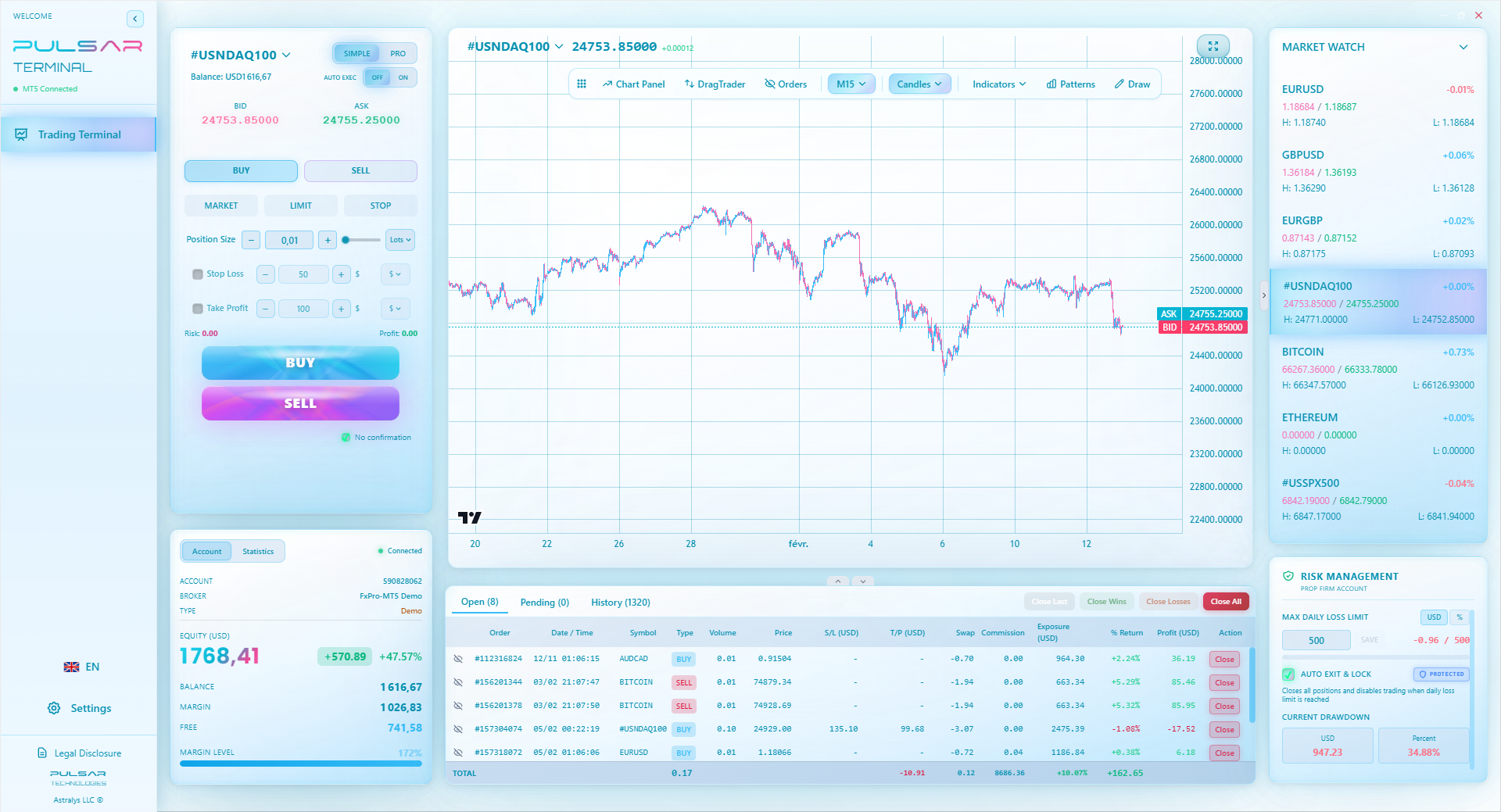
Managing multiple trades with different lot sizes and correlated risk is complex, but tools like Pulsar Terminal provide a portfolio view and one-click partial closures to manage it all directly on MT5.
Pulsar Terminal
The all-in-one MT5 companion: drag-and-drop orders, multi-TP/SL, trailing stop, grid trading, Volume Profile, and prop firm protection. Used by 1,000+ traders daily.
“It's better to be stopped out at your planned 1% loss than to let it turn into an unplanned 10% disaster.”
Let's make this simple and actionable.
Step 1: Know Your Numbers
- Write down your total trading capital in SGD.
- Decide your maximum risk per trade (I recommend 0.5%-1%).
- Calculate that dollar amount. SGD 10,000 x 1% = SGD 100.
Step 2: Choose Your Broker & Account Type
- Pick an MAS-regulated broker that offers micro lots (0.01).
- Understand their cost: low spread + commission vs. wider spread-only. For small lots starting out, a simple spread-only account is often easier.
Step 3: Plan Every Trade
- Before you click buy/sell, identify your entry and stop-loss price.
- Measure the distance in pips/points.
- Use a calculator to find the lot size that risks your SGD 100 (or less).
- Write this lot size down on your trading plan.
Step 4: Execute and Review
- Enter the exact lot size from your plan. No rounding up!
- After the trade closes (win or lose), review. Did you follow your sizing rule? Was the stop-loss reasonable? Adjust your analysis, not your risk percentage.
Your lot size is your seatbelt. You can drive a fancy car (a great strategy) on a dangerous road (the markets), but without the seatbelt, one crash ends the journey. In Singapore's massive, liquid forex market - turning over over SGD 2 trillion a day - the crashes come fast. Size small, survive long, and let consistency build your account. That's the real Singapore trader's edge.
FAQ
Q1What is the best lot size for a beginner in Singapore with a $500 SGD account?
Stick to micro lots (0.01). With a $500 account and a strict 1% risk rule ($5 SGD), a micro lot gives you the flexibility to place sensible stop-losses without risking too much. A standard or even mini lot would be far too large and could wipe out your account in a few bad trades.
Q2Does MAS regulate the maximum lot size I can trade?
No, MAS doesn't regulate lot size directly. They influence it through use limits (effectively 20:1 for retail) and broker capital requirements. The lot size you choose is your responsibility. The broker's margin system will simply prevent you from opening a position if your chosen lot size requires more margin than you have available.
Q3How does lot size affect my profit and loss in SGD?
It's a direct multiplier. If a 1-pip move on EUR/USD is worth $0.10 USD per micro lot, then a 100-pip win is $10 USD. Convert that to SGD at the current rate (e.g., 1.35) for ~SGD 13.50 profit. A standard lot would be 100x that: ~SGD 1,350. Bigger lot = bigger P&L swings in your local currency.
Q4Can I change my lot size in the middle of a trade?
You can't directly modify an open position's lot size. However, you can partially close a portion of it (close 0.03 lots out of a 0.05 lot trade). Some advanced tools, like Pulsar Terminal for MT5, make this partial closure very easy with a drag-and-drop. To effectively 'increase' your size, you would open an additional separate trade at the same price.
Q5Is trading nano lots (0.001) a good way to practice?
It can be useful for absolute beginners to get used to platform mechanics with almost zero financial risk. However, the spreads and costs become extremely large relative to potential profits, so it's not a realistic simulation of actual trading psychology or strategy testing. Moving to micro lots (0.01) with a small real deposit is a better next step.
Q6How do I calculate lot size for a cross pair like EUR/GBP?
The principle is the same, but the pip value is not in USD. Your trading platform's order ticket will show the estimated margin required and profit/loss. The safest method is to use a position size calculator where you input your account currency (SGD), the pair, your stop-loss in pips, and your risk in dollars. It will handle the conversions for you.
Prof. Winston's Lesson
Key Takeaways:
- ✓Risk a maximum of 1% of capital per trade.
- ✓Micro lots (0.01) are a beginner's best friend.
- ✓Singapore retail use is effectively capped at 20:1.
- ✓Always use a position size calculator.
How useful was this article?
Click a star to rate
Weekly Trading Insights
Free weekly analysis & strategies. No spam.
About the Author
Daniel Harrington
Head of Content
Head of content at The Trading Mentor. Veteran trader with a passion for making complex trading concepts accessible. Covers global topics, strategies, and platform guides.
Comments
Risk Disclaimer
Trading financial instruments carries significant risk and may not be suitable for all investors. Past performance does not guarantee future results. This content is for educational purposes only and should not be considered investment advice. Always conduct your own research before trading.
You Might Also Like

Cara Trading Forex Sukses: 7 Prinsip dari Trader Profesional
Cara trading forex sukses dengan 7 prinsip trader pro: manajemen modal, disiplin, journal trading, backtest. Data nyata, bukan janji profit palsu.
Jam Trading Forex Terbaik untuk Trader Indonesia: Panduan Lengkap dengan Tabel Waktu
Panduan jam trading forex untuk trader Indonesia. Tabel 4 sesi dunia, jam emas 20:00-00:00, sesi mana yang harus dihindari. Data akurat + tips dari trader berpengalaman.
Top 5 Sàn Forex Uy Tín Nhất 2026: Review Jujur dari Trader Indonesia
Top 5 sàn forex uy tín 2026 untuk trader Indonesia. Review jujur: spread, deposit, withdraw, dukungan lokal. Exness, XM, IC Markets & lebih.
Get Pulsar Terminal
All these calculators are built into Pulsar Terminal with real-time data from your MT5 account. One-click position sizing, automatic risk management, and instant calculations.
Get Pulsar Terminal