


Everywhere you look in Nigeria, you see ads screaming 'forex traders wanted.' It's pitched as a quick path to wealth, a side hustle that prints dollars.

Olumide Adeyemi
West African Trading Pioneer ·  Nigeria
☕ 11 min read
What you'll learn:
Everywhere you look in Nigeria, you see ads screaming 'forex traders wanted.' It's pitched as a quick path to wealth, a side hustle that prints dollars. I'm here to tell you that's mostly nonsense. The real message behind 'forex traders wanted' is 'your capital is wanted.' The industry profits from your activity, not your success. After 12 years of trading and coaching, I've seen the cycle: hype, deposit, blow up, repeat. This guide isn't about getting you excited. It's about showing you the legal framework, the real costs, and the psychological grind so you can decide if you're built for this - before you lose a kobo.
Let's clear this up first. Trading forex with your own money is legal in Nigeria. The Central Bank of Nigeria (CBN) and the Securities and Exchange Commission (SEC) know you're doing it. The problem starts when companies start pooling funds from the public. That's where the SEC steps in with crackdowns on Ponzi schemes masquerading as forex investment clubs.
The CBN's main concern is the flow of foreign currency. You've probably felt this trying to fund an international broker with your Naira card. Those restrictions aren't about stopping you from trading; they're about monetary policy. A key development is the Nigerian Foreign Exchange (FX) Code that took effect in late 2024. It's aimed at wholesale dealers and banks, but its push for transparency trickles down.
And yes, the taxman cometh. The Federal Inland Revenue Service (FIRS) expects a 10% capital gains tax on your trading profits. Very few retail traders ever make enough to worry about this, but it's the law. Operating in this grey area means your primary protection is your own due diligence. Choosing a broker with a solid reputation is your first line of defense, more than any local regulation.

Warning: If a 'funding manager' promises you monthly returns for pooling your money, run. That's not trading; it's the oldest scam in the book. The SEC has shut down dozens of these.

💡 Winston's Tip
Your first profitable month is your most dangerous. It validates bad habits. Stick to your plan like your life depends on it, because your trading account does.
“The real message behind 'forex traders wanted' is 'your capital is wanted.'”
When brokers advertise 'forex traders wanted' with a $1 minimum deposit, it's a trap. They're selling the dream of starting small. But the real cost of trading isn't your initial deposit. It's the cost of education, technology, and - most expensively - your losing trades.
Let's break down the numbers you won't see in the ads:
The Learning Tax: You can go the self-taught route, which costs nothing but 1-2 years of your life and likely a blown account. Or you can pay. A basic course runs ₦50,000 to ₦100,000. A serious mentorship? That's ₦150,000 to ₦350,000+. I paid $1,200 for a course early on. It was mostly garbage, but one concept on market structure saved me ten times that amount later. The point is, education is a minefield.
The Infrastructure Bill: You need rock-solid internet. We're talking ₦15,000 a month minimum for a reliable data plan. A power backup solution (inverter, solar) is non-negotiable. Imagine being in a profitable trade when NEPA takes light. I lost $870 on a GBP/USD trade in 2017 because of a sudden outage. That loss paid for a small generator.
The Hidden Broker Fees: The spread is just the start. Overnight swap rates can eat your profits if you're a swing trader. Some brokers have inactivity fees. Funding and withdrawing money often comes with processing fees, especially with international transfers. Always read the fine print on your broker's website, like our detailed Exness review or IC Markets review that break these costs down.
| Cost Category | Low-End Estimate (Monthly) | Realistic Cost for Serious Trading |
|---|---|---|
| Internet & Power | ₦15,000 | ₦25,000+ |
| Education | ₦0 (self-taught) | ₦10,000 (ongoing books/courses) |
| Platform Fees | $0 (MT4/MT5) | $50-$100 (advanced platforms) |
| Psychological Cost | High Stress | Very High Stress |
The biggest cost is never listed: your psychological capital. The stress, the sleepless nights watching Asian session, the frustration. That's the real price of admission.
“Desperation is a terrible trading strategy.”
The global failure rate is high, but in Nigeria, specific cultural and economic pressures make it worse. Understanding these traps is your only chance to avoid them.
The 'Quick Rich' Mentality
Naira is struggling, the job market is tight, and forex is sold as the escape hatch. This creates desperate, impatient traders. They see a signal on WhatsApp, risk 10% of their account on one trade, and are out of the game in a week. I've been there. In 2015, I put ₦150,000 (almost all my savings) into an account, tried to double it in a month using a scalping strategy I didn't understand, and was down to ₦40,000 in three weeks. Desperation is a terrible trading strategy.
Poor Risk Management
This is the universal killer, but it's exacerbated by starting with tiny accounts. If your entire capital is $100 (about ₦140,000), a sensible 1% risk per trade is $1. That's nothing. So traders 'logically' risk 10% or 20% to make meaningful gains. This guarantees blow-up. It's mathematical. You need a larger starting capital to practice proper risk management, which creates a vicious cycle. Use a position size calculator religiously, even when the numbers seem too small.
Chasing 'Surefire' Strategies
There's a whole industry selling 'secret indicators' and '100% win rate' systems to Nigerian traders. Let me be blunt: they don't exist. If someone had a printing machine for money, they wouldn't sell it for ₦30,000 on Instagram. The market is a probabilistic game. You need an edge, not a crystal ball. Tools like the RSI indicator or MACD indicator are useful, but only as part of a broader, tested plan.

Pro Tip: Your first goal isn't to make profit. Your first goal is to survive long enough to learn. Aim to make your starting capital last for at least 6 months and 100 trades. That's a win.
“Desperation is a terrible trading strategy.”
If the market could post a real job description for 'forex traders wanted,' it wouldn't ask for charting geniuses. It would ask for disciplined accountants with the patience of a monk.
- Risk Management: This is the number one skill. It's boring. It's about calculating your position size before every single trade, setting your stop-loss, and sticking to it. It's knowing that if you lose 50% of your capital, you need a 100% return just to break even. The math is brutal and unforgiving.
- Emotional Discipline: Can you take a full week of losing trades without changing your strategy? Can you take a profit without feeling like a genius and then doubling your risk on the next trade? The market is designed to trigger your greed and fear. I once had a 7-trade winning streak on XAU/USD and felt invincible. The 8th trade, I broke my rules, didn't set a stop, and gave back 80% of those profits in one go.
- Journaling & Review: The traders who make it treat trading like a science experiment. They journal every trade: entry, exit, reason, emotional state. They review weekly to find their real edge. Is your win rate higher on EUR/USD during the London session? Do you always lose when you trade before lunch? The data doesn't lie.
- Patience: This is a waiting game. You might get only 2-3 high-probability setups a week. Can you sit on your hands and do nothing for days? Most can't. They overtrade, pay the spread over and over, and slowly bleed their account dry.
These aren't sexy skills you learn in a weekend. They're built over hundreds of trades and countless mistakes.
💡 Winston's Tip
The market doesn't know you exist. Your ego, your bills, your dreams are irrelevant to the price chart. Trade the chart, not your story.
“Your first goal isn't to make profit. Your first goal is to survive long enough to learn.”
Lately, the loudest 'forex traders wanted' calls are from proprietary trading firms. They offer a compelling deal: pass our challenge, trade our capital, keep most of the profits. For a fee of ₦50,000 to ₦150,000, you get to risk their money, not yours. It sounds perfect.
Here's the real story. These challenges are designed to be difficult. They have strict drawdown rules (often trailing) and profit targets that force you to trade in a very specific, often aggressive, way. The psychology is different. Now you're trading to 'pass a test,' not to follow your system. The pressure is immense.
I've evaluated for three different prop firms. I passed one, blew the account in the funded stage, and failed the other two challenges. The one I passed had a 10% profit target in 30 days with a 5% max drawdown. I hit the target in 12 days by catching a big move on GBP/JPY. I felt brilliant. Then, in the funded stage, with 'real' money on the line, I became scared and hesitant. I missed my rules, took a bad loss, and hit the daily margin call limit. Game over.
The value of prop firms isn't the capital. It's the structure. They force extreme discipline. But you must have a rock-solid, proven strategy first. Don't use the challenge fee as your tuition to learn how to trade. Use it as an exam for a skill you already have.

Example: A typical challenge: Fee = ₦80,000. Account size = $100,000. Target = 10% ($10,000) in 30 days. Max Daily Loss = 5% ($5,000). You make $6,000 in week one. You now have a trailing drawdown. If you give back $3,000, you're at $3,000 net. Your new loss limit might be $3,000 below your peak equity. One bad trade can fail you, even if you're still in profit.
“Your first goal isn't to make profit. Your first goal is to survive long enough to learn.”
Forget finding the perfect indicator. Your plan needs to answer these five questions with cold, hard numbers. No vague answers allowed.
- What markets do I trade? Don't say 'forex.' Be specific. 'I trade EUR/USD and GBP/USD during the London overlap (8 AM - 12 PM GMT).' Each pip movement has a defined value. Master these before adding more.
- What is my setup? This is your trigger. It must be objective. Not 'I feel it's going up.' More like: 'Price pulls back to the 4-hour EMA 50, forms a bullish engulfing candle on the 1-hour chart, and the RSI is above 40.' Backtest this. How often did it work over the last 100 instances?
- Where is my stop-loss? Always, always, always. It's based on market structure, not how much you're willing to lose. 'My stop is 15 pips below the swing low.'
- Where is my take-profit? Do you use a fixed risk-reward ratio (like 1:2)? Or do you take partial profits? A tool that lets you set multiple take-profit levels can change your psychology. Taking 50% off at 1:1 risk-reward and letting the rest run removes the anxiety of a trade turning against you in profit.
- What is my risk per trade? This is the king of all rules. It's a percentage of your current account balance, not a fixed dollar amount. 1% is standard. 2% is aggressive. More than that is gambling. If your account is ₦500,000, 1% is ₦5,000. You calculate your position size from there.
Write this down. Print it. Tape it to your monitor. A plan you don't follow is just a wish list.
💡 Winston's Tip
If you wouldn't risk ₦50,000 on a business idea after 5 minutes of thought, why would you risk it on a trade after 5 minutes of chart staring? Treat each trade with more scrutiny than an investment.
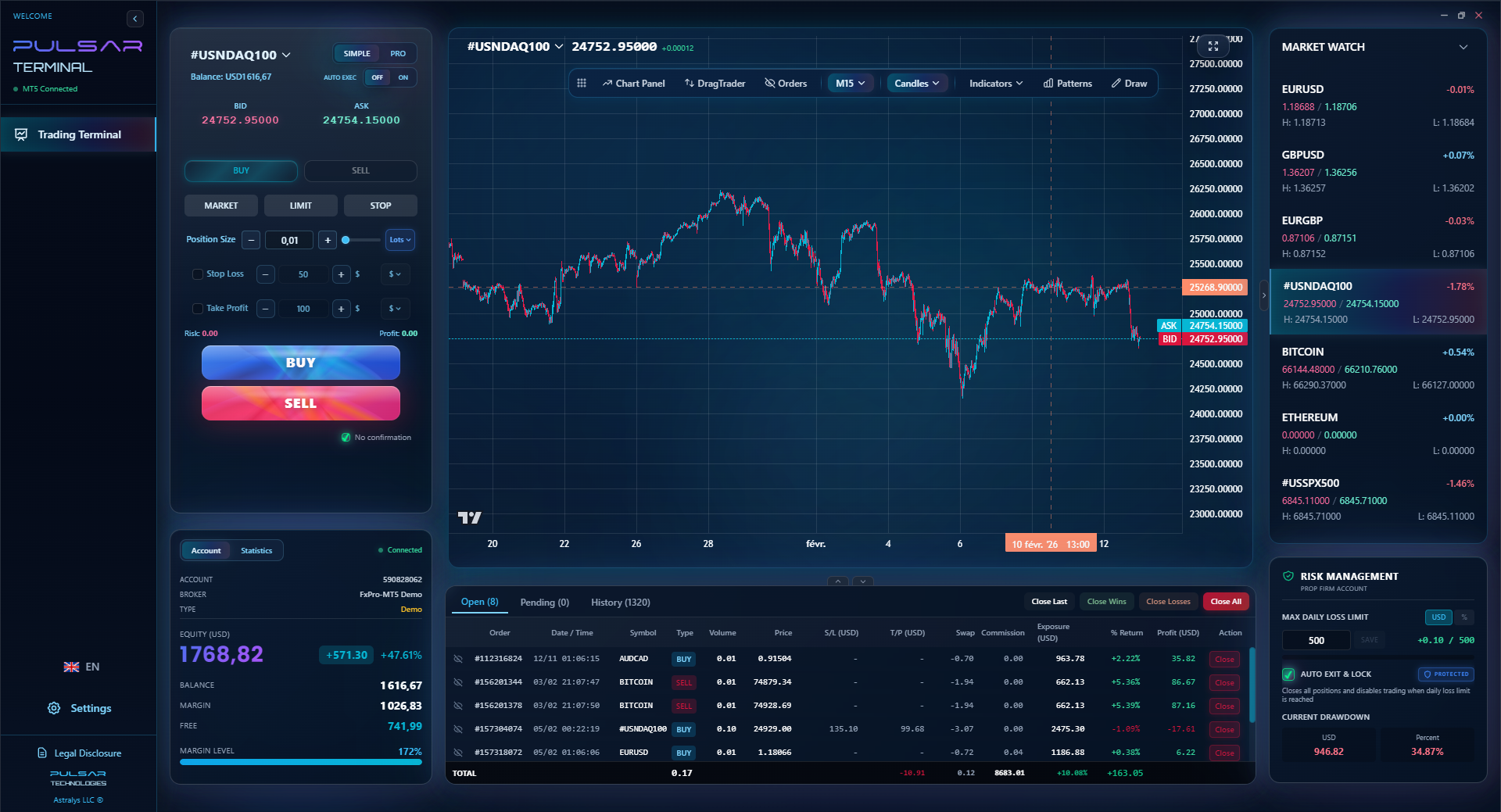
Executing a multi-take-profit plan without emotion is nearly impossible manually, which is why tools like Pulsar Terminal that automate partial closures directly on MT5 are game-changers for discipline.
Pulsar Terminal
The all-in-one MT5 companion: drag-and-drop orders, multi-TP/SL, trailing stop, grid trading, Volume Profile, and prop firm protection. Used by 1,000+ traders daily.
“The market is designed to trigger your greed and fear.”
If you've read this far and still think you're cut out for this, here's how to start without lighting your money on fire.
- Open a Demo Account: Not for a week. For a minimum of three months. Treat it like real money. Start with a simulated ₦1,000,000. Follow your budding plan. Your goal is to not blow up the demo. If you can't preserve virtual capital, you have zero chance with real money.
- Choose a Reputable Broker: Look for low spreads, reliable execution, and easy deposits/withdrawals for Nigerians. Don't get dazzled by bonuses. Read real reviews. We've analyzed many, like XM and Pepperstone, to see how they work for African traders.
- Study Market Structure First: Before any indicator, learn support/resistance, trend lines, and higher highs/lower lows. This is the foundation. All profitable strategies are built on understanding this.
- Start a Trading Journal: Use a Google Sheet. Column A: Date. Column B: Pair. Column C: Outcome (Win/Loss). Column D: Pips. Column E: Why I took the trade. Column F: Mistake made. Review it every Sunday.
- Fund with 'Risk Capital': This is money you can afford to lose 100% of without affecting your rent, family responsibilities, or mental health. For most starters, that's between ₦100,000 and ₦300,000. If that sounds like a lot, you're not ready. Go back to the demo.
The path is long. The 'forex traders wanted' ads sell a sprint. It's a marathon, and most runners never see the finish line. Your job is to be one of the few who does.
FAQ
Q1Is forex trading legal and safe in Nigeria?
It is legal to trade with your own money. However, 'safe' is a different question. The primary risks aren't legal; they're from unregulated brokers, scams, and your own lack of skill. Your safety comes from your knowledge and discipline, not from government protection.
Q2How much money do I really need to start forex trading in Nigeria?
You can technically start with $1. But to practice proper risk management and avoid psychological pressure, you need enough so that 1% of your account is a meaningful amount to trade with. Realistically, a starting capital of at least ₦500,000 ($350) is a more serious foundation. Your learning and infrastructure costs (internet, power, education) will be far higher than your first deposit.
Q3What is the best forex trading strategy for beginners in Nigeria?
There is no 'best' strategy. A simple price action strategy focusing on one or two major currency pairs during a specific session (like London) is the best place to start. Master identifying trends and key support/resistance levels. Avoid complex multi-indicator systems. The goal is consistency, not complexity.
Q4Are prop firms a good way to start trading with no money?
No, they are a terrible way to start. Prop firm challenges require an advanced skill set. You need a proven, disciplined strategy before you attempt one. The evaluation fee (₦50k-₦150k) is often more than a sensible personal starting capital. Use prop firms as a next step after you are consistently profitable on a personal account for 6+ months.
Q5How do I avoid forex scams in Nigeria?
Avoid any scheme that: 1) Promises guaranteed or weekly profits. 2) Asks you to send money to a 'master trader.' 3) Operates via WhatsApp/Telegram groups with payment to a personal account. 4) Pressures you to recruit others. Only use well-known, internationally regulated brokers and remember: if it sounds too good to be true, it is.
Q6How are forex trading profits taxed in Nigeria?
Profits are subject to a 10% Capital Gains Tax, payable to the Federal Inland Revenue Service (FIRS). In practice, very few retail traders reach a profit level where this becomes an issue, but you are legally required to declare and pay it.
Prof. Winston's Lesson
Key Takeaways:
- ✓Legal ≠ Safe. Your main risk is you.
- ✓Real starting capital is ₦500k+, not $1.
- ✓Prop firms are exams, not schools.
- ✓Journal every trade. Data beats feelings.
- ✓10% Capital Gains Tax applies to profits.
How useful was this article?
Click a star to rate
Weekly Trading Insights
Free weekly analysis & strategies. No spam.
About the Author
Olumide Adeyemi
West African Trading Pioneer
One of Nigeria's most active forex trading educators. 8 years of experience trading from Lagos. Specializes in low-capital strategies and prop firm challenges for African traders.
Comments
Risk Disclaimer
Trading financial instruments carries significant risk and may not be suitable for all investors. Past performance does not guarantee future results. This content is for educational purposes only and should not be considered investment advice. Always conduct your own research before trading.
You Might Also Like

Cara Trading Forex Sukses: 7 Prinsip dari Trader Profesional
Cara trading forex sukses dengan 7 prinsip trader pro: manajemen modal, disiplin, journal trading, backtest. Data nyata, bukan janji profit palsu.
Jam Trading Forex Terbaik untuk Trader Indonesia: Panduan Lengkap dengan Tabel Waktu
Panduan jam trading forex untuk trader Indonesia. Tabel 4 sesi dunia, jam emas 20:00-00:00, sesi mana yang harus dihindari. Data akurat + tips dari trader berpengalaman.
Top 5 Sàn Forex Uy Tín Nhất 2026: Review Jujur dari Trader Indonesia
Top 5 sàn forex uy tín 2026 untuk trader Indonesia. Review jujur: spread, deposit, withdraw, dukungan lokal. Exness, XM, IC Markets & lebih.
Get Pulsar Terminal
All these calculators are built into Pulsar Terminal with real-time data from your MT5 account. One-click position sizing, automatic risk management, and instant calculations.
Get Pulsar Terminal