


Most traders think account management is about picking the right trades.

Sarah Collins
Trading Strategist ·  United Kingdom
☕ 10 min read
What you'll learn:
Most traders think account management is about picking the right trades. They're wrong. It's the boring, unsexy discipline of not losing your shirt that separates the pros from the punters. In the UK, with the FCA watching, you've got rules that can save you from yourself if you use them right. I've seen too many 'students' nail a 50% gain only to give it all back plus more in a single, stupid week. This isn't about getting rich quick. It's about building something that lasts. I'll show you how.
Let's clear this up straight away. Forex trading account management isn't about letting some smooth-talking fund manager handle your money. That's a different, often expensive, game. What we're talking about is personal capital management. It's the set of rules you impose on yourself to control risk, preserve capital, and grow your account sustainably. It's the difference between gambling and trading.
Think of it as the rulebook for your own one-person hedge fund. You're the risk manager, the compliance officer, and the head trader all rolled into one. The moment you start trading without these rules, you're just hoping. And hope is a terrible strategy. The FCA's use caps (1:30 on majors) are a regulatory starting point, but your personal rules should be even stricter. Your first job isn't to make money. It's to not lose the money you have. Everything else, the fancy strategies, the perfect entries, comes second.

Warning: The FCA requires brokers to display that between 51% and 89% of retail clients lose money on CFDs. That statistic isn't a warning about the markets. It's a warning about poor forex trading account management. They're losing because they're over-leveraged, under-capitalised, and emotionally reckless.
“Your first job isn't to make money. It's to not lose the money you have.”
Trading in the UK comes with a regulatory framework that's actually designed to protect you from the worst of your own impulses. Ignoring these rules is like refusing to wear a seatbelt because you're a 'good driver'.
Client Money Protection means your cash is held in segregated accounts. If your broker goes under, your money isn't part of their bankruptcy estate. This is non-negotiable. Never, ever deposit a penny with an unregulated entity offering you 1:500 use.
Negative Balance Protection is a game-saver. It means you can't lose more than your account balance. In the old days, a flash crash on a highly leveraged position could leave you owing the broker thousands. Now, your loss is capped at your deposit. This doesn't make losing it all okay, but it prevents financial ruin.
The use Caps are your friend. 1:30 on major pairs might feel restrictive if you've dabbled offshore, but it forces a degree of sanity. Let me be blunt: if you need more than 1:30 use to make your strategy work, your strategy is garbage. It's based on being right all the time, and you won't be. A proper scalping strategy or swing trading approach can work perfectly within these limits.
Finally, the Financial Services Compensation Scheme (FSCS) covers you up to £85,000 if an authorised firm fails. It's the ultimate backstop. This safety net allows you to focus on trading, not on broker solvency. When choosing a broker, this FCA authorisation is the first and most important box to tick. Reviews of firms like Pepperstone or IC Markets will always highlight their regulatory status for good reason.

💡 Winston's Tip
Your first £100 profit is the market's bait. Your first £100 loss is its lesson. Which one you listen to defines your career.
“If you need more than 1:30 use to make your strategy work, your strategy is garbage.”
This is where your personal rulebook gets written. These aren't suggestions, they are commandments.
Position Sizing: The #1 Skill
This is everything. It determines how much you bet on each idea. The classic amateur move is to bet 10% of your account because 'this setup is perfect.' One loss like that and you're down 10%. Do that a few times and you're finished. My rule, and one I've beaten into every successful student, is to risk no more than 1-2% of your account balance on any single trade.
Here's a real example from last month. My account was at £12,500. I saw a setup on GBP/USD. My stop loss was 25 pips away. 1% of my account is £125. How many units can I trade? £125 / (25 pips * £0.10 per pip per micro lot) = 5 micro lots. That's it. I didn't think 'but I'm really confident!' I just did the math. I use a position size calculator for this every single time. It removes emotion.

Example: Account: £10,000 Risk per Trade: 1% = £100 Trade: EUR/USD, Stop Loss = 20 pips Pip Value (per lot): ~£8 (for a standard lot) Position Size: £100 / (20 pips * £8) = 0.625 lots. You'd round down to 0.6 lots.
Stop Losses: Your Get-Out-of-Jail Card
A stop loss isn't a suggestion. It's a pre-planned admission that you're wrong. You must decide where it goes before you enter the trade, based on your chart analysis, not on how much money you're willing to lose. Placing it too tight just gets you stopped out by noise. Placing it too wide means your 1% risk rule forces you to trade a tiny position. If your strategy requires a 50-pip stop, you trade a smaller size. It's that simple.
Daily/Weekly Loss Limits
This is the circuit breaker. You might stick to your 1% rule per trade, but what if you have five losing trades in a row? It happens. A bad day can turn into a catastrophic week if you're trying to 'get back to even.' My rule is a 5% daily loss limit. If my account is down 5% from the day's starting balance, I shut it down. Walk away. The screens go off. This single rule has saved me more money than any indicator ever made. It prevents the emotional death spiral.
“If you need more than 1:30 use to make your strategy work, your strategy is garbage.”
I hear it all the time. 'But my friend in another country uses 1:500!' Good for them. They're also one bad trade away from a margin call that wipes them out. The FCA's 1:30 cap on majors is a blessing in disguise.
Let's talk numbers. On a £1,000 account, 1:30 use gives you £30,000 of buying power. That's enough to trade one standard lot (where 1 pip on EUR/USD = ~£8). Sounds like a lot, right? Now apply our 1% risk rule. To risk just £10 on a trade, your stop loss would have to be barely over 1 pip. That's impossible. So what does a sensible trader do? They trade smaller positions. Maybe a mini lot (0.1) or a micro lot (0.01). The use is there, but you're not using all of it. That's the key.
use is a tool, not a target. Having 1:30 available doesn't mean you should use 1:30. I typically operate at an effective use of 1:5 or less. It means my positions are smaller relative to my capital, my stops can be placed in logical places, and I can sleep at night. Chasing higher use is the hallmark of an undercapitalised trader who doesn't respect the market. Build your account properly, and you'll never miss the mythical 1:500.
💡 Winston's Tip
A trading journal isn't a diary of your brilliance. It's a confession booth for your mistakes. Be brutally honest in it.
“use is a tool, not a target. Having it available doesn't mean you should use it all.”
Your trading plan is a list of rules. Your psychology is what decides whether you follow them. Account management is the bridge between the two. It builds systems that keep your worst impulses in check.
The Martingale Trap: This is the devil on your shoulder. You lose £100 on a trade. 'I'll just double up on the next one to get it back fast.' That's not a strategy, it's a gambling addiction. Your risk-per-trade is a fixed percentage, not a variable amount based on recent wins or losses. The position size calculator output is sacred.
Profit Taking & Moving Stops: This is where I've personally messed up. You're in a trade, it's going well, up 2%. Greed whispers, 'let it run!' But then it reverses and you end up with nothing. My hard rule now: once a trade hits 1.5x my risk (e.g., I risked 20 pips for 30 pips profit), I move my stop to breakeven. It locks out the loss. Then, I can let the rest run without stress. Managing a winner is just as important as managing a loser.
The Quarterly Withdrawal: This is a mental trick that works. Don't view your trading account as a bank balance. Once a quarter, if you're up, withdraw a percentage of the profits (I take 20-30%). Put it in a real savings account, spend it on something nice. It makes the profits real, it rewards discipline, and it physically reduces the amount of capital you can emotionally gamble with next quarter. It turns trading from a video game into a real business.
“use is a tool, not a target. Having it available doesn't mean you should use it all.”
Your rules are only as good as your ability to enforce them. Modern platforms offer features that automate your discipline.
Platform Choice: MT4/MT5 are ubiquitous for a reason. They allow for expert advisors (EAs) and scripts that can enforce your risk parameters. But the native tools can be clunky. Setting a multi-level take-profit or a trailing stop that only activates after a certain point often requires manual babysitting.
Order Types Are Your Friend: Never enter a trade without a stop loss order already set. Use 'Buy Limit' or 'Sell Stop' orders to enter at predefined levels according to your plan, not in a moment of FOMO. This takes the emotion out of the entry itself.
The Journal: This is your most important tool, and it costs nothing. Every. Single. Trade. Log it. Entry, exit, size, stop, target, the chart setup (e.g., 'bounce off daily support'), and most importantly, your emotional state ('felt rushed', 'confident', 'impatient'). Review it weekly. You'll see patterns in your losses you never noticed. Maybe you always lose on trades entered after 3 PM. Maybe your win rate on EUR/USD is terrible but great on XAU/USD. The data doesn't lie. I once reviewed a month of losses and realised 80% came from trades where I used the RSI indicator alone. I changed my approach and saved my quarter.
💡 Winston's Tip
Withdrawing profits isn't taking money off the table. It's taking proof of your discipline off the table and putting it in your pocket.
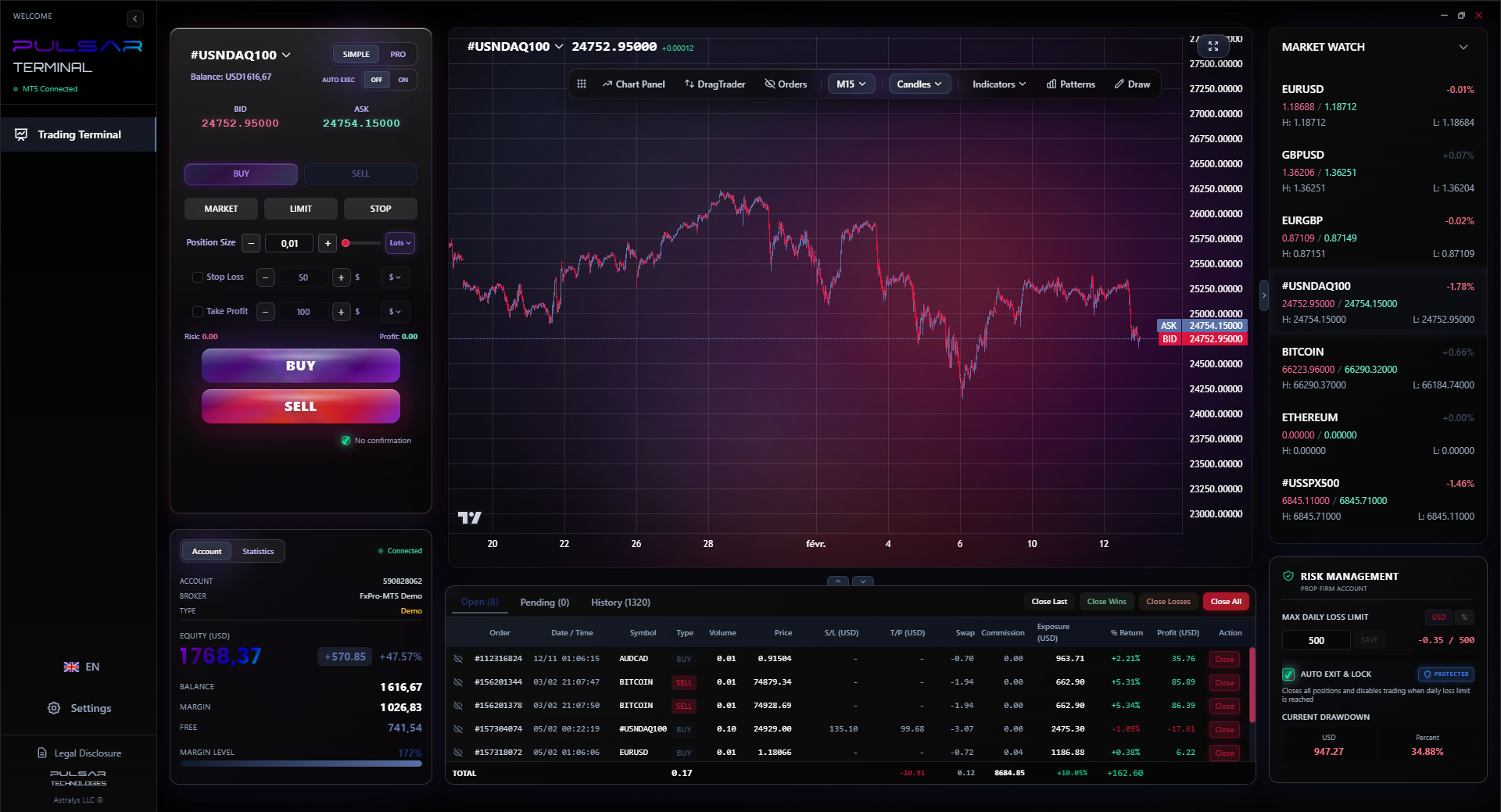
Manually moving stops to breakeven and managing multi-level take-profits is a chore; Pulsar Terminal automates these essential account management tasks directly on your MT5 chart.
Pulsar Terminal
The all-in-one MT5 companion: drag-and-drop orders, multi-TP/SL, trailing stop, grid trading, Volume Profile, and prop firm protection. Used by 1,000+ traders daily.
“Managing a winner is just as important as managing a loser.”
Sometimes, you might consider giving someone else Limited Power of Attorney (LPOA) to trade for you. Tread carefully.
The manager can trade, but crucially, they cannot withdraw your funds. Your money stays in your name at an FCA broker. That's the protection.
The fees are where it gets ugly. A common structure is '2 and 20' – a 2% annual management fee on your assets, plus 20% of any profits. On a £50,000 account, that's £1,000 a year just for them to have your money, plus they take a fifth of your gains. They have no 'loss fee' – they only make money when you do, which aligns incentives, but the hurdle is high.
Before you consider this, ask yourself: have you exhausted your own education? Could you replicate their strategy with your own disciplined forex trading account management? For most people, the answer is yes, and it's far cheaper. The journey of learning to manage your own risk is more valuable in the long run than any single year's returns from a manager.
FAQ
Q1What's the single most important rule in forex account management?
The 1% risk rule. Never risk more than 1% of your total account capital on a single trade. This isn't a suggestion, it's the foundation. It's what keeps a string of losses from becoming an account-killer.
Q2Is the FCA's 1:30 use limit too restrictive?
No, it's protective. If you think you need more use to succeed, your real problem is undercapitalisation or a poor strategy. Sensible trading, using proper position sizing, works perfectly within 1:30. It stops you from blowing up your account in minutes.
Q3How often should I withdraw profits from my trading account?
Set a regular schedule, like quarterly. Withdraw a portion of your profits (e.g., 20-30%). This makes the money real, rewards your discipline, and psychologically separates your 'business capital' from your 'winnings'. It prevents you from recklessly re-risking all your profits.
Q4What's the difference between a stop loss and a daily loss limit?
A stop loss manages risk on a single trade. A daily loss limit manages risk on your entire day. It's a circuit breaker. If you hit your daily limit (e.g., down 5%), you must stop trading entirely. It prevents emotional 'revenge trading' after a few bad trades.
Q5Are managed accounts (LPOA) a good idea for beginners?
Rarely. You miss the crucial learning phase of managing your own risk. You also pay high fees (often 20%+ of profits). It's better to start small, learn your own forex trading account management discipline with a demo or tiny live account, and build from there. Control is more valuable than delegation early on.
Q6How do I calculate my position size for each trade?
Use this formula: (Account Balance x Risk %) / (Stop Loss in Pips x Pip Value). Or, just use a reliable position size calculator. Do this before every trade. Never guess or use a 'standard' lot size. Your position size should change with every trade based on your stop distance.
Prof. Winston's Lesson
Key Takeaways:
- ✓Risk a maximum of 1% of your account per trade.
- ✓Enforce a 5% daily loss limit as a circuit breaker.
- ✓Withdraw a portion of profits quarterly to make them real.
- ✓Use a position size calculator for every single trade.
- ✓Your trading journal is your most important tool.
How useful was this article?
Click a star to rate
Weekly Trading Insights
Free weekly analysis & strategies. No spam.
About the Author
Sarah Collins
Trading Strategist
London-based trading strategist with 12 years in financial markets. Former analyst at a City of London brokerage. Covers GBP pairs, European markets, and FCA-regulated trading.
Comments
Risk Disclaimer
Trading financial instruments carries significant risk and may not be suitable for all investors. Past performance does not guarantee future results. This content is for educational purposes only and should not be considered investment advice. Always conduct your own research before trading.
You Might Also Like

Cara Trading Forex Sukses: 7 Prinsip dari Trader Profesional
Cara trading forex sukses dengan 7 prinsip trader pro: manajemen modal, disiplin, journal trading, backtest. Data nyata, bukan janji profit palsu.
Jam Trading Forex Terbaik untuk Trader Indonesia: Panduan Lengkap dengan Tabel Waktu
Panduan jam trading forex untuk trader Indonesia. Tabel 4 sesi dunia, jam emas 20:00-00:00, sesi mana yang harus dihindari. Data akurat + tips dari trader berpengalaman.
Top 5 Sàn Forex Uy Tín Nhất 2026: Review Jujur dari Trader Indonesia
Top 5 sàn forex uy tín 2026 untuk trader Indonesia. Review jujur: spread, deposit, withdraw, dukungan lokal. Exness, XM, IC Markets & lebih.
Get Pulsar Terminal
All these calculators are built into Pulsar Terminal with real-time data from your MT5 account. One-click position sizing, automatic risk management, and instant calculations.
Get Pulsar Terminal