


Here's a number that should make you pause: the RBI's 'Alert List' of unauthorized forex entities had over 100 names on it by early 2026.

Rajesh Sharma
Senior Forex Analyst ·  India
India
☕ 11 min read
What you'll learn:
Here's a number that should make you pause: the RBI's 'Alert List' of unauthorized forex entities had over 100 names on it by early 2026. Every single one of those was being promoted somewhere, somehow. If you're in India and you've seen a slick ad promising easy forex profits, you're standing at a dangerous crossroads. The line between a legal opportunity and a regulatory violation is razor-thin here. I've watched friends get burned, and I've had to navigate this minefield myself for over a decade. Let's cut through the marketing fluff and talk about what these forex trading advertisements really mean for an Indian trader.
First things first, you need to understand the playing field. It's not what the ads show. In India, retail forex trading isn't a free-for-all. The Reserve Bank of India (RBI) and SEBI have built a very specific cage around it.
You are legally allowed to trade currency derivatives - futures and options - but only on Indian exchanges like the NSE or BSE. The pairs are limited: USD-INR, EUR-INR, GBP-INR, JPY-INR, and a few cross-currency pairs like EUR-USD (but settled in INR). That's it. Full stop.
Any advertisement showing you trading GBP/JPY, AUD/USD, or exotic pairs through an offshore platform? That's promoting activity that violates the Foreign Exchange Management Act (FEMA). The RBI has been crystal clear: you cannot use the Liberalised Remittance Scheme (LRS) to fund speculative forex accounts abroad. I learned this the hard way early on, trying to fund an international account only to have my bank block the transaction and give me a stern warning.

Warning: The RBI's Alert List doesn't just name shady platforms. It explicitly includes websites and entities that promote unauthorized trading. Seeing an ad for a platform on that list is a giant red flag waving in a hurricane.
The only safe, legal path for an Indian resident is through a SEBI-registered stockbroker like Zerodha, Upstox, or ICICI Direct for those exchange-traded INR pairs. Everything else exists in a regulatory grey area with zero local protection. Remember, a flashy forex trading advertisement might be selling you a dream that could land you in hot water with authorities.
These ads have a playbook. Once you know it, you can't unsee it. They're designed to hook your emotions, not inform your decisions.
The 'Get Rich Quick' Fantasy
They'll show luxury cars, beachfront villas, and stacks of cash. The message is always about lifestyle, never about the grueling work of analysis, risk management, and emotional control that real trading requires. I fell for this once, early in my career. I saw an ad, deposited ₹50,000 with a platform promising 'guaranteed signals,' and blew the entire account in two weeks following their 'sure-shot' tips.
The Misleading 'Educational' Front
Many ads masquerade as free seminars or webinars. 'Learn the secrets of forex!' They're often just long sales pitches for a proprietary trading system or a signal service with a hefty monthly fee. The 'educator' is usually a marketer, not a trader.
The use Lure
This is a big one. Ads from international brokers will flaunt use like 500:1 or even 3000:1. It sounds powerful - control a huge position with little money! What they don't show is the margin call that wipes you out when the market moves 0.2% against you. On Indian exchanges, use for currency derivatives is typically around 20:1. That's not a limitation; it's a safety feature.

Pro Tip: If an ad highlights use before it highlights risk management, close the tab. They're selling a dangerous weapon, not a trading plan.
The Fake Testimonial
Those smiling faces with quotes about quitting their jobs? Most are stock photos or paid actors. Real trading success is private, messy, and never consistent enough for a neat marketing quote.
The core reality these ads ignore? Regulated brokers like IC Markets or Pepperstone, while operating in a grey area for Indian clients, don't typically use these kinds of aggressive, fantastical ads. Their marketing is usually drier, focused on spreads, platforms, and execution. The louder the ad, the more skeptical you should be.

💡 Winston's Tip
The most expensive market tuition is paid to brokers who were found via the shiniest advertisement. Your due diligence is your first trade, and it should be a winning one.
“In India, a flashy forex ad might be selling you a dream that could land you in hot water with the RBI.”
Ads scream 'FREE!' or 'NO COMMISSION!' Let's translate that. In forex, you always pay. The question is how.
Spreads: This is the difference between the buy and sell price. It's your primary cost. An ad might say 'tight spreads,' but you need to see the actual numbers during volatile market hours (like London open). A '1 pip spread' on EUR/USD can instantly widen to 3 pips when news hits. Brokers known for good pricing, like Pepperstone on their Razor account or IC Markets on Raw, offer near-zero spreads but charge a commission per lot.
Minimum Deposits: This is where they get you in the door. Ads love low numbers. 'Start trading with just $5!' (≈₹400). Sure, you can open an account with XM for that. But what can you realistically do with $5? Almost nothing without insane use, which is a recipe for a quick loss. A more serious Standard account might need $100-$200 (₹8,000-₹16,000).
The Other Fees: Inactivity fees, withdrawal fees, currency conversion fees (if depositing INR to a USD account). These are never in the headline ad. I once got stung by a 3% currency conversion fee on both deposit and withdrawal with a broker - a cost I completely missed in the fine print.
Let's break down a common scenario with a hypothetical trade:

Example: You buy 1 mini lot (10,000 units) of EUR/USD.
- Broker A (Advertises 'No Commission'): Spread is 2.0 pips. Cost = 2.0 pips * $1 per pip = $2 cost on entry.
- Broker B (Advertises 'Raw Spreads + Commission'): Spread is 0.2 pips. Commission is $3.5 per lot per side. Cost = (0.2 pips * $1) + $3.5 = $3.70 cost on entry.
Broker A looks cheaper in the ad, but Broker B is often cheaper in reality, especially for larger volumes. You have to do the math. Always use a position size calculator to understand your true costs before you trade.
This is the practical stuff that separates smooth sailing from a nightmare.
Trading Platforms: The global standard is MetaTrader 4 or 5 (MT4/MT5). Any reputable international broker will offer it. Ads might show fancy, proprietary platforms, but MT4/MT5's strength is its universality and vast library of indicators and Expert Advisors (EAs). For legal trading on Indian exchanges, you'll use the broker's own platform like Zerodha's Kite or Upstox Pro.
Payment Methods for Indians: This is a major filter. A good broker for Indian clients will offer local bank transfer (NEFT/RTGS), UPI, and maybe IMPS. UPI is a game-changer for speed. I can fund my account in minutes. Some international brokers also accept e-wallets like Skrill or Neteller. If an ad is targeting Indians but only lists international credit cards or wire transfers, they haven't done their homework.
Withdrawals: This is the real test. Deposits are easy for them; giving your money back is where issues arise. Read reviews specifically about withdrawal experiences. A smooth, fee-free, timely withdrawal process is worth more than any sign-up bonus an ad can offer.
The local reality is this: you are navigating a system not designed for global retail forex. Your payment methods, tax implications (which are complex on international profits), and legal exposure are uniquely Indian challenges. No glossy ad from Cyprus or the Seychelles will ever address them.
💡 Winston's Tip
If an ad mentions use before it mentions stop-losses, it's not a trading service. It's a casino advertisement dressed in a suit.
“Verification takes 30 minutes and can save you your entire capital. It's the most important trade you'll never place.”
So you see an ad. What next? Don't click 'Sign Up.' Start a detective routine.
- Check the Regulator: Go to the broker's website, scroll to the very bottom. Which financial authority licenses them? For international brokers, look for top-tier regulators like ASIC (Australia), FCA (UK), CySEC (Cyprus), or MAS (Singapore). Then, go to that regulator's official website and search their register. Confirm the license is active and covers the services offered. If they're 'regulated' in offshore jurisdictions like Vanuatu or the Bahamas, treat it as virtually unregulated.
- Cross-Reference with the RBI Alert List: Make this a habit. Search the entity's name on the RBI's official website. If it's on the Alert List, run away.
- Ignore the 'Awards': Most 'Broker of the Year' awards are bought or given by obscure websites. They are marketing tools, not quality assurances.
- Find Independent Reviews: Look for detailed reviews on reputable financial sites (like ours) that discuss actual trading conditions, slippage, and customer service. Look for patterns in user complaints.
- Test Support: Before depositing, contact their customer support with a technical question. See how long they take to respond and how knowledgeable they are. It's a preview of your experience when you have a real problem.
I once liked an ad for a new broker. Did my checks. Their ASIC license was for 'general financial advice,' not for operating a forex trading desk. That was a deal-breaker. Verification takes 30 minutes and can save you your entire capital.
A huge segment of forex trading advertisement in 2024-2026 is for 'prop trading firms' - companies that give you a simulated account to trade, and if you pass their challenge, you get to trade their capital for a profit split.
The ads are relentless: "Trade $100,000 of our money!" They make it sound like a free lottery ticket. Here's the truth.
You almost always pay an upfront 'challenge fee.' This can be from $50 to $500. This is their real business model - selling challenges, not funding traders. The rules are designed to make you fail: insanely high profit targets, tight daily loss limits, and rules against sensible swing trading holds.
They advertise high use and huge accounts, pushing you towards aggressive, high-risk trading to hit their targets quickly. It's the opposite of good discipline. I tried one a couple years ago. Paid a $200 fee for a $50k challenge. The profit target was 10% in 30 days with a max daily loss of 5%. I got to 8% profit, then had a single bad day that hit the 5% loss limit. Account failed. No refund. They made their money.
If you're considering this path, your due diligence needs to be triple. Read every single rule in their FAQ. Understand that you are buying a very expensive, stressful video game, not a job. And for managing those tricky daily loss limits, a tool that can automate protections is almost mandatory to avoid emotional mistakes.
💡 Winston's Tip
A regulated broker's website will make you work to find the sign-up button. A scam broker's site will have it flashing before you even know their name.
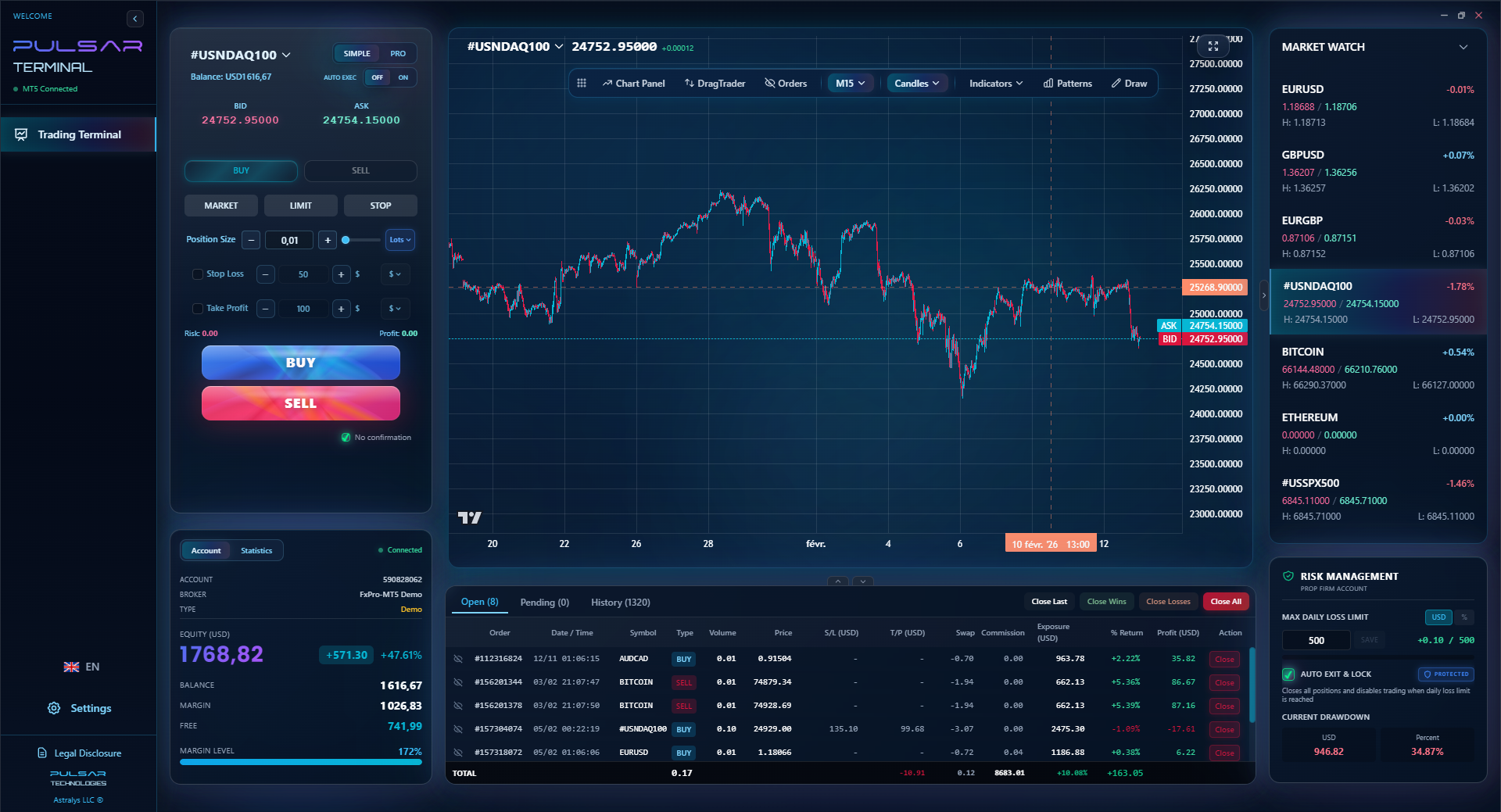
Managing the strict daily loss limits of a prop firm challenge requires robotic discipline, which is where a tool like Pulsar Terminal, with its automated daily loss protection feature, becomes essential for removing emotion from the equation.
Pulsar Terminal
The all-in-one MT5 companion: drag-and-drop orders, multi-TP/SL, trailing stop, grid trading, Volume Profile, and prop firm protection. Used by 1,000+ traders daily.
“The goal isn't to make a million from one trade you saw in an ad. The goal is to be a consistent trader who survives.”
Let's replace ad fantasy with a real starter plan for an Indian trader.
Step 1: Define Your Legal Path. Choose:
- The Legal Route: Open an account with a SEBI broker. Learn to trade USD-INR futures. The market is deep, liquid, and you have full legal protection. Start here to learn the basics of order execution and pip movement without regulatory anxiety.
- The Grey Route (Acknowledge the Risk): If you want global pairs, choose a well-regulated international broker with good local payment support. Understand you have no SEBI/RBI recourse if something goes wrong.
Step 2: Start Small, Painfully Small. Your first deposit should be money you are 100% prepared to lose. Not ₹10 lakhs, not ₹1 lakh. Maybe ₹10,000-₹25,000. This is tuition fee, not investment capital.
Step 3: Learn Price Action First. Before buying any course advertised to you, learn to read a naked chart. Understand support/resistance, candlestick patterns. Then, and only then, add one or two indicators like the RSI indicator or MACD indicator for confluence.
Step 4: Paper Trade for Months. Not days. Months. Demo trade through different market conditions - trending, ranging, volatile. Develop and test a simple strategy. A good scalping strategy or swing approach needs to be proven in simulation before real money is involved.
Step 5: Risk Management is Your Religion. Decide that you will never, ever risk more than 1-2% of your account on a single trade. Use stop-losses on every position. This single habit will keep you in the game longer than any signal from a flashy ad ever could.
The goal isn't to make a million from one trade you saw in an ad. The goal is to be a consistent trader who survives, learns, and grows slowly. That story doesn't sell webinars, but it does build wealth.
FAQ
Q1Is it illegal to click on a forex trading advertisement in India?
No, clicking on an ad isn't illegal. However, acting on it by signing up with an unauthorized entity and trading prohibited currency pairs (like EUR/USD, GBP/JPY) is a violation of FEMA rules. The illegality lies in the trading activity, not in viewing the advertisement itself.
Q2What is the safest way for an Indian to start forex trading?
The safest, fully legal way is to open an account with a SEBI-registered broker like Zerodha or Upstox and trade INR-based currency derivatives (e.g., USD-INR futures) on the NSE or BSE. You get full legal protection, clear taxation, and operate within the RBI's framework.
Q3I see ads for brokers like XM and IC Markets. Are they legal for Indians?
They operate in a significant regulatory grey area. These global brokers accept Indian clients but are not regulated by SEBI for forex trading in India. Trading global pairs through them violates RBI rules under FEMA. While many Indians use them, you have no local legal recourse if you face issues like withdrawal problems or platform manipulation.
Q4What does a 'low spread' in an ad actually mean?
The spread is the cost of entering a trade. A 'low' or 'tight' spread means that difference is small. However, ads often show the best possible spread under ideal conditions. In reality, spreads can widen dramatically during news events or low liquidity. Always check the broker's average spread statistics, not just their advertised minimum.
Q5Can I trust forex trading advertisements that feature celebrity endorsements?
Absolutely not. In India, SEBI regulations strictly prohibit unauthorized entities from using celebrities or public figures to endorse investment products. Any such ad is almost certainly for an unauthorized service. Legitimate, regulated financial services rarely use celebrity endorsements in this manner.
Q6What's the biggest lie in most forex trading ads?
The implied promise of consistent, easy profits with minimal effort. Ads sell the outcome (wealth, freedom) and hide the process (years of study, emotional discipline, frequent losses, rigorous risk management). They make trading look like a destination, when it's actually a difficult, never-ending journey.
Q7If I trade through an international broker, how do I handle taxes?
It's complex. Profits from international trading are likely considered 'Income from Other Sources' or speculative business income in India. You are responsible for declaring this foreign-sourced income and paying applicable taxes (Income Tax + possibly GST). The broker won't help you with Indian tax compliance. Consult a CA who understands forex and international income.
Prof. Winston's Lesson
Key Takeaways:
- ✓Legal forex in India is only INR pairs on SEBI exchanges.
- ✓RBI's Alert List is your first checkpoint for any broker.
- ✓Ads sell fantasy; real trading requires painful discipline.
- ✓Risk management (1-2% per trade) is non-negotiable.
How useful was this article?
Click a star to rate
Weekly Trading Insights
Free weekly analysis & strategies. No spam.
About the Author
Rajesh Sharma
Senior Forex Analyst
Trading Indian and South Asian markets for over 10 years. Started with NSE currency derivatives before moving to international forex. Specializes in USD/INR and emerging market pairs.
Comments
Risk Disclaimer
Trading financial instruments carries significant risk and may not be suitable for all investors. Past performance does not guarantee future results. This content is for educational purposes only and should not be considered investment advice. Always conduct your own research before trading.
You Might Also Like

Cara Trading Forex Sukses: 7 Prinsip dari Trader Profesional
Cara trading forex sukses dengan 7 prinsip trader pro: manajemen modal, disiplin, journal trading, backtest. Data nyata, bukan janji profit palsu.
Jam Trading Forex Terbaik untuk Trader Indonesia: Panduan Lengkap dengan Tabel Waktu
Panduan jam trading forex untuk trader Indonesia. Tabel 4 sesi dunia, jam emas 20:00-00:00, sesi mana yang harus dihindari. Data akurat + tips dari trader berpengalaman.
Top 5 Sàn Forex Uy Tín Nhất 2026: Review Jujur dari Trader Indonesia
Top 5 sàn forex uy tín 2026 untuk trader Indonesia. Review jujur: spread, deposit, withdraw, dukungan lokal. Exness, XM, IC Markets & lebih.
Get Pulsar Terminal
All these calculators are built into Pulsar Terminal with real-time data from your MT5 account. One-click position sizing, automatic risk management, and instant calculations.
Get Pulsar Terminal