


I lost 150,000 NGN in a single week back in 2019.

Olumide Adeyemi
West African Trading Pioneer ·  Nigeria
☕ 10 min read
What you'll learn:
- 1What Forex Trading Analysis Really Means (And What It Doesn't)
- 2Technical Analysis: Reading the Price Story
- 3Fundamental Analysis: The Nigerian Context
- 4Building a Trade Plan from Your Analysis
- 5Mistakes I See (And Made) All the Time
- 6The Legal and Tax Reality for Nigerian Traders
- 7Your First 90 Days: A Practical Plan
I lost 150,000 NGN in a single week back in 2019. The Naira was taking a hit against the dollar, and I thought I was being clever by shorting USD/NGN on an offshore platform. I saw the price dropping, piled in with too much size, and got absolutely wrecked when the CBN intervened unexpectedly. I had charts, I had a feeling, but I had zero real analysis. That loss, which felt like a fortune at the time, taught me the brutal difference between guessing and actually knowing how to analyze the forex market. This guide is what I wish I'd had before pressing that sell button.
Let's clear something up first. Forex trading analysis isn't about finding a magic crystal ball or a secret indicator that prints money. Anyone selling you that is lying. It's a process of gathering evidence to make a slightly more educated guess about where price might go next, while knowing exactly where you'll admit you're wrong.
In Nigeria, this gets a local twist. You're not just analyzing EUR/USD in a vacuum. You're analyzing it while considering what the CBN might do with interest rates, how the price of crude oil (our lifeblood) is moving, and what the parallel market rate for the Naira is doing. That last one is a huge sentiment driver that you won't find on most trading platforms.
There are two main pillars to this evidence-gathering: technical analysis (reading the charts) and fundamental analysis (understanding the economic weather). Most successful traders I know, myself included, use a blend of both. Relying on just one is like trying to drive with only one headlight.

Warning: Analysis doesn't guarantee profit. Its primary job is to give you a structured reason to enter a trade and a clear, unemotional reason to exit when it's not working. I've seen more traders fail from ignoring their exit analysis than from imperfect entry analysis.
Technical analysis is the study of past price action to identify patterns and potential future movements. Think of it as the market's memory. In Nigeria's often volatile sessions, especially when London overlaps with our afternoon, reading these patterns quickly is a key skill.
Start with Price Action
Forget complicated indicators at the beginning. Learn to read the raw price chart. Look for obvious levels where the price has bounced up or down multiple times - these are your support and resistance zones. A break through one of these zones often signals the next move. My first consistent profits came from simply buying near proven support on GBP/USD and selling near resistance, using a tight stop-loss.
Add Key Indicators Sparingly
Indicators are tools, not trading systems. I use maybe three regularly.
- The RSI indicator helps spot when a move is potentially overstretched (overbought or oversold). On USD/NGN pairs, which can trend for long periods, I only consider RSI signals when they align with a key support/resistance level.
- The MACD indicator is great for gauging momentum and trend changes. It helped me catch a big move on XAU/USD (Gold) last year, signaling the start of an uptrend I rode for over $200 per ounce.
- Simple moving averages (like the 50 and 200-period) act as dynamic support/resistance and help define the trend's direction.
Timeframes Are Everything
Are you checking the 1-minute chart or the daily chart? A buy signal on the 5-minute chart could be a sell signal on the 4-hour. I use a top-down approach: I identify the trend on the daily chart, look for an entry opportunity on the 4-hour chart, and fine-tune my entry and stop-loss on the 1-hour chart. This keeps me trading in the direction of the larger tide, not just the small waves. This method is core to both swing trading and longer-term approaches.

💡 Winston's Tip
A chart tells you what is happening. Your job is to ask 'why?' before you ask 'where next?'. The 'why' is found in the economic calendar and the news, not in an indicator.
“Analysis doesn't guarantee profit. Its primary job is to give you a structured reason to enter and a clear, unemotional reason to exit.”
If technical analysis is the how, fundamental analysis is the why. For a Nigerian trader, this has two layers: global economics and local realities.
Global Fundamentals
You need a basic handle on what moves major currencies. The US Dollar (USD) is moved by Federal Reserve interest rate decisions, inflation data (CPI), and employment numbers (NFP). The Euro reacts to European Central Bank (ECB) policy and economic data from Germany and France. An economic calendar is your best friend here. Trading EUR/USD around a major US news release without knowing the expected outcome is gambling.
Local Fundamentals That Hit Your P&L
This is where it gets real for us. The CBN is the most important actor in your forex trading analysis for any Naira-related trade or for understanding domestic market sentiment.
- Monetary Policy Committee (MPC) Meetings: Decisions on the Monetary Policy Rate (MPR) directly affect the Naira's attractiveness. A rate hike can strengthen the Naira, at least in the official markets.
- FX Reserve Levels: As of early 2026, reserves were around $48.5 billion. The market watches this number closely. Rising reserves can boost confidence in the Naira; falling reserves can trigger devaluation fears.
- Oil Prices: Simply put, Brent Crude is our main dollar earner. A sustained drop in oil prices often leads to pressure on the Naira, as dollar inflows dry up. I missed this correlation early on and paid for it.
- Inflation Data: Nigeria's soaring inflation (over 30% in recent times) forces the CBN's hand and destroys local purchasing power. It creates a very tricky environment for holding Naira assets.

Pro Tip: Don't just follow the official CBN rate. Keep a casual eye on the parallel market rate (you know where to look). The spread between the two is a direct measure of market stress and dollar scarcity. A widening spread often precedes official market volatility.
Analysis is useless if it doesn't lead to a clear, executable plan. Here’s how I structure mine, using a real example from January 2026.
1. The Thesis: Fundamental analysis showed US inflation was cooling, and the Fed was expected to pause hikes. Technically, Gold (XAU/USD) was consolidating above the key $2,000/oz support level on the daily chart. My thesis was for a bullish breakout.
2. The Trigger: I waited for the price to break and close above the consolidation resistance at $2,050. The breakout was my entry signal, confirming both the technical pattern and the underlying bullish fundamental shift.
3. The Numbers:
- Entry: $2,052
- Stop-Loss: $2,030 (placed just below the consolidation zone. This was my "I'm wrong" price).
- Take-Profit 1: $2,100
- Take-Profit 2: $2,150
4. The Risk: My position size calculator told me that with a 22-point stop and my standard 1% risk per trade, I could buy 0.45 lots. This risked about $99, which was 1% of my account. This step is non-negotiable.
The trade hit my first target, and I moved my stop-loss to breakeven. It then rallied to my second target. That single trade, built on clear analysis, returned over 4% on my account risk. The analysis didn't make it win, but it gave me a logical framework to manage it from start to finish.
💡 Winston's Tip
The most important line you'll ever draw on a chart is your stop-loss. It's not a failure; it's the cost of information. A stopped-out trade is a completed experiment.
“Hope is not a strategy. Deleting your stop-loss because you 'believe' in the trade is the opposite of analysis.”
Let's talk about the pitfalls so you can avoid them.
Overtrading the Naira Pairs: USD/NGN is not like EUR/USD. The spreads are often massive (sometimes 50-100 pips or more), and liquidity can vanish. I learned this the hard way trying to scalp it. The costs will eat you alive. It's better for larger, longer-term swing trades if you have access, or simply as a sentiment indicator for your other trades.
Ignoring the Cost of Trading: That "0 pip spread" account usually has a commission. That "commission-free" account has a wider spread. You must know your total cost per trade. On a $10,000 account, if you're paying $20 in spread+commission per round lot, you start every trade 2 pips in the hole. Choose brokers like Pepperstone or IC Markets known for transparent, low costs.
Analysis Paralysis: You can have 10 indicators on your chart, all giving different signals. You freeze. Simplify. Pick a support/resistance level, a trend tool, and one momentum indicator. More information isn't better information.
Letting a Loser Run: This is the killer. Your analysis said to sell EUR/USD at 1.0950 with a stop at 1.0980. It hits 1.0980. That's your analysis telling you the trade idea is invalid. Deleting your stop-loss because you 'believe' in the trade is not analysis, it's hope. Hope is not a strategy. I've watched a 50-pip loss turn into a 300-pip nightmare that triggered a margin call.
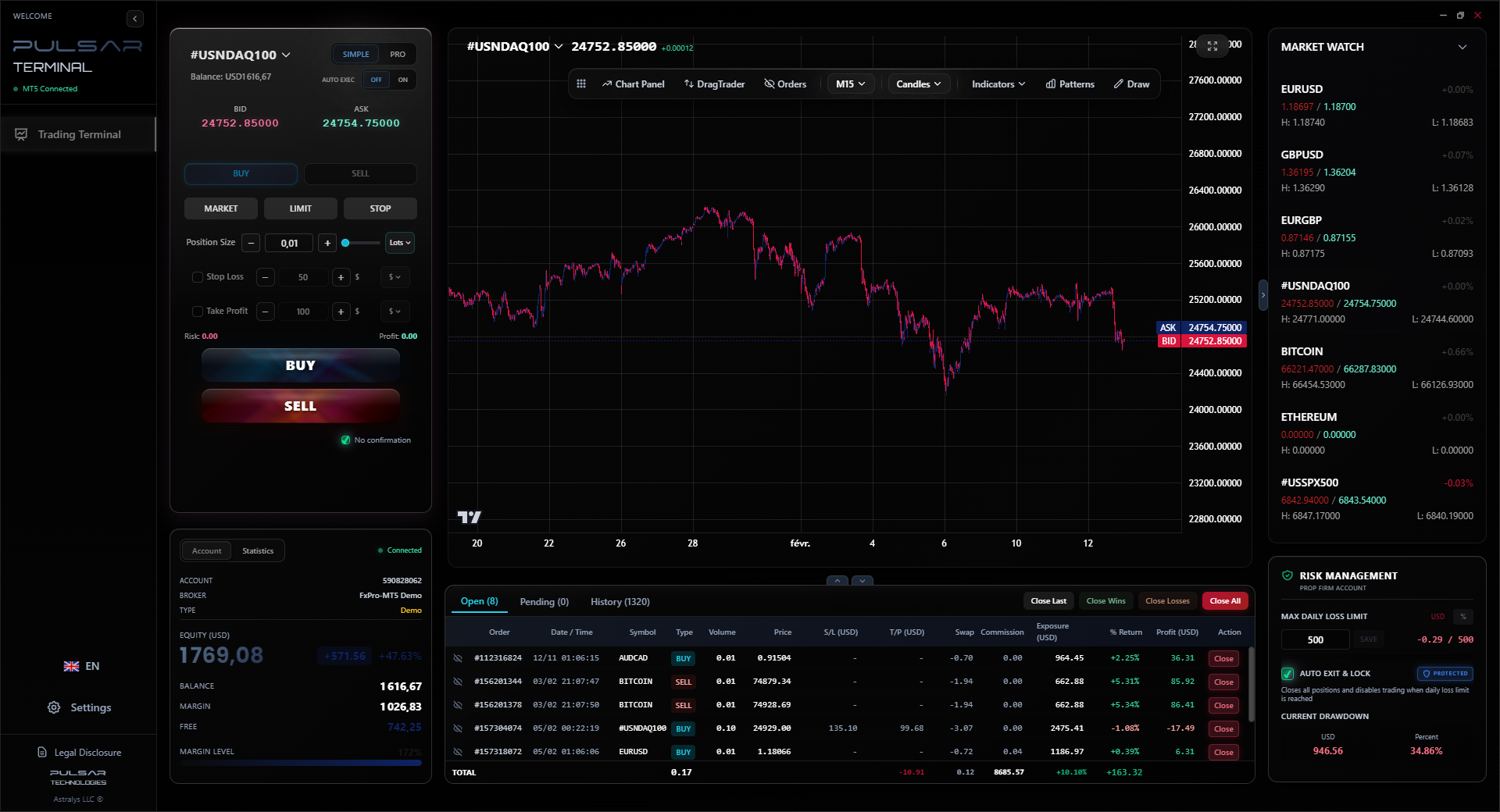
Sticking to your analysis-defined stop-loss and take-profit levels is critical, and tools like Pulsar Terminal automate this execution directly on your MT5 platform, removing emotion from the equation.
Pulsar Terminal
The all-in-one MT5 companion: drag-and-drop orders, multi-TP/SL, trailing stop, grid trading, Volume Profile, and prop firm protection. Used by 1,000+ traders daily.
Trading with international brokers is common, but you need to be smart about the local rules.
Is it Legal? Yes, trading forex with international brokers is legal for individuals. The CBN's rules (like the EFEMS system and the $150,000 weekly limit for BDCs) govern the official institutional and BDC markets, not necessarily your personal trading account with Exness or XM. However, funding that account can be a hurdle due to restrictions on international card payments for forex purchases.
The Tax Man Cometh: This is critical. According to the Capital Gains Tax Act, profits from forex trading are considered capital gains. The current rate is 10%. You are required to declare this profit and pay the tax to the Federal Inland Revenue Service (FIRS).
Warning: I am not a tax advisor, but I know traders who have been audited. Keep detailed records of all your trades (your broker statement), your deposits (bank receipts), and withdrawals. Calculate your net profit at the end of the year. The FIRS is getting more sophisticated, and ignoring this is a risk to your entire trading capital. Factor the 10% into your overall profit expectations.
💡 Winston's Tip
In Nigeria, your fundamental analysis isn't complete until you've asked: 'What does this mean for the price of dollars on the street?' That sentiment leaks into everything.
“The most volatile periods for us are during the London session and the overlap with New York. That's when your analysis on shorter timeframes will be most reliable.”
Here's a roadmap to build your analysis skills without blowing up an account.
Month 1: Paper Trade. Don't deposit real money. Open a demo account with a broker like HFM or Fusion Markets that offers NGN accounts. Practice your analysis. Test identifying support/resistance. Watch how price reacts to news. Get used to the platform. Your only goal is to make 100 trades in a simulated environment and review each one.
Month 2: Define One Strategy. Based on what you learned, pick one simple setup. Maybe it's "buy when price bounces off the 50-day moving average in an uptrend." Maybe it's a specific MACD crossover. Backtest it on your demo account for the past year. Does it have a positive edge? Keep a trading journal noting your analysis for each signal.
Month 3: Trade Micro Lots. Deposit the smallest amount you can - maybe $50 or 20,000 NGN. Trade in micro lots (0.01). Your goal is not to make money. Your goal is to execute 20-30 real trades following your analysis and plan perfectly. The psychological pressure is different with real money, even small amounts. Feel the emotion when a stop-loss is hit, and practice sticking to the plan.
Throughout this, continuously work on your forex trading analysis skills. The market will teach you, but only if you're listening and adapting.
FAQ
Q1What is the best type of forex trading analysis for beginners in Nigeria?
Start with simple technical analysis. Learn to draw support and resistance lines on the 4-hour and daily charts of major pairs like EUR/USD or GBP/USD. Combine this with one or two indicators like the RSI. Avoid Naira pairs at first due to high spreads. Fundamental analysis is crucial, but get your feet wet with chart reading first - it gives immediate, visual feedback.
Q2How do I analyze the USD/NGN pair as a retail trader?
Carefully, and with the understanding that it's a different beast. Focus on the long-term chart (daily, weekly). Your analysis must include CBN policy announcements, oil price trends, and FX reserve levels. Understand that the spread is huge, so short-term trading is very difficult. For most, it's better used as a macroeconomic indicator for your overall sentiment rather than a primary trading instrument.
Q3Is technical analysis enough for forex trading in Nigeria?
No, not really. While you can make trades based purely on technicals, ignoring fundamentals is dangerous here. A perfectly good technical setup on EUR/USD can be obliterated by a surprise CBN policy that causes global risk-off sentiment, or a sharp move in oil prices. Use technicals for your entry and exit timing, but let fundamentals guide your overall bias (whether you're more looking to buy or sell).
Q4What time is best for forex trading analysis in Nigeria?
The most volatile and liquid periods are during the London session (11 AM - 3 PM WAT) and the overlap with the New York session (3 PM - 5 PM WAT). This is when most major currency pairs see their biggest moves and your technical analysis on shorter timeframes will be most reliable. Avoid analyzing and trading during very thin periods like the Asian session late at night.
Q5Do I need to pay tax on my forex trading profits in Nigeria?
Yes. The FIRS considers forex trading profits as capital gains, taxable at a rate of 10%. You are legally required to declare this income and pay the due tax. Keep impeccable records of all your trades, deposits, and withdrawals from your broker to make this process manageable.
Q6How much money do I need to start practicing forex trading analysis?
To practice analysis, you need $0. Use a free demo account for at least 2-3 months. When you switch to real money, you can start with as little as $50 or 20,000 NGN with a broker offering micro lots. This lets you feel real market pressure while your primary investment is in your education, not your initial capital.
Prof. Winston's Lesson
Key Takeaways:
- ✓Always calculate your risk (1-2% per trade) before your reward.
- ✓Factor the 10% capital gains tax into your profit goals.
- ✓Use demo trading for your first 100 trades, no exceptions.
- ✓Simplify your charts: price action, one trend tool, one momentum indicator.
How useful was this article?
Click a star to rate
Weekly Trading Insights
Free weekly analysis & strategies. No spam.
About the Author
Olumide Adeyemi
West African Trading Pioneer
One of Nigeria's most active forex trading educators. 8 years of experience trading from Lagos. Specializes in low-capital strategies and prop firm challenges for African traders.
Comments
Risk Disclaimer
Trading financial instruments carries significant risk and may not be suitable for all investors. Past performance does not guarantee future results. This content is for educational purposes only and should not be considered investment advice. Always conduct your own research before trading.
You Might Also Like

Cara Trading Forex Sukses: 7 Prinsip dari Trader Profesional
Cara trading forex sukses dengan 7 prinsip trader pro: manajemen modal, disiplin, journal trading, backtest. Data nyata, bukan janji profit palsu.
Jam Trading Forex Terbaik untuk Trader Indonesia: Panduan Lengkap dengan Tabel Waktu
Panduan jam trading forex untuk trader Indonesia. Tabel 4 sesi dunia, jam emas 20:00-00:00, sesi mana yang harus dihindari. Data akurat + tips dari trader berpengalaman.
Top 5 Sàn Forex Uy Tín Nhất 2026: Review Jujur dari Trader Indonesia
Top 5 sàn forex uy tín 2026 untuk trader Indonesia. Review jujur: spread, deposit, withdraw, dukungan lokal. Exness, XM, IC Markets & lebih.
Get Pulsar Terminal
All these calculators are built into Pulsar Terminal with real-time data from your MT5 account. One-click position sizing, automatic risk management, and instant calculations.
Get Pulsar Terminal