


Here's the biggest myth about forex trading and tax in the UK: that it's all tax-free if you're clever about it.

Sarah Collins
Trading Strategist ·  United Kingdom
☕ 10 min read
What you'll learn:
- 1The FCA Rulebook: Your First Line of Defence
- 2The Tax Crossroads: Capital Gains Tax vs. Spread Betting
- 3When HMRC Says You're Running a Business
- 4Keeping Records HMRC Will Actually Accept
- 5The 3 Costly Tax Mistakes I See Every Year
- 6Your Tax Year End Checklist (Do This Every April)
- 7Tools and Platforms Built for the UK Reality
- 8The Final Word: Staying on the Right Side of HMRC
Here's the biggest myth about forex trading and tax in the UK: that it's all tax-free if you're clever about it. I've seen traders jump into spread betting thinking they've found a magic loophole, only to get burned by the reality of how HMRC actually views things. The truth is messier, more nuanced, and honestly, a bit of a headache. But getting it wrong costs real money - I've paid for that lesson myself. Let's cut through the confusion and lay out exactly how the system works right now, with the numbers you need and the traps to avoid.
Before we even talk about tax, let's talk about who you're allowed to trade with. The Financial Conduct Authority (FCA) isn't just some government office; it's your main protection against getting scammed. Trading with an FCA-regulated broker isn't a suggestion - it's non-negotiable. I learned this the hard way early on, chasing slightly tighter spreads with an offshore firm. The platform froze during a major news event, and my stop loss didn't trigger. I lost £1,200 in about 90 seconds. That wouldn't have happened with a proper UK broker.
Here’s what FCA regulation actually gives you:
Client Money Protection: Your cash is held in segregated accounts. If the broker goes bust, your money isn't part of their assets. It's ring-fenced.
Negative Balance Protection: This is huge. You can't lose more than you deposit. In the old days, a gap could leave you owing thousands. Now, your risk is capped at your account balance.
use Limits: The FCA slapped these on to stop people blowing up accounts. For major forex pairs like EUR/USD, it's 30:1. For minors and gold, it's 20:1. It feels restrictive, but it saved my bacon more than once when I was overconfident.
The Financial Services Compensation Scheme (FSCS): If your authorised broker fails, you're covered up to £85,000. It's the ultimate safety net.

Warning: Just because a broker has a '.co.uk' website doesn't mean they're FCA-regulated. Always, always check the FCA Register. I keep it bookmarked. If they're not on there, walk away.
Popular platforms like MT4 and MT5 are standard here, and brokers like Pepperstone and IC Markets offer strong FCA-regulated entities. The rules also mean transparent pricing - no hidden fees. You'll see the spread and commission right there on the deal ticket.
This is where most of the confusion lives. Your tax bill depends entirely on how you trade, not just what you trade.
Route 1: CFD & Spot Forex (Capital Gains Tax)
If you're trading forex CFDs or spot forex through a standard account, HMRC generally sees your profits as capital gains. Here’s the current math (2026/27 tax year):
- Annual Exempt Amount (AEA): £3,000. This is your tax-free allowance. Any net profit above this gets taxed.
- CGT Rates: Basic rate taxpayers pay 10% on gains above the AEA. Higher and additional rate taxpayers pay 20%.
Let’s say you make a £15,000 net profit this tax year. You deduct your £3,000 allowance, leaving £12,000 of taxable gain. If you're a higher-rate taxpayer, you owe £2,400 in CGT (£12,000 x 20%).

Example: You buy GBP/USD at 1.2500 and sell at 1.2700 on a standard £50,000 position. That's a 200 pip move, worth £1,000 profit (1 pip = £5 on a standard lot). That £1,000 is part of your total gains for the year. If your total gains are £4,000, only £1,000 (£4,000 - £3,000 AEA) is taxable.
You can offset losses against gains. Had a terrible trade on XAU/USD? That loss reduces your total taxable gain.
Route 2: Spread Betting (The "Tax-Free" Option)
Spread betting is a derivative product unique to the UK and Ireland. Profits are currently exempt from Capital Gains Tax and Income Tax for most retail traders. HMRC views it as gambling. This is the big draw.
But there's a massive catch:
- Losses are useless. You can't use spread betting losses to offset gains from other investments (like shares or CFD trades).
- The "Badge of Trade" test. If HMRC decides you're running a business - trading very frequently, with substantial capital, in an organised way - they can reclassify your spread betting profits as taxable trading income. This is rare for casual traders but a real risk for full-time pros.
I use both. I'll take longer-term, directional views via CFDs where I want to use losses strategically. For short-term scalping ideas, I often use a spread betting account to keep it simple at tax time.

💡 Winston's Tip
The £3,000 CGT allowance isn't a target. It's a threshold. Structure your trading to build sustainable gains year after year, not just one big hit that disappears to tax.
“Your trading log is your legal defence. You will not remember that losing trade from eight months ago.”
This is the grey area that keeps professional traders up at night. HMRC uses something called the "Badges of Trade" to decide if your activity is a hobby (investment) or a trade (business). If they deem it a trade, your profits are subject to Income Tax and National Insurance, not CGT. The rates are much higher.
Signs you might be classified as a business:
- It's your main or only source of income.
- You trade very frequently (dozens of trades a day).
- You use sophisticated, organised methods (like automated systems).
- You're seeking profit from short-term market movements, not long-term investment.
- You advertise your trading services.
If you're classified as a trader, you pay Income Tax: 20% up to £50,270, 40% up to £125,140, and 45% above that. You also pay Class 2 and Class 4 National Insurance. Suddenly, that "tax-free" spread betting account looks very different.
My advice? If you're making consistent, full-time living from trading, get an accountant who specialises in financial traders. Don't try to navigate this alone. I didn't for two years, and the stress of a potential enquiry wasn't worth the few hundred quid I saved.
You will not remember that losing EUR/JPY trade from eight months ago when HMRC sends a letter. Trust me. Your trading log is your legal defence.
What you MUST keep for at least 6 years:
- Broker statements (monthly/annually).
- A detailed trade journal: Entry/exit price, date, instrument, position size, profit/loss in GBP.
- Records of all deposits and withdrawals.
- Calculations of your total gains and losses for each tax year (April 6 to April 5).
I use a simple spreadsheet. One tab per tax year. Columns for: Date, Pair, Direction, Entry, Exit, Pips, £ P/L, Notes. The 'Notes' column is crucial - why did I take the trade? Was it a MACD crossover? A news play? This proves it's a considered investment activity, not random gambling.

Pro Tip: At the end of each tax year, I run a P&L report from my broker, reconcile it with my journal, and save the final summary as a PDF. I then file it with my other tax docs. It takes an hour and makes everything bulletproof.
This discipline also makes you a better trader. Reviewing that journal showed me I was terrible at swing trading EUR/USD but decent at scalping it. I adjusted my position size accordingly.
💡 Winston's Tip
Your trade journal is a tax document first and a learning tool second. Write each entry as if you'll have to explain it to a sceptical HMRC officer in five years. Clarity is king.
“The FCA's rules protect you from the worst market abuses. HMRC's rules are just a cost of doing business.”
-
Ignoring the CGT Allowance Drop. The Annual Exempt Amount was £12,300 in 2022/23. It's now £3,000. A huge number of casual traders are now taxable when they weren't before. If your net profit is over £3k, you have to declare it.
-
Mixing Up Personal and Trading Money. Never fund your trading account from your main current account. Open a separate bank account. Transfer a lump sum to your broker from there. It makes tracking deposits/withdrawals for tax purposes infinitely easier and looks more professional to HMRC.
-
Forgetting About the Trading Allowance. There's a £1,000 tax-free "Trading Allowance" for miscellaneous income. If your total gross trading income (before costs) is under £1,000, you might not need to declare it. But this is for very small-scale activity. Once you're serious, you're in CGT territory.
A fourth, subtler mistake: not understanding how a margin call or a blown account affects your tax. If you lose your entire £5,000 deposit, that's a £5,000 capital loss. You can carry that forward indefinitely to offset against future gains. Document it.
- Download Statements: Get your annual statement from every broker you used (CFD and spread betting).
- Calculate Net Gain/Loss: For CFD/Spot accounts: Total all profits, subtract all losses. Do this in GBP. That's your net gain or loss for CGT purposes.
- Check Against Allowance: Is your net gain over £3,000? If yes, you have a tax liability.
- Report on Your Self-Assessment: If liable, you must fill out the Capital Gains Tax summary pages of your Self-Assessment tax return (SA108). The deadline for online submission is January 31 following the end of the tax year.
- Pay What You Owe: The payment deadline is also January 31. HMRC will charge interest and penalties if you're late.
For spread betting: You don't need to include tax-free profits on your return. But keep all your records anyway, in case HMRC has questions.
I set a calendar reminder for April 10th: "Start Tax Tidy-Up." Getting it done early saves a world of pain in January.
“Factor your potential tax liability into your profit targets. It changes your entire risk management.”
Your trading platform needs to fit within the FCA's rules and your tax strategy.
For Spread Betting & CFDs: Most major brokers offer dual platforms. You can often have a CFD account and a spread betting account with the same login, switching between them. This is ideal for testing which style suits you.
Tax Reporting Tools: Some UK-focused brokers provide annual tax certificates that summarise your P/L. These are helpful starting points, but always verify with your own records.
Platform Features That Matter: Given the use limits, precise order management is key. Tools that let you set multiple take-profits or automate a trailing stop are useful for locking in gains on a winning EUR/USD run without babysitting the screen. Good drawing tools and indicators like the RSI are standard, but execution efficiency is what protects your profits.
The market's moved on from just MT4. While it's still a workhorse, the environment around MT5 and other platforms is where the real edge is for managing trades in a regulated, tax-aware way.
💡 Winston's Tip
If you're profitable enough to worry about tax, you're profitable enough to hire a specialist accountant. The fee is a business expense and buys you sleep.
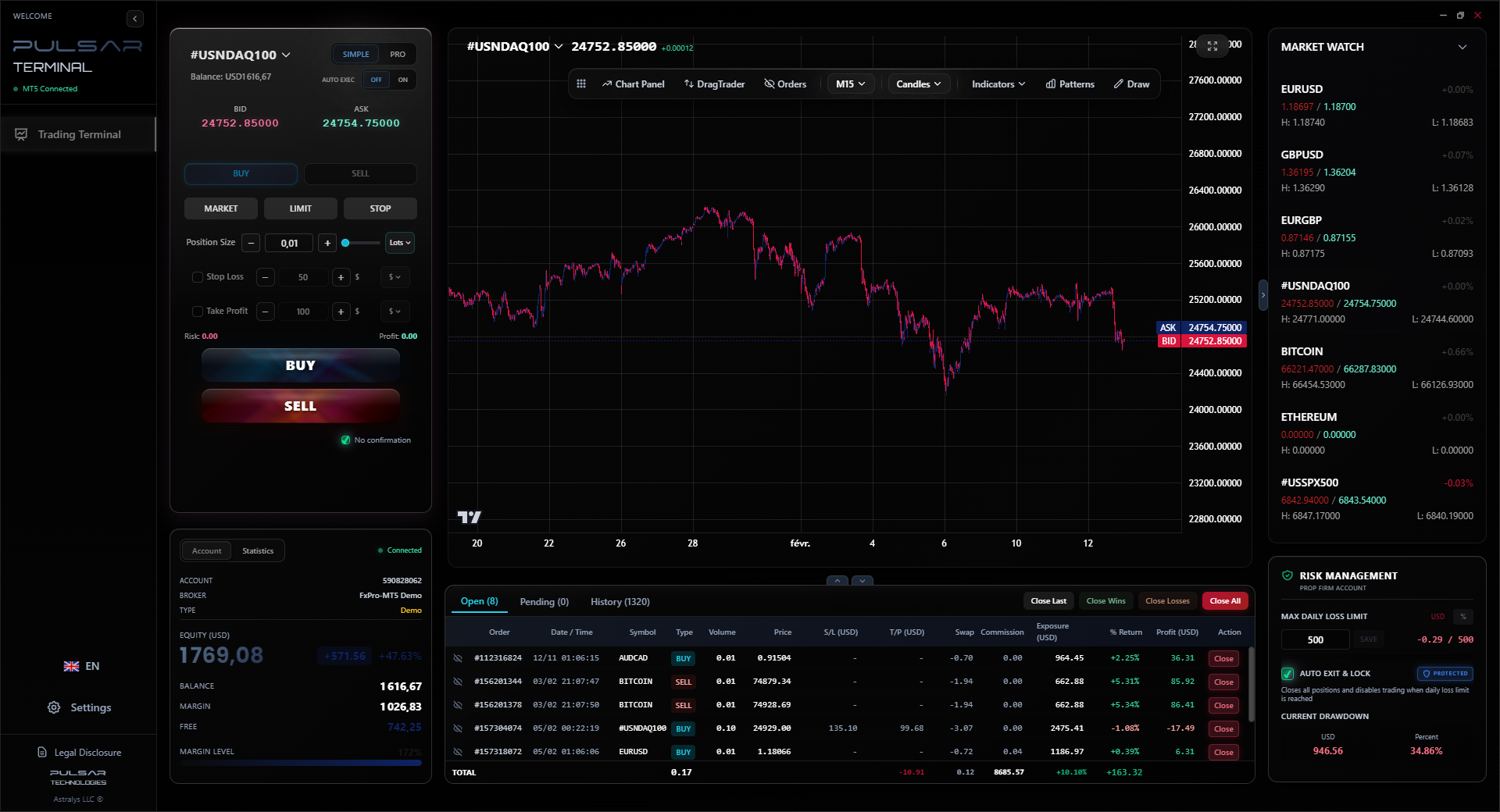
Managing multiple trades within FCA leverage limits requires precision; Pulsar Terminal's drag-and-drop orders and multi-TP/SL features on MT5 let you execute complex strategies without losing control.
Pulsar Terminal
The all-in-one MT5 companion: drag-and-drop orders, multi-TP/SL, trailing stop, grid trading, Volume Profile, and prop firm protection. Used by 1,000+ traders daily.
Forex trading and tax in the UK isn't about finding loopholes. It's about understanding the clear, if slightly annoying, rules and playing by them. The goal is to keep as much of your hard-earned profit as possible, legally.
My personal stance: I treat my CFD trading as an investment activity for CGT. I keep immaculate records. I use spread betting for specific, short-term strategies where the tax simplicity is worth it. And I have a great accountant on speed dial for the annual review.
The FCA's rules protect you from the worst market abuses. HMRC's rules are just a cost of doing business. Factor your potential tax liability into your profit targets. If you need a 10% return to break even after tax, that changes your risk management, doesn't it?
Start organised, stay organised, and trade knowing exactly where you stand. That peace of mind is worth more than any single trade.
FAQ
Q1Is forex trading tax-free in the UK?
No, not automatically. Profits from standard forex CFD or spot trading are subject to Capital Gains Tax if your annual net gains exceed the £3,000 allowance. The only commonly 'tax-free' method is financial spread betting, where profits are exempt from CGT for most retail traders, but this comes with important caveats and restrictions.
Q2What is the Capital Gains Tax allowance for 2026/27?
The Annual Exempt Amount (AEA) for Capital Gains Tax in the 2026/27 tax year is £3,000. This is a significant reduction from previous years. Any net trading gains above this threshold from your CFD/spot forex accounts are potentially taxable.
Q3Can I offset forex trading losses against my salary?
No, you cannot offset capital losses from forex CFD trading against your employment income. Capital losses can only be offset against other capital gains (e.g., from shares or property) in the same tax year or carried forward to offset against future capital gains.
Q4Do I need to pay tax on spread betting?
For the vast majority of retail traders, no. Profits from financial spread betting are generally exempt from Capital Gains Tax and Income Tax. However, if HMRC determines you are trading as a business (a 'trader' with high frequency and organisation), they can reclassify profits as taxable trading income. This is uncommon but a risk for full-time professionals.
Q5How do I declare my forex trading profits to HMRC?
If your net taxable gains from CFD/spot forex exceed the £3,000 allowance, you must report them on a Self-Assessment tax return. You use the 'Capital Gains Summary' pages (SA108). You need to calculate your total gains and losses for the tax year (April 6 to April 5), subtract the allowance, and pay any tax owed by January 31 of the following year.
Q6What records do I need to keep for HMRC?
You must keep detailed records for at least 6 years. This includes: all broker statements, a trade journal with dates, pairs, entry/exit prices, position size, and profit/loss in GBP, records of all deposits/withdrawals, and your annual P&L calculation. Good records are your best defence in an enquiry.
Q7Can I trade with non-FCA brokers as a UK resident?
Technically, you can, but you absolutely should not. You lose all UK regulatory protections: no negative balance protection, no client money segregation, no FSCS coverage, and you'll likely be offered illegal use. The risks far outweigh any perceived benefit like lower costs. Always use an FCA-authorised broker.
Prof. Winston's Lesson
Key Takeaways:
- ✓FCA regulation is non-negotiable for UK trader safety.
- ✓CGT allowance is now only £3,000; plan accordingly.
- ✓Spread betting is tax-free for most, but losses are useless.
- ✓Impeccable records for 6 years are your best defence.
- ✓Get a specialist accountant if you trade full-time.
How useful was this article?
Click a star to rate
Weekly Trading Insights
Free weekly analysis & strategies. No spam.
About the Author
Sarah Collins
Trading Strategist
London-based trading strategist with 12 years in financial markets. Former analyst at a City of London brokerage. Covers GBP pairs, European markets, and FCA-regulated trading.
Comments
Risk Disclaimer
Trading financial instruments carries significant risk and may not be suitable for all investors. Past performance does not guarantee future results. This content is for educational purposes only and should not be considered investment advice. Always conduct your own research before trading.
You Might Also Like

Cara Trading Forex Sukses: 7 Prinsip dari Trader Profesional
Cara trading forex sukses dengan 7 prinsip trader pro: manajemen modal, disiplin, journal trading, backtest. Data nyata, bukan janji profit palsu.
Jam Trading Forex Terbaik untuk Trader Indonesia: Panduan Lengkap dengan Tabel Waktu
Panduan jam trading forex untuk trader Indonesia. Tabel 4 sesi dunia, jam emas 20:00-00:00, sesi mana yang harus dihindari. Data akurat + tips dari trader berpengalaman.
Top 5 Sàn Forex Uy Tín Nhất 2026: Review Jujur dari Trader Indonesia
Top 5 sàn forex uy tín 2026 untuk trader Indonesia. Review jujur: spread, deposit, withdraw, dukungan lokal. Exness, XM, IC Markets & lebih.
Get Pulsar Terminal
All these calculators are built into Pulsar Terminal with real-time data from your MT5 account. One-click position sizing, automatic risk management, and instant calculations.
Get Pulsar Terminal