


Looking for the best forex trading app in South Africa? Let me guess.

David van der Merwe
Emerging Markets Trader ·  South Africa
☕ 10 min read
What you'll learn:
Looking for the best forex trading app in South Africa? Let me guess. You're tired of sifting through sponsored lists and vague reviews that don't mention the real costs, the FSCA rules, or what it's actually like to trade the Rand from your phone in Pretoria or Cape Town. I've been trading here for over a decade, and I've made every mistake in the book so you don't have to. This isn't a fluffy overview. It's a straight-talking guide to the apps, the regulations, the hidden costs, and the strategies that work with our unique market.
First thing's first: trading forex is legal in South Africa, but you have to play by the house rules. The house is the Financial Sector Conduct Authority (FSCA). Ignoring them is a surefire way to lose your money before you even place a trade.
The big one? use is capped at 30:1 for retail traders. This came in back in 2021. You'll see some apps, especially international ones, advertising crazy use like 500:1 or 1000:1. If you're signing up as a South African resident with an FSCA-licensed broker, you won't get that. And honestly, that's a good thing. Early in my career, I blew an account using 100:1 on a volatile GBP/ZAR trade. The 30:1 cap forces a bit of discipline.
Your broker must have an FSP number. You can and should check this on the FSCA's public register. A legit app will display this license proudly. If you can't find it, walk away. Client money should be in segregated accounts. This isn't just paperwork; it means your funds are separate from the broker's operating money.
Finally, let's talk taxes. The South African Revenue Service (SARS) views trading profits as income. You need to declare it. Keep a detailed log of all your trades. I learned this the hard way after a good year in 2019 and had to scramble to reconstruct my history. Use a spreadsheet or a dedicated journal from day one.

Warning: Trading with an unregulated offshore broker might give you higher use, but you have zero protection if they go under or decide to freeze your withdrawals. Your first filter for any forex trading app in South Africa should be FSCA regulation.

💡 Winston's Tip
The FSCA's 30:1 use cap isn't a restriction, it's a life jacket. The sea of forex is stormy enough without a 100:1 anchor tied to your ankle.
Forget the marketing. The true cost of trading isn't the minimum deposit; it's the spread and commissions. This is where your profit gets eaten. Let's look at what you'll actually pay on a major pair like EUR/USD.
The Spread Game
Most 'standard' accounts make money from the spread. Here's the reality for a South African trader as of now:
| Broker (Account Type) | Typical EUR/USD Spread | Notes |
|---|---|---|
| XM (Ultra Low) | 0.8 pips | Popular choice, good for smaller accounts. |
| AvaTrade (Fixed) | From 0.9 pips | Predictable costs, but watch for inactivity fees. |
| Exness (Standard) | 1.0 pip | Reliable execution, common among local traders. |
| FP Markets | 1.3 pips | Well-regulated, strong platform choice. |
| FxPro | 1.6 pips | Established, but on the higher side for spreads. |
The Commission Model
If you're trading larger sizes or scalping, raw spread accounts with a commission are often cheaper. You pay a tiny spread plus a fee per lot.
- IC Markets: Their Raw Spread account often shows 0.0 pips on EUR/USD. You pay a commission of $3.50 per 100k lot (round turn). For active traders, this can be significantly cheaper. I switched to this model for my scalping strategy and saved thousands in slippage over a year.
- Tickmill: Similar story. 0.1 pip spreads with a $2 per lot commission.

Example: Trade 1 standard lot (100,000 units) on EUR/USD.
- On a 1.3 pip spread: Cost = 1.3 pips * $10 = $13
- On a 0.1 pip spread + $4 commission: Cost = (0.1 * $10) + $4 = $5 The difference is $8 per trade. Do 100 trades a month, and that's $800 saved (or kept in your pocket).
Other fees? Many top brokers like IC Markets or Pepperstone don't charge for deposits or withdrawals in ZAR via local bank transfer. But always check. Inactivity fees are a silent killer - AvaTrade, for instance, charges $50 after three months of no activity. If you're taking a break, close the account.
Understanding your cost per pip definition is non-negotiable. It directly impacts your position size calculator and risk management.
“A slightly higher spread with a reputable, FSCA-regulated broker is infinitely cheaper than hidden slippage from a 'zero spread' cowboy.”
The 'app' is usually just the front end. You're really choosing a trading platform. In South Africa, you have three main paths.
The MetaTrader Dynasty
MetaTrader 4 (MT4) & MetaTrader 5 (MT5) are the undisputed kings. Almost every broker offers them. The mobile apps are decent for checking positions, placing basic orders, and reading charts. But for serious analysis, you'll want the desktop version. MT5 is the newer, more powerful brother (more timeframes, better backtesting). Most Exness review, XM review, and IC Markets review will highlight their MT4/MT5 integration. It's the universal language of retail forex.
The Broker's Own App
Brokers like IG and Plus500 have invested heavily in their proprietary apps. They're slick, user-friendly, and great for beginners. The downside? You're locked into their environment. If you want to switch brokers later, you have to learn a whole new platform. I started on one of these and found the transition to MT4 painful but necessary for advanced order types.
The Professional's Edge: cTrader & Add-ons
cTrader, offered by brokers like Pepperstone review and IC Markets, is a beautiful, intuitive platform with fantastic charting and direct market access (DMA) feel. Its mobile app is the best for technical analysis on the go.
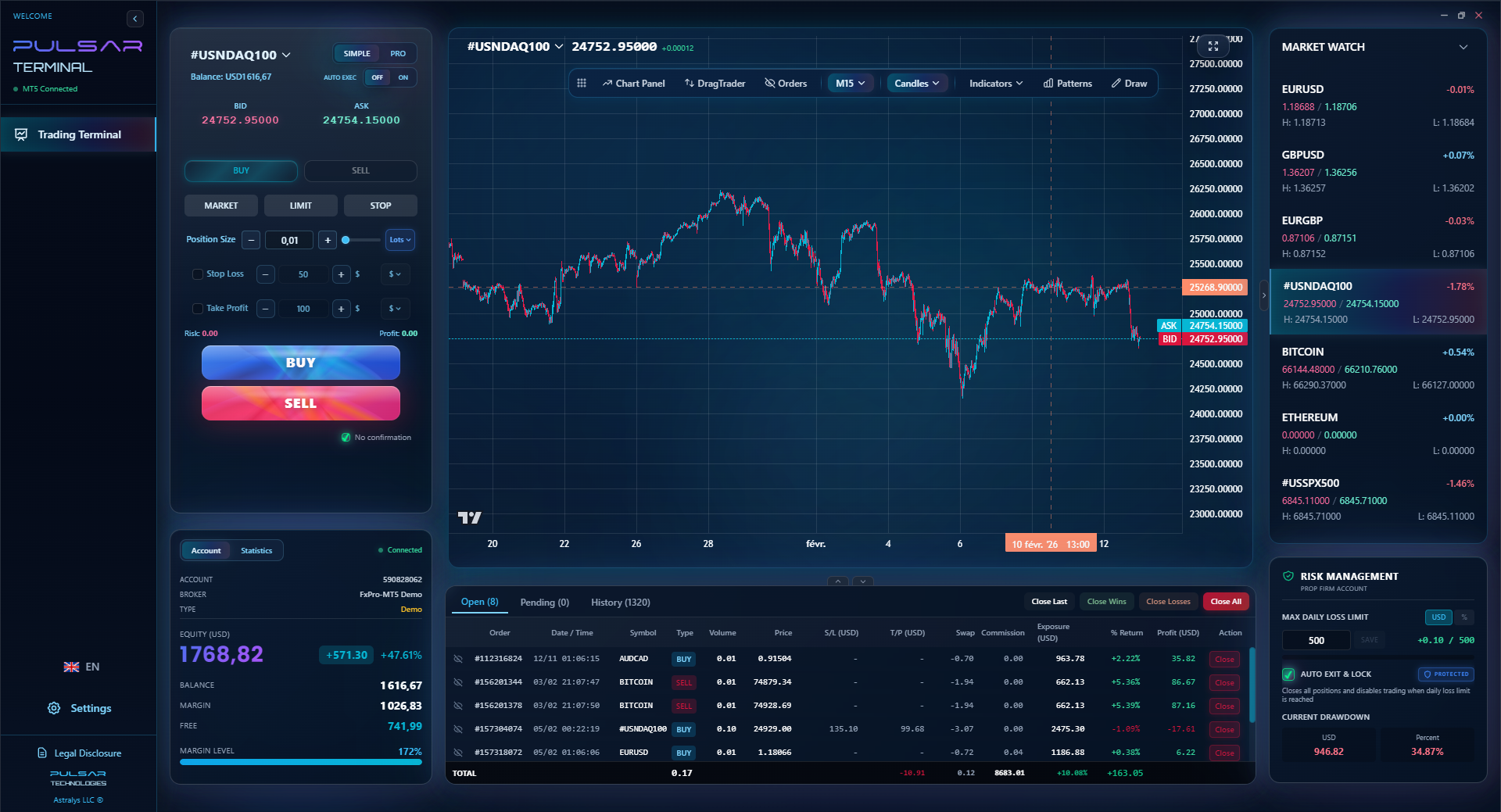
Then there are platform enhancers. This is where professional tools live. Think Pulsar Terminal (an MT5 companion) or TradingView integration. These aren't broker apps, but they connect to your broker's API and give you institutional-grade tools: drag-and-drop orders, advanced trailing stops, volume profile, and automated trade management. Once you use a proper Volume Profile tool on MT5, you won't go back.
My setup? IC Markets for execution, MT5 on desktop for analysis, and their mobile app for monitoring and emergency exits. I haven't placed a complex trade from my phone in years. The screen is just too small.
Trading USD/ZAR or EUR/ZAR is a different beast to the major pairs. It's our home game, and you need to understand the local drivers.
Liquidity & Spreads: Don't expect 0.1 pip spreads. A 'tight' spread on USD/ZAR might be 40-50 pips during the London session. It can widen to 150+ pips overnight or around local data releases. This massively affects your risk. A 50-pip stop-loss on EUR/USD is wide; on USD/ZAR, it's extremely tight.
What Moves the Rand?
- SA-specific data: CPI, SARB interest rate decisions, budget speeches, unemployment figures. The Rand is a risk-sensitive, high-yield currency. Bad local news hits it hard.
- Global risk sentiment: When global markets panic ("risk-off"), money flows out of currencies like the ZAR and into the USD and JPY.
- Commodity prices: We're a resource economy. Strong gold (XAU/USD guide), platinum, and coal prices can support the ZAR.
A Personal Trade: In March 2023, ahead of a SARB decision, I went long USD/ZAR (betting on Rand weakness) at 18.25. My reasoning was persistent local load-shedding and a hawkish Fed. The SARB hiked, but the statement was less hawkish than feared. The pair dumped to 17.90 in minutes. I got stopped out at 18.10 for a 150-pip loss. The lesson? Even if your macro view is right, the immediate market reaction to the news vs. expectation can wipe you out. I should have used a wider stop or avoided the news event altogether.
For ZAR pairs, I almost exclusively use a swing trading approach. The spread definition costs make scalping very difficult unless you have a massive edge.
💡 Winston's Tip
Your first R10,000 in the market is tuition, not investment. Pay it willingly with small trades, and you might get an education instead of a bill for arrogance.
“The chart doesn't care about your patriotism. Follow the price action, not your heart.”
I'll give you the free education I paid for with my own capital.
Mistake 1: Chasing the 'Zero Spread' Dream. I opened an account with a shady offshore broker advertising 0.0 spreads on everything. The execution was criminal. My market orders on EUR/USD would consistently fill 3-5 pips away from the price I clicked. The 'spread' was zero, but the slippage was a hidden commission. I lost R8,000 in a week just on bad fills. Lesson: A slightly higher spread with a reputable, FSCA-regulated broker like FP Markets or IC Markets is infinitely cheaper than hidden slippage.
Mistake 2: Ignoring the Platform's Limits. I tried to run a complex multi-basket grid strategy on a broker's basic mobile app. The app couldn't handle the multiple pending orders and modifications. It froze during a volatile GBP news event, and I couldn't close positions. Result: a margin call and a blown account. Lesson: Test your strategy on a demo account using the exact same app and platform you will use live. If your strategy needs advanced order management, you need a platform that supports it natively or through an add-on.
Mistake 3: Over-trading the Rand on Emotion. As a South African, you 'feel' the Rand's strength every time you fill up your car or buy imported goods. This emotional connection is toxic for trading. I kept trying to 'defend' the Rand by shorting USD/ZAR during political turmoil, fighting the clear trend. It was patriotic, but it was terrible trading. I gave back a month's profits in two days. Lesson: The chart doesn't care about your patriotism. Follow the price action, not your heart. Use the RSI indicator or MACD indicator for objective signals, not your gut feeling about Eskom.
Managing complex strategies and protecting profits requires tools beyond a basic mobile app, which is where a platform enhancer like Pulsar Terminal for MT5 becomes essential.
Pulsar Terminal
The all-in-one MT5 companion: drag-and-drop orders, multi-TP/SL, trailing stop, grid trading, Volume Profile, and prop firm protection. Used by 1,000+ traders daily.
Here's your step-by-step, no-nonsense plan to start trading with a forex app in South Africa.
- Get Your Finances in Order. Only trade with risk capital - money you can afford to lose completely. Have your emergency fund and debts sorted first. This is non-negotiable.
- Choose a Regulated Broker. Pick 2-3 from the list above (IG, Exness, IC Markets, XM, Pepperstone). Compare their spreads on the pairs you care about, their ZAR deposit/withdrawal process, and their platform.
- Download and Demo. Open a demo account with your top choice. Download their mobile app and their desktop platform (MT5/cTrader). Practice for at least a month. Place 50+ demo trades. Get a feel for the order execution, the charts, and how to set a stop-loss.
- Start Absurdly Small. When you go live, deposit the minimum. Your first goal is not to make money; it's to not lose money. Practice executing your plan with real emotion on the line, but with tiny position sizes where a loss is the cost of a nice dinner, not your rent.
- Document Everything. Note every trade: entry, exit, reason, emotion. Review it weekly. This is how you learn.

Pro Tip: Don't get distracted by 100 different indicators. Master one major pair like EUR/USD guide first. Understand its daily range, its typical reaction to news. Become a specialist before you become a generalist.
The best forex trading app in South Africa is the one that gives you reliable execution, clear costs, and fits your trading style. It's a tool, not a magic money machine. Your brain is the magic part. Now go put in the screen time.
FAQ
Q1Is forex trading tax-free in South Africa?
No, it is not tax-free. Profits from forex trading are considered income by SARS and must be declared on your annual tax return. You can deduct certain trading-related expenses. Keep detailed records of all your trades from day one.
Q2Can I use international forex apps like Robinhood or eToro in South Africa?
eToro does accept South African clients, but they are not FSCA-regulated for forex/CFDs (they are regulated for other services). Robinhood is not available. While you can use them, you forfeit the specific protections of the FSCA regime, like the 30:1 use cap and guaranteed segregated funds. I always recommend starting with an FSCA-licensed broker.
Q3What is the minimum deposit to start trading forex in South Africa?
It varies. Brokers like XM and Exness can have minimums as low as $10 (roughly R180). IG might require around R4000 for a full account. My advice? Start with the minimum possible. Your skill, not your account size, determines success. You can learn just as much trading a $50 account as a $5000 one.
Q4Which is better for beginners: MT4 or MT5?
For a complete beginner, MT4 is slightly simpler and has more free indicators and tutorials available. However, MT5 is more powerful and is the future. If your broker offers both, I'd suggest starting with MT5 to avoid having to switch later. The core concepts of placing trades and reading charts are identical.
Q5Why are spreads on USD/ZAR so high compared to EUR/USD?
Liquidity. EUR/USD is the most traded financial instrument in the world, with billions traded daily. USD/ZAR has far less trading volume. Lower liquidity means brokers face higher costs to execute your trade, and they pass this on as a wider spread. It's the cost of trading an emerging market currency.
Q6Can I make a living trading forex in South Africa?
A very small percentage of traders do. It requires significant capital (so that realistic returns cover living expenses), immense discipline, years of experience, and a proven, strong strategy. It's a marathon, not a sprint. Do not quit your job to trade. Start as a serious side hustle and see if you have the consistent profitability over several years to even consider it.
Prof. Winston's Lesson
Key Takeaways:
- ✓FSCA regulation is your first and most important filter.
- ✓Real cost is spread + commission + slippage, not just the advertised number.
- ✓Trade ZAR pairs with swing strategies, not scalps, due to wide spreads.
- ✓Your first live goal is survival, not profit. Start miniscule.
- ✓Document every trade. Your journal is your best teacher.
How useful was this article?
Click a star to rate
Weekly Trading Insights
Free weekly analysis & strategies. No spam.
About the Author
David van der Merwe
Emerging Markets Trader
Johannesburg-based trader with 11 years in emerging market currencies. Specializes in ZAR pairs, FSCA-regulated trading, and South African market analysis.
Comments
Risk Disclaimer
Trading financial instruments carries significant risk and may not be suitable for all investors. Past performance does not guarantee future results. This content is for educational purposes only and should not be considered investment advice. Always conduct your own research before trading.
You Might Also Like

Cara Trading Forex Sukses: 7 Prinsip dari Trader Profesional
Cara trading forex sukses dengan 7 prinsip trader pro: manajemen modal, disiplin, journal trading, backtest. Data nyata, bukan janji profit palsu.
Jam Trading Forex Terbaik untuk Trader Indonesia: Panduan Lengkap dengan Tabel Waktu
Panduan jam trading forex untuk trader Indonesia. Tabel 4 sesi dunia, jam emas 20:00-00:00, sesi mana yang harus dihindari. Data akurat + tips dari trader berpengalaman.
Top 5 Sàn Forex Uy Tín Nhất 2026: Review Jujur dari Trader Indonesia
Top 5 sàn forex uy tín 2026 untuk trader Indonesia. Review jujur: spread, deposit, withdraw, dukungan lokal. Exness, XM, IC Markets & lebih.
Get Pulsar Terminal
All these calculators are built into Pulsar Terminal with real-time data from your MT5 account. One-click position sizing, automatic risk management, and instant calculations.
Get Pulsar Terminal