


So you're sitting there, probably after watching some YouTube guru, wondering: is forex trading banned in India? Can I even do this? The short answer is no, it's not banned.

Rajesh Sharma
Senior Forex Analyst ·  India
India
☕ 10 min read
What you'll learn:
- 1The Legal Reality: Not Banned, But Heavily Regulated
- 2What Happens If You Break the Rules? (Real Penalties)
- 3How to Trade Forex Legally in India: A Step-by-Step
- 4Legal vs. Illegal: A Side-by-Side Comparison
- 5Recent Crackdowns and What They Mean For You (2024-2026)
- 6Practical Advice for the Indian Trader
So you're sitting there, probably after watching some YouTube guru, wondering: is forex trading banned in India? Can I even do this? The short answer is no, it's not banned. But the real answer is way more complicated, and if you get it wrong, you're not just risking your capital - you're risking fines, jail time, and having your bank account frozen. I've seen it happen. Let's cut through the noise and talk about what's actually legal, what will get you in serious trouble, and how you can participate in the market without ending up on the wrong side of the Reserve Bank of India.
First things first: the phrase 'forex trading banned in India' is a massive oversimplification. It creates this black-and-white picture that just isn't accurate. The truth is, India has one of the most protective and specific regulatory frameworks in the world for retail forex.
The government isn't trying to stop you from trading. They're trying to stop you from losing your shirt to unregulated offshore brokers and from causing volatility in the Indian Rupee (INR). The entire system is built around the Foreign Exchange Management Act (FEMA) of 1999. Think of FEMA as the rulebook. Every transaction you make that involves converting INR to another currency falls under its gaze.
So, what's actually legal? You can trade currency derivatives - futures and options - on recognized Indian exchanges like the NSE, BSE, or MSEI. But here's the critical catch: you can only trade pairs that include the Indian Rupee. That means USD/INR, EUR/INR, GBP/INR, and JPY/INR are your playground. Dreaming of trading EUR/USD or GBP/JPY from your apartment in Mumbai? That's where you cross the line into illegal territory if done through an offshore broker.
All legal trading must go through a SEBI-registered broker. These brokers, like Zerodha or Upstox, act as gatekeepers. They enforce KYC norms, segregate client funds, and route all your orders through the official exchanges. This system is designed for safety, not necessarily for the kind of high-use, 24/5 speculative trading you see advertised online.

Warning: A common misconception is using the Liberalised Remittance Scheme (LRS) to fund an international broker account for forex trading. The RBI has explicitly stated this is a violation. Using LRS for speculative trading can lead to penalties and suspension of your LRS privileges.

💡 Winston's Tip
The market's greatest illusion is accessibility. True access isn't about opening an account anywhere; it's about operating within a system where your rights are enforceable. The Indian exchange is your fortress.
This isn't some theoretical risk. The authorities are actively cracking down, especially since 2025. I know a guy - let's call him Rohan - who thought he was being clever. He used a VPN, opened an account with an offshore broker advertising 500:1 use on EUR/USD, and funded it through a series of small UPI transfers. He made about ₹2 lakh in six months. Then his bank account was flagged. He ended up with a fine of ₹5 lakh (more than he made) and a legal notice that scared him straight. He got off relatively easy.
The penalties under FEMA are no joke and are designed to be a deterrent:
- Financial Penalties: Up to three times the amount involved in the illegal transaction. Alternatively, a fixed penalty of up to ₹5,00,000. They can also hit you with ₹10,000 for every day the violation continues.
- Imprisonment: This is the scary part. You can face jail time of up to five years. If the authorities can prove aggravating circumstances (like fraud or a very large sum), that can stretch to ten years.
- Asset Confiscation: Any money or assets connected to the illegal trading activity can be seized.
The RBI maintains an 'Alert List' of unauthorized platforms, and banks have been told to watch for transactions related to them. In March 2026, the government specifically called out platforms like Olymp Trade and reiterated that trading CFDs or forex on non-INR pairs through offshore entities is not permitted.

Example: Let's say you illegally trade $10,000 (approx. ₹8.3 lakh) on an offshore platform. If caught, you could be fined three times that amount: ₹24.9 lakh. Plus, you could face jail time. That's a life-altering risk for a speculative trade.
“This isn't some theoretical risk. The penalties under FEMA are no joke and are designed to be a deterrent.”
Okay, so the illegal path is a minefield. Here's how you actually get in the game the right way. It's different from what most international tutorials teach, but it's the only safe way.
Step 1: Choose a SEBI-Registered Broker
This is non-negotiable. You're not choosing a broker based on who has the lowest spread on EUR/USD. You're choosing one licensed to operate in India. Popular and reputable choices include Zerodha, Upstox, Angel One, ICICI Direct, and HDFC Securities. I started with Zerodha years ago because their platform was clean and their pricing was transparent.
Step 2: Open a Trading & Demat Account
You'll go through full KYC. Have your PAN card, Aadhaar, and bank details ready. This process links everything to your financial identity legally.
Step 3: Understand the Product
You won't be trading a 'forex spot' market. You'll be trading exchange-traded currency derivatives:
- Currency Futures: Contracts to buy/sell a currency pair at a future date. The USD/INR future is the most liquid.
- Currency Options: Gives you the right, but not the obligation, to buy/sell at a set price.
These are standardized contracts with fixed expiry dates (usually monthly).
Step 4: Know the Costs
Forget about 'zero spread' accounts. Your costs will look like this (using Zerodha as a common example):
- Brokerage: For currency futures, it's around ₹0.05 per ₹1 lakh of turnover + GST. For options, it's ₹2 per ₹1 lakh of premium + GST.
- Statutory Charges: You pay Securities Transaction Tax (STT), SEBI charges (₹10 per crore), and GST on brokerage.
- Margin: This is your collateral. For one lot of USD/INR futures, the minimum margin is roughly ₹2,500. This is not use in the international sense; it's the exchange's risk requirement. You can use a position size calculator to work out your risk per trade based on this.
I made a classic mistake early on. I treated a USD/INR futures trade like a spot forex trade, ignoring the expiry. The contract decayed in the last week, and even though my directional call was right, I lost money on the rollover. Lesson learned: you're trading a derivative contract, not the underlying spot price directly.
To make it crystal clear, here’s what you can and cannot do.
| Feature | Legal (SEBI/RBI Framework) | Illegal (Offshore/Unauthorized) |
|---|---|---|
| Currency Pairs | Only INR pairs (USD/INR, EUR/INR, etc.) | Any pair (EUR/USD, GBP/JPY, etc.) |
| Platform | NSE, BSE, MSEI via broker terminal | MT4/MT5 from unregulated offshore broker |
| use | Effectively low, controlled by exchange margin | Can be 100:1, 500:1, or even 1000:1 |
| Broker Regulation | SEBI (India) | FCA, ASIC, CySEC (not recognized for Indian residents) |
| Funding/Withdrawal | Through linked Indian bank account | International wire, crypto, sometimes shady e-wallets |
| Taxation | Clear (treated as business income/speculative) | Obfuscated, often not declared |
| Primary Risk | Market risk | Market risk + Regulatory risk (fines/jail) + Broker risk |
| Product Type | Exchange-traded Futures & Options | Spot Forex, CFDs, Options (OTC) |
The biggest temptation is the use and the variety of pairs. I get it. Trading USD/INR can feel slow compared to the volatility of something like GBP/JPY. But ask yourself: is that extra volatility worth the constant low-grade fear of a regulatory hammer coming down? For me, once I understood the penalties, it was an easy choice.
A practical note on strategy: because you're dealing with futures and a less volatile pair, many popular international scalping strategies are harder to execute. You might find more success with a swing trading approach on the daily charts of USD/INR, using indicators like the MACD or RSI to time your entries on the NSE.
💡 Winston's Tip
A strategy built on regulatory arbitrage is a strategy built on sand. It's not a matter of if the tide comes in, but when. Your edge must come from analysis and discipline, not from exploiting a legal grey area.
“The door to the offshore world is being welded shut. For your trading psychology, this is actually good news.”
The rules aren't static. The RBI and government have been actively tightening the screws. If you're trading now, you need to know this timeline.
January 2024: The RBI dropped a bombshell circular on forex derivatives. They said you could only use rupee derivatives if you had a real, underlying foreign exchange exposure (like an import/export business). This was aimed squarely at killing speculative trading. The backlash was huge, and they deferred the rule to May 2024, but the intent was clear: speculation is not welcome.
2025: Revisions to FEMA made some things easier for businesses but kept retail speculation in check. The RBI also issued new directions for Electronic Trading Platforms (ETPs), further formalizing the market.
March/April 2026 (Right Now): This is the big one. The government and RBI made coordinated statements.
- They explicitly said offshore forex and CFD platforms are not permitted.
- The RBI told banks to stop offering certain complex rupee derivative products to everyone, including non-residents.
- Banks were instructed to be more vigilant in monitoring transactions for unauthorized forex activity.
This isn't old news. This is the current environment. The message is louder than ever: the only safe, legal path is through the domestic exchanges. The door to the offshore world is being welded shut. For your trading psychology, this is actually good news. It forces you to focus on one market (USD/INR is huge) and master it, rather than jumping from one shiny pair to the next.
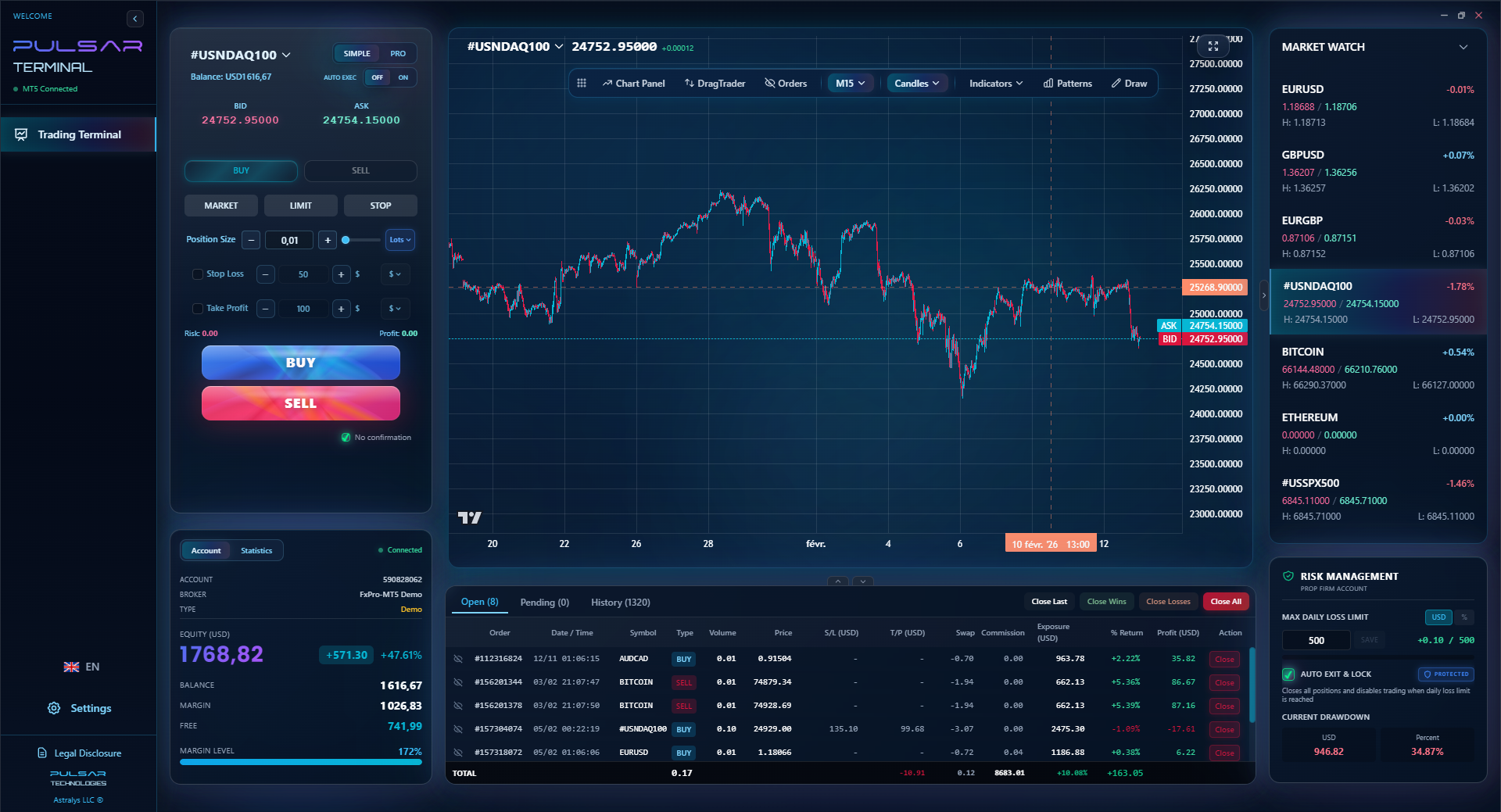
When trading USD/INR futures on a platform like MT5 through your broker, managing complex orders and risk manually is a hassle; Pulsar Terminal's drag-and-drop order system and automated trade management tools let you execute your strategy precisely without taking your eyes off the chart.
Pulsar Terminal
The all-in-one MT5 companion: drag-and-drop orders, multi-TP/SL, trailing stop, grid trading, Volume Profile, and prop firm protection. Used by 1,000+ traders daily.
Given this landscape, here’s my blunt advice after 12 years in the trenches.
Start with USD/INR. It's the most liquid, has the tightest spreads, and has plenty of data. All your classic technical analysis works here. Follow the EUR/USD guide for macro principles, but apply them to the Rupee. What drives USD/INR? Domestic RBI policy, US Fed policy, oil prices (India imports a lot), and broad dollar strength.
Manage your risk religiously. The lower effective use is a blessing in disguise. It prevents you from blowing up your account in one bad trade. Still, always use a stop-loss. A common horror story is a trader not using a stop on a futures contract, getting a margin call, and owing the broker money. Don't be that person.
Forget the get-rich-quick fantasy. The legal Indian forex market is a tool for steady, risk-managed speculation or hedging. It's not a casino. The guys showing off Lamborghinis from forex trading? They're either breaking the law, lying, or selling you a course.
Consider other asset classes. If you're frustrated by the limitations, look at other SEBI-regulated markets. You can trade equity derivatives, commodities, or even international equity ETFs. The goal is to grow your capital, not just to trade forex.

Pro Tip: Paper trade the USD/INR futures for at least two months. Get a feel for the contract size, the expiry cycles, and how news events impact it. Most broker demo accounts will let you do this with virtual money. It's the cheapest education you'll ever get.
Finally, if you are evaluating brokers, always check their SEBI registration number. It should be front and center on their website. If you're looking for a platform with advanced tools that works within this environment, you need a powerful charting and order management system that connects to your broker.
FAQ
Q1Can I legally trade EUR/USD if I am an Indian resident?
No, you cannot. Trading in non-INR currency pairs like EUR/USD, GBP/USD, or any pair that does not include the Indian Rupee is illegal for Indian retail residents, regardless of the broker or platform you use. The only legal forex trading for residents is in INR-based pairs (USD/INR, EUR/INR, etc.) on SEBI-regulated exchanges.
Q2What is the minimum deposit to start legal forex trading in India?
It varies by broker. With a broker like Zerodha, you can start with a few thousand rupees. The real requirement is the margin needed for a trade. For one standard lot of USD/INR futures, you need approximately ₹2,500 as margin in your account. Some brokers might have a minimum account balance requirement, but it's generally accessible.
Q3Are international brokers like Exness or IC Markets legal in India?
No. While brokers like Exness or IC Markets are regulated abroad, they are not authorized by the RBI or SEBI to offer forex trading services to Indian residents. Using them to trade non-INR pairs violates FEMA rules. Your funds are not protected under Indian law, and you risk severe penalties.
Q4How are profits from legal currency futures trading taxed?
Profits are treated as 'Business Income' or 'Speculative Business Income' under the Income Tax Act. You must file them under the appropriate head (usually P&F from Business and Profession). You can deduct related expenses like brokerage, internet, etc. It's crucial to maintain a clear profit & loss statement for tax purposes.
Q5Can I use a VPN to hide my location and trade with an offshore broker?
This is extremely dangerous and does not make the activity legal. You are still an Indian resident subject to FEMA. Banks monitor forex transactions, and funding/withdrawing will create a trail. The RBI's recent directives have specifically ordered banks to crack down on such flows. You risk account freezes, heavy fines, and legal prosecution.
Q6What happens if my unregulated offshore broker shuts down or refuses a withdrawal?
You have virtually no recourse. You cannot complain to SEBI or RBI because you were engaging in an illegal activity. Your money is likely gone. This is a massive risk that legal trading through Indian exchanges completely eliminates, as client funds are mandatorily segregated and protected.
Prof. Winston's Lesson
Key Takeaways:
- ✓Legal trading is confined to INR pairs (USD/INR, EUR/INR).
- ✓Penalties include fines up to 3x the amount and 5+ years in jail.
- ✓You must use a SEBI-registered broker (Zerodha, Upstox, etc.).
- ✓Forget high use; focus on margin-managed futures trading.
- ✓Recent 2026 crackdowns have made offshore routes extremely risky.
How useful was this article?
Click a star to rate
Weekly Trading Insights
Free weekly analysis & strategies. No spam.
About the Author
Rajesh Sharma
Senior Forex Analyst
Trading Indian and South Asian markets for over 10 years. Started with NSE currency derivatives before moving to international forex. Specializes in USD/INR and emerging market pairs.
Comments
Risk Disclaimer
Trading financial instruments carries significant risk and may not be suitable for all investors. Past performance does not guarantee future results. This content is for educational purposes only and should not be considered investment advice. Always conduct your own research before trading.
You Might Also Like

Cara Trading Forex Sukses: 7 Prinsip dari Trader Profesional
Cara trading forex sukses dengan 7 prinsip trader pro: manajemen modal, disiplin, journal trading, backtest. Data nyata, bukan janji profit palsu.
Jam Trading Forex Terbaik untuk Trader Indonesia: Panduan Lengkap dengan Tabel Waktu
Panduan jam trading forex untuk trader Indonesia. Tabel 4 sesi dunia, jam emas 20:00-00:00, sesi mana yang harus dihindari. Data akurat + tips dari trader berpengalaman.
Top 5 Sàn Forex Uy Tín Nhất 2026: Review Jujur dari Trader Indonesia
Top 5 sàn forex uy tín 2026 untuk trader Indonesia. Review jujur: spread, deposit, withdraw, dukungan lokal. Exness, XM, IC Markets & lebih.
Get Pulsar Terminal
All these calculators are built into Pulsar Terminal with real-time data from your MT5 account. One-click position sizing, automatic risk management, and instant calculations.
Get Pulsar Terminal