


Everyone tells you to join a forex trading community.

Daniel Harrington
Head of Content
☕ 11 min read
What you'll learn:
- 1Why Communities Matter (Especially in Singapore)
- 2The 5 Types of Communities (And Which to Avoid)
- 3Spotting the Red Flags & Scams
- 4What a Good Community Actually Does
- 5How to Build Your Own Network (The Right Way)
- 6Singapore-Specific Considerations
- 7My Personal Journey: From $8k Down to a Valuable Network
- 8Your Action Plan to Get Started Today
Everyone tells you to join a forex trading community. 'Find your tribe!' they say. 'Learn from others!' I bought into that hype early in my career, and it cost me over $8,000 in bad trades and subscription fees before I learned the hard truth. Most trading communities are echo chambers of confirmation bias, not education. In Singapore's tightly regulated but massive market - we're talking US$1.485 trillion in daily volume - finding the right community can mean the difference between consistent profits and becoming another statistic in that 70-80% retail loss rate. Let me show you what actually works.
Trading can be brutally lonely. You're staring at charts for hours, making decisions that feel personal. In Singapore, where MAS caps use at 50:1 for majors (a sensible rule, honestly), you can't just YOLO your way out of bad trades with insane margin. You need precision. A good community provides three things you can't get alone: perspective, accountability, and shared market intelligence.
I remember during the 2020 market panic, I was convinced USD/SGD would crash. My chart analysis said so. But in a small Telegram group I trusted, two veteran traders were pointing to MAS's likely intervention to stabilize the currency pair. They shared historical data from the 2008 crisis. That single conversation stopped me from opening a huge short position that would have been stopped out hard. The community saved me from myself.
Singapore's market has unique quirks. The SGD is a top-10 global currency, but its liquidity can dry up around local public holidays. Good local communities know this. They'll warn you about thin volume during Hari Raya Puasa or Chinese New Year eve, when spreads on USD/SGD can widen unexpectedly on brokers like OANDA Singapore or FOREX.com. That's practical, location-specific intel you won't find in a generic global forum.

Warning: Don't confuse a community with a signal service. A community discusses why to trade. A signal service just tells you what to trade. The former teaches you to fish; the latter gives you a fish that might be poisoned.
The Paid Mentor Group
These charge anywhere from SGD $50 to $500 a month. The good ones are led by proven traders who share live trades, explain their position size calculator logic, and host regular Q&As. The bad ones? They're just sales funnels. I joined one in 2018 for $200/month. The 'mentor' posted screenshot after screenshot of winning trades on EUR/USD, but never a losing one. When I asked about his risk management, I was muted. Red flag.
The Free Discord/Telegram Hub
These are a mixed bag. Some are fantastic, like niche servers focused solely on Asian session trading or XAU/USD analysis. Others are spam-filled wastelands. The best ones have active moderators who enforce rules against unsolicited signals and pump-and-dump talk.
The Broker-Specific Forum
Brokers like IG Markets or Saxo Bank often host client forums. The upside: traders discuss platform-specific execution issues. The downside: heavy moderation that often removes criticism of the broker itself. Use these for technical support, not unbiased strategy talk.
The Social Media Group (Facebook, Reddit)
/r/Forex or Facebook's 'Forex Trading Singapore' groups. I'm blunt: these are mostly terrible. They're dominated by beginners asking 'what's a pip?' and covert advertisers. The signal-to-noise ratio is awful. However, Reddit's r/RealDayTrading has a rigorous verification process for its pros - that's a rare exception.
The In-Person Meetup
Pre-COVID, I attended a few at cafes in Raffles Place. You meet real people. You see who's actually serious. It's harder to fake competence face-to-face. These have moved online, but the principle remains: smaller, curated groups beat massive open ones every time.
Here’s a quick comparison:
| Community Type | Cost | Best For | Biggest Risk |
|---|---|---|---|
| Paid Mentor Group | High | Structured learning | Scams, cult-like followings |
| Free Discord | Free | Real-time discussion | Misinformation, spam |
| Broker Forum | Free | Platform-specific help | Censored, biased opinions |
| Social Media Group | Free | Very basic questions | Terrible advice, noise |
| In-Person/Private Group | Low/Free | Accountability & deep trust | Time commitment, limited views |

💡 Winston's Tip
The loudest voice in a trading room is often the least profitable. Seek out the members who ask thoughtful questions, not the ones who constantly boast.
“A real community makes you a better trader, not a follower.”
Singapore's regulators are tough, but scams still slip through. They prey on our 'kiasu' (afraid to lose out) mentality. Here’s what I’ve learned to spot.
The Guarantee: Anyone guaranteeing profits is lying. Period. The MAS doesn't allow that kind of advertising for a reason. If a group says '90% win rate guaranteed,' run. My early loss came from a signal provider who 'guaranteed' 10 pips a day on EUR/USD. He got 10 pips for three days, then blew up my account on the fourth with a terrible reversal trade.
The Lifestyle Flex: Be wary of communities where the leader constantly posts photos of luxury cars, watches, and resort vacations. Real professional traders are typically focused and relatively private about wealth. This is marketing 101, targeting greed.
The Complicated Fee Structure: A simple monthly fee is okay. But if they're pushing 'mastermind' tiers, 'funded trader' challenges with huge upfront costs, or commissions on your profits, it's a business model, not a community. I once saw a 'prop firm preparation' group charging SGD $1,000 for 'coaching' to pass a challenge, while using a scalping strategy that would instantly violate the firm's rules. Predatory.
No Discussion of Losses: This is the biggest tell. A healthy trading community talks openly about losing trades, margin calls, and emotional mistakes. A toxic one only celebrates wins. If every chart shared is a green, perfect entry, you're being sold a fantasy.

Pro Tip: Ask a potential community one question: 'Can you share a recent losing trade and what you learned from it?' The response will tell you everything.
A real community makes you a better trader, not a follower. Here’s what to look for.
It Focuses on Process, Not Picks: Good groups spend time on risk management frameworks, journal reviews, and psychology. They might dissect why a trader moved their stop-loss to breakeven too early, or how they used the RSI indicator in a ranging market. The conversation is about the how and why.
It Shares Data, Not Just Opinions: Instead of 'I'm bullish USD,' you'll see: 'Here's the CFTC commitment of traders report showing leveraged funds are net short JPY. Here's the yield spread driving it. My plan is to wait for this MACD indicator crossover on the 4H chart for confirmation.' That's actionable analysis.
It Has Rules and Moderation: The best Discord servers I'm in have strict rules: no direct signals, no 'what should I do?' posts without your own analysis first, and mandatory trade tagging (e.g., #SwingTrade-Idea, #RiskManagement-Question). This keeps quality high.
It Accommodates Different Styles: You'll have a scalping trader discussing 1-minute chart order flow, and a swing trader talking about weekly chart structure. They learn from each other. A community that only promotes one 'holy grail' system is limiting your growth.
From my experience, the most valuable moments weren't when someone called a trade. They were when a member posted a losing trade and the group helped them diagnose the error - was it the entry, the risk, or just market noise? That's gold.
💡 Winston's Tip
If you wouldn't trust a person to hold your wallet, don't trust them with your trade ideas. Build community trust slowly, over many months.
“The goal isn't to find people to follow. The goal is to find peers who make you think harder.”
Don't just join communities, cultivate your own network. This is more work but pays off forever.
Start by Giving Value: Find a small forum or chat and start answering questions. Help someone understand spreads or how to use a position size calculator. Don't promote yourself. People will notice genuine helpfulness and start engaging with you privately.
Be Specific in Your Asks: Instead of 'What do you think of GBP/USD?' in a large group, try this: 'I'm looking at GBP/USD on the daily. Price is at this key support, but the MACD indicator is bearish. My plan is to wait for a 4H close above this level. Has anyone traded a similar setup during London open?' This shows you've done work and invites specific feedback.
Form a Mastermind: Once you've identified 2-3 serious traders you respect, propose a private weekly check-in. Keep it small. In mine, we each share one best trade and one worst trade from the week. We screen share our charts and explain our thinking. The accountability is immense. It stopped me from revenge trading after a loss last quarter.
Use Tech to Your Advantage: We use a shared trading journal spreadsheet (anonymized) and a private Telegram channel just for urgent market alerts - like unexpected MAS policy news that could rock the SGD pairs. The key is intentionality.

Example: My mastermind group's rule: If you share a trade idea, you must include Entry, Stop-Loss, Take-Profit, and Position Size as a % of capital. No exceptions. This forces discipline and makes discussion concrete, not theoretical.
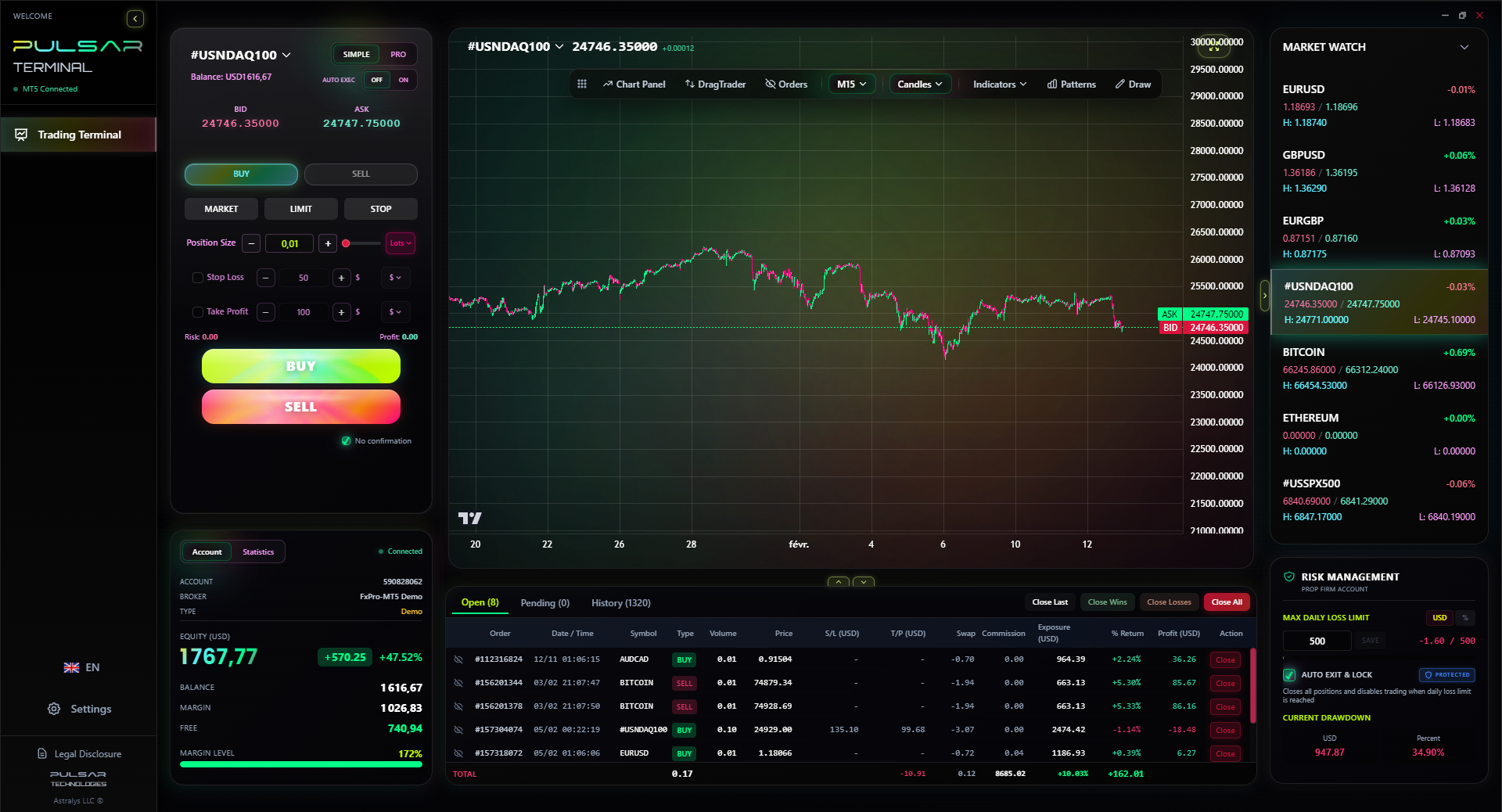
When your mastermind group reviews trades, being able to quickly visualize complex entries and exits with multiple take-profit levels on a shared chart is invaluable, which is where a tool like Pulsar Terminal for MT5 shines.
Pulsar Terminal
The all-in-one MT5 companion: drag-and-drop orders, multi-TP/SL, trailing stop, grid trading, Volume Profile, and prop firm protection. Used by 1,000+ traders daily.
Our context changes the game. A community of US traders won't get these points.
Trading Hours: The Asian session is our home turf. Good local communities are active when USD/SGD and AUD pairs are moving. They understand the liquidity gaps between Tokyo close and London open. This is prime time for certain scalping strategies that fail in other sessions.
Regulatory Talk: A solid SG-based group will discuss the practical implications of MAS rules. For example, understanding why a broker like Pepperstone offers different use to SG clients vs. their global clients. Or the tax implications - reminding everyone that trading profits are not taxable if it's personal investment, but you better have your records straight.
Local Broker Insights: Who has the best PayNow deposit speeds? Which MAS-regulated broker has consistent slippage on NFP news? This is grassroots intel. I learned from a community that one major international broker had slow SGD withdrawal times for amounts over $10k, so I split my withdrawals. Saved me a week of waiting.
Currency Pairs: While everyone talks about EUR/USD, a Singapore-focused community will have deeper insight into USD/SGD, AUD/SGD, and SGD crosses. They'll follow Singapore's CPI releases, MAS monetary policy statements (which are unique, focusing on the exchange rate), and how it all feeds into the charts.
💡 Winston's Tip
Your best community might only have three people in it. Value depth of insight over the number of members. Five sharp minds beat five hundred noisy ones.
“Your community is your edge - not because it gives you answers, but because it helps you ask better questions.”
Let me be vulnerable. My first foray into communities was a disaster. I paid for two different 'elite' groups. One was just a guy forwarding signals from another service. The other was a motivational cult where questioning the leader was forbidden. I took bad trades out of FOMO, ignored my own rules, and lost real money.
The turning point was when I quit everything. I traded alone for six months, built a simple swing trading system, and started a public trading journal. I posted every trade, win or lose, with charts and reasoning. Slowly, other traders doing the same thing started commenting. We migrated to a private chat. Now, that group of five is my core network.
One concrete example: In Q3 2023, I was swing trading Gold (XAU/USD). I was long from $1900, with a stop at $1885. Price dropped to $1890. My gut said to bail. I shared the chart in our group. Another trader, who focuses on institutional order flow, pointed out that the volume profile showed massive support at $1888-90. He said the drop was on low volume. I held. Price reversed and hit my target at $1950. His perspective, grounded in a different methodology, gave me the conviction to stick to my plan. That trade netted me over $5,000.
The community didn't give me the trade. It gave me the clarity to execute my own trade properly. That's the difference. Today, I'd rather be in one small, trusted chat than fifty large, noisy ones. It's about quality of connection, not quantity of signals.
- Audit Your Current Inputs: Leave every generic Forex Facebook group and Reddit forum. Unfollow the 'guru' Instagram pages. This is a detox.
- Lurk with Purpose: Find 2-3 potential communities. Look for the ones where the conversation is question-driven, not signal-blasting. Spend two weeks just reading. Don't post.
- Engage Strategically: When you engage, ask a specific, process-oriented question. Provide context from your own analysis first. This attracts the right kind of attention.
- Propose a 1-on-1: If you find someone whose analysis you consistently respect, ask if they'd be open to a 15-minute chat to discuss a specific trade idea or concept. Most serious traders will say yes. Offer to buy them a coffee (virtually).
- Prioritize Off-Platform: The real value moves off public forums. Aim to build connections that migrate to private messages or small group chats. This is where honest talk happens.
- Contribute Relentlessly: Share your own lessons. Did you get stopped out? Share why you think it happened. Did a broker's spread widen abnormally? Warn others. Be the source of value you want to see.
Remember, the goal isn't to find people to follow. The goal is to find peers who make you think harder, keep you honest, and help you see your own blind spots. In a game where most lose, your community is your edge - not because it gives you answers, but because it helps you ask better questions.
FAQ
Q1Are paid forex trading communities in Singapore worth the money?
Rarely. Most are overpriced and under-deliver. The exception might be a structured educational course with a proven mentor, not just a signal group. Before paying, demand a trial period or ask to speak to current members. A legitimate educator won't hide their students' results.
Q2What's the biggest risk of joining a free trading Telegram group?
Following bad advice blindly. Free groups are often filled with unverified 'gurus' and pump-and-dump schemes. The risk isn't losing a subscription fee; it's losing your entire trading capital by copying a reckless trade from an anonymous user. Always verify any strategy with your own analysis first.
Q3How can I verify if a community leader is a legitimate profitable trader?
Ask for a long-term, verified track record (like a Myfxbook link spanning years, not months). Be skeptical of screenshot wins. A real trader will discuss their risk framework, max drawdown, and losing trades openly. If they only show profits and get defensive about verification, they're likely not trading their own advice.
Q4Is it legal to share trade signals in Singapore-based groups?
Sharing ideas is legal. However, providing financial advice without a MAS license is illegal. The line is blurry. A community discussing general analysis is fine. Someone consistently directing followers to 'buy here, sell there' for a fee is likely operating without a license. Stick to groups that educate rather than dictate specific trades.
Q5I'm a beginner. What type of community should I look for first?
Avoid signal groups entirely. Look for communities focused on the basics: risk management, how to use a position size calculator, understanding pips and spreads, and trading psychology. Your goal is to learn foundational skills, not to copy trades. A good starter community answers 'why,' not just 'what.'
Q6How do I handle conflicting advice from different people in a community?
This is normal and healthy. Don't look for one 'correct' answer. Analyze the reasoning behind each opinion. One trader might be using a 5-minute chart for a scalp, another a daily chart for a swing. Understand their timeframe and premise. Then, decide which aligns with your trading plan. The community's job is to present perspectives, not make your decisions.
Prof. Winston's Lesson
Key Takeaways:
- ✓Process talk beats signal talk every time.
- ✓Always ask to see a recent losing trade.
- ✓Small private groups > massive public forums.
- ✓Give value first; connections follow.
How useful was this article?
Click a star to rate
Weekly Trading Insights
Free weekly analysis & strategies. No spam.
About the Author
Daniel Harrington
Head of Content
Head of content at The Trading Mentor. Veteran trader with a passion for making complex trading concepts accessible. Covers global topics, strategies, and platform guides.
Comments
Risk Disclaimer
Trading financial instruments carries significant risk and may not be suitable for all investors. Past performance does not guarantee future results. This content is for educational purposes only and should not be considered investment advice. Always conduct your own research before trading.
You Might Also Like

Cara Trading Forex Sukses: 7 Prinsip dari Trader Profesional
Cara trading forex sukses dengan 7 prinsip trader pro: manajemen modal, disiplin, journal trading, backtest. Data nyata, bukan janji profit palsu.
Jam Trading Forex Terbaik untuk Trader Indonesia: Panduan Lengkap dengan Tabel Waktu
Panduan jam trading forex untuk trader Indonesia. Tabel 4 sesi dunia, jam emas 20:00-00:00, sesi mana yang harus dihindari. Data akurat + tips dari trader berpengalaman.
Top 5 Sàn Forex Uy Tín Nhất 2026: Review Jujur dari Trader Indonesia
Top 5 sàn forex uy tín 2026 untuk trader Indonesia. Review jujur: spread, deposit, withdraw, dukungan lokal. Exness, XM, IC Markets & lebih.
Get Pulsar Terminal
All these calculators are built into Pulsar Terminal with real-time data from your MT5 account. One-click position sizing, automatic risk management, and instant calculations.
Get Pulsar Terminal