


Here's a fact that might surprise you: over 70% of new Nigerian traders who pick the wrong forex trading company blow their first account within six months.

Olumide Adeyemi
West African Trading Pioneer ·  Nigeria
☕ 11 min read
What you'll learn:
- 1What Exactly Is a Forex Trading Company? (It's Not What You Think)
- 2The Nigerian Rulebook: Regulations & The 10% Tax Reality
- 3Side-by-Side: What to Compare in a Forex Company
- 4The Hidden Costs That Eat Your Naira
- 5International Broker vs. Local Platform: The Final Showdown
- 6Red Flags: When to Run from a Forex Company
- 7Your First 30 Days: A Realistic Action Plan
Here's a fact that might surprise you: over 70% of new Nigerian traders who pick the wrong forex trading company blow their first account within six months. It's not just about bad trades. It's about picking a partner that doesn't fit your reality - your Naira deposits, your internet speed, your tax obligations. I've seen it happen to friends, and I nearly fell for it myself early on. This isn't about finding the 'best' broker globally. It's about finding the right one for you, right here in Nigeria, where the rules are still being written and the opportunities are massive.
When you hear 'forex trading company' in Nigeria, you're probably thinking of two very different things. First, there's the international broker - the platform you actually trade on, like Exness or IC Markets. They provide the software, the use, and the market access. Second, there are the local 'signal sellers' or 'investment managers' who promise to trade for you. We're talking about the first one: the broker.
A real forex trading company (the broker) is your gateway to the market. They're not your friend, your mentor, or your get-rich-quick scheme. They're a service provider. Their job is to execute your orders, hold your money securely, and provide a stable platform. Everything else - education, signals, account management - is often just marketing to get you in the door.
I learned this the hard way. Back in 2015, I was dazzled by a 'company' offering managed accounts with 5% weekly returns. I ignored the broker they used, which was unregulated. When the 'manager' disappeared with a dozen accounts, the broker offered zero recourse. The platform itself was fine, but the entity behind it was a ghost. The broker is the company. Its regulation, its reputation, and its financial health are everything.

Warning: If a 'forex company' in Nigeria is primarily selling you signals or account management, but is vague about which regulated broker they use, run. You're hiring a marketer, not a trading firm. Your money should only ever be with a licensed broker.
Let's get the legalities straight. Trading forex for yourself is completely legal in Nigeria. The Central Bank of Nigeria (CBN) and the SEC are the main watchdogs, but here's the critical nuance: the online retail space you and I operate in isn't tightly regulated yet. The CBN focuses on the big institutional market.
This creates a grey area. Nigerian-incorporated brokers need CBN authorization. But there's no law stopping you from opening an account with a broker regulated abroad, like the UK's FCA or Cyprus's CySEC. This is what most serious Nigerian traders do. We use international brokers because their regulatory standards are often stricter, especially concerning client fund segregation.
Now, for the part everyone tries to forget: taxes. The Federal Inland Revenue Service (FIRS) wants its share. Your trading profits are subject to Capital Gains Tax at a rate of 10%. I know, I know. It feels unfair when you're just starting. But treat it as a business expense. The day you start making consistent profits is the day you need to plan for this. I set aside 10% of every profitable withdrawal into a separate account. It's not fun, but getting a surprise tax bill is worse.
The CBN has also made it clear: you cannot use the official foreign exchange window to fund your trading account. You'll be using your card or a payment processor, which means you're subject to their rates and fees. This directly impacts your starting capital and your position size calculator logic.

💡 Winston's Tip
A broker is a utility, not a strategy. Your profits come from your edge, not their platform. Pick one that's reliable, cheap, and lets you sleep at night.
“Your first forex trading company is a learning partner. Choose one that won't fail you while you're learning the ropes.”
Don't just look at who has the flashiest ads on Instagram. You need to compare these specific points. I've made a table based on what actually matters for day-to-day trading here.
| Feature | Why It Matters for Nigerian Traders | What to Look For |
|---|---|---|
| Deposit/Withdrawal | Naira accessibility, speed, fees. | Local bank transfers, card deposits, fees under 2%. Fast withdrawals (1-3 days). |
| Spreads & Commissions | This is your direct trading cost. | For EUR/USD: Under 1.5 pips on standard accounts, or raw spread + commission under $7 per lot. |
| use Offered | Can be a tool or a trap. | 1:100 to 1:500 is common. Higher isn't better. It increases risk of a margin call. |
| Platform & Tools | Your trading environment. | MT4/MT5 stability. Good mobile app for when NEPA takes light. |
| Customer Support | When you have a withdrawal issue at 10 PM. | Live chat, local phone number, WhatsApp support. Responsive on weekends. |
The Minimum Deposit Trap
You'll see ads for accounts starting at $1. That's a marketing gimmick. Can you open one? Yes. Can you trade seriously with $1? Absolutely not. A $1 account with 1:500 use lets you control $500. One bad pip definition move and it's gone. It teaches you nothing about real risk.
My honest advice? Start with at least $200-$500. This lets you trade micro lots (0.01) with sane risk, survive a few losses, and learn without the panic of watching every tick destroy 20% of your account. A standard account needing $1,000 is for when you have a proven, profitable strategy.

Example: Let's say you deposit ₦250,000 (approx. $300). With a 1:100 use broker, you control $30,000. If you risk just 1% of your capital ($3) per trade, you can trade a 0.01 micro lot on EUR/USD and have a 30-pip stop-loss. That's a real, manageable trade. With a $10 account, 1% risk is 10 cents. You can't even place the trade.
The advertised spread is just the tip of the iceberg. If you don't account for these, your profitable strategy on paper becomes a loser in reality.
1. Payment Processing Fees: This is the big one for us. When you fund your account in Naira, the broker's payment provider converts it to USD. They add a fee, often 2-4%, and use their own exchange rate, which is usually worse than the official rate. I once lost nearly ₦5,000 on a ₦150,000 deposit just from the conversion. Some brokers absorb this cost as a promotion, but it's usually temporary.
2. Inactivity Fees: Life happens. You get busy, take a break. Many brokers will charge you $5-$15 a month if your account is dormant (no trades) for 6-12 months. Just close your account if you're taking a long break.
3. Swap/Rollover Rates: If you hold a trade overnight, you pay or earn interest. For a scalping strategy this doesn't matter. For swing trading, it can. Holding a sell position on a high-interest currency pair can cost you daily. Check the broker's swap calculator before holding for days.
4. The 'Zero Spread' Illusion: Accounts with 0.0 pip spread definition sound amazing. But they charge a commission per lot. Do the math. A 0.0 pip spread + $5 commission per lot is often more expensive than a 0.8 pip spread with no commission on a typical short-term trade. It only becomes cheaper if you're trading massive volumes.
Here's a real trade from last month: I went long on Gold (XAU/USD) using my XAU/USD guide strategy. Broker A had a 0.9 pip spread. Broker B had a 0.1 pip spread + $4.50 commission per lot. On my 0.5 lot position, Broker B's total cost was $4.50 + (0.1 pip * $5) = $5. Broker A's cost was (0.9 pip * $5) = $4.50. The 'zero spread' account was actually more expensive.
💡 Winston's Tip
The 'minimum deposit' is a marketing number. Your 'effective minimum' is the amount needed to trade your strategy with proper risk. That's usually 50x the advertised minimum.
“Over 70% of new Nigerian traders who pick the wrong forex trading company blow their first account within six months.”
This is the core decision. Let's break down the pros and cons with Nigerian eyes.
International Brokers (e.g., Exness, IC Markets, XM)
- Pros: Strong, established regulation (CySEC, FCA, ASIC). Often more advanced platforms and tools. Generally better liquidity and tighter spreads. Your funds are held in segregated accounts with top-tier banks.
- Cons: Customer support might not be Nigeria-timezone focused. Deposit/withdrawal can be slower and more expensive due to international transfers. They may not actively market to Nigeria.
Local/Regional Brokers
- Pros: Blazing-fast deposits/withdrawals in Naira. Customer support that understands your specific issues. Marketing and education tailored to the Nigerian trader.
- Cons: Regulatory oversight may be weaker. Platform stability and liquidity can sometimes be inferior. May offer fewer instruments.
My take? For safety and long-term growth, I lean towards well-regulated international brokers. My primary account has been with an international firm for 8 years. The peace of mind knowing my funds are protected under EU regulations is worth the occasional hassle with a withdrawal. I use a local broker for a smaller, tactical account where I need instant Naira access.

Pro Tip: Don't put all your eggs in one basket. Test a broker with a small amount first. Make a deposit, execute a few trades, and most importantly, make a withdrawal. If they pass the withdrawal test smoothly, you've cleared the first major hurdle. I did this with Exness review and Pepperstone review before committing larger capital.
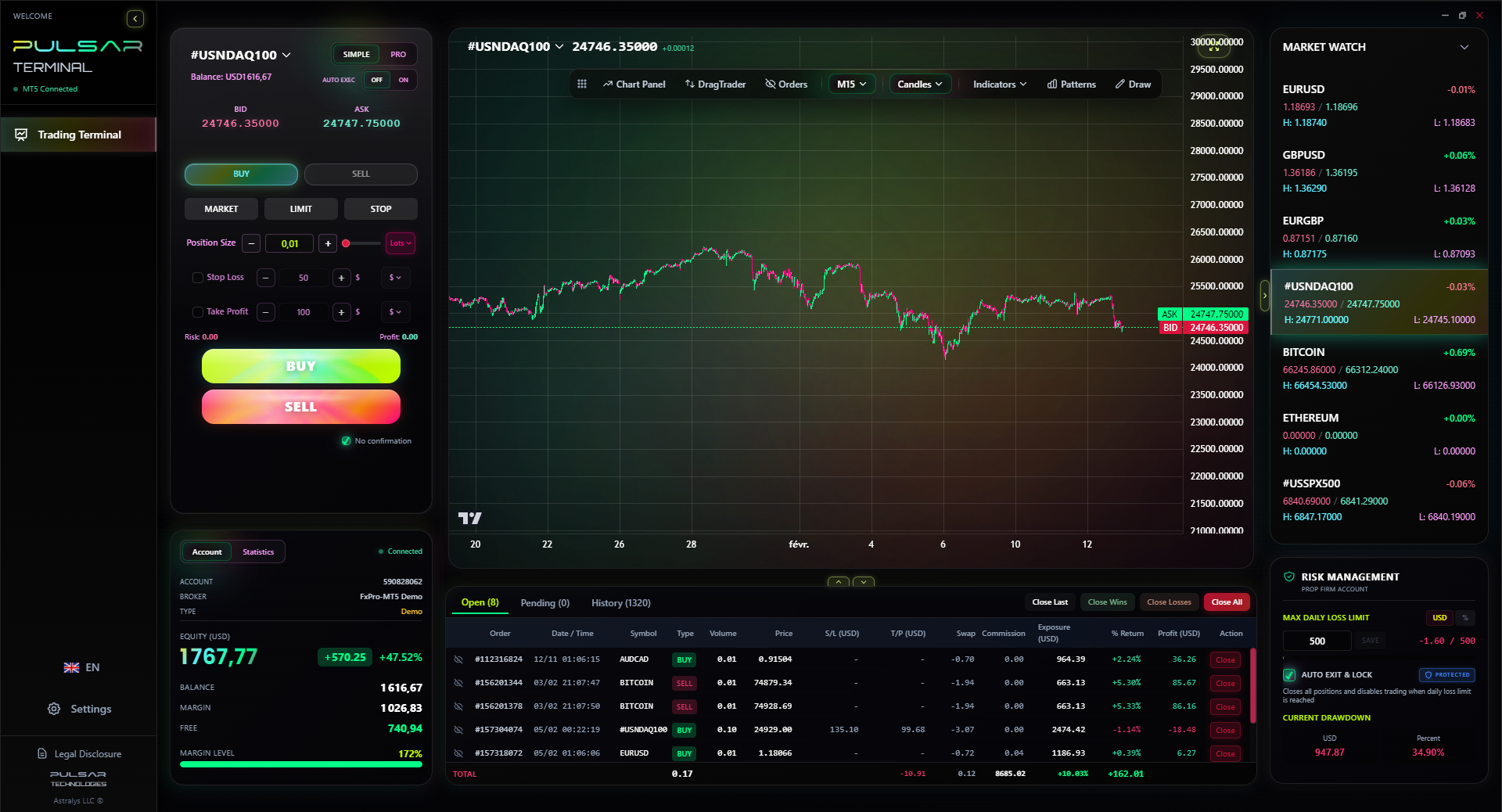
Managing risk across multiple trades with a Nigerian broker is critical, and Pulsar Terminal's drag-and-drop order system lets you set multi-level take-profits and stop-losses on MT5 in seconds, protecting your Naira capital from volatile swings.
Pulsar Terminal
The all-in-one MT5 companion: drag-and-drop orders, multi-TP/SL, trailing stop, grid trading, Volume Profile, and prop firm protection. Used by 1,000+ traders daily.
Your gut is usually right. If something feels off, it probably is. Here are the glaring red flags I've learned to spot.
1. Guaranteed Profits: Any company that promises you a specific monthly return (e.g., '20% monthly guaranteed!') is lying. The market doesn't guarantee anything. This is often a Ponzi scheme.
2. Pressure to Deposit More: 'Your account is too small to make real money. Deposit $5,000 to unlock our VIP signals.' This is a classic recovery scam. They get you to lose a little, then pressure you to 'recover' by depositing more.
3. Unverifiable Regulation: They say they're 'regulated' but the license number doesn't check out on the regulator's website (like the FCA's register). Or they're 'regulated' in a place you've never heard of with no online presence.
4. Complicated Withdrawal Process: They ask for endless 'verification' documents you already submitted, or they charge outrageous fees to process your own money. A legitimate broker makes withdrawals almost as easy as deposits.
5. The 'Fund Manager' Who Needs Your Login: No legitimate, regulated money manager will ever ask for your trading account login details. They use a separate system (like a PAMM or MAM) where they have trading authority but cannot withdraw your funds. If they ask for your login, they can empty your account.
I fell for Red Flag #1 early on. A 'company' promised 15% monthly. I made two months of 'profits' on my statement (which were just numbers on a screen). When I tried to withdraw my initial capital, the excuses started. I lost $1,200. That $1,200 bought me a lesson I never forgot: if it sounds too good to be true, it's a scam.
💡 Winston's Tip
Do a withdrawal test before a large deposit. A broker that makes it hard to get a small amount out will be a nightmare when you have real profits.
“A broker is a utility, not a strategy. Your profits come from your edge, not their platform.”
Okay, you're ready to choose. Let's map out a sane first month. This is the plan I wish I had.
Week 1: The Paperwork Phase. Don't touch the markets. Pick 2-3 brokers from reputable comparisons (like our IC Markets review or XM review). Open a demo account with each. Fund it with a virtual $10,000. Your goal isn't to make money. Your goal is to test the platform. Place orders, set stop-losses, use the charts. See which platform feels intuitive. Check their Nigerian deposit options on their real website.
Week 2-3: The Demo Trade Phase. Pick ONE demo account. Now, trade with real rules. Decide on a simple strategy. Maybe use the MACD indicator and a moving average crossover. Risk only 1% of your virtual capital per trade. Write down every trade: why you took it, your entry, your stop-loss, your target. This builds discipline, not just skill.
Week 4: The Live Launch. Fund your chosen broker with your planned starting capital (again, I recommend $200-$500). But only trade with 10% of it initially. If you deposited $300, trade as if you only have $30. This is your 'paid demo.' The psychology is different with real money, even a small amount. The goal of your first 10-20 live trades is not profit. The goal is to execute your plan perfectly, including taking your stop-losses without hesitation.
Throughout this, keep a journal. Note how the broker performs during volatile news events (like US Non-Farm Payrolls). Is the platform stable? Does the spread definition widen to an insane level? This is valuable intel. Your first forex trading company is a learning partner. Choose one that won't fail you while you're learning the ropes.
FAQ
Q1Is forex trading legal in Nigeria?
Yes, trading forex for yourself is completely legal. The Central Bank of Nigeria (CBN) and the Securities and Exchange Commission (SEC) oversee financial markets, but retail trading isn't heavily regulated yet. You can use both local and international brokers. Just remember, your profits are subject to a 10% Capital Gains Tax.
Q2What is the minimum amount to start forex trading in Nigeria?
While some brokers let you start with $1, it's a trap. You can't trade or learn properly with that. For realistic risk management, plan to start with at least $200-$500 (roughly ₦250,000 - ₦600,000). This allows you to trade micro lots and survive the learning curve without blowing your account on a single trade.
Q3How do I fund my forex trading account in Nigeria?
You'll typically use a debit/credit card (Visa/Mastercard) or a bank transfer directly from your Nigerian bank account to the broker's payment processor. The CBN prohibits using the official foreign exchange window for this. Be aware of conversion fees (2-4% is common) and the exchange rate used, as this is a hidden cost.
Q4Should I use a Nigerian forex broker or an international one?
There's a trade-off. International brokers (regulated by bodies like CySEC or the FCA) often offer stronger fund protection and tighter spreads. Nigerian brokers offer faster Naira deposits and local support. For safety and long-term growth, I recommend a well-regulated international broker. Always test withdrawals with a small amount first.
Q5What is the biggest mistake new Nigerian traders make?
Choosing a broker based on hype or high use alone, and not understanding position sizing. They deposit ₦100,000, use 1:500 use, and trade a full lot. A 10-pip move against them can wipe out 50% of their account. They blame the market, but the real mistake was using a position size calculator wrong and picking a broker that offered dangerous levels of use to a beginner.
Q6How do I avoid forex trading scams in Nigeria?
Run from any 'company' that guarantees profits, pressures you to deposit more to 'recover' losses, or asks for your trading account login details. Check the broker's regulatory license on the official regulator's website (not just their own). If they're promising the moon on social media with flashy car pics, it's likely a marketing front for a poor service or a straight-up scam.
Prof. Winston's Lesson
Key Takeaways:
- ✓Start with $200+, not $1.
- ✓Always account for the 10% capital gains tax.
- ✓Test withdrawals before large deposits.
- ✓use above 1:200 is usually a risk trap.
- ✓International regulation often beats local convenience.
How useful was this article?
Click a star to rate
Weekly Trading Insights
Free weekly analysis & strategies. No spam.
About the Author
Olumide Adeyemi
West African Trading Pioneer
One of Nigeria's most active forex trading educators. 8 years of experience trading from Lagos. Specializes in low-capital strategies and prop firm challenges for African traders.
Comments
Risk Disclaimer
Trading financial instruments carries significant risk and may not be suitable for all investors. Past performance does not guarantee future results. This content is for educational purposes only and should not be considered investment advice. Always conduct your own research before trading.
You Might Also Like

Cara Trading Forex Sukses: 7 Prinsip dari Trader Profesional
Cara trading forex sukses dengan 7 prinsip trader pro: manajemen modal, disiplin, journal trading, backtest. Data nyata, bukan janji profit palsu.
Jam Trading Forex Terbaik untuk Trader Indonesia: Panduan Lengkap dengan Tabel Waktu
Panduan jam trading forex untuk trader Indonesia. Tabel 4 sesi dunia, jam emas 20:00-00:00, sesi mana yang harus dihindari. Data akurat + tips dari trader berpengalaman.
Top 5 Sàn Forex Uy Tín Nhất 2026: Review Jujur dari Trader Indonesia
Top 5 sàn forex uy tín 2026 untuk trader Indonesia. Review jujur: spread, deposit, withdraw, dukungan lokal. Exness, XM, IC Markets & lebih.
Get Pulsar Terminal
All these calculators are built into Pulsar Terminal with real-time data from your MT5 account. One-click position sizing, automatic risk management, and instant calculations.
Get Pulsar Terminal