


Here's the biggest myth about forex trading in Mumbai: that taking a ₹20,000 course will turn you into a profitable trader overnight.
Rajesh Sharma
Senior Forex Analyst ·  India
India
☕ 9 min read
What you'll learn:
- 1The Legal Reality Check: What You Can Actually Trade
- 2Course Costs & What You Actually Get
- 3Brokers & Platforms: The Legal Gateway
- 4Payment Methods & Local Logistics
- 5What Actually Makes a Course Worth It?
- 6Top Training Institutes in Mumbai: A Reality-Based Look
- 7Building Your Skills: The Real Work Begins After the Course
Here's the biggest myth about forex trading in Mumbai: that taking a ₹20,000 course will turn you into a profitable trader overnight. I've seen too many friends get burned by this promise. The truth is, most courses focus on flashy strategies while completely ignoring the critical legal and practical realities of trading in India. Let's set the record straight on what you actually need to know before spending a single rupee on education.
Before we talk about courses, we need to talk about what's legal. This is where most Mumbai-based trainers gloss over the details, and it's the fastest way to get into serious trouble.
In India, you're only allowed to trade currency pairs that involve the Indian Rupee (INR). That means USD/INR, EUR/INR, GBP/INR, and JPY/INR. That's it. Trading EUR/USD, GBP/USD, or any other major pair through an offshore broker? Strictly prohibited under FEMA regulations. The RBI has an Alert List of unauthorized entities, and they mean business.
All legal trading must happen on recognized exchanges like the NSE, BSE, or MSE through SEBI-regulated brokers. The RBI's Liberalised Remittance Scheme (LRS) explicitly cannot be used for speculative forex trading abroad. I learned this the hard way early in my career when I almost transferred money to an international broker, only to have a banker friend pull me aside and explain the potential penalties.

Warning: Trading non-INR pairs through offshore platforms isn't just risky - it's illegal. You could face severe financial penalties and legal action. No course is worth that.
The landscape got even tighter recently. In April 2024, the RBI mandated that on-exchange rupee derivatives can only be used for hedging "contracted exposure," not speculation. This pushed a lot of speculative volume offshore, but that doesn't make it legal for you to follow.
Walk around Lower Parel or Andheri East, and you'll see ads for forex trading courses ranging from ₹8,000 to ₹1,25,000. The average seems to hover around ₹20,000. But what are you really paying for?
The Breakdown
Most courses follow a similar structure: basic chart reading, a few indicators like the RSI indicator and MACD indicator, some risk management theory, and then a "proprietary system" that's usually just a repackaged common strategy. The expensive ones might throw in some mentorship sessions.
Here's my experience: I paid ₹35,000 for a course in 2018. The instructor was charismatic, the classroom was fancy, but the content was basic. I could have learned 80% of it from free YouTube videos and practicing with a demo account. The real value came from the networking - meeting other traders facing the same challenges.
What to Look For
A good forex trading course in Mumbai should spend significant time on:
- Indian regulations – Not just a footnote, but detailed explanations of FEMA, SEBI rules, and tax implications.
- Platform-specific training – How to actually place trades on Zerodha Kite or Upstox Pro for currency derivatives.
- Realistic expectations – Not promises of monthly returns, but how to manage the 70-80% failure rate among new traders.

Pro Tip: Before enrolling, ask for a detailed syllabus. If it doesn't dedicate at least 20% of time to Indian regulations and legal frameworks, walk away. That knowledge is more valuable than any trading signal.

💡 Winston's Tip
A student once asked me how to pick a course. I said, 'If the instructor can't clearly explain the tax liability on a winning USD/INR trade, they're teaching a fantasy, not a business.'
“Trading EUR/USD from Mumbai isn't a strategy; it's a regulatory violation.”
You can't trade without a broker, and in India, your choices are defined by regulation. Forget about signing up with those flashy international brokers you see advertised online. For legal forex trading (INR pairs), you need a SEBI-regulated broker.
Popular Legal Brokers in India:
| Broker | Key Feature | Good For |
|---|---|---|
| Zerodha | Low brokerage, Kite platform | Cost-conscious traders |
| Upstox | User-friendly Pro platform | Beginners |
| Angel One | Zero brokerage on equity delivery | Multi-asset traders |
| ICICI Direct | Integrated banking | Those who want everything in one place |
| 5Paisa | Competitive pricing | Active traders |
These brokers route your USD/INR trades through the NSE or BSE. The platforms are different from MetaTrader. Zerodha's Kite, for example, is excellent but has its own learning curve. A good course should teach you how to use these specific platforms - how to set orders, read the currency futures contract details, and understand the fees.
Speaking of fees, they're generally low. Brokers like m.Stock charge a one-time ₹999 for lifetime zero brokerage on equity. For currency derivatives, fees are typically a small percentage of the transaction value. The spreads (the difference between buy and sell price) on INR pairs can be wider than you'd find on global EUR/USD markets, which affects strategies like scalping.
International brokers like Exness or IC Markets may accept Indian clients, but using them to speculate on forex violates RBI rules. It's a regulatory gray area that's best avoided entirely.
This is the practical stuff that often gets skipped. How do you actually fund your trading account in Mumbai?
Thankfully, it's straightforward with local brokers. They integrate directly with Indian banking systems:
- UPI (Unified Payments Interface): Instant transfers, usually with limits of ₹1-5 lakhs per transaction. This is my go-to method.
- IMPS/NEFT/RTGS: Bank transfers that work reliably.
- Debit/Credit Cards: Possible, but often capped around ₹1 lakh per transaction and may incur 3-5% international transaction fees if processed overseas.
Funding an offshore broker illegally is a different, risky game involving cryptocurrencies or intermediary wallets, which I don't recommend and won't detail here.
Withdrawals work in reverse. Profits from legal trading on Indian exchanges come back to your linked bank account. Remember, these profits are taxable as "Business Income" or "Capital Gains" depending on your trading frequency. A serious forex trading course in Mumbai should have a session with a CA or tax advisor. I didn't get this, and my first tax filing after a profitable year was a confusing nightmare.
💡 Winston's Tip
The most expensive lesson isn't a course fee; it's the loss you take because you didn't understand the [spread definition](/en/glossary/spread) on your broker's platform. Know your costs cold.
“A ₹20,000 course needs to help you avoid just one major mistake to pay for itself.”
After 12 years and taking multiple courses myself, here's what separates the useful from the useless.
The Hallmarks of a Good Course:
- Psychology Focus: Trading is 80% psychology. Does the course cover handling fear, greed, and discipline? My biggest early loss - a ₹50,000 hit on a single USD/INR trade - wasn't due to bad analysis, but to panic and refusing to set a stop-loss.
- Risk Management Drills: It should force you to use a position size calculator religiously. They should teach you what a margin call looks like on Kite or Upstox and how to avoid it.
- Market Profile & Analysis: Look for courses that go beyond basic candlesticks. Tools like Volume Profile, which you can find in advanced platforms, help you see where big money is active. Understanding this was a turning point in my swing trading on GBP/INR.
- Community & Mentorship: The ongoing access to the instructor and a community of peers is often the most valuable part. My profitable EUR/USD guide strategy (for educational purposes only, remember!) was refined through discussions with a mentor from a course.
Red Flags:
- Guarantees of specific returns.
- Focus on "secret indicators."
- Pushing you to sign up with specific (especially offshore) brokers.
- No discussion of taxes or regulations.
A course should give you the tools and framework to build your own edge, not sell you a fantasy.
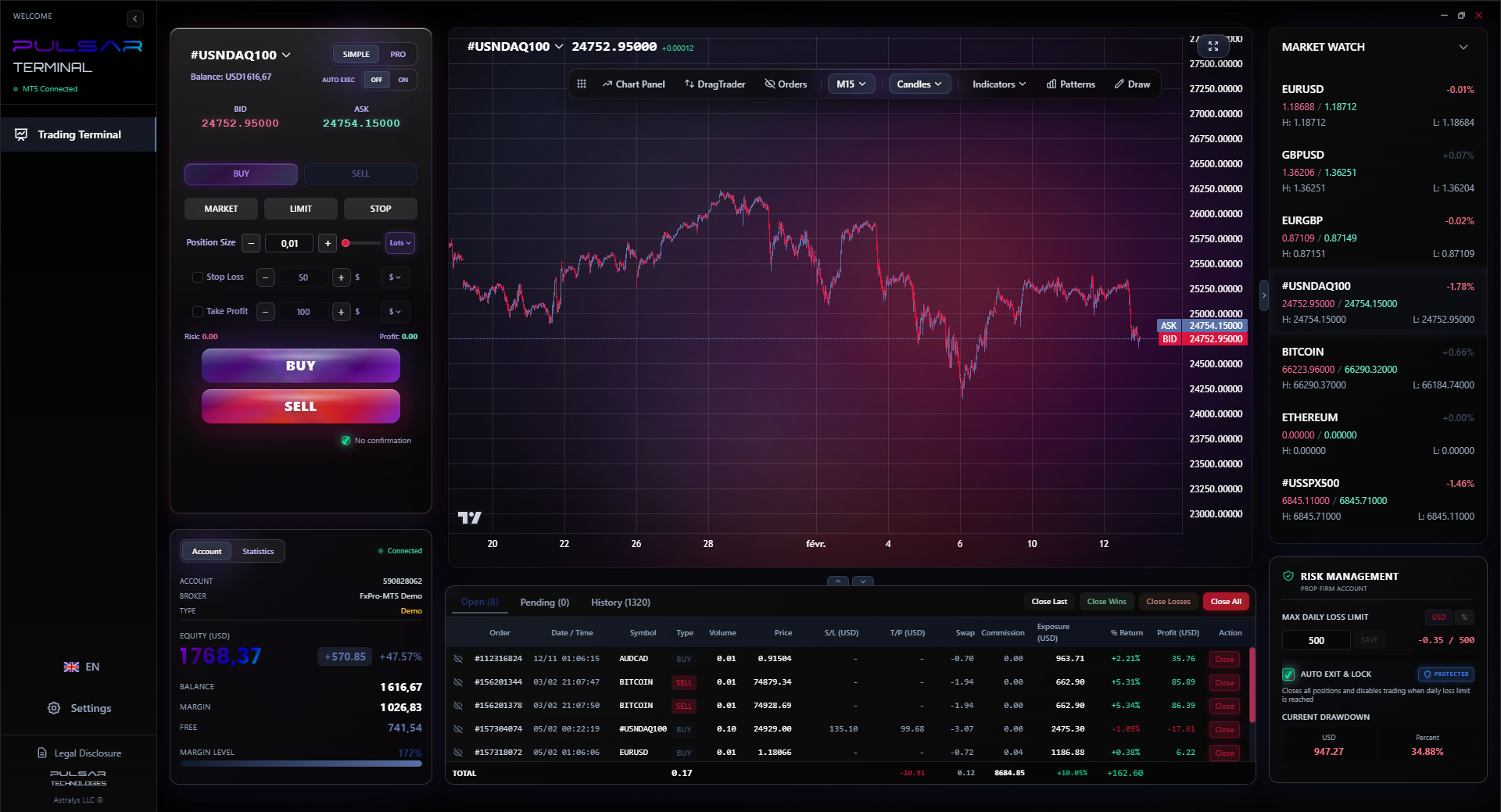
When you move from theory to live trading, managing multiple targets and stops on a single USD/INR position becomes critical, which is where advanced trading tools can help automate the process.
Pulsar Terminal
The all-in-one MT5 companion: drag-and-drop orders, multi-TP/SL, trailing stop, grid trading, Volume Profile, and prop firm protection. Used by 1,000+ traders daily.
Mumbai is full of institutes. Based on my network's experiences, here's a candid take on a few:
- BSE Institute & NSE Academy: These are the gold standard for regulatory and foundational knowledge. Less about "get rich quick" and more about how the markets actually function. Highly recommended for building a solid base.
- Kredent Academy & Mint Internationals: Often mentioned by peers for practical, hands-on sessions with trading platforms used in India.
- Empirical F&M Academy: Has a mixed reputation. Some find their market analysis strong, but always verify their regulatory compliance messaging.
- Asmita Patel Global School Of Trading: Marketed heavily online. Focuses heavily on psychology, which is good, but do your due diligence on the legal aspects they teach.
My advice? Visit them. Sit in on a demo session if possible. Ask direct questions: "How do I legally trade forex from India?" "Can you show me a tax calculation on a sample trade?" "What's your take on the RBI's April 2024 derivatives rule?" Their answers will tell you everything.

Example: A ₹20,000 course needs to help you avoid just one major mistake to pay for itself. One missed pip definition calculation on a large USD/INR position can cost thousands. A good course drills this precision.
💡 Winston's Tip
Your trading journal is your real teacher. The course just gives you the notebook. I've kept one for 4,218 trades. The patterns there made me profitable.
“The market will teach you harsh lessons no course can prepare you for.”
Completing a forex trading course in Mumbai is like getting your driver's license. You know the rules of the road, but you're not ready for the Formula 1 circuit.
Your Post-Course Action Plan:
- Paper Trade for 3-6 Months: Use a demo account on Zerodha or Upstox. Don't touch real money. I paper traded for 4 months and still blew my first live account because the psychology was different.
- Journal Relentlessly: Every trade. Why you took it, your emotion, the outcome. Review weekly. This boring habit is what turned me from a loser into a consistent trader.
- Start Small: When you go live, start with positions so small that a loss doesn't hurt. Your goal is to validate your process, not make money. I started with single lots of USD/INR futures.
- Specialize: The USD/INR behaves differently from the EUR/INR. Don't try to master all four legal pairs at once. Pick one, learn its personality - its average daily range, what news moves it.
- Use the Right Tools: As you advance, basic platform tools might limit you. This is where professional trading software becomes relevant for advanced order types and analysis.
The market will teach you harsh lessons no course can prepare you for. The right course gives you the helmet and seatbelt for that crash.
FAQ
Q1Is forex trading legal in Mumbai?
Yes, but only under strict conditions. You can only trade INR-based pairs (like USD/INR) on SEBI-regulated Indian exchanges (NSE, BSE) through authorized brokers. Trading major pairs like EUR/USD on international platforms is illegal for speculative purposes.
Q2How much does a forex trading course in Mumbai cost?
Costs typically range from ₹8,000 to over ₹1,00,000, with many around the ₹20,000 mark. Price doesn't guarantee quality. Look for complete coverage of Indian regulations, risk management, and platform training, not just trading signals.
Q3Can I use MetaTrader 4 or 5 (MT4/MT5) in India?
You can use the MT4/MT5 platform, but only if your SEBI-regulated Indian broker offers it for trading INR pairs. Using MT4/MT5 with an offshore broker to trade non-INR pairs is against RBI regulations.
Q4What is the minimum deposit to start trading forex legally in India?
With Indian brokers, there's often no fixed minimum deposit, but you need enough capital to meet margin requirements for currency futures. A single USD/INR futures contract might require margin of ₹15,000-₹20,000. Start with a demo account first.
Q5Do forex trading profits get taxed in India?
Absolutely. Profits from trading are considered speculative business income or capital gains and are fully taxable under the Income Tax Act. A good course should provide basic tax guidance or include a session with a finance professional.
Q6What's the difference between a SEBI broker and an international broker for an Indian?
A SEBI broker (like Zerodha) lets you trade legally on Indian exchanges. An international broker (like XM or Pepperstone) offers global pairs but using it for speculation violates FEMA rules. The RBI's LRS scheme cannot be used for this purpose.
Q7Are there free alternatives to paid courses in Mumbai?
Yes. The NSE and BSE websites offer extensive free learning modules. Broker websites like Zerodha's Varsity are fantastic free resources. Use these first to build a base before considering a paid course for mentorship and structured learning.
Prof. Winston's Lesson
Key Takeaways:
- ✓Only trade INR pairs (USD/INR, EUR/INR) on NSE/BSE.
- ✓A good course must cover Indian tax and FEMA rules.
- ✓Paper trade for 3-6 months minimum post-course.
- ✓Risk management is more important than entry signals.
- ✓Your trading journal is your most valuable tool.
How useful was this article?
Click a star to rate
Weekly Trading Insights
Free weekly analysis & strategies. No spam.
About the Author
Rajesh Sharma
Senior Forex Analyst
Trading Indian and South Asian markets for over 10 years. Started with NSE currency derivatives before moving to international forex. Specializes in USD/INR and emerging market pairs.
Comments
Risk Disclaimer
Trading financial instruments carries significant risk and may not be suitable for all investors. Past performance does not guarantee future results. This content is for educational purposes only and should not be considered investment advice. Always conduct your own research before trading.
You Might Also Like

Cara Trading Forex Sukses: 7 Prinsip dari Trader Profesional
Cara trading forex sukses dengan 7 prinsip trader pro: manajemen modal, disiplin, journal trading, backtest. Data nyata, bukan janji profit palsu.
Jam Trading Forex Terbaik untuk Trader Indonesia: Panduan Lengkap dengan Tabel Waktu
Panduan jam trading forex untuk trader Indonesia. Tabel 4 sesi dunia, jam emas 20:00-00:00, sesi mana yang harus dihindari. Data akurat + tips dari trader berpengalaman.
Top 5 Sàn Forex Uy Tín Nhất 2026: Review Jujur dari Trader Indonesia
Top 5 sàn forex uy tín 2026 untuk trader Indonesia. Review jujur: spread, deposit, withdraw, dukungan lokal. Exness, XM, IC Markets & lebih.
Get Pulsar Terminal
All these calculators are built into Pulsar Terminal with real-time data from your MT5 account. One-click position sizing, automatic risk management, and instant calculations.
Get Pulsar Terminal