


I was staring at my screen in my Umhlanga apartment back in 2018, watching USD/ZAR rip from 11.80 to 12.30 in a single session.

David van der Merwe
Emerging Markets Trader ·  South Africa
☕ 11 min read
What you'll learn:
I was staring at my screen in my Umhlanga apartment back in 2018, watching USD/ZAR rip from 11.80 to 12.30 in a single session. I'd just taken a massive loss, convinced I knew the Rand's moves. I didn't. That loss cost me R45,000. It was the moment I realized that the 'knowledge' I'd paid for in a fancy Sandton seminar was worthless. This guide isn't about selling you another dream. It's about cutting through the noise around forex trading courses in Durban and showing you what you actually need to survive.
Trading from Durban isn't like trading from London or New York. Our market hours, our currency's volatility, and our specific regulatory cage create a unique battlefield. The ZAR isn't for the faint-hearted. I've seen USD/ZAR swing 500 pips in a week on pure political noise from Pretoria. That kind of move can wipe out an account faster than you can say 'load shedding.'
First, understand the legal cage. The FSCA caps use at 30:1 for retail traders. That's a good thing, honestly. I've seen too many guys in Durban North blow up accounts with 500:1 use from offshore brokers, chasing that one big win. The FSCA's push for ODP licenses means the cowboy days are ending. Brokers need more capital, and you get more protection. Use a FSCA-regulated broker like IC Markets or Pepperstone. Don't be clever and go offshore for higher use; it's a shortcut to the poorhouse.
Then there's funding. You can't just wire Rands directly to speculate against the ZAR. You use your foreign capital allowance (R10 million per year) through an Authorised Dealer. Most decent brokers offer ZAR accounts now, which saves you conversion fees. Payment? I use EFT for larger amounts and Skrill for speed. Just know your bank might ask questions if you're moving money to Cyprus or the Seychelles frequently.

Warning: The FSCA has been screaming from the rooftops about social media 'gurus' on Instagram and Telegram selling signals. If someone promises you 10% a month from a Durban basement, they're running a scam. Providing trading signals is a financial service that requires an FSP license. Full stop.
“A course that skips psychology or risk management is teaching you how to drive a car without mentioning brakes.”
Let's talk about the actual forex trading courses in Durban you'll find. I've sat through some of these, and my students have brought me their notes from others. Here's the unvarnished truth.
The Knowledge Academy: They offer a 1-day Forex Trading Course in Durban. One day. Let that sink in. You cannot learn to trade in a day. You can learn some terminology and maybe how to place a buy order. For the price (which they don't openly list, but similar courses run from ZAR 246 to over ZAR 5,000), you're getting an expensive introduction. It's like paying for a one-day seminar on how to be a brain surgeon. Useful? Maybe as a first taste. Sufficient? Not a chance.
CTFX School of Trading: They advertise a 'Premier' course with private coaching. This looks more hands-on. They talk about Nasdaq, Gold, and US30 strategies, which is good - diversifying beyond just forex. The lifetime coaching promise raises my eyebrow. What does that actually mean? Is it unlimited WhatsApp support, or a monthly group call? Get specifics. If the mentorship is structured and the coach has a verifiable track record (ask for it!), this could have value. But 'lifetime' often means 'until we stop answering your emails.'
Wealth Forex Academy: Based in Sandton, but their online courses are accessible. Their pricing is transparent, which I respect. R4,999 for the online Standard package (3 weeks training, 6 months mentorship). R9,999 for the Premium (6 weeks, 12 months mentorship). That's a serious chunk of change. For R10k, you could fund a small trading account and learn by doing. The question is: does their mentorship provide real-time trade feedback, or just pre-recorded videos? The latter isn't mentorship; it's a video library.
The Bigger Picture
Here's my issue with most structured courses: they teach a single, rigid system. The market doesn't work like that. What works on EUR/USD in the London session might get you slaughtered on USD/ZAR during a SARB announcement. A good course should teach you how to think, not what to think. It should cover risk management and psychology more than it covers fancy indicators.

Pro Tip: Before you pay for any course, ask the provider for a 30-minute consultation. Ask them: 'What was your worst trade last month, and what did you learn?' If they can't or won't share a real, recent mistake, walk away. They're selling an illusion.

💡 Winston's Tip
Your first R10,000 is better spent on 20 small, real trades (risking R500 each) than on any course. Real loss teaches what theory cannot.
“The course fee is the smallest part of the cost. Your real tuition is paid with your own lost capital.”
Everyone focuses on the course fee. That's the smallest part of the cost. Let me break down what learning to trade from Durban actually costs you, using real numbers from my own journey.
1. The Tuition Fee (The Obvious Cost): Say you pay R7,500 for a mid-tier course. That's just the entry ticket.
2. The 'Demo to Live' Losses (The Inevitable Cost): No course can simulate the psychology of real money. Your first live account will likely blow up. My first proper live account was R20,000 with Exness. I traded it down to R12,000 in six weeks chasing losses. That R8,000 was my real tuition.
3. Platform & Data Costs (The Hidden Cost): If you want to get serious, a demo MT4 account won't cut it. You need proper backtesting software, maybe a VPS for running bots if your Durban internet is flaky during storms, and reliable data feeds. That can run you R500-R1000 a month easily.
4. The Opportunity Cost (The Silent Killer): The hours you spend analyzing, studying, and stressing. Hundreds of hours. What's your time worth?
Let me give you a concrete example from 2022. I took a course on Market Profile (cost: R6,000). I then spent two months backtesting a strategy on USD/ZAR. I lost R15,000 in live markets tweaking it before it became profitable. The total cost of acquiring that one skill? R21,000 plus 200 hours of my life. That's the reality. A course gives you a map, but you pay for the journey with your own capital and time.
“The course fee is the smallest part of the cost. Your real tuition is paid with your own lost capital.”
This is the eternal debate. Here’s my blunt opinion: you need both, but in the right order.
Start with FREE self-education. I'm serious. Don't spend a cent yet.
- Read every article, glossary term, and guide on sites like this one. Understand what a pip really is, how spread works, and what swing trading entails.
- Open a demo account with a broker like Pepperstone or XM. Trade it for three months. Not a week. Three full months.
- Learn the basic indicators yourself. Play with the RSI and MACD on your MT4 chart. See how they behave on the ZAR pairs versus the majors.
Then, and only then, consider a paid course. Why? Because now you have context. You know what you don't know. You'll be able to ask specific questions like, 'How does your strategy handle gaps during the Asian session on USD/ZAR?' instead of 'What's a candle?'
A structured course should solve specific problems you've already encountered. It should accelerate your learning, not initiate it. The best course I ever bought was a R8,000 advanced price action course after I'd already been trading for four years. It fixed a specific leak in my process. I wouldn't have understood a word of it as a beginner.

Example: A student of mine spent R5,000 on a 'beginners bootcamp.' He didn't know how to use a position size calculator. He blew his account in a week because he was risking 5% per trade on 30:1 use. The course never covered it. That's criminal. Learn the absolute basics for free first.
💡 Winston's Tip
The best course supplement? A cheap notebook. Write down the reason for every trade. Your biggest enemy is your own forgotten excuses.
“There are no secrets. Successful trading is about discipline and risk management, not a hidden indicator.”
Durban, like the rest of SA, is fertile ground for forex scams. The FSCA warning list grows every week. Here’s how to not become a statistic.
Red Flag 1: Promises of Specific Returns. 'Make 15% monthly guaranteed!' Run. The market offers no guarantees. My best year ever was 42% return on capital. My worst was a 22% drawdown. Anyone promising steady, high returns is lying.
Red Flag 2: The 'Secret System.' There are no secrets. Successful trading is about discipline and risk management, not a hidden indicator. If they're selling a 'once-in-a-lifetime algorithm,' it's probably a repainted moving average they bought for $50 on MQL5.
Red Flag 3: Pressure to Sign Up. 'This offer expires tonight!' That's marketing 101 for suckers. Real education doesn't have a fake deadline.
Red Flag 4: No Verifiable Track Record. Ask for a verified myfxbook or FX Blue statement showing real, live results over at least two years. If they say it's 'proprietary' or 'confidential,' they have none. I share my worst drawdowns with my students. It builds trust.
Red Flag 5: The Social Media Glamour. The Instagram feed full of luxury cars, watches, and 'lifestyle.' Real traders spend most of their time in front of a screen in sweatpants, not on a yacht. That lifestyle porn is funded by course sales, not trading profits.
Do this: Go to the FSCA website. Use their 'Search for an authorised financial services provider' function. Type in the company or individual's name. If they're not there, and they're offering training or signals, they are operating illegally. It's that simple.
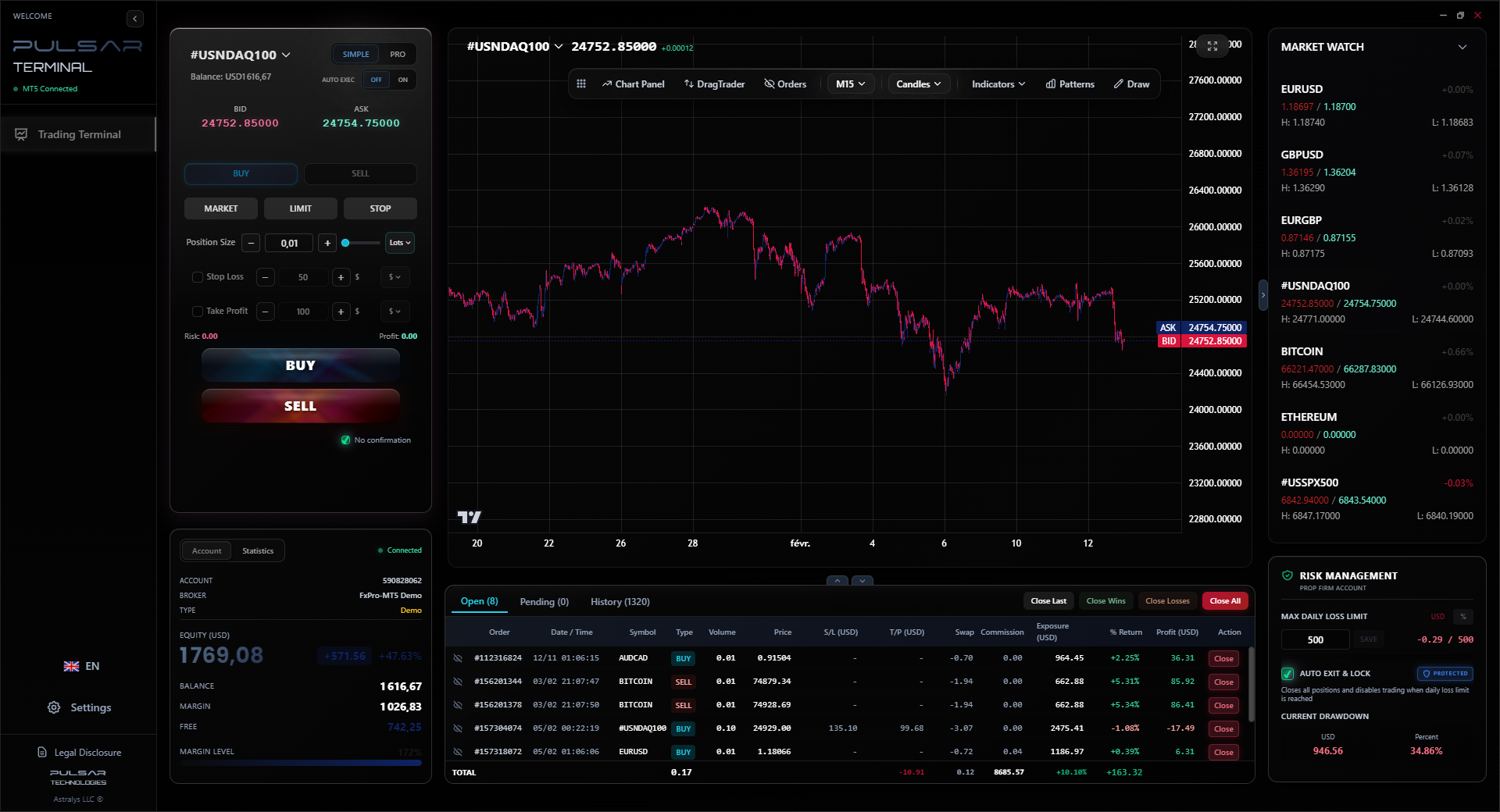
Managing multiple trades and strict risk rules is complex, but tools like Pulsar Terminal automate this directly on your MT5, turning a course's theory into executable, disciplined action.
Pulsar Terminal
The all-in-one MT5 companion: drag-and-drop orders, multi-TP/SL, trailing stop, grid trading, Volume Profile, and prop firm protection. Used by 1,000+ traders daily.
“There are no secrets. Successful trading is about discipline and risk management, not a hidden indicator.”
If you're going to spend money on forex trading courses in Durban, use this checklist. Don't settle for less.
| Topic | What to Look For | Why It's Critical for Durban Traders |
|---|---|---|
| Risk Management | Concrete rules: max risk per trade (e.g., 1%), daily loss limits, use of stop-losses. | Volatile pairs like USD/ZAR can stop you out quickly. You need iron-clad rules. |
| Psychology | Handling fear, greed, revenge trading. Journaling techniques. | This is 80% of the game. Local market stress (load shedding, ZAR crashes) tests your mind. |
| Broker & Platform Setup | How to set up MT4/5, configure charts, understand order types. | Saves you tech headaches and prevents costly mis-clicks. |
| Market Analysis - BOTH Types | Technical analysis (price action, support/resistance) AND Fundamental analysis (SARB rates, commodity prices). | The ZAR is driven by gold, politics, and USD strength. You need to understand why, not just see a pattern. |
| Strategy with Edge | A clear, rules-based strategy for entry, exit, and trade management. Backtested results. | You need a repeatable process, not random guesswork. |
| Local Market Nuances | Specific discussion on trading ZAR pairs, liquidity times, impact of SA news. | Trading EUR/USD at 10am SA time is different from trading USD/ZAR. |
| Post-Course Support | Active mentorship, Q&A sessions, a community. Not just pre-recorded videos. | You will have questions when you trade live. You need access to answers. |
A course that skips psychology or risk management is teaching you how to drive a car without mentioning brakes. It's negligent. The best course I ever took spent its first four modules solely on mindset and risk. The actual strategy came last.
💡 Winston's Tip
If a strategy doesn't work on USD/ZAR with a 1.5% risk limit, it's not a strategy. It's a prayer. Test everything against the Rand's volatility first.
“Your goal in year one shouldn't be profitability; it should be survival. Don't blow up your account.”
The market has changed. Low volatility in 2026 means those old scalping strategies might not work like they did. Here's how I'm adapting, and what you should consider.
Focus on Swing Trading: With potential carry trades coming back into favor, holding positions for days or weeks to capture interest rate differentials might be smarter than frantic day trading. This pairs well with a full-time job in Durban - you don't need to stare at screens all day.
Master One Pair First: Don't try to trade everything. Start with USD/ZAR or EUR/USD. Learn its personality, its average daily range, how it reacts to news. I traded nothing but XAU/USD (Gold) for my first two years. Depth beats breadth every time.
Your First Investment Should Be a Journal, Not a Course: Buy a notebook. Log every demo trade: entry, exit, why you took it, your emotion. Review it weekly. This free habit will teach you more about yourself than any guru can.
Connect with Local Traders (Carefully): Look for legitimate, non-salesy meetups or online forums. Sharing ideas with other South Africans who understand the local context is useful. Just avoid the ones trying to recruit you into a pyramid scheme.
Finally, manage your expectations. This is a skill, like law or medicine. It takes years. If a course promises to make you a profitable trader in a month, it's lying. Your goal in year one shouldn't be profitability; it should be survival. Don't blow up your account. Learn, preserve capital, and build slowly. That's the only path that works.
FAQ
Q1Are forex trading courses in Durban worth the money?
It depends entirely on the course and you. A good course with real mentorship can accelerate your learning. A bad one is a waste of R5,000-R15,000. You must do extensive free self-education first to even judge a course's value. Never buy a course as your first step into trading.
Q2What is the typical cost of a forex trading course in South Africa?
Costs vary wildly. You'll see short introductory courses from around ZAR 2,500. More complete training with mentorship typically ranges from ZAR 5,000 to ZAR 15,000. The most expensive 'premium' packages can exceed R20,000. Remember, the course fee is a small part of your total learning cost.
Q3Can I learn forex trading for free in Durban?
Absolutely. The foundational knowledge is all available for free online: broker tutorials, YouTube videos on basic analysis, and articles on risk management. Open a demo account and practice for months. Paid courses should only be considered once you have a solid base and specific questions that free resources can't answer.
Q4How do I know if a forex course or mentor is a scam?
Check the FSCA website to see if they are a licensed Financial Services Provider (FSP). Be wary of guaranteed profits, 'secret' strategies, heavy social media lifestyle marketing, and pressure to sign up. Always ask for a verifiable, long-term track record of live trading results. If they refuse or make excuses, it's a major red flag.
Q5What trading platform is best for beginners in Durban?
MetaTrader 4 (MT4) is still the most common and beginner-friendly. Almost every broker offers it, and there are countless free tutorials. It's reliable and does everything a new trader needs. Stick with MT4 on a demo account from a broker like XM or Pepperstone until you're completely comfortable.
Q6Is it legal to trade forex in Durban, South Africa?
Yes, it is legal. The Financial Sector Conduct Authority (FSCA) regulates the market. You should use an FSCA-licensed broker for protection. There are rules: use is capped at 30:1 for retail traders, and you must use your foreign capital allowance to fund international accounts. Trading with unregulated offshore brokers is legal but carries significantly higher risk.
Q7What should I learn first before trading with real money?
Learn these three things inside out: 1) How to calculate your position size and risk per trade (use a calculator). 2) How to place a stop-loss and take-profit order. 3) The basic economic drivers of the currency pair you want to trade (e.g., what moves the Rand?). Without this knowledge, you are gambling, not trading.
Prof. Winston's Lesson
Key Takeaways:
- ✓use is capped at 30:1 for a reason. Respect it.
- ✓Test every strategy first on volatile USD/ZAR.
- ✓The FSCA website is your scam-check bible. Use it.
- ✓Master one pair before you even look at a second.
- ✓Your trading journal is more valuable than any indicator.
How useful was this article?
Click a star to rate
Weekly Trading Insights
Free weekly analysis & strategies. No spam.
About the Author
David van der Merwe
Emerging Markets Trader
Johannesburg-based trader with 11 years in emerging market currencies. Specializes in ZAR pairs, FSCA-regulated trading, and South African market analysis.
Comments
Risk Disclaimer
Trading financial instruments carries significant risk and may not be suitable for all investors. Past performance does not guarantee future results. This content is for educational purposes only and should not be considered investment advice. Always conduct your own research before trading.
You Might Also Like

Cara Trading Forex Sukses: 7 Prinsip dari Trader Profesional
Cara trading forex sukses dengan 7 prinsip trader pro: manajemen modal, disiplin, journal trading, backtest. Data nyata, bukan janji profit palsu.
Jam Trading Forex Terbaik untuk Trader Indonesia: Panduan Lengkap dengan Tabel Waktu
Panduan jam trading forex untuk trader Indonesia. Tabel 4 sesi dunia, jam emas 20:00-00:00, sesi mana yang harus dihindari. Data akurat + tips dari trader berpengalaman.
Top 5 Sàn Forex Uy Tín Nhất 2026: Review Jujur dari Trader Indonesia
Top 5 sàn forex uy tín 2026 untuk trader Indonesia. Review jujur: spread, deposit, withdraw, dukungan lokal. Exness, XM, IC Markets & lebih.
Get Pulsar Terminal
All these calculators are built into Pulsar Terminal with real-time data from your MT5 account. One-click position sizing, automatic risk management, and instant calculations.
Get Pulsar Terminal