


I lost $847 in my first week trading forex.
James Mitchell
Senior Trading Analyst
☕ 12 min read
What you'll learn:
I lost $847 in my first week trading forex. I thought I'd cracked the code with some YouTube strategy, went all-in on EUR/USD with way too much use, and got stopped out during the London open. The market didn't care about my confidence. That experience taught me what most 'forex trading for beginners PDF' guides won't tell you: it's not about finding a secret indicator. It's about understanding the rules of the game here in the US, managing risk like your life depends on it, and building real skill. Let me save you that $847 and a whole lot of frustration.
Trading in America comes with a specific rulebook. Ignore it, and you're playing a different game than everyone else. Our market is policed by two main organizations, and they're not messing around.
The Commodity Futures Trading Commission (CFTC) is the big federal watchdog. Their job is to keep the markets fair. Then you have the National Futures Association (NFA), which is the self-regulatory body every legit broker has to answer to. If a broker isn't registered with both, run. Don't even think about it.
Here's the rule that changes everything for beginners: use caps. In the US, you're limited to 50:1 on major pairs like EUR/USD and just 20:1 on minors and exotics. You'll see folks online from other countries talking about 500:1 or even 1000:1. That's not our reality. This rule probably saved me from blowing up my entire account in those early days. It forces you to use more of your own capital, which makes you think twice before entering a trade.

Warning: The NFA doesn't have an investor compensation fund like some European regulators. If a broker goes under, recovering funds can be a long legal process. This makes choosing a well-capitalized, reputable broker non-negotiable.
Brokers also have to keep your money in segregated accounts. That means your trading capital is separate from the broker's operating funds. They can't use it to pay their office rent. It's a basic but critical protection.
Taxes? Yeah, you gotta pay 'em. Forex profits are generally taxed as ordinary income under Section 988 rules. Keep a detailed trade journal from day one. I use a simple spreadsheet logging entry, exit, profit/loss, and the date. Come tax season, you'll be glad you did.

💡 Winston's Tip
The market's job is to find the price where the most people will be wrong. Your job is to not be one of them. Focus on your exit, not your entry.
Forget the 'commission-free' marketing. Trading is never free. Your profits get chipped away by costs, and if you don't account for them, you'll wonder why you're always barely breaking even.
The Spread: Your Silent Partner (Who Takes a Cut)
This is the difference between the buy and sell price. It's how many brokers make their money. On a major pair like EUR/USD, a good spread might be 0.6 to 1.0 pips during active hours. That means the price has to move in your favor by that amount just for you to be at breakeven. On exotic pairs, spreads can be 3, 5, or even 10 pips wide. I learned this the hard way trying to trade USD/TRY. The spread was so huge I was down $50 the second I entered the trade.
Commissions & Other Fees
Some brokers, especially those with 'raw' or 'professional' accounts, charge a commission instead of widening the spread. It might be $5 per 100,000 units (a standard lot). You need to do the math. A tight spread plus a commission can sometimes be cheaper than a wide, 'commission-free' spread.
Then there's the swap rate, or overnight financing fee. If you hold a position past 5 PM New York time, you pay or receive interest based on the difference between the two currencies' central bank rates. For a beginner holding trades for a few days, it's usually a small cost. But if you're trying a carry trade strategy, it becomes central to your plan.
Inactivity fees are a sneaky one. Some brokers will charge you (say, $10 a month) if you don't place a trade for a set period, like 12 months. Just be aware of your broker's policy.

Example: Let's say you buy 1 standard lot of EUR/USD (a $100,000 position).
- Spread Cost: 1.0 pip = $10
- Commission (if applicable): $5
- Total to Break Even: $15 The price needs to move 1.5 pips in your favor before you see a cent of profit.
That's why understanding position size is more important than predicting the market. A tool like that can show you exactly how much each pip is worth, so you're never surprised.
“Your risk management is your strategy. Decide where you're wrong before you enter.”
Your broker is your gateway to the market. A bad one can ruin you with requotes, slippage, and shady practices. A good one becomes invisible, executing your trades cleanly. For US traders, your list of regulated options is shorter than elsewhere, but that's not a bad thing. It simplifies the choice.
I've had accounts with a few of the major players. Here's the straight talk.
OANDA was my first. Their $0 minimum deposit let me start small, which I recommend. Their platform is solid for beginners, and I never had an issue withdrawing money. Spreads are competitive. They're a classic, reliable choice to learn the ropes.
Forex.com is another giant. They offer multiple account types. Their standard account has no commission but wider spreads. Their commission-based account can be cheaper for active traders. Their research and educational materials are top-notch for a beginner digging into their first forex trading for beginners PDF style of learning.
Interactive Brokers is the choice if you think you might branch out into stocks, options, or futures later. Their forex fees are incredibly low, but their platform (Trader Workstation) has a steep learning curve. It's not where I'd send a total newbie on day one.
The key is to open a demo account first. Test their platform. See how the spreads look during the volatile New York open at 8 AM ET. Try placing and closing orders. Does it feel clunky or smooth? Your broker's platform is your office. Make sure you can work in it.
Also, check their customer service. Call them. Ask a dumb question. See how long it takes to get a real person and if they're helpful. You don't want to find out they're terrible when you have a live trade on and can't access your account.
When I started, I had 15 indicators on my chart. It looked like a rainbow vomited on my screen. I was paralyzed. The truth is, simple works. Your goal in the first six months isn't to get rich. It's to not lose money while you learn.
Start with one or two major pairs. I always recommend EUR/USD. It's the most liquid, has tight spreads, and moves in clear trends. Spend a month just watching it. Notice how it reacts at 8 AM ET (NY open), 2 PM ET (London close), and around major news events.
Find one way to identify a trend. The 50 and 200-period Simple Moving Average (SMA) crossover is a classic for a reason. Price above both? General uptrend. Price below? Downtrend. Your first rule: only take trades in the direction of the higher timeframe trend. This alone will keep you out of a world of bad, counter-trend trades.
Then, find one way to find an entry. Support and resistance is a great place to start. In an uptrend, look for the price to pull back to a previous support level and show signs of bouncing. That's a potential entry. Use a basic indicator like the RSI indicator to see if the pullback is overdone (like an RSI dipping below 30 in an uptrend).
Your risk management is your strategy. Decide where you're wrong before you enter. That's your stop-loss. A common beginner method is to place your stop just beyond the recent swing low (in an uptrend) or swing high (in a downtrend). Then, use your position size calculator to figure out how many units to trade so that if your stop is hit, you only lose 1% of your account.

Pro Tip: Practice this exact process on a demo account for 100 trades. Log every single one. Entry reason, stop loss, target, outcome. Don't skip the losers. Review the log weekly. This journal is your real 'forex trading for beginners PDF' – it's written by you, about your own behavior.
💡 Winston's Tip
A losing trade where you followed your plan is a good trade. A winning trade where you broke your rules is a disaster. One teaches you discipline, the other teaches you bad habits.
“A trader who loses 50% of their account needs a 100% return just to get back to breakeven.”
This is the part no PDF can teach you, but it's 80% of the battle. Trading will test your personality flaws like nothing else. My biggest early flaw was revenge trading. I'd lose $100 on a bad EUR/USD trade, get angry, and immediately jump into another trade twice the size to 'make it back.' I'd usually lose another $250.
You have to learn to separate your ego from your P&L. A losing trade isn't a failure. It's a cost of doing business, like a restaurant buying ingredients. A series of losing trades is information, telling you maybe the market conditions have changed or your strategy isn't working right now.
Fear of missing out (FOMO) is another account killer. You see a pair rocketing up, you jump in late near the top, and it reverses. You're left holding the bag. Have a plan, and wait for your setup. If you miss it, there's always another trade tomorrow. The market isn't going anywhere.
Finally, you have to be brutally honest with yourself. Are you trading for the excitement? Or are you treating it like a skilled profession? I had to admit I loved the adrenaline at first. Turning that into a disciplined, sometimes boring routine was the real key to becoming consistently profitable. Tools that help automate discipline, like setting stop-losses the second you enter, are useful. A platform that lets you set multiple take-profit levels and move your stop to breakeven automatically can remove emotional decisions from the equation entirely.
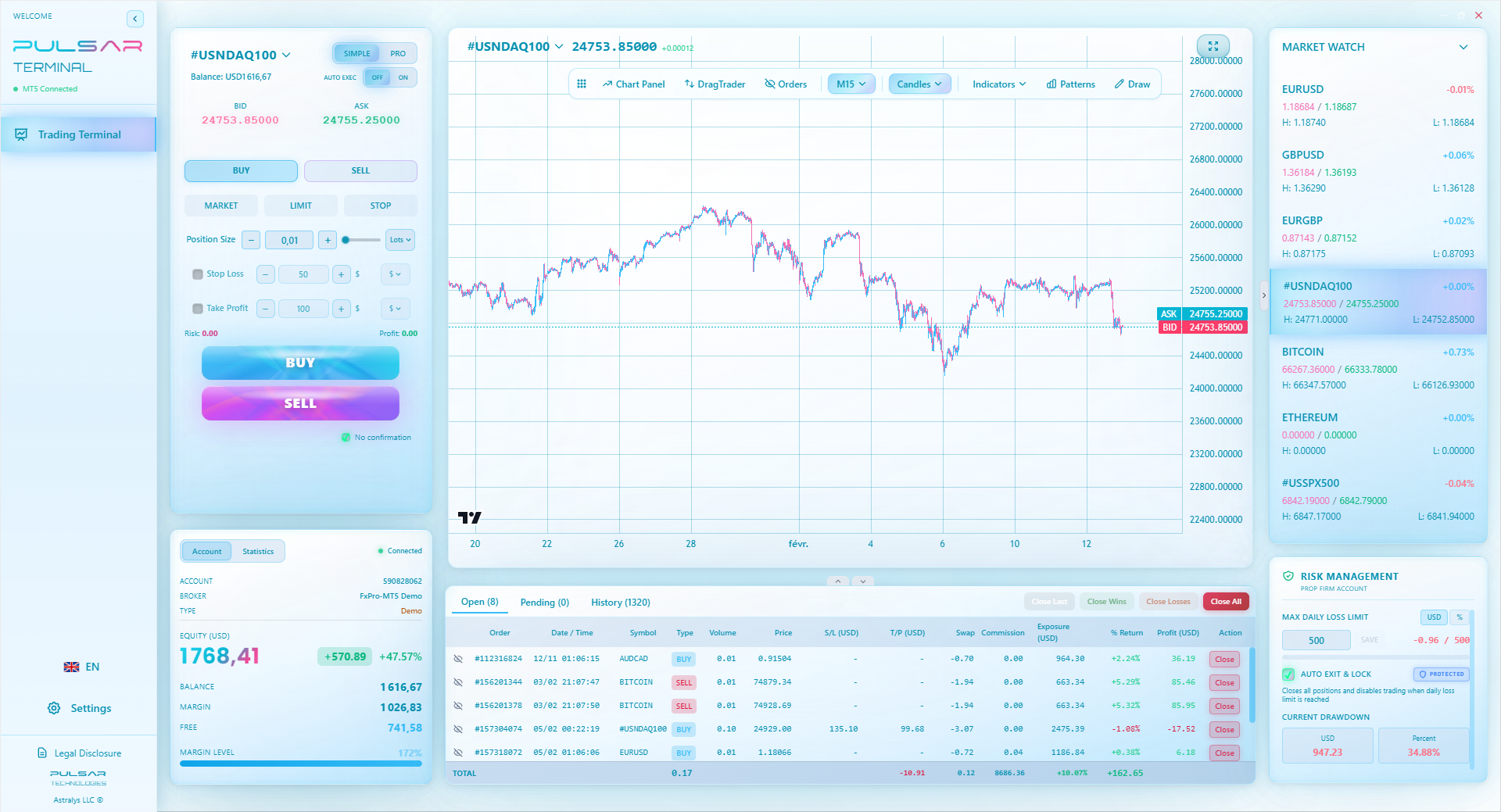
Sticking to a disciplined exit strategy is the hardest part of trading, which is why tools that automate stop-loss and take-profit orders directly on your MT5 chart are so valuable for beginners.
Pulsar Terminal
The all-in-one MT5 companion: drag-and-drop orders, multi-TP/SL, trailing stop, grid trading, Volume Profile, and prop firm protection. Used by 1,000+ traders daily.
Instead of searching for that one magic guide, create your own living document. This is your trading plan, and it should be specific enough that a stranger could read it and execute your strategy.
Section 1: The Rules. Write down your hard limits. 'I will never risk more than 1% of my account on a single trade.' 'I will not trade during major news events like Non-Farm Payrolls.' 'I will review my trade journal every Sunday night.'
Section 2: The Strategy. Define your setup in painful detail. 'I trade EUR/USD on the 1-hour chart. I confirm the trend using the 50 EMA. I look for pullbacks to the 20 EMA. My entry trigger is a bullish engulfing candle on the 15-minute chart. My stop loss is 15 pips below the entry candle's low. My take-profit is 30 pips away, giving me a 1:2 risk-to-reward ratio.'
Section 3: The Checklist. A pre-trade checklist prevents impulsive mistakes. Mine has five questions: 1) Is this my defined setup? 2) Is my risk 1% or less? 3) Have I marked my stop-loss and take-profit? 4) Is there major news within the next hour? 5) Am I emotionally calm?
Section 4: The Post-Mortem. A template for reviewing your trades. What was the outcome? Did I follow my plan? If I lost, was it a good trade that just didn't work, or did I break my rules?
Print this document. Keep it next to your screen. When you feel the urge to deviate, read it. This self-made guide is infinitely more valuable than any generic 'forex trading for beginners PDF' you'll download. It forces you to think through your process, and that's where the learning happens.
For analyzing those trades, getting a clean read on the market structure is half the fight. Having a charting tool that clearly shows you where price has historically stalled or broken through - those support and resistance zones - takes the guesswork out of where to place your stops and targets.
💡 Winston's Tip
If you can't explain your trade setup in one simple sentence, you don't have a strategy. You have a hope.
“The only person who should care about your money is you.”
Let me save you some time and pain by listing the holes I fell into, so you can walk around them.
Pitfall 1: Chasing 'Surefire' Robot or Signal Services. I paid $97 a month for a signal service in my second month. The alerts were always late, and the logic was opaque. You never learn, and you're trusting your money to a stranger. The only person who should care about your money is you.
Pitfall 2: Over-trading. This isn't a video game. More trades don't equal more profit. In fact, the opposite is often true. My most profitable months have had fewer than 20 trades. Quality over quantity. If you're bored, you're probably doing it right.
Pitfall 3: Ignoring the Higher Timeframe. I'd see a beautiful buy setup on the 5-minute chart while the 4-hour chart was screaming 'downtrend.' I'd buy anyway and get crushed. Always zoom out. The trend on the 1-hour or 4-hour chart is your boss.
Pitfall 4: Moving Your Stop-Loss Further Away. This is the 'hope' trade. Your trade goes against you, and instead of taking the small, planned loss, you move your stop, hoping it'll come back. It's a recipe for turning a $50 loss into a $500 loss. Respect your initial stop. It's there for a reason.
Pitfall 5: Not Accounting for the Spread. As mentioned, if your strategy relies on scalping for 5-pip gains but the spread is 3 pips, you need the market to move 8 pips in your favor just to make 2. That's a terrible bet. Make sure your average target is significantly wider than the average spread for your chosen pair.
The biggest trap is thinking you'll be the exception to these rules. You won't. We all think we're smarter until the market humbles us. Accept that these pitfalls exist and build defenses against them into your trading plan.
FAQ
Q1Is forex trading legal in the United States?
Yes, absolutely. It's legal and regulated by the Commodity Futures Trading Commission (CFTC) and the National Futures Association (NFA). The key is you must use a broker that is registered with these bodies. Trading with an unregulated, offshore broker as a US resident is a very bad idea and offers you no legal protection.
Q2What's the minimum amount I need to start trading forex in the US?
Technically, some brokers like OANDA have a $0 minimum. But realistically, you shouldn't start a live account with less than $500, and $1,000 is a better buffer. Why? With US use limits (max 50:1), you need enough capital to make meaningful trades while still obeying the 1% risk rule. With a $100 account, a 10-pip stop-loss might only allow you to trade a tiny position size, making commissions and spreads eat you alive.
Q3Why is use so low in the US compared to other countries?
It's a consumer protection rule. After the 2008 financial crisis, regulators looked at the high number of retail traders blowing up accounts with massive use and decided to cap it. The 50:1 (for majors) and 20:1 limits force you to use more of your own skin in the game, which theoretically makes you more careful. As frustrating as it can feel when you see others with 500:1, it's probably saved more beginner accounts than any educational course.
Q4How are my forex profits taxed?
For most individual traders, forex trading profits are taxed as ordinary income under the Section 988 election. This means your net profit for the year gets added to your other income and taxed at your standard income tax rate. You can't claim capital gains rates. Keep careful records of every trade. Some active traders may qualify for Section 1256 treatment (60/40 long-term/short-term capital gains), but that's complex - talk to a tax pro who understands trading.
Q5What's the single most important thing for a beginner to focus on?
Risk management. Full stop. Before you learn a single candlestick pattern, learn how to calculate your position size and where to place a stop-loss. Your first goal is survival. A trader who loses 50% of their account needs a 100% return just to get back to breakeven. Protect your capital like it's the last dollar you'll ever have. Everything else - entries, strategies, psychology - builds on that foundation.
Q6Are demo accounts useful, or are they just a game?
They are incredibly useful if you use them correctly. The mistake is treating them like a game where you YOLO huge positions. Use a demo account to practice your exact trading plan with real market conditions. Test your risk management. Practice entering and exiting trades without the pressure of real money. Do this for at least 2-3 months and 100+ trades. The goal isn't to make fake money; it's to build consistent habits before real cash is on the line.
Prof. Winston's Lesson
Key Takeaways:
- ✓US use caps (50:1) are a protective cage, not a limitation.
- ✓The spread is your first opponent; know its size before you trade.
- ✓Risk only 1% of your capital on any single trade.
- ✓100 demo trades with a journal teach more than any PDF.
How useful was this article?
Click a star to rate
Weekly Trading Insights
Free weekly analysis & strategies. No spam.
About the Author
James Mitchell
Senior Trading Analyst
Based in New York with over 9 years of trading experience. Focuses on major USD pairs, prop firm challenges, and the US regulatory landscape.
Comments
Risk Disclaimer
Trading financial instruments carries significant risk and may not be suitable for all investors. Past performance does not guarantee future results. This content is for educational purposes only and should not be considered investment advice. Always conduct your own research before trading.
You Might Also Like

Cara Trading Forex Sukses: 7 Prinsip dari Trader Profesional
Cara trading forex sukses dengan 7 prinsip trader pro: manajemen modal, disiplin, journal trading, backtest. Data nyata, bukan janji profit palsu.
Jam Trading Forex Terbaik untuk Trader Indonesia: Panduan Lengkap dengan Tabel Waktu
Panduan jam trading forex untuk trader Indonesia. Tabel 4 sesi dunia, jam emas 20:00-00:00, sesi mana yang harus dihindari. Data akurat + tips dari trader berpengalaman.
Top 5 Sàn Forex Uy Tín Nhất 2026: Review Jujur dari Trader Indonesia
Top 5 sàn forex uy tín 2026 untuk trader Indonesia. Review jujur: spread, deposit, withdraw, dukungan lokal. Exness, XM, IC Markets & lebih.
Get Pulsar Terminal
All these calculators are built into Pulsar Terminal with real-time data from your MT5 account. One-click position sizing, automatic risk management, and instant calculations.
Get Pulsar Terminal