


Here's a number that might surprise you: Nigeria's forex market turnover jumped 56.4% to $8.6 billion in 2025.

Olumide Adeyemi
West African Trading Pioneer ·  Nigeria
☕ 12 min read
What you'll learn:
- 1What Is Forex Trading, Really?
- 2The Legal Stuff: Rules, Taxes, and Nigerian Reality
- 3The Real Costs: From Minimum Deposit to Hidden Fees
- 4Your First Trade: A Step-by-Step Walkthrough
- 5Simple Strategies That Actually Work in Nigeria
- 6Mistakes Every Nigerian Trader Makes (And How to Avoid Them)
- 7Your Action Plan: What to Do Now
Here's a number that might surprise you: Nigeria's forex market turnover jumped 56.4% to $8.6 billion in 2025. That's not just big money moving around - it's a sign that more people like you and me are getting involved. But here's the thing nobody tells you upfront: about 80% of retail traders lose money in their first year. The difference between joining that statistic or beating it comes down to truly understanding how forex trading works, especially here in Nigeria where our rules and realities are unique.
At its core, forex trading is simply exchanging one currency for another, hoping the value changes in your favor. You're betting that one currency will strengthen against another. When you hear 'EUR/USD,' you're looking at the Euro versus the US Dollar. If you buy it, you're betting the Euro will rise against the Dollar.
But here's where it gets interesting for us in Nigeria. We're not just trading major pairs from afar. The Nigerian Naira (NGN) itself is a traded currency. You'll see pairs like USD/NGN or GBP/NGN. Trading these feels different because you're dealing with a currency you use every day. I remember watching USD/NGN spike during a CBN policy announcement in 2023. The volatility was insane - opportunity and risk wrapped together.
The market operates 24 hours a day, five days a week, moving through sessions in Tokyo, London, and New York. That London-New York overlap (2 PM to 5 PM Nigerian time) is usually when things get most active. Perfect for trading after work.

Warning: Trading Naira pairs can be emotionally tricky. You might think you understand the local news better, but that can lead to overconfidence. Always use the same risk management rules you would for EUR/USD.
Most retail trading happens through contracts for difference (CFDs). You don't actually own the currency; you're speculating on price movements. This is where use comes in - a broker lets you control a large position with a small deposit. It's powerful, but it's also why so many blow up accounts. We'll get to that soon.

💡 Winston's Tip
Your first profitable skill isn't picking entries, it's managing exits. A good stop loss saves more accounts than a perfect entry ever will.
This is the part most new traders skip, and it's a massive mistake. Yes, forex trading is legal for individuals in Nigeria. The key regulators are the Central Bank of Nigeria (CBN) and the Securities and Exchange Commission (SEC).
The Brokerage Loophole (And Its Cost)
While Nigerian brokers need CBN authorization, there's no law stopping you from using an international broker regulated abroad (like the UK's FCA or Cyprus's CySEC). Most of us do this for better platforms and conditions. But this creates a tax responsibility you can't ignore.
Any profit you make trading with a foreign broker is considered foreign-sourced income. You're supposed to declare it and pay a 10% Capital Gains Tax to the Federal Inland Revenue Service (FIRS). I know, I know - hardly anyone does. But if you start making serious money, it becomes a real consideration. Keep detailed records of all your trades.
The CBN's Real Concern
The CBN's main issue isn't with you trading. It's with how you get the dollars to trade. They've strictly banned using official banking channels to fund forex trading accounts. This is to protect the Naira's value. So when you deposit $200 with Exness or IC Markets, you're almost certainly using a payment processor or crypto, not your bank's FX window.
The market is often called 'poorly regulated' at the retail level. This means you might find brokers offering crazy use like 1:2000. That freedom comes with a big warning label: you need to be extra careful about who you trust with your money.

Pro Tip: Always verify a broker's regulation on the regulator's own website, not just the broker's. A quick check on the FCA or CySEC register takes two minutes and can save you from a scam.
“The difference between joining the 80% who lose or beating it comes down to truly understanding how forex trading works in Nigeria.”
Let's cut through the 'trade with $1' marketing. Can you start with $10? Technically, yes. Some brokers like Exness allow it. Should you? Absolutely not.
Here's my blunt advice: If you can't afford to risk at least $200, you're not ready to trade with real money. Stick to a demo account. Why? Proper risk management is impossible with a tiny balance. If your account is $50, a sensible 1% risk per trade is just 50 cents. Brokerage costs and spreads will eat you alive.
Where Your Money Actually Goes
Your main costs are the spread and sometimes a commission. The spread is the difference between the buy (ask) and sell (bid) price.
| Account Type | Typical EUR/USD Spread | Commission (per lot) | Best For |
|---|---|---|---|
| Standard | 0.7 - 1.5 pips | $0 | Beginners, casual traders |
| Raw/ECN | 0.0 - 0.3 pips | $6 - $7 | High-volume traders, scalpers |
A pip is the smallest price move. For most pairs, it's 0.0001. So a 1-pip spread on EUR/USD means you start the trade 0.0001 in the red.
I learned this the hard way. I started on a standard account with XM, thinking no commission was cheaper. When I switched to a raw spread account with Pepperstone and paid a commission, my total costs dropped by about 40% because I was a frequent trader. For a beginner making a few trades a week, the standard account is probably fine.
The use Trap
This is critical. Nigerian traders often get offered extremely high use - 1:500, 1:1000, even 'unlimited.' use is a loan from your broker. It magnifies both gains and losses.
Example: With 1:100 use, your $200 deposit controls $20,000 worth of currency. A 1% move against you wipes out your entire $200. That's a margin call. I blew my first $500 account in 2014 this exact way, trading GBP/JPY with too much size. Use use as a tool for efficiency, not for gambling. Start with 1:10 or 1:20 max until you're consistently profitable.
Let's make this concrete. Here's exactly how forex trading works from your phone or laptop in Lagos, Abuja, or Port Harcourt.
Step 1: Choose a Broker and Platform
You'll likely use MetaTrader 4 (MT4) or MetaTrader 5 (MT5). They're the industry standard. Look for a broker that offers Naira deposits and withdrawals to save on conversion fees. HFM (HotForex) has local offices and NGN accounts, which is convenient.
Step 2: Fund Your Account
You can't use your bank's official FX. You'll use:
- Local bank transfer (to the broker's Nigerian partner)
- Debit/Credit card (Visa/Mastercard)
- E-wallets like Skrill or Neteller
- Cryptocurrency (USDT is very common now)
Deposit in Naira if possible. Let the broker do the conversion to USD for your trading account.
Step 3: Analyze and Place a Trade
Let's say you've studied the charts and think the Euro will rise against the Dollar (EUR/USD).
- Open the EUR/USD chart on MT4.
- Right-click -> 'New Order'.
- A window pops up. You'll see 'Symbol' (EUR/USD), 'Volume' (trade size), 'Stop Loss' and 'Take Profit'.
Volume: This is your position size. A '1.00' lot is 100,000 units of the base currency (Euros). That's huge for a $200 account. You'd use a '0.01' (micro lot) or '0.10' (mini lot). Always use a position size calculator. For a $1000 account risking 1%, a 30-pip stop loss means your position size should be roughly 0.03 lots.
Stop Loss (SL): This is your automatic exit if the trade goes wrong. SET IT ALWAYS. If you buy EUR/USD at 1.0850, you might place your SL at 1.0820 (30 pips risk).
Take Profit (TP): Your target. Maybe 1.0900 (50 pips profit). This creates a positive risk-reward ratio (50/30 = 1.67).
You click 'Buy' (if you think price will go up) or 'Sell' (if you think it will go down). That's it. Your trade is live. You can monitor it, close it manually, or let the SL/TP do its job.
The Psychology of That First Trade
Your heart will race. You'll check the chart every 30 seconds. This is normal. The key is to follow your plan, not your emotions. Don't move your stop loss further away 'hoping' it'll come back. That's how small losses become account-killers.
💡 Winston's Tip
If you can't explain your trade setup in one simple sentence, you don't understand it well enough to risk money on it.
“If you can't afford to risk at least $200, you're not ready to trade with real money. Stick to a demo account.”
Forget the complex 'secret systems' sold online. Profitable trading is about consistency, not magic. Here are two approaches I've used successfully, even with Nigerian internet speeds.
Price Action Swing Trading
This is my bread and butter. You're looking to catch moves that last days or weeks, not minutes. You need less screen time, which is perfect if you have a day job.
I look for key support (where price bounces up) and resistance (where price falls from) levels on the daily and 4-hour charts. For example, if USD/NGN has reversed three times near 1500, that's a strong resistance zone. I wait for price to approach that zone again, show signs of rejecting it (like a bearish pin bar candlestick), and then enter a sell trade.
I'll use the RSI indicator to check if the market is overbought or oversold as extra confirmation. A trade might take a week to play out. This requires patience, but it's less stressful than staring at screens all day. You can learn more about this style in our swing trading guide.
News-Based Trading (Be Careful)
This is riskier but can be very profitable if you're disciplined. You trade around major economic news releases like US Non-Farm Payrolls or CBN Monetary Policy Committee (MPC) announcements.
The strategy: Place buy and sell orders a certain number of pips above and below the current price just before the news drops. Whichever direction the market spikes, one order gets triggered. You immediately cancel the other order and ride the momentum with a tight trailing stop.
I made $420 in 90 seconds doing this with a GBP/USD news event once. I also lost $300 just as fast when I got greedy and didn't take profits. The key is to take quick profits and not expect the trend to continue all day. This is a form of scalping strategy.

Example: Let's say EUR/USD is trading at 1.0850 before US inflation data. You place a buy order at 1.0870 (20 pips above) and a sell order at 1.0830 (20 pips below). The news hits, price spikes down to 1.0825, triggering your sell. You cancel the buy order at 1.0870. Price drops to 1.0800. You bank 30 pips profit and get out. Done.
No matter your strategy, backtest it first. Use MT4's strategy tester or just go back on charts and see how your idea would have worked over the last year. If it wouldn't have worked then, it won't work now.
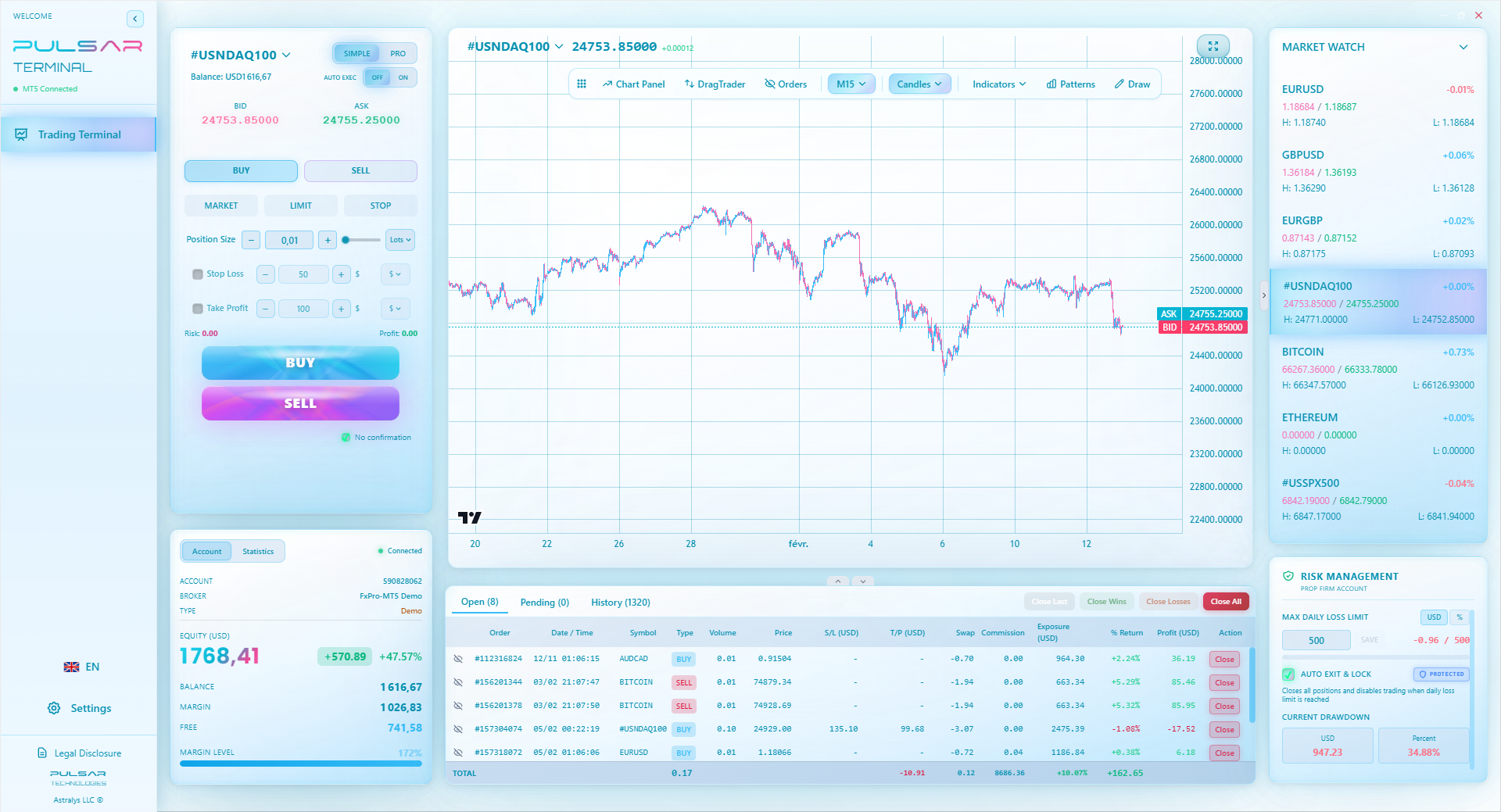
Managing multiple take-profit levels and trailing stops manually is stressful, but Pulsar Terminal automates it all directly within your MT5 platform.
Pulsar Terminal
The all-in-one MT5 companion: drag-and-drop orders, multi-TP/SL, trailing stop, grid trading, Volume Profile, and prop firm protection. Used by 1,000+ traders daily.
I've made most of these. Learn from my lost Naira.
1. Chasing 'Surefire' Signals on WhatsApp/Telegram. If someone had a guaranteed way to print money, they wouldn't sell it for 5k Naira a month. These signal sellers are not accountable for your losses. Learn to analyze the market yourself.
2. Over-trading the Naira Pairs. Because we follow local news, we feel like experts on USD/NGN. This leads to taking low-quality trades based on emotion, not technicals. Trade it like any other pair.
3. Not Accounting for Spreads on Exotic Pairs. Want to trade GBP/NGN or EUR/NGN? The spreads can be massive - sometimes 50-100 pips. You need a much bigger move just to break even. Stick to majors (EUR/USD, GBP/USD, USD/JPY) and crosses (EUR/GBP) when starting.
4. Withdrawing Profits Too Soon (Or Never). Your first profit is a thrill. Withdraw some of it! It makes trading real. Conversely, never adding to your account after losses is a mistake. If you started with $200 and are down to $150, your position sizes need to shrink. Don't try to trade the same size to 'get back to even' faster.
5. Ignoring the Power of a Trading Journal. Write down every trade: entry, exit, reason, emotion. I review mine every Sunday. My biggest lesson? My win rate on trades I held overnight was 20% higher than on day trades. That single insight changed my entire approach.
The common thread in all mistakes? Letting emotion override your system. Have a written trading plan and stick to it, even when it's boring.
💡 Winston's Tip
The market doesn't care about your rent, your bills, or your pride. Trade the price you see, not the price you need.
“Forex trading works by transferring money from the impatient and emotional to the patient and structured.”
Don't just read this and jump in. Follow these steps.
- Open a Demo Account. Today. Use IC Markets, Pepperstone, or any major broker. Practice for at least two months. Your goal isn't to make fake money, but to execute your plan 100 times without deviating.
- Study One Pair. Start with EUR/USD. It's the most liquid, has the tightest spreads, and moves in clear trends. Don't get distracted by gold (XAU/USD) or crypto yet.
- Learn One Indicator In-Depth. Master the MACD indicator or Moving Averages. Understand its signals, its failures, and how it behaves in different market conditions (trending vs. ranging).
- Start Small. When you go live, start with a maximum of $200. Risk no more than 1% ($2) per trade. Your goal for the first six months is to preserve capital, not get rich.
- Join a Community (Carefully). Find a serious trading community, not a signal group. Look for ones focused on education and review. Avoid anyone promising easy money.
Forex trading works by transferring money from the impatient, emotional, and undisciplined to the patient, logical, and structured. In Nigeria, with our unique challenges and opportunities, that structure is even more important. It's a skill you build over years, not weeks. Now you know how it really works. The rest is up to you.
FAQ
Q1Is forex trading legal and taxable in Nigeria?
Yes, it's legal for individuals. You are subject to a 10% Capital Gains Tax on your profits, payable to the FIRS. You must declare income earned with international brokers as foreign-sourced income.
Q2What is the realistic minimum amount to start forex trading in Nigeria?
While some brokers accept deposits as low as $10, a realistic minimum for effective risk management is between $200 and $500. Starting with less makes proper position sizing nearly impossible and costs like spreads will consume your capital.
Q3How do I fund my forex trading account as a Nigerian?
You cannot use official bank FX windows. Common methods include local bank transfers to the broker's Nigerian partner, Visa/Mastercard debit/credit cards, e-wallets (Skrill, Neteller), and cryptocurrencies like USDT. Many brokers offer Naira-denominated accounts for easier deposits.
Q4What is use and what's a safe amount to use?
use is a loan from your broker that amplifies your trading size. While Nigerian traders are often offered 1:500 or more, using excessive use is the fastest way to lose your money. Start with 1:10 or 1:20 maximum until you have a proven, profitable strategy.
Q5Which trading platform is best for beginners in Nigeria?
MetaTrader 4 (MT4) is the most common and beginner-friendly. It's stable, works well on mobile, and has countless free indicators and resources available. Most Nigerian traders and local educational content are based on MT4.
Q6What is a pip and a spread?
A pip is the smallest standard price move, usually 0.0001 for pairs like EUR/USD. The spread is the difference between the buy and sell price, measured in pips. It's your primary trading cost. A 1-pip spread means your trade starts 1 pip in the red.
Q7Can I trade the Nigerian Naira (NGN) as a currency pair?
Yes, pairs like USD/NGN and GBP/NGN are available. However, be cautious: they often have very wide spreads (50-100 pips) and can be highly volatile around local political or CBN news. Trade them with extra care and wider stop losses.
Prof. Winston's Lesson
Key Takeaways:
- ✓Start with $200 minimum, risk only 1% per trade.
- ✓Use max 1:20 use while learning.
- ✓Always set a stop loss before every entry.
- ✓Master one currency pair before adding others.
- ✓Withdraw your first profit to make it real.
How useful was this article?
Click a star to rate
Weekly Trading Insights
Free weekly analysis & strategies. No spam.
About the Author
Olumide Adeyemi
West African Trading Pioneer
One of Nigeria's most active forex trading educators. 8 years of experience trading from Lagos. Specializes in low-capital strategies and prop firm challenges for African traders.
Comments
Risk Disclaimer
Trading financial instruments carries significant risk and may not be suitable for all investors. Past performance does not guarantee future results. This content is for educational purposes only and should not be considered investment advice. Always conduct your own research before trading.
You Might Also Like

Cara Trading Forex Sukses: 7 Prinsip dari Trader Profesional
Cara trading forex sukses dengan 7 prinsip trader pro: manajemen modal, disiplin, journal trading, backtest. Data nyata, bukan janji profit palsu.
Jam Trading Forex Terbaik untuk Trader Indonesia: Panduan Lengkap dengan Tabel Waktu
Panduan jam trading forex untuk trader Indonesia. Tabel 4 sesi dunia, jam emas 20:00-00:00, sesi mana yang harus dihindari. Data akurat + tips dari trader berpengalaman.
Top 5 Sàn Forex Uy Tín Nhất 2026: Review Jujur dari Trader Indonesia
Top 5 sàn forex uy tín 2026 untuk trader Indonesia. Review jujur: spread, deposit, withdraw, dukungan lokal. Exness, XM, IC Markets & lebih.
Get Pulsar Terminal
All these calculators are built into Pulsar Terminal with real-time data from your MT5 account. One-click position sizing, automatic risk management, and instant calculations.
Get Pulsar Terminal