


You've heard the phrase 'forex trading ki' a thousand times.

Daniel Harrington
Head of Content
☕ 9 min read
What you'll learn:
- 1What 'Forex Trading Ki' Really Means (It's Not What You Think)
- 2The Bangladeshi Context: Fees, Psychology, and Reality
- 3The Core Risk Rules (Non-Negotiable)
- 4Position Sizing: The Practical Math
- 5Common BD Trader Mistakes to Avoid at All Costs
- 6Building Your Own Trading Plan (The 'Ki' in Action)
- 7Tools & Brokers for BD Traders
- 8Mindset: The Final Piece (It's Not What You Think)

You've heard the phrase 'forex trading ki' a thousand times. It's usually followed by vague promises of 'mindset' or 'discipline' from someone who's never risked real money. Let's be clear: the 'ki' isn't some mystical secret. It's a brutally simple set of risk management rules that 95% of traders ignore because they're boring. I've managed risk for funds and blown up my own account twice learning this. This isn't motivational fluff. This is the operational manual you actually need.
In Dhaka's trading circles, 'forex trading ki' gets thrown around like a magic spell. People think it's about finding the perfect indicator or having nerves of steel. That's nonsense. The real 'ki' - the core principle - is this: your primary job is not to make money. It's to not lose money.
I learned this the hard way in 2017. I had a great run on EUR/USD, turning 50,000 BDT into about 180,000 BDT in three months. I felt invincible. Then I broke my own rule on a single USD/JPY trade. I didn't use a stop loss because I was 'sure' it would reverse. It didn't. I lost 110,000 BDT in one afternoon watching the chart, frozen. That's the opposite of 'ki.'
True trading 'ki' is the boring, systematic removal of emotion. It's your position size calculator open before every trade. It's knowing your exact stop loss before you click buy. It's accepting that you will be wrong, often, and having a plan for that. The market doesn't care about your feelings, your goals, or your need to make back yesterday's loss.

Warning: If your idea of 'forex trading ki' involves holding losing trades hoping they'll turn around, you are not trading. You are gambling with extra steps. The market will take your capital, every time.

💡 Winston's Tip
If you can't state your exact maximum loss in BDT before entering a trade, you're not trading. You're speculating with a blindfold on.
Trading from Bangladesh isn't the same as trading from London or New York. Our context changes everything, and ignoring this is a fast track to a blown account.
The Cost of Doing Business
First, transaction costs. You're often dealing with higher spreads and sometimes sneaky fees. A broker advertising 'zero commission' might have a 3-pip spread on EUR/USD instead of 0.8. That means your trade is down $30 on a standard lot the moment you enter. You need to win just to get back to breakeven. Always factor in the real spread definition and commission. I made the mistake of ignoring this when I started scalping strategy, and the costs ate all my tiny profits.
The Psychological Trap
There's a huge social pressure to be 'successful' quickly. Seeing friends or Facebook gurus post fake profit screenshots makes you feel behind. This leads to overtrading - forcing setups that aren't there. Real 'forex trading ki' means having the discipline to sit and watch paint dry for days if the market gives you no clear opportunity. Your most powerful tool is often the 'Disconnect' button on your router.
Regulatory Reality
Let's be frank. The local regulatory landscape is different. This places the entire burden of broker due diligence on you. I always use globally regulated brokers with a strong track record. Doing your own research, like reading our Exness review or IC Markets review, is part of the job. Don't just chase the highest use offer.

“Your primary job is not to make money. It's to not lose money.”
These aren't suggestions. They are the foundation. Violate them, and you're not practicing 'forex trading ki,' you're just donating money to smarter traders.
1. The 1% Rule (Maximum): Never risk more than 1% of your trading capital on a single trade. For a 100,000 BDT account, that's 1,000 BDT. This isn't your position size, it's your potential loss. Calculate it using your stop loss distance. This single rule would save 80% of new accounts.
2. Stop Loss First, Entry Second: You find your entry price after you determine where you're wrong. Your stop loss defines your risk. If the stop is too wide for your 1% risk, you either pass on the trade or lower your position size. Never move your stop loss further away after entering.
3. Daily & Weekly Loss Limits: Set a hard line. Mine is 3% daily and 6% weekly. If I hit it, I shut down the platform for the day or week. This prevents 'revenge trading' - the number one account killer. I learned this after a bad Monday loss led to a desperate Tuesday that wiped out another 5%. That week ended at a 9% loss, all because I didn't have a circuit breaker.

Example: Your account: 200,000 BDT. Your 1% risk per trade: 2,000 BDT. You want to buy GBP/USD at 1.2600 with a stop at 1.2570 (30 pips risk). Risk per pip (standard lot) = $10. 30 pips risk = $300 risk. Your allowed risk is 2,000 BDT (~$18.5 at 108 BDT/$). You cannot afford a standard lot. You need a micro lot (0.01) where 1 pip = $0.10. 30 pips = $3 risk, which is safe. This is the math of survival.
This is where 'forex trading ki' becomes a numbers game. Let's make it concrete.
The formula is simple: Position Size = (Account Risk in $) / (Stop Loss in Pips * Pip Value in $)
Let's use a real trade I took last month on XAU/USD guide (Gold).
- Account Balance: $2,000 (my prop firm account)
- Account Risk (1%): $20
- Entry Price: $2,180
- Stop Loss Price: $2,170 (10 points risk. In gold, 1 point = $1 per 0.01 lot)
- Pip/Point Value for 0.01 lot: $0.10
Calculation: $20 / (10 points * $0.10) = $20 / $1 = 20.
My position size was 0.20 lots (20 micro lots). I used my position size calculator to do this instantly. I was stopped out on that trade. Loss: $20. My account was down 1%. I lived to trade the next setup. That's the game.
Compare this to emotional sizing: "Gold looks good! Let's throw on 1 lot!" Risk: 10 points * $10 per point (for 1 lot) = $100. That's a 5% loss on a $2,000 account from one trade. Do that a few times, and you're staring at a margin call.
💡 Winston's Tip
The market's job is to find the price where you will panic and exit your position. Your job is to decide that price in advance and let a machine enforce it.
“Being wrong and taking a small loss is a successful trade - you followed your plan.”
After mentoring traders here for years, I see the same financial suicide patterns.
Mistake 1: Trading Too Big for the Account. This is the king of all mistakes. With a 50,000 BDT account, you are not a hedge fund. Don't act like one. A 10,000 BDT loss is a catastrophe, not a 'drawdown.'
Mistake 2: Averaging Down on Losers. This is celebrated as a 'strategy' in some groups. It's not. It's doubling down on a bad decision. If price hits your stop, you were wrong. Adding more just turns a small, planned loss into a potential account-ending disaster.
Mistake 3: Over-Reliance on Lagging Indicators. Your RSI indicator or MACD indicator tells you what already happened. Using them alone for entries is like driving while only looking in the rearview mirror. Price action and structure are far more important.
Mistake 4: Ignoring Timeframes. You can't use a 5-minute chart for your entry and a daily chart for your 'idea.' Your stop loss and profit target logic must come from the same timeframe you use for entry. Mixing them creates unmanageable risk. For longer-term ideas, study swing trading principles.
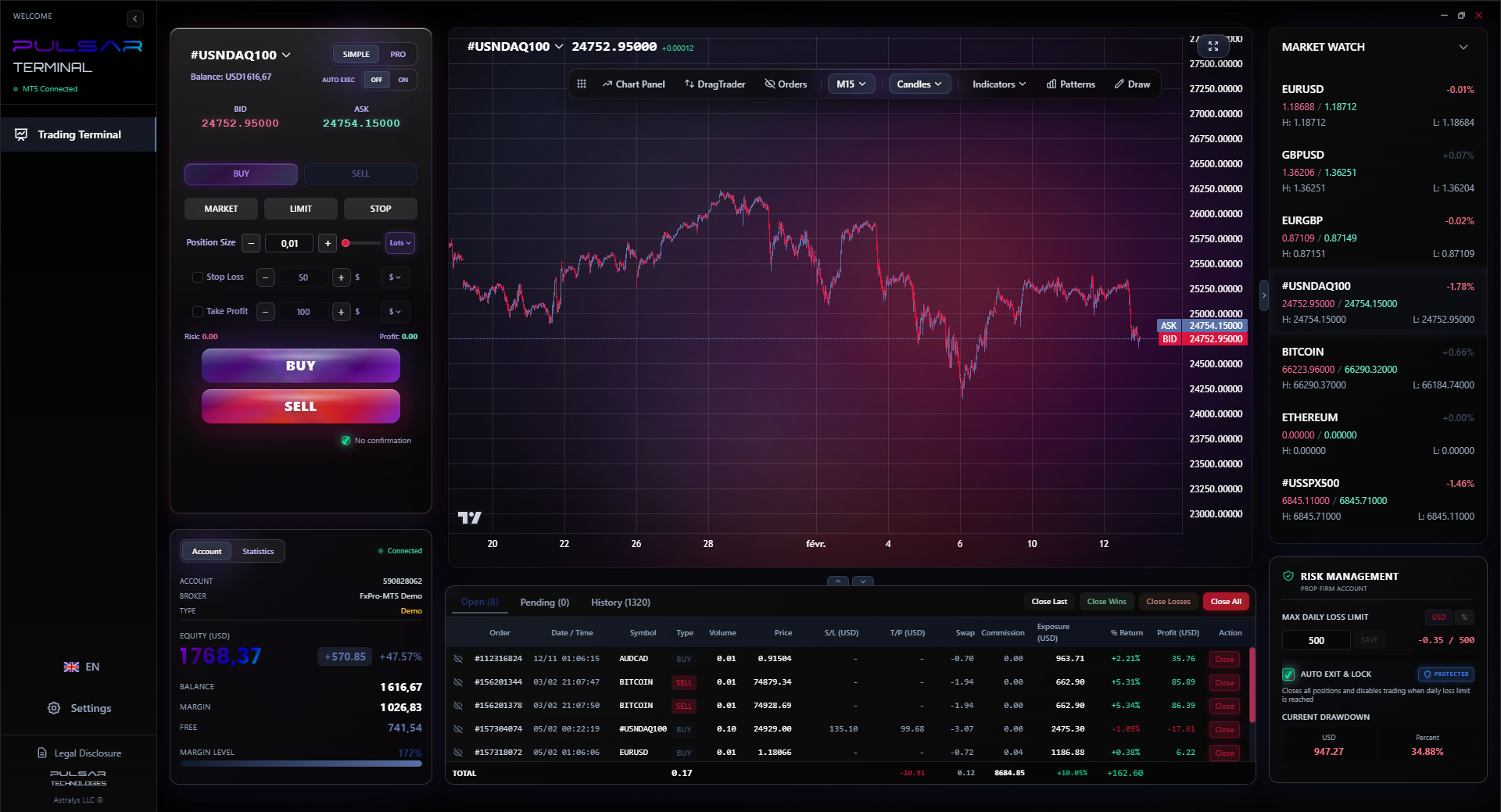
Manually moving stops and managing multiple targets is where most mistakes happen; a tool like Pulsar Terminal automates this risk management directly on your MT5 charts.
Pulsar Terminal
The all-in-one MT5 companion: drag-and-drop orders, multi-TP/SL, trailing stop, grid trading, Volume Profile, and prop firm protection. Used by 1,000+ traders daily.
Your trading plan is your constitution. It removes emotion. Here's a skeleton to build on.
1. Market Conditions: What will you trade? (e.g., Only EUR/USD guide and Gold during London/N.Y. overlap). 2. Entry Criteria: Be specific. (e.g., Price retests a broken structure on the 1H chart, with a pin bar rejection). No 'it looks good.' 3. Exit Criteria:
- Stop Loss: Always predefined.
- Take Profit: Based on a logical target (like a previous swing high/low). Consider using multiple targets to bank partial profits. 4. Risk Parameters:
- Max risk per trade: 1%.
- Max daily loss: 3%. Stop trading if hit.
- Max weekly loss: 6%. Stop for the week. 5. Journaling: After every trade, record it. Why did you enter? Did you follow the plan? What did you feel? This feedback loop is where real learning happens.
My plan once forced me to sit out for a full week after two quick losses. It was frustrating, but it saved me from a volatile period where I would have likely lost more. That discipline is 'ki.'

“High use tempts you to break your position sizing rules, which is the opposite of disciplined trading.”
Your tools should enforce your rules, not tempt you to break them.
Broker Choice: You need reliability and fair pricing. Look for:
- Strong international regulation (ASIC, FCA, CySEC).
- Low, transparent spreads on the majors.
- Reliable deposit/withdrawal methods for Bangladesh (like Skrill, Neteller, or local bank transfer options).
- A proven track record. Don't be the beta tester for a new 'offshore' broker. I've had good execution experiences with brokers like Pepperstone review and XM review, but you must do your own ongoing due diligence.
Trading Platform: MT4/MT5 is the standard. Learn it inside out. The real edge comes from tools that help you manage risk automatically.
Charting & Analysis: Beyond basic indicators, learn about order flow and market structure. These help you see where the big players are placing their orders, which is far more valuable than an overbought RSI.

Pro Tip: Never, ever trade with money you cannot afford to lose. Your trading capital should be 'risk capital' - money that, if gone, doesn't affect your rent, your family's meals, or your education. This mental separation is the first step in 'forex trading ki.'
💡 Winston's Tip
A 1% loss requires a 1.01% gain to recover. A 50% loss requires a 100% gain. Protect your capital like your trading life depends on it, because it does.
Finally, we talk mindset. Not the 'believe in yourself' garbage. The gritty, operational mindset.
Emotional Detachment: Your trade is a hypothesis. The market will tell you if you're right or wrong. Don't argue with it. Being wrong and taking a small loss is a successful trade - you followed your plan. That's a win.
Patience as a Weapon: The market will be there tomorrow. The best traders I know are masters of inactivity. They wait for their pitch. You don't have to swing at every ball.
Continuous Learning, Not Secret Hunting: The market changes. Your education never stops. But focus on risk and psychology, not another magical indicator. I spent two years and thousands of dollars chasing the 'perfect system' before realizing the problem was between my chair and my keyboard.
The ultimate 'forex trading ki' is the acceptance of simple, boring truths. Manage your risk ruthlessly. Follow your plan mechanically. Protect your capital above all else. Do this consistently, and you might just survive long enough to become profitable. That's the only secret there is.

FAQ
Q1What is the most important rule in forex trading ki for a beginner in Bangladesh?
The 1% risk rule. Never, under any circumstances, risk more than 1% of your total account balance on a single trade. This single rule will prevent you from blowing up your account while you're learning. Calculate it using a position size calculator before every entry.
Q2Is high use good for practicing forex trading ki?
Absolutely not. High use is a double-edged sword that amplifies losses just as fast as profits. For practicing true 'ki' (risk management), use the lowest use your broker allows, or cap it yourself (e.g., never use more than 10:1). High use tempts you to break your position sizing rules, which is the opposite of disciplined trading.
Q3How much money do I need to start forex trading in Bangladesh?
You can start with a small amount (like $100 or 10,000 BDT) with a broker offering micro lots. However, the real question is about risk capital. Only use money you can afford to lose completely. The goal with a small account is to learn the process and practice your risk rules, not to make life-changing money. That comes later with consistent execution and larger, well-managed capital.
Q4Can I rely on technical indicators alone for forex trading ki?
No. Indicators like RSI or MACD are lagging. They describe past price action. True 'ki' involves understanding market structure, price action, and where key support/resistance levels are. Use indicators as secondary confirmation, not as your primary entry signal. The chart itself tells the clearest story.
Q5What should I do after a big loss?
First, adhere to your daily loss limit and STOP TRADING. This is critical. Then, review your trade journal. Did you follow your plan? If the loss was within your planned risk (e.g., 1%), then it was a good trade - you managed risk correctly. If you broke your rules, you need to identify why and address the emotional trigger. Never try to 'revenge trade' to win it back immediately.
Q6How long does it take to master forex trading ki?
There is no 'mastery,' only continuous improvement. You can learn the basic rules in a week. It takes months, often years, of consistent practice to internalize them so you follow them under emotional pressure (like during a losing streak). Focus on surviving for 6 months without breaking your core risk rules. That's a better milestone than any profit target.
Prof. Winston's Lesson
Key Takeaways:
- ✓Risk a maximum of 1% per trade, always.
- ✓Define your stop loss BEFORE your entry price.
- ✓Set a daily loss limit of 3% and a weekly limit of 6%.
- ✓Use a position size calculator for every single trade.
- ✓Patience and inactivity are powerful trading tools.
How useful was this article?
Click a star to rate
Weekly Trading Insights
Free weekly analysis & strategies. No spam.
About the Author
Daniel Harrington
Head of Content
Head of content at The Trading Mentor. Veteran trader with a passion for making complex trading concepts accessible. Covers global topics, strategies, and platform guides.
Comments
Risk Disclaimer
Trading financial instruments carries significant risk and may not be suitable for all investors. Past performance does not guarantee future results. This content is for educational purposes only and should not be considered investment advice. Always conduct your own research before trading.
You Might Also Like

Cara Trading Forex Sukses: 7 Prinsip dari Trader Profesional
Cara trading forex sukses dengan 7 prinsip trader pro: manajemen modal, disiplin, journal trading, backtest. Data nyata, bukan janji profit palsu.
Jam Trading Forex Terbaik untuk Trader Indonesia: Panduan Lengkap dengan Tabel Waktu
Panduan jam trading forex untuk trader Indonesia. Tabel 4 sesi dunia, jam emas 20:00-00:00, sesi mana yang harus dihindari. Data akurat + tips dari trader berpengalaman.
Top 5 Sàn Forex Uy Tín Nhất 2026: Review Jujur dari Trader Indonesia
Top 5 sàn forex uy tín 2026 untuk trader Indonesia. Review jujur: spread, deposit, withdraw, dukungan lokal. Exness, XM, IC Markets & lebih.
Get Pulsar Terminal
All these calculators are built into Pulsar Terminal with real-time data from your MT5 account. One-click position sizing, automatic risk management, and instant calculations.
Get Pulsar Terminal