


I downloaded a slick 'Forex Millionaire Blueprint' PDF back in 2018.

Rajesh Sharma
Senior Forex Analyst ·  India
India
☕ 11 min read
What you'll learn:
- 1Why Most Forex PDFs Are Illegal Advice for Indians
- 2The Legal Indian Forex Landscape: SEBI & RBI Rules
- 3Where to Find Real Education: SEBI Brokers Are Your Best Bet
- 4Building a Strategy That Works in India
- 5Tools and Platforms for the Indian Trader
- 6The Real Costs & Taxes You Must Know
- 7Creating Your Own Indian Forex Lessons Plan
I downloaded a slick 'Forex Millionaire Blueprint' PDF back in 2018. It promised a 1:500 use strategy on EUR/USD. I followed it, funded an offshore account with ₹50,000, and blew it in three days. The strategy was garbage, but the bigger problem? I was breaking Indian law and didn't even know it. That's the danger of most 'forex trading lessons pdf' files floating around. They're written for a global, unregulated market that doesn't exist for you and me. Let's cut through the nonsense and talk about what learning forex trading in India actually looks like.
Open any random forex trading lessons pdf. I guarantee the first page will tell you to sign up with an international broker, trade EUR/USD with 1:100 use, and use MetaTrader. Congratulations, you've just been handed a guide to violating the Foreign Exchange Management Act (FEMA).
The core issue is jurisdiction. Those PDFs assume you're in the UK, Australia, or some other region with a liberalized forex market. India's market is deliberately restricted to protect the rupee and retail traders from themselves. The Reserve Bank of India (RBI) couldn't be clearer: trading non-INR pairs (like EUR/USD or GBP/JPY) on international platforms is prohibited. Using your Liberalised Remittance Scheme (LRS) limit to fund speculative forex trades abroad? Also a big no-no.
So when a PDF teaches you a scalping strategy on GBP/USD, it's not just teaching you a method. It's implicitly telling you to operate in a grey/black market. The lessons on broker selection, use, and instruments are fundamentally wrong for your legal context. You're learning to play cricket with a baseball rulebook.

Warning: If an educational resource doesn't start with a massive disclaimer about SEBI regulations and INR pairs, it's not for Indian traders. It's a trap that could lead to penalties, frozen accounts, or worse.
I learned this the expensive way. After my initial loss, I doubled down, thinking I just needed a better strategy. I moved another ₹1 lakh to a different offshore broker touted in another 'advanced' PDF. I made ₹25,000 in a week scalping Gold (XAU/USD). Then, the broker 'reviewed' my account, said my profits were from 'price arbitrage,' and confiscated the entire balance. No recourse. That's the reality of the unregulated space those PDFs guide you toward.

💡 Winston's Tip
The most expensive lesson is the one that teaches you how to break the law. Your first filter for any educational material should be: does this person know I live in India?
Forget what you've read in international PDFs. Here's your actual trading universe, defined by SEBI and the RBI.
What You CAN Trade (Legally)
You can trade currency derivatives - futures and options - on SEBI-recognized Indian exchanges like the NSE and BSE. The permitted pairs are:
| Currency Pair | Type | Trading Venue |
|---|---|---|
| USD/INR | INR Pair | Indian Exchange |
| EUR/INR | INR Pair | Indian Exchange |
| GBP/INR | INR Pair | Indian Exchange |
| JPY/INR | INR Pair | Indian Exchange |
| EUR/USD | Cross Currency | Indian Exchange |
| GBP/USD | Cross Currency | Indian Exchange |
| USD/JPY | Cross Currency | Indian Exchange |
Yes, you can trade EUR/USD, but only on the Indian exchange, with Indian brokers, under Indian use rules (which are very low compared to offshore offers). The contract specifications, expiry, and liquidity are completely different from the spot forex market those PDFs discuss.
What You CANNOT Do
- Open an account with Exness, IC Markets, XM, or Pepperstone to trade international forex. Even if they accept Indian clients, you're on the wrong side of RBI rules.
- Use high use. Say goodbye to 1:500. SEBI-regulated use on currency derivatives is a fraction of that, designed to limit risk.
- Trade exotic pairs or cryptocurrencies as forex.
The RBI has been tightening screws. Recent notifications (like the April 2024 circular) emphasize that exchange-traded derivatives are for hedging, not pure speculation. While enforcement on retail traders is evolving, the legal risk is real. Your first lesson in forex should be this regulatory framework. A proper forex trading lessons pdf for Indians would have this chapter first.
“Those PDFs assume you're in a liberalized forex market. You're not. You're in India.”
Throw away that shady PDF. Your single best source for legitimate, context-aware education is your SEBI-regulated broker's platform. They have a legal obligation to educate you correctly.
Brokers like Zerodha, Upstox, and Angel One have invested heavily in educational hubs. Zerodha's 'Varsity' is a goldmine. Their modules on currency derivatives explain the actual contracts you'll trade, the expiry cycles, the tick size, and the margin requirements - all the boring, crucial stuff the get-rich-quick PDFs skip.
These platforms teach you how to place an order on their system, calculate profit/loss in rupees for a USD/INR futures contract, and understand the settlement process. This is practical knowledge. I switched to trading USD/INR futures on Zerodha in 2020. The first thing I did was go through their entire currency derivatives module. It saved me from a classic mistake: not accounting for the contract's expiry. I once held a long position in EUR/INR futures, purely on a technical breakout from a PDF strategy. The setup was right, but the PDF never mentioned expiry. I had to roll over the contract, incurring extra costs, which ate half my profit. The broker's own tutorial had a whole section on that.

Pro Tip: Don't just look for a 'forex trading lessons pdf.' Look for 'currency derivatives tutorial' or 'USD/INR futures guide' on your broker's website. That's the material written for you.
These resources also cover essential concepts like the pip definition (which, in futures, is tied to the contract multiplier) and spread definition as it applies to exchange-traded instruments, which is often tighter but has a different composition than the broker spreads you see on MT4.
💡 Winston's Tip
Your broker's tutorial on contract expiry is worth ten fancy PDFs on harmonic patterns. Master the boring mechanics first. The fancy stuff comes later.
You can't just copy-paste a strategy from a PDF. The Indian currency derivatives market has its own personality. Liquidity is fantastic in the near-month USD/INR contract but drops off a cliff in the far-month or in pairs like GBP/INR. The market hours (9 AM to 5 PM for INR pairs, extended for cross-currency) mean you miss the volatile London-New York overlap for EUR/USD.
Your strategy must adapt. A scalping strategy that relies on 1-pip movements on an offshore MT4 account will strangle you with transaction costs on an exchange. You need to think in terms of bigger moves. Swing trading over several days, playing into RBI intervention levels or major dollar inflows/outflows, tends to work better.
Technical analysis still applies, but the volume profile is different. I primarily use price action and a couple of key indicators. For instance, I found the RSI indicator useful for spotting overbought/oversold conditions in USD/INR, especially around key psychological levels like 83.00 or 83.50. But I combine it with watching the RBI's likely pain points. In October 2023, I went long on USD/INR futures at 83.10, with an RSI showing bullish momentum. My target was 83.40. It hit 83.38 and reversed sharply on suspected RBI intervention. I got out at 83.32. The textbook PDF trade said hold for 83.50. The India-aware trade said take profits before the central bank slaps you down.
Risk management is even more critical here because use is lower. You might be tempted to over-use by taking a larger position size. Always, always use a position size calculator. A 20-pip stop-loss in USD/INR futures can mean a very different rupee loss than a 20-pip stop in spot forex.
“Your single best source for legitimate education is your SEBI-regulated broker's platform. They have a legal obligation to be right.”
Forget MT4 and MT5 for your legal trading. Your world is now dominated by proprietary platforms from Indian brokers.
Zerodha Kite is the industry benchmark. It's clean, reliable, and has decent charting. Upstox Pro and Angel One are strong competitors. These platforms are built for the Indian equity and F&O markets, with currency derivatives integrated. The learning curve is about understanding their order types, their charting tools (which may feel basic if you're coming from TradingView), and how to quickly analyze the futures chain.
The good news? The tech is excellent. The bad news? Some of the advanced order management features you read about in PDFs - like automated trailing stops or multi-level take-profits - might be clunky or missing.
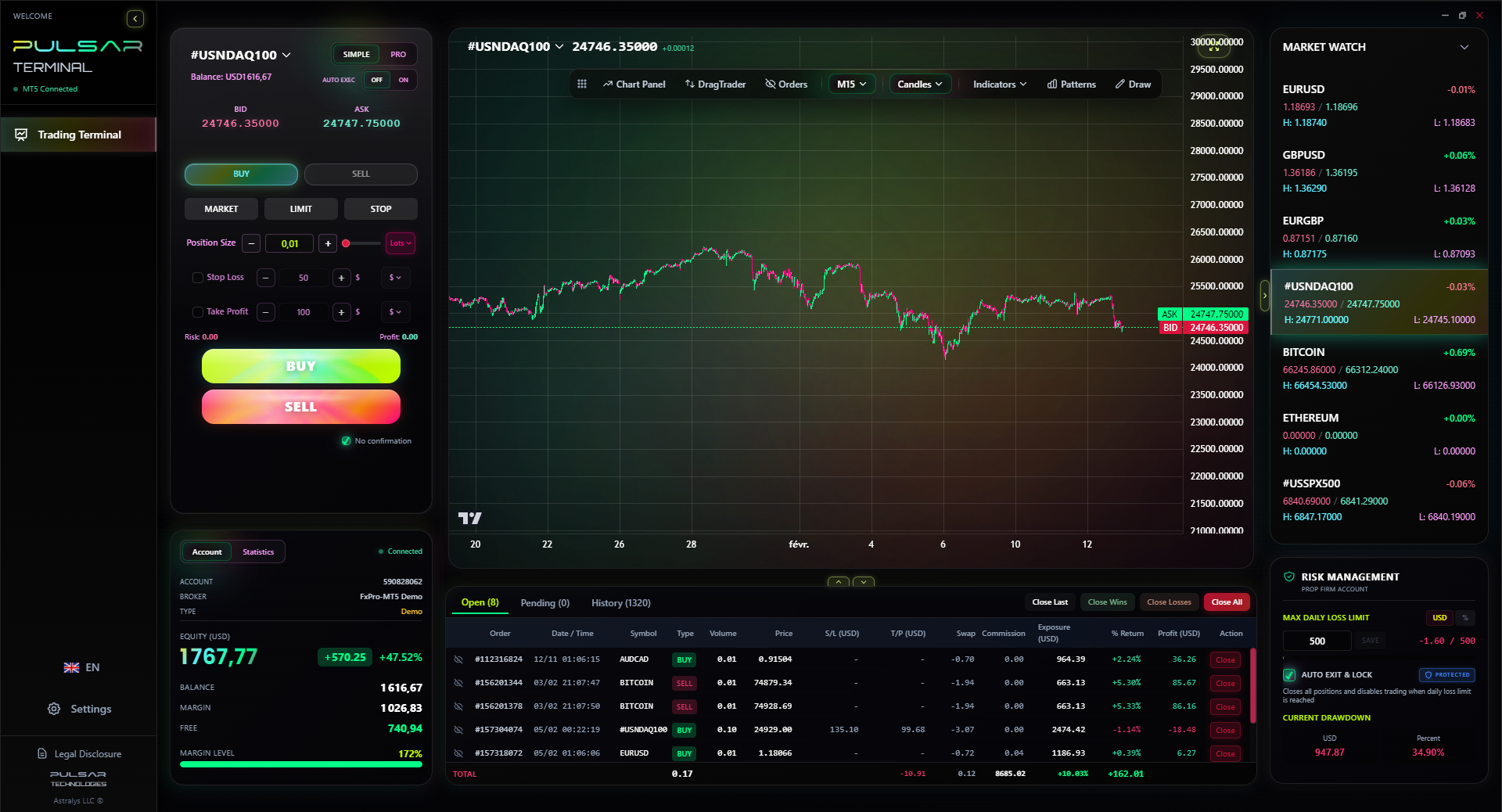
This is where a tool like Pulsar Terminal becomes interesting. It acts as a companion to MT5, but the principle is what matters: having precise control over your trade management. On Indian platforms, you need to be extra diligent about setting your stop-loss and take-profit orders manually the moment you enter a trade, because the 'set and forget' automation might not be there. The habit of defining your risk upfront, which any good forex trading lessons pdf should hammer home, is non-negotiable here.
Charting analysis is still key. I spend most of my time on TradingView for analysis (plotting support/resistance, using the MACD indicator for trend confirmation), and then execute on Kite. It's a two-screen workflow that works.
Precise trade management is key on Indian platforms, and tools like Pulsar Terminal bring advanced order automation directly to your workflow.
Pulsar Terminal
The all-in-one MT5 companion: drag-and-drop orders, multi-TP/SL, trailing stop, grid trading, Volume Profile, and prop firm protection. Used by 1,000+ traders daily.
This chapter is never in the sexy PDFs. Let's talk money.
Trading Costs:
- Brokerage: It's usually very low. Zerodha charges ₹0.05 per lakh + GST on turnover for futures. For a single USD/INR futures contract (which has a lot size of $1000), the brokerage is negligible.
- Exchange Charges & GST: These are the real costs. They include transaction charges, SEBI turnover fees, and GST on everything. It adds up. On a ₹50,000 turnover trade, expect total statutory charges to be around ₹10-15. This makes hyper-scalping unviable.
- Spread: The bid-ask spread on the exchange. It's usually tight for USD/INR.
Taxes: This is critical. Your trading profits are classified as Business Income if you're a frequent trader (which you will be). You need to maintain proper books of account, and profits are added to your total income and taxed at your applicable slab rate (can be 30%+). You can deduct legitimate business expenses (internet, platform fees, home office portion).
Alternatively, if you're a very occasional trader, you might treat it as Capital Gains. But for active traders, the IT department will see it as business income. I learned this the hard way in my first year. I made a profit of ₹2.8 lakhs and tried to file it as capital gains. My CA sat me down and explained how that could invite scrutiny. We re-filed as business income. The tax liability was higher, but it was clean.

Example: You make a profit of ₹1,00,000 from trading in a year. As business income (assuming you're in the 30% slab), you owe ~₹30,000 in tax + cess. You must also consider advance tax payments if your tax liability exceeds ₹10,000 in a financial year. That PDF didn't mention that, did it?
💡 Winston's Tip
If a strategy doesn't explicitly account for brokerage, taxes, and GST in its profit calculations, it's a fantasy, not a plan. Always calculate your net profit after all costs.
“The goal of your first live account isn't to make money, but to lose it without breaking your rules. That's the tuition fee.”
So, how do you actually learn? Don't look for one magic forex trading lessons pdf. Build your own curriculum.
Phase 1: Regulation & Basics (2 Weeks)
- Read the RBI FAQs on forex and SEBI's investor website.
- Open a demo account with Zerodha or Upstox. Don't even think about real money.
- Complete the 'Currency Derivatives' module on Zerodha Varsity or equivalent.
- Learn the contract specifications of USD/INR futures by heart: lot size ($1000), tick size (0.0025), tick value (₹0.0025 * 1000 = ₹2.5), expiry date.
Phase 2: Platform & Analysis (1 Month)
- Paper trade on your demo account. Practice placing limit/market orders, setting SL and TP.
- Learn one form of analysis in depth - price action or a single indicator system. I started with just support/resistance and candlestick patterns.
- Start a trading journal. Note every paper trade: reason for entry, position size, stop-loss, target, and outcome.
Phase 3: Risk & Psychology (Ongoing)
- Define your risk-per-trade rule (e.g., never risk more than 1% of capital). Use the calculator before every trade.
- Read about trading psychology. The biggest lesson isn't a strategy; it's learning to handle a string of losses without blowing up your account. Understanding a margin call is theoretical until you're close to one.
- Move to a small live account. Start with ₹10,000-₹20,000. The goal here is not to make money, but to lose it without breaking your rules. It's the tuition fee for emotional control.
There's no shortcut. The PDFs sell a shortcut. The real path is slower, regulated, and built on a foundation of local rules. It's the only path that's sustainable and legal for an Indian trader.
FAQ
Q1Is it illegal to download and read international forex trading PDFs?
No, reading isn't illegal. The problem is acting on the advice. Those PDFs assume you can trade on international platforms with high use, which is illegal for an Indian resident. Using their strategies in the wrong market context (like on Indian exchanges) can also lead to losses, as the market mechanics are different.
Q2Can I use MetaTrader 4 or 5 in India?
You can download and use the software. However, you cannot legally connect it to an international broker's server to trade forex. Some SEBI-registered brokers may offer MT4/MT5 as a front-end to trade on Indian exchanges, but this is rare. Your primary platforms will be the brokers' own systems like Kite or Upstox Pro.
Q3What is the maximum use I can get legally in India?
SEBI strictly limits use for currency derivatives on exchanges. It's not a fixed ratio like 1:50; it's based on the SPAN margin system, which is dynamic and changes with volatility. Effectively, it's a small fraction of what offshore brokers offer - think more like 1:10 or even less on the total contract value. This is a safety feature, not a limitation.
Q4Where can I find a legitimate forex trading lessons PDF for India?
Don't search for 'forex PDF.' Search for 'currency derivatives guide' or 'F&O module' on the educational sections of SEBI-regulated broker websites (Zerodha Varsity, Angel One Academy, Upstox Learning Center). The National Stock Exchange (NSE) website also has educational materials. These are the legitimate, context-aware resources.
Q5How are my forex trading profits taxed in India?
If you trade frequently, profits are treated as 'Business Income' and taxed at your applicable income tax slab rate (up to 30%+). You can deduct related expenses. Occasional trades might be filed under 'Capital Gains,' but frequent trading will almost certainly be seen as a business by the IT Department. Consult a CA who understands trading.
Q6Can I trade cryptocurrencies like forex in India?
No. Trading cryptocurrencies is a separate activity and is not classified as forex trading in India. It operates in a regulatory grey area and involves different platforms, risks, and tax implications (30% flat tax + 1% TDS). Do not confuse crypto trading with currency derivatives trading.
Prof. Winston's Lesson
Key Takeaways:
- ✓Trading offshore forex is illegal under FEMA/RBI rules.
- ✓You can only trade INR & select cross-currency pairs on Indian exchanges.
- ✓SEBI broker tutorials are your primary, legal learning source.
- ✓Taxes on profits are business income, up to 30%+ slab rate.
- ✓Real use in India is a fraction of offshore offers.
How useful was this article?
Click a star to rate
Weekly Trading Insights
Free weekly analysis & strategies. No spam.
About the Author
Rajesh Sharma
Senior Forex Analyst
Trading Indian and South Asian markets for over 10 years. Started with NSE currency derivatives before moving to international forex. Specializes in USD/INR and emerging market pairs.
Comments
Risk Disclaimer
Trading financial instruments carries significant risk and may not be suitable for all investors. Past performance does not guarantee future results. This content is for educational purposes only and should not be considered investment advice. Always conduct your own research before trading.
You Might Also Like

Cara Trading Forex Sukses: 7 Prinsip dari Trader Profesional
Cara trading forex sukses dengan 7 prinsip trader pro: manajemen modal, disiplin, journal trading, backtest. Data nyata, bukan janji profit palsu.
Jam Trading Forex Terbaik untuk Trader Indonesia: Panduan Lengkap dengan Tabel Waktu
Panduan jam trading forex untuk trader Indonesia. Tabel 4 sesi dunia, jam emas 20:00-00:00, sesi mana yang harus dihindari. Data akurat + tips dari trader berpengalaman.
Top 5 Sàn Forex Uy Tín Nhất 2026: Review Jujur dari Trader Indonesia
Top 5 sàn forex uy tín 2026 untuk trader Indonesia. Review jujur: spread, deposit, withdraw, dukungan lokal. Exness, XM, IC Markets & lebih.
Get Pulsar Terminal
All these calculators are built into Pulsar Terminal with real-time data from your MT5 account. One-click position sizing, automatic risk management, and instant calculations.
Get Pulsar Terminal